
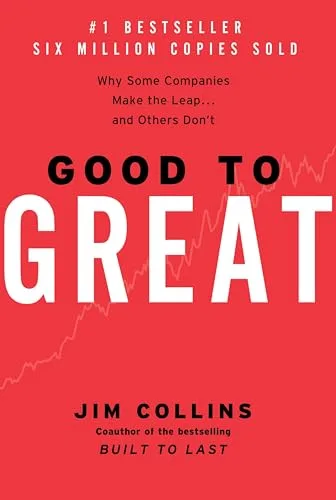
Key ideas
- Good is the enemy of great: most companies never become great precisely because settling for good is so comfortable and so common.
- Greatness is not a matter of circumstance or a single genius; it comes from a disciplined, almost boring accumulation of the right practices over years.
- The transition starts with people, not vision: get the right people on the bus and the wrong people off before deciding where to drive.
- Great companies confront the most brutal facts of their reality while keeping unwavering faith they will prevail, a tension Collins calls the Stockdale Paradox.
- Focus comes from the Hedgehog Concept: the single intersection of what you can be best in the world at, what drives your economics, and what you are deeply passionate about.
- Technology, culture, and momentum all matter, but only as accelerators of a sound concept, never as substitutes for one.
Great is not a lucky break or a lone genius; it is a disciplined culture turning a well-chosen flywheel, quietly, for years, until the results look sudden from the outside.
Mental models
- Level 5 Leadership — The top tier of a five-level hierarchy: a leader who fuses intense professional will with deep personal humility, channeling ambition into the company rather than the self.
- First Who, Then What (the bus) — Get the right people on the bus, the wrong people off, and the right people in the right seats before you decide where the bus is going. People first, direction second.
- The Stockdale Paradox — Hold two things at once: absolute faith that you will prevail in the end, and the discipline to confront the most brutal facts of your current reality, without letting either cancel the other.
- The Hedgehog Concept — The overlap of three circles: what you can be best in the world at, what drives your economic engine (a single profit per X), and what you are deeply passionate about. Great strategy is the simple idea that lives in all three.
Product applications
- Fix the team before the roadmap: when a product area is failing, Collins's order says get the right people in the right seats first, because the best strategy executed by the wrong people still fails.
- Build red-flag mechanisms so brutal facts reach you: replace status-green dashboards with forums where the team can surface what is actually going wrong without being punished for it.
- Define your product's Hedgehog: name the one thing you can be best in the world at, the single metric that drives your economics, and what the team genuinely cares about, then kill work that sits outside all three.
- Keep a stop-doing list, not just a to-do list: a culture of discipline is as much about what a focused team refuses to do as about what it ships.
- Treat every new technology, including AI, as an accelerator to test against your Hedgehog, not a strategy in itself; adopt it because it advances your concept, not because rivals are.
Questions to think about
If you had to name the one thing your product could be truly best in the world at, and it turned out to be different from what you spend most of your time on, would you have the discipline to stop the rest?
Chapter by chapter
Good Is the Enemy of Great
The reason so few companies become great is that so many settle for good, and good is comfortable. A merely good product, team, or company rarely feels broken enough to force the hard changes greatness demands. The enemy is not failure; it is contentment.
The claim rests on evidence, not opinion. Collins's team screened every company that had appeared in the Fortune 500 and found only eleven that made a sustained leap: fifteen years of cumulative stock returns at least three times the market after a clear transition point. Walgreens, Kimberly-Clark, Nucor, Wells Fargo, and seven others.
Each was matched against a comparison company with the same industry, size, and opportunity that never made the leap. The whole book is the answer to one question: what did the great ones do differently. The surprise is how unglamorous the answers turned out to be.
For a product manager, the warning lands close to home. A product doing fine is the hardest one to transform, because nothing is obviously on fire. Naming good enough as the actual enemy is what gives you permission to disrupt a product that is quietly plateauing.
Level 5 Leadership
The leaders who took companies from good to great were not the celebrity visionaries the business press loves. They were self-effacing, quiet, even awkward, and fiercely determined. Collins calls this combination Level 5: extreme personal humility fused with intense professional will.
Humility plus will
Darwin Smith of Kimberly-Clark is the archetype. Mild and unassuming, he made the ferocious decision to sell the company's core paper mills and bet everything on consumer brands, eventually beating rivals like Procter and Gamble. His ambition was for the company, not for himself.
The window and the mirror
Level 5 leaders look out the window to credit others and good luck when things go well, and into the mirror to take the blame when things go badly. Comparison-company leaders did the reverse, claiming credit and blaming external factors. Ego, not ability, was often the difference.
For a PM, this reframes leadership as credit flow. The leaders who build lasting momentum push credit to the team and absorb blame themselves. It is a small behavior with a large effect on whether people bring you the truth and take real ownership.
First Who ... Then What
The great companies did not start with a brilliant strategy and then hire people to execute it. They started with people. Get the right people on the bus, the wrong people off the bus, and the right people in the right seats, and only then figure out where to drive it.
The logic is practical. If you have the right people, the problem of motivation and direction largely takes care of itself, and a team of the right people can change direction when the world does. A great vision with mediocre people just drives the wrong bus faster.
Rigorous, not ruthless
This is not about being harsh. It means being rigorous: when in doubt, keep looking rather than settling; act the moment you know someone is in the wrong seat; and put your best people on your biggest opportunities, not your biggest problems. Pay attracts and retains, but never drives greatness.
For a PM, who leads and staffs a product area matters more than the roadmap written for it. Before reworking a failing strategy, ask whether the right people are in the right seats, because the same plan succeeds or fails on that answer.
Confront the Brutal Facts (Yet Never Lose Faith)
Great companies faced their harsh realities squarely, while comparison companies often flinched from them. Yet facing facts did not mean losing hope. The two had to coexist.
The Stockdale Paradox
Collins names the tension after Admiral Jim Stockdale, the highest-ranking American prisoner of war in Vietnam. Stockdale survived by holding two beliefs at once: unwavering faith that he would get out, and brutal honesty that it might take years. The prisoners who died were the optimists who set false deadlines and broke when they passed.
For a company, that means confronting decline, a failing product, or a stronger rival without pretending, while never doubting you will find a way through. Kroger faced the shift to superstores and rebuilt; A and P clung to its old format and fell.
A climate where truth is heard
Leaders build this by leading with questions, engaging in real debate, running blameless autopsies on failures, and setting up red-flag mechanisms that turn information into information that cannot be ignored.
For a PM, the practical tool is the red-flag mechanism. Replace reassuring green dashboards with a standing way for the team and customers to surface what is genuinely broken, so bad news reaches you early rather than after it is fatal.
The Hedgehog Concept (Simplicity within the Three Circles)
The fox knows many things; the hedgehog knows one big thing. Great companies are hedgehogs. They simplify a complex world into a single organizing idea and let everything else fall away.
The three circles
The Hedgehog Concept lives where three circles overlap:
- What you can be the best in the world at, and, just as important, what you cannot.
- What drives your economic engine, captured as a single denominator: profit per X.
- What you are deeply passionate about, the work you would do regardless.
Walgreens found it: be the most convenient drugstore, and drive profit per customer visit rather than per store. That one idea reorganized everything, from where they built stores to how they measured them.
Best at, not just good at
The hard truth is the first circle. Being passionate about something, or even good at it, is not enough if you cannot be the best in the world at it. Finding the concept took the good-to-great companies about four years of honest debate on average, not a single offsite.
For a PM, the Hedgehog is a focus test for the roadmap. Name the one thing your product can be genuinely best at, the single metric that funds it, and what the team cares about, then treat anything outside all three circles as a candidate to cut.
A Culture of Discipline
When you have disciplined people, you do not need hierarchy. When you have disciplined thought, you do not need bureaucracy. When you have disciplined action, you do not need excessive controls. A culture of discipline combines all three with an ethic of freedom and responsibility.
The point is not a tyrant imposing order. Companies whose greatness depended on a single disciplinarian fell back when that person left. The goal is a culture where self-disciplined people take disciplined action within the Hedgehog framework, so freedom and rigor reinforce each other.
Rinsing the cottage cheese
Collins borrows an image from a world-class triathlete who rinsed the fat off his cottage cheese, a tiny act of discipline on top of an already punishing regimen. Greatness is a thousand such unglamorous, consistent choices, not one heroic push.
The stop-doing list
Discipline shows up most in what a company refuses to do. Great companies kept a stop-doing list, cutting anything outside the three circles with the same energy others spend adding initiatives.
For a PM, the stop-doing list is the takeaway. A focused team is defined as much by the features, segments, and bets it deliberately declines as by what it ships, and saying no is the discipline that protects the Hedgehog.
Technology Accelerators
In a period of dot-com mania, the great companies had a strikingly calm relationship with technology. They never used it to start a transformation, only to accelerate one already underway.
The test was always the Hedgehog Concept. A great company asked whether a technology fit directly with its one big idea. If yes, it became an early and aggressive pioneer; if not, it ignored the hype. Technology was a means, never the reason.
Crawl, walk, run
Walgreens met the Internet not with panic but with patience, quietly integrating the web into its convenience model rather than spinning up a flashy dot-com to please the market. Comparison companies more often lurched at technology out of fear of being left behind.
The blunt conclusion: technology alone never makes a company great, and never causes its decline. Used without a Hedgehog Concept, even the best technology cannot rescue a mediocre company; it just helps it fail faster.
For a PM, this is the discipline to apply to every new platform, including AI. Adopt it because it accelerates your product's core concept, not because competitors announced it. Technology chasing is the doom loop wearing an innovation costume.
The Flywheel and the Doom Loop
From the outside, good-to-great transformations looked like sudden breakthroughs. From the inside, there was no single defining moment. Greatness came from pushing a heavy flywheel turn after turn until momentum compounded into unstoppable speed.
No one push, program, or acquisition explains the leap. Each disciplined action added to the last, and the visible results arrived only after years of buildup that felt, at the time, like slow and unspectacular progress.
The doom loop
Comparison companies ran the opposite pattern. Chasing the one big breakthrough, they launched dramatic new programs, reorganized, and made splashy acquisitions, then abandoned each when the miracle did not arrive. Every lurch stalled whatever momentum they had, so nothing ever compounded.
For a PM, this is patience discipline. A product roadmap of consistent, compounding improvements in one direction beats a series of dramatic relaunches, and the pressure to show a single breakthrough is exactly what tips teams into the doom loop.
From Good to Great to Built to Last
Good to Great is really a prequel to Collins's earlier book, Built to Last. Becoming great is the first act; staying great and enduring for decades is the second.
The bridge is core ideology. Enduring great companies preserve a fixed set of core values and a purpose beyond just making money, while relentlessly changing their practices and strategies around that unchanging core. Preserve the core, stimulate progress.
BHAGs
They also commit to a Big Hairy Audacious Goal, a BHAG: a huge, clear, almost intimidating objective that focuses effort for ten to thirty years. A good BHAG fits inside the Hedgehog Concept, so ambition and focus point the same way rather than pulling apart.
For a PM, this connects daily focus to durable purpose. A strong Hedgehog keeps you disciplined this quarter; a core ideology and a BHAG keep the product meaningful across years, so short-term rigor and long-term ambition reinforce instead of competing.
The Entire Book in One Framework
The whole model is a sequence with a shape: disciplined people, then disciplined thought, then disciplined action, all turning a flywheel. Level 5 leaders get the right people on the bus. Those people confront the brutal facts and find the Hedgehog Concept. A culture of discipline and technology accelerators then turn that concept, turn after turn, into breakthrough.
What unifies it is the absence of a silver bullet. There is no single move, leader, or technology that makes a company great. There is only the compounding of disciplined choices around a simple, honest idea.
Greatness is not a function of circumstance. It is a function of conscious choice and discipline, repeated long enough that the flywheel's momentum makes the result look, from the outside, like it happened overnight.
10 Most Important Takeaways
- Good is the enemy of great; comfort with good enough is why greatness is rare.
- Level 5 leaders combine fierce professional will with genuine personal humility.
- Credit out the window, blame in the mirror, is the tell of a Level 5 leader.
- First who, then what: get the right people on the bus before choosing the destination.
- Be rigorous, not ruthless, and put your best people on your biggest opportunities.
- Hold the Stockdale Paradox: confront the brutal facts while keeping faith you will prevail.
- Find your Hedgehog Concept, the overlap of best-in-world, economic engine, and passion.
- Capture your economics as one denominator: profit per X.
- Build a culture of discipline and keep a stop-doing list, not just a to-do list.
- Technology only accelerates a sound concept; it never creates greatness on its own.
The deepest idea is that greatness is undramatic. It is not a moment of genius or a lucky market, but disciplined people making disciplined choices around one clear idea, long enough for the flywheel to take over.