
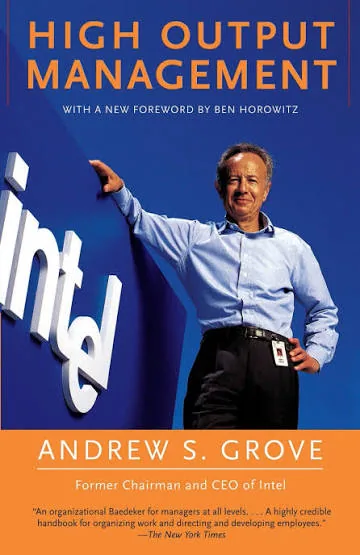
Key ideas
- Every production process, whether it produces a breakfast, a new hire, or a compiled program, has one limiting step that should set the schedule, and catching defects early is always cheaper than catching them at the end.
- A manager's real output is the combined output of every team and person under their influence, not their own personal work completed.
- Managerial leverage means a small number of well-chosen activities, a training session, a single decision, a role-modeled behavior, get multiplied across everyone they touch.
- Management style should match a person's readiness for a specific task, not a manager's personal comfort zone or a one-size-fits-all default.
- As organizations scale, hybrid structures and mixed modes of control (market, contract, culture) become unavoidable, and shared culture is the only control mode that keeps working as complexity rises.
- Feedback tools, appraisal, compensation, and training, only produce leverage when they're delivered honestly and specifically and run as a repeatable process rather than a once-a-year event.
Management is itself a production system, and a manager's job is to raise the output of everyone that system touches, not to maximize their own personal busyness.
Mental models
- The Limiting Step — Any process has one stage that takes the longest or is the least flexible; build the schedule backward from that stage instead of forward from the starting gun, because speeding up any other stage does nothing for total delivery time.
- Managerial Leverage — A manager's output equals the sum, across every activity they do, of that activity's leverage multiplied by how much time goes into it; the fastest way to raise output is shifting time toward the few activities that ripple across many people, not working longer hours.
- Task-Relevant Maturity — Readiness for one specific task, built from achievement drive, willingness to take responsibility, and relevant education, training, and experience; the same person can be highly ready for one task and unready for another, so the right management style changes task by task, not person by person.
- Modes of Control — Behavior can be steered by market incentives, by written contracts and rules, or by shared cultural values; the more ambiguous and interdependent the work, the more the organization has to lean on culture, since no contract can cover every case in advance.
Product applications
- Map your team's actual workflow, identify the true limiting step, and build sprint or release schedules backward from that step instead of forward from kickoff.
- Before adding a new review, report, or meeting, ask which single high-leverage activity, one template, one clarifying document, one well-run decision meeting, would multiply value across the most people, and do that first.
- Before your next one-on-one or review, rate the person's readiness on the specific task at hand and pick directive, coaching, or hands-off accordingly, rather than defaulting to your usual style.
- When a cross-functional decision stalls among peers with no clear owner, name the stalling pattern out loud and either set a decision deadline or bring in a tiebreaker.
- Instead of scheduling a generic training session, build one reusable module that solves a real recurring problem on your team, and deliver it yourself the first time.
Questions to think about
Where on your own team is a rule or approval step standing in for a shared understanding that would actually scale better as trust and culture, and where is trust being asked to do a job that really needs an explicit rule?
Chapter by chapter
The Basics of Production: Delivering a Breakfast (or a College Graduate, or a Compiler, or a Convicted Criminal…)
What a production process actually has to deliver
Every production process, regardless of industry, has to satisfy the same three requirements: deliver the output on schedule, at a quality level customers will accept, and at the lowest sustainable cost. A breakfast of a soft-boiled egg, buttered toast, and coffee has to hit a table simultaneously, hot, and fresh. That's a real production problem, not a trivial one.
The limiting step
Boiling an egg to the right consistency takes about three minutes and can't be rushed without ruining it. Toast takes one minute. Coffee is nearly instant. The egg is the "limiting step," the longest and least flexible stage in the whole sequence.
The correct way to build the schedule is to work backward from that step: start the egg first, then time everything else to finish alongside it. Starting from the beginning and hoping everything lines up at the end is backward planning; starting from the constraint and building outward from it reliably hits the deadline.
The same logic under different names
A college graduate moving through recruiting and onboarding, a piece of source code moving through a compiler, and a case moving through a criminal justice system are all production processes with the identical underlying structure: raw material goes in, a series of transformations happen, and a finished output comes out, each stage constrained by whichever step is hardest to compress.
Where to catch problems
Inspecting for defects gets cheaper the earlier it happens in a process and more expensive the later it happens. A flaw caught in raw material costs almost nothing to fix; the same flaw caught in a finished, packaged product costs the entire value already added to that unit, plus the cost of redoing it.
That's an argument for building inspection into the earliest possible stage of any workflow, rather than concentrating all quality checks at the very end.
A practical way to use this: before committing to a launch date, identify the actual limiting step in your delivery chain, often review or QA capacity rather than the build itself, and set the schedule from that constraint outward. It also pays to push validation, spec review, data checks, as early as possible, since a wrong assumption caught at the requirements stage costs a fraction of what it costs once shipped.
Managing the Breakfast Factory
The black box
Any production unit can be modeled as a "black box": raw materials and labor go in one side, a finished output comes out the other. The value of this model is that it forces a manager to be explicit about exactly what's being converted into what, at every stage, rather than treating the operation as one undifferentiated blur of activity.
Paired indicators
Tracking a single number invites gaming it at the expense of everything else. A manager who tracks only units produced will get more units and worse quality; a manager who tracks only quality will get flawless output at a crawl. The fix is pairing indicators: track output volume alongside a quality or error measure for that same stage, so improving one number can't come free at the expense of the other.
Buffers
Three kinds of inventory buffer exist: raw materials waiting to be used, work in process waiting for the next stage, and finished goods waiting for a customer. Buffers absorb the unpredictability of supply and demand without stopping the line every time something runs slightly early or late.
Carrying too much buffer ties up cash and risks it going stale before it's used; carrying too little risks a stall every time demand or supply wobbles even slightly. The right buffer size is a deliberate trade-off, not a default of zero or a default of excess.
Adding value as late as possible
Committing a product to its final, customized form should happen at the last responsible moment. An egg cooked to order the instant it's wanted beats a tray of pre-cooked eggs held under a heat lamp: the later customization happens, the less waste there is from guessing wrong about what was needed.
It's worth listing the metrics your team already tracks and checking whether each one has a natural counter-metric pairing with it, velocity paired with defect rate, activation rate paired with 30-day retention. A single unpaired metric invites the team to optimize it in a way that quietly damages something you're not measuring.
Managerial Leverage
Redefining a manager's output
A manager's own individual completed tasks are not the manager's output. The real output is the combined output of every team, person, and adjacent group the manager supervises or influences. A manager who is personally extremely busy but whose team is stalled has produced very little, no matter how full their calendar looks.
The leverage formula
Managerial output can be modeled as a sum: for each activity a manager does, multiply that activity's leverage, how much downstream output it generates per unit of the manager's time, by how much time gets spent on it. Raising total output means doing the same activities faster, choosing higher-leverage activities, or shifting the overall mix of time toward the higher-leverage end.
What makes an activity high leverage
- Reach: an activity that touches many people, like a well-designed process document, keeps paying off every time someone new uses it.
- Durability: a decision or a training session that keeps influencing behavior long after the meeting ends outproduces a decision that only matters once.
- Role modeling: behavior a manager visibly demonstrates gets copied by everyone watching, multiplying a single action across an entire team's habits.
Negative leverage
Not all managerial time adds value. Meddling, excessive second-guessing, or micromanaging a task a subordinate is already capable of doing actually subtracts output, since it slows the subordinate down and signals the manager doesn't trust them. Monitoring progress is not the same thing as meddling in execution; the first preserves leverage, the second destroys it.
A useful exercise is auditing a week of your calendar and labeling each meeting or task by rough leverage: does it change how one person works once, or how a whole team or process works repeatedly. Then deliberately move one recurring low-leverage task off your plate and replace it with a higher-leverage one, like a decision doc future decisions can reference.
Meetings: The Medium of Managerial Work
Meetings are the work, not a distraction from it
Gathering information, making decisions, nudging people in a direction, and modeling behavior are the actual substance of managerial work, and meetings, along with their equivalents like a phone call, a written report, or a walk around the floor, are the medium through which that substance gets transmitted. Treating meetings as overhead misunderstands what a manager's job consists of.
Process-oriented meetings
These are recurring and built around an ongoing relationship rather than a single topic.
- One-on-ones: the subordinate sets the agenda, since they hold the detailed knowledge; frequency should track how much day-to-day guidance that person currently needs on that task.
- Staff meetings: peers on the same team discuss issues that cross individual areas, giving the manager a chance to watch how the group actually interacts.
- Operation reviews: a wider forum where knowledge moves across levels of the organization that don't otherwise talk directly.
Mission-oriented meetings
These exist to solve one specific problem or make one specific decision, then end. They work best with a clear chair who states the objective up front, a small group, roughly six to eight people, since more than that stalls real discussion, and an explicit statement of what decision the meeting is meant to produce.
The manager's role in the room
A manager running a meeting functions as a facilitator who draws out disagreement and expertise, not a lecturer delivering conclusions. A meeting where the manager does most of the talking has usually failed at its actual purpose, which is pooling knowledge the manager doesn't already have.
Before scheduling any recurring meeting, it helps to name which category it belongs to, process or mission, and who owns the agenda. A standing meeting with no clear owner and no stated purpose is usually a sign that the underlying decision or relationship it exists to serve was never actually defined.
Decisions, Decisions
The ideal decision sequence
A sound decision process runs through four stages: open discussion where every relevant view gets aired, a clear point where the decision actually gets made, full support from everyone afterward regardless of their original position, and a willingness to revisit the decision later if new facts show it was wrong. Skipping straight from discussion to support, with no clean decision point, leaves people unsure whether anything was decided.
Peer-group syndrome
When a decision needs to be made by a group of equals with no one formally in charge, a specific failure mode shows up: "peer-group syndrome," where nobody wants to be the one to overrule a colleague, so debate drags on and the group circles the same points repeatedly. The decision effectively gets made by default, by whoever acts first or by running out the clock.
The fix is naming the pattern when it appears and either forcing a deadline or bringing in someone with the authority to close it out.
Six questions to structure any decision
- What exactly is being decided?
- By when does it need to be decided?
- Who has the authority to make the call?
- Who needs to be consulted before it's made?
- Who can ratify or veto it?
- Who simply needs to be informed once it's made?
Skipping this framing is why the same decision can get remade three times by three different people who never realized they were all deciding it. The next time a cross-functional decision has been "under discussion" for more than two meetings with no owner, that's peer-group syndrome, not genuine complexity, and running these six questions beats scheduling a third discussion round.
Planning: Today's Actions for Tomorrow's Output
The central planning question
Planning exists to answer one question: what needs to happen today to affect tomorrow's results, or better yet, to prevent tomorrow's problem before it happens at all. That framing makes planning an ongoing discipline rather than an annual ritual disconnected from daily work.
The three-step planning flow
- Read the external environment: what will customers, competitors, and the underlying technology actually demand by the time this plan matters?
- Assess the current state honestly: what is actually being delivered right now, at what quality, at what pace?
- Identify the specific gap-closing actions that move from the current state to the anticipated future state, and start them now.
Objectives and a small number of measurable results
An objective states the direction: where the effort is trying to go. The results attached to it should be a small number of concrete, checkable milestones that make it possible to tell, without argument, whether the objective is actually being met.
Keeping the total list of objectives short matters more than it sounds: spreading effort across too many objectives dilutes focus on all of them at once, and a long list functions the same as no priorities at all.
Who should build the plan
The people who will actually execute a plan should be substantially involved in building it. A plan handed down without their input tends to miss operational realities that only show up once someone tries to execute it, and it generates less real commitment than a plan people helped shape.
When writing a quarterly plan, cut the objective list until only the vital few remain, and check that each one has result metrics specific enough that two people looking at the same data would agree on whether it was hit. A roadmap with a dozen equally-weighted priorities is, in practice, a roadmap with none.
The Breakfast Factory Goes National
From one unit to many
Once a single successful operation expands into multiple locations, a new tension appears that didn't exist at one site: centralize decisions for consistency and buying power, or decentralize them so each location can respond to its own local conditions. Neither extreme works cleanly at scale.
The centralization trade-off
Centralizing functions like purchasing or brand standards captures economies of scale and keeps quality consistent across every location, but it slows local responsiveness and can force a one-size-fits-all answer onto genuinely different local conditions. Decentralizing functions like hiring or day-to-day scheduling lets each location move fast and fit its own neighborhood, but it risks inconsistency and duplicated effort across locations.
There is no clean answer, only a per-function one
The right split isn't "centralized" or "decentralized" as a single company-wide choice, it's a function-by-function judgment. Purchasing power benefits from centralization because volume buys leverage. Local hiring benefits from decentralization because the person on-site actually knows the local labor market and customer base.
Getting this split wrong in either direction, on any given function, shows up as either sluggish local service or wildly inconsistent quality across locations.
Setting up the next set of problems
Once an organization accepts that it will run some functions centrally and others locally, it has effectively created two organizing principles operating at once inside the same company. That overlap, rather than being an accident to eliminate, is the structural condition every growing organization eventually has to manage deliberately.
When a product scales across multiple regions or business units, decide centralization function by function, design system, pricing, localization, support, rather than adopting a single blanket policy. A platform team that centralizes everything or a regional team that decentralizes everything is optimizing for consistency or speed at the other's expense, without ever making that trade-off a conscious choice.
Hybrid Organizations
Two organizing logics, one company
Real organizations combine mission-oriented units, organized around a specific market or product and judged by that market's results, with functional units, organized around a discipline like finance or engineering and judged by how efficiently they serve every mission unit that needs them. Almost no real company is purely one or the other.
The internal subcontractor dynamic
A functional unit effectively acts as an "internal subcontractor" to the mission units it serves: it needs to be efficient and consistent across many internal customers at once, while each mission unit wants fast, tailored support built just for its own priorities. Those two goals genuinely pull in different directions, and pretending the tension doesn't exist just pushes the conflict underground.
Where the friction concentrates
- Mission units want dedicated capacity and fast turnaround from shared functions.
- Functional units want standardized processes that scale efficiently across every mission unit they serve.
- Neither side is wrong; they're optimizing for genuinely different, legitimate goals.
Middle managers carry the seam
The people who sit at the boundary between a functional group and a mission group are the ones who actually resolve this tension day to day, negotiating which requests get priority and which standard practices bend for a specific team's needs. An organization's real hybrid structure lives less in the org chart and more in how well these middle managers broker that ongoing negotiation.
If a platform or infrastructure team keeps missing a product team's deadlines, or a product team keeps demanding one-off exceptions from a shared team, that's the mission-versus-functional tension showing up exactly as this chapter predicts, not a sign either team is broken. Naming it that way turns the conversation from blame into an explicit negotiation over standardization versus customization.
Dual Reporting
Splitting authority instead of picking one boss
When someone reports into both a mission-oriented manager and a functional or technical manager at once, dual reporting only works if authority is split cleanly rather than left ambiguous: the mission manager decides what gets worked on and in what priority order, while the technical manager owns professional standards, skill growth, and how the work gets done well.
Why the split has to be explicit
Leaving the boundary unstated doesn't create flexibility, it creates an opening. A person with two unclear bosses can end up pulled in conflicting directions by both, or can play one manager's priorities off the other's to avoid accountability to either. Both failure modes trace back to the same root cause: nobody spelled out, in advance, which manager owns which kind of decision.
The precondition for it to work
Dual reporting depends on both managers communicating directly with each other, not just separately with the shared subordinate, and it depends on an organizational baseline of trust, since a huge amount of day-to-day coordination between the two managers happens informally rather than through a rulebook covering every case.
Where it shows up most often
This structure is most common for specialists, a data scientist embedded in a product team but professionally managed by a central data organization, for example, whose day-to-day priorities come from one place and whose long-term craft development comes from another.
If your team includes a specialist who technically reports elsewhere, design, data, security, write down explicitly, and share with both managers, who owns their sprint priorities and who owns their skill development and career growth. An undefined split here is the single most common cause of a dual-reporting relationship quietly breaking down.
Modes of Control
Three ways to get the right behavior without watching everyone constantly
- Free-market forces: people respond to clear incentives, like a price or a bonus tied directly to an outcome; this works cleanly only when the value being exchanged is genuinely measurable.
- Contractual obligations: explicit rules, procedures, and service-level agreements specify exactly what's expected; cheap to run when the work is simple and stable, but brittle the moment a situation the contract didn't anticipate comes up.
- Cultural values: a shared understanding of goals and acceptable methods lets people choose the right action themselves, without a rule existing for that specific case.
Why culture becomes unavoidable at scale
As tasks become more ambiguous and more interdependent, more people's work depends on more other people's judgment calls, writing a contract for every contingency becomes impossible, and market incentives struggle to capture value that isn't easily measured in the first place.
Modes of control that rely on shared culture are the only one of the three that keeps working as complexity increases, because it doesn't require anticipating every case in advance.
Matching the mode to the situation
A brand-new employee with no track record usually needs the structure of explicit contractual rules before they've built up enough shared context to be trusted with cultural judgment calls. A long-tenured team facing a genuinely novel situation, by contrast, is exactly where culture has to carry the weight, since no rulebook was written with that situation in mind.
When writing a process document for a new or ambiguous workflow, notice whether you're trying to write a rule for every possible case, a losing battle as the workflow gets more ambiguous, versus building shared judgment through examples, principles, and repeated exposure. The more novel and cross-functional the decision, the more the investment should go into shared understanding, not a longer rulebook.
The Sports Analogy
Two causes, two different fixes
A performance shortfall on a team has exactly two possible root causes: the person is unable to do the task well, or the person is unwilling to, for reasons rooted in their environment or incentives. Training addresses the first; changing the environment, incentives, or obstacles addresses the second. Applying a training fix to a motivation problem, or the reverse, wastes effort and misdiagnoses the issue.
The manager as coach, not star player
An effective manager, like an effective coach, doesn't take personal credit for the plays the team executes, sets standards that genuinely stretch the team, and has typically been competent at the underlying work themselves at some point. Motivation can't be installed directly into another person; a manager's real job is removing obstacles and creating conditions where people who already want to perform well actually can.
Functional teams versus mission-oriented teams
- A functional team, like a track and field squad, succeeds when individual scores simply add up; coordination between teammates matters less than each person's own performance.
- A mission-oriented team, like a soccer team, succeeds only through genuinely interlocking play; individual brilliance disconnected from the team's shared movement doesn't translate into wins.
The free electron
A "free electron" is someone who strongly prefers acting independently. That's a fine, even valuable, trait on a functional team where individual output is what counts, but it becomes disruptive on a mission-oriented team, where the whole point is coordinated, interdependent play.
When a specific person's output is lagging, it helps to diagnose capability versus motivation explicitly before reacting. And when structuring a team, check whether the actual work resembles individual-scoring track, where independent operators thrive, or interlocking soccer, where a free electron who resists coordination will quietly cost the team more than their individual output adds.
Task-Relevant Maturity
Readiness is per task, not per person
"Task-Relevant Maturity" (TRM) is how ready someone is for one specific task, built from their achievement drive, their willingness to take on responsibility, and their relevant education, training, and experience. Crucially, TRM isn't a fixed trait of a person overall: a senior engineer moved into a first sales role can have very high TRM on engineering problems and very low TRM on selling, at the exact same time.
Matching management style to maturity level
- Low TRM: the effective approach is structured and directive, spelling out exactly what to do, when, and how, since the person doesn't yet have enough context to fill in the gaps themselves.
- Medium TRM: the effective approach shifts toward two-way communication and emotional support, since the person has real capability but still needs encouragement and dialogue to apply it confidently.
- High TRM: the effective approach becomes largely hands-off, limited mainly to agreeing on objectives together and then monitoring outcomes, since heavy involvement at this level actively gets in the person's way.
The common misuse
Managers tend to default to whichever style is most comfortable for them personally, applying the same directive or hands-off approach to every person on the team regardless of that person's actual TRM on the task at hand. That mismatch either smothers a capable person with unneeded oversight or leaves an unready person without the structure they actually need.
TRM changes over time
As someone gains experience on a task, their TRM rises and the right management style should loosen accordingly; when someone changes roles or takes on something genuinely new, their TRM resets for that specific task even if their overall seniority hasn't changed at all.
Before your next one-on-one, rate each direct report's TRM specifically for their current top task, not their general seniority, and pick your check-in style to match. A senior person handling something new to them needs more structure than their title suggests, and a junior person on their strongest task needs less oversight than their title suggests.
Performance Appraisal: Manager as Judge and Jury
Why one conversation carries so much leverage
A performance appraisal is a high-leverage activity because a single well-run session can materially shift a person's output for a long stretch of time afterward; a poorly run or postponed one does real, lasting damage in the same way. The stakes of getting this one recurring conversation right are disproportionate to the hour or two it actually takes.
Two kinds of measures to combine
- Output measures: objective, backward-looking evidence of what actually happened, like results delivered against agreed targets.
- Capability measures: forward-looking evidence of whether the person is building the skills that upcoming work will require, even if this period's output measures alone look fine.
Leaning only on output measures rewards short-term results at the expense of long-term readiness; leaning only on capability measures loses touch with whether the work is actually getting done.
The three L's of delivery
- Level: state the honest assessment plainly, even where it's uncomfortable to say out loud.
- Listen: confirm the person actually absorbed what was said, not just that it was said.
- Leave yourself out: keep the manager's own ego, defensiveness, or need for the conversation to go smoothly out of the room.
Focus and where to invest extra effort
Covering everything in one review dilutes all of it; a review focused on a small number of areas actually changes behavior. Extra appraisal effort is worth investing disproportionately in top performers, since a modest improvement in someone already performing at a high level compounds into more total impact than the same effort spent moving a weak performer slightly.
In your next review cycle, cap yourself to two or three focus areas per person instead of covering every dimension, and deliberately spend more prep time on your strongest performer's review than instinct suggests, since that's where marginal improvement compounds hardest.
Two Difficult Tasks
Interviewing a candidate
The candidate should be talking roughly 80 percent of the time, with the interviewer steering through direct, specific questions rather than open-ended hypotheticals that invite rehearsed answers. How a candidate explains a past failure or discrepancy reveals more about their real judgment and values than how they describe a success, since failures are harder to spin convincingly on the spot.
Reacting to a surprise resignation
- Drop the current task and meet immediately; delaying the conversation itself signals that the person doesn't matter enough to interrupt the schedule for.
- Listen without arguing, countering, or trying to talk the person out of it in that first conversation.
- Keep asking past the first, stated reason, since the announced reason, often compensation, and the real underlying reason, often feeling unrecognized or stuck, are frequently two different things.
What both situations share
Both are moments where the stakes are high and the information available is incomplete, which is exactly why a deliberate structure, an 80/20 talking ratio in one case, immediate response plus patient digging in the other, matters more here than in routine day-to-day management, where instinct usually suffices.
A common mistake in each
In interviews, the common mistake is talking too much and mistaking a comfortable rapport for real signal. In resignations, the common mistake is accepting the first stated reason at face value instead of digging for the real one, which means the actual underlying problem never gets addressed, for that person or for whoever might raise it next.
In your next candidate interview, actually time how much you're talking versus the candidate; if it's not close to 80/20 in their favor, you're gathering less signal than you think. And if someone resigns unexpectedly, treat the stated reason as a starting point for a real conversation, not the final answer.
Compensation as Task-Relevant Feedback
Money is never just money inside an organization
Pay gets read as a signal of standing regardless of whether it was designed to send one, mattering across the whole range from covering basic financial security up through recognition and a sense of achievement. That's precisely why compensation functions as feedback whether a manager intends it to or not, and why a mismatch between what someone is told and what they're paid undercuts the message every time.
Variable pay should scale with level
As someone moves into roles with more leverage over outcomes, a larger share of their total compensation should shift toward variable, performance-linked pay rather than fixed salary, since higher-leverage roles justify carrying more differentiated upside and downside.
The Peter Principle, reframed
The "Peter Principle" describes people rising, through a string of promotions earned by strong performance, until they land in a role that finally exceeds their capability and then stall there. The reframe here is practical: an underperforming promotee isn't a permanent verdict on that person, it's a signal that a specific promotion decision didn't match the role to that person's current readiness.
The honest fix is recycling them back to a role that matches their actual current readiness, framed openly as a correction to a management decision, not as a punishment of the employee.
Why this framing matters
Treating a bad promotion as a management error rather than a personal failure keeps the conversation about fit and readiness, and keeps the door open for that person to be promoted again later once their readiness for a higher role has genuinely developed.
If a recently promoted team member is struggling, it helps to check whether the honest read is a wrong fit for this specific role right now before defaulting to a performance-improvement narrative, and to be willing to propose moving them back to a role matched to their current strengths as a legitimate outcome, not a demotion in disguise.
Why Training Is the Boss's Job
The two levers on a subordinate's output
A manager has exactly two ways to raise how well a subordinate performs: increase their motivation, how much they want to do the job well, or increase their capability, how well-equipped they are to do it. Training is the direct lever on capability, and because a single well-built training session gets reused by every person who ever takes it, it ranks among the highest-leverage activities a manager can personally do.
Why the manager should deliver it, not hand it off
A manager who does the actual work firsthand knows precisely what good performance looks like on that specific team, in a way a generic outside trainer or a general-purpose training department usually can't replicate. Outsourcing training entirely trades that concrete, task-specific knowledge for generic content that doesn't reflect the team's real situation.
How to actually build training that works
- Treat training as an ongoing process tied to real, current work, not a one-time event delivered once and never revisited.
- Pilot the first delivery on a small group of already-knowledgeable people, since they'll stress-test the material and help refine it before it scales to a wider audience.
- Teach it yourself the first time; explaining a concept out loud to a real audience is often the most clarifying way to discover the gaps in your own understanding of it.
The payoff
Poorly trained employees generate real costs: inefficiency, avoidable rework, and dissatisfied customers, all of which compound quietly over time until they show up as a much larger, harder-to-trace problem.
Pick one recurring mistake your team keeps making, a misunderstood spec format, a recurring QA gap, and build one short, specific training module addressing exactly that, delivered by you first to a small group before it goes any wider. That single module, reused by every future person who hits the same gap, is higher leverage than repeating the same one-off correction in every individual review.
One More Thing…
Turning the lens back on yourself
Everything covered so far treats the reader as a manager responsible for other people's output. The closing move applies the identical logic inward: your own career can be modeled as a one-person enterprise, with your skills as its product, competing in an open market against every other person offering comparable skills, and with you as the sole manager, effectively the chief executive, of that enterprise.
The same tools, aimed at yourself
- Track your own output honestly, the same way a black box demands tracking a factory's output, rather than just staying busy.
- Watch for the moment your current skill set stops matching what the market actually needs, the same way a production process has to adapt when the environment around it shifts.
- Apply the same planning logic to your own trajectory: what you need to do today to be ready for where your field is heading, rather than reacting only once you're already behind.
Why this closing frame matters
A reader who only ever manages other people's readiness, output, and career development while neglecting their own has applied the book's logic everywhere except the one place they have the most direct control over: themselves. The final message is that self-management is not a separate skill from the rest of the book, it's the same discipline, aimed at a company of one.
The epilogue's content is itself the reflective exercise it calls for: periodically audit your own skills the way you'd audit a product, and ask honestly whether your current capabilities still match what your field will need in two years, not just what it needed when you first learned them.
The Entire Book in One Framework
Every piece connects through a single idea: management is itself a production process, and its product is the output of every person and team it touches. The production tools from the opening chapters, the limiting step, the black box, paired indicators, describe how to think about any process, including a manager's own.
Leverage explains how one manager's limited time gets multiplied across many people through meetings, decisions, and planning. Once one manager's reach isn't enough, organization design, hybrid structures, dual reporting, modes of control, explains how that same leverage gets distributed across a whole structure.
The closing chapters bring it back down to the individual level: matching style to a person's actual readiness, giving honest feedback through appraisal and pay, and building capability through training are the mechanisms that make leverage actually land on a real person doing real work.
The common misreading treats this as a book of management techniques to apply one at a time. The actual argument is that a manager's whole job is running one continuous production system, and every technique in the book is that same system applied at a different scale.
10 Most Important Takeaways
- Build any schedule backward from the true limiting step, not forward from the start date.
- Catch defects as early in a process as possible; the same flaw costs far more to fix the later it's caught.
- A manager's real output is the output of every team and person they influence, not their own personal work.
- Managerial leverage comes from a small number of high-reach, durable, role-modeled activities, not from working longer hours.
- Meetings are the actual medium of managerial work, not a distraction from it, so run them with a clear purpose and owner.
- Name peer-group syndrome when a decision stalls among equals, and force either a deadline or a tiebreaker.
- As organizations scale, some functions should centralize and others decentralize, decided function by function, not company-wide.
- Shared culture is the only mode of control that keeps working as tasks get more ambiguous and interdependent.
- Match management style to a person's Task-Relevant Maturity on the specific task at hand, not to your default style.
- Deliver appraisal, compensation, and training as honest, specific, ongoing processes, since each is among the highest-leverage tools a manager has.
The deepest idea underneath all ten: once you accept that your real output is everyone else's output, every other tool in the book, from indicators to appraisal to training, stops being a separate technique and becomes just another way of answering the same question, how do you make the people and processes around you produce more than they would without you.