
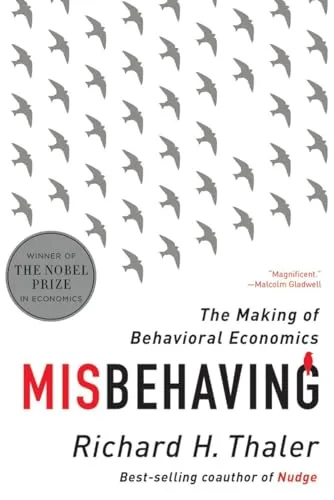
Key ideas
- Standard economics assumes rational "Econs," but real people are "Humans" who predictably misbehave, and those deviations are systematic enough to build a science on.
- The factors economics dismisses as irrelevant, "supposedly irrelevant factors," actually drive much human behavior and must be taken seriously.
- We value what we own far more than what we do not (the endowment effect), and we treat money in separate mental accounts rather than as fungible.
- We honor sunk costs we should ignore, and we struggle with self-control because a farsighted planner and a shortsighted doer live inside us.
- People care deeply about fairness, and perceptions of fair or unfair treatment constrain what markets and firms can get away with.
- Because people misbehave predictably, well-designed choice architecture, nudges, can help them make better decisions without restricting freedom.
The things economists call "supposedly irrelevant factors" are exactly the things that make us human, and ignoring them does not make people rational, it just makes the theory wrong.
Mental models
- Econs versus Humans — Standard economics is built on "Econs": perfectly rational agents who optimize, have consistent preferences, and are unmoved by irrelevant context. Real people are "Humans," who use rules of thumb, are swayed by emotion and framing, lack self-control, and care about fairness. Thaler's career was documenting the systematic, predictable ways Humans differ from Econs. The point is not that people are stupid, but that a theory assuming Econs will mispredict the behavior of the Humans who actually populate the economy.
- Supposedly irrelevant factors and the endowment effect — Thaler kept a list of behaviors that standard theory said should not matter, "supposedly irrelevant factors" (SIFs). A prime example is the endowment effect: people demand much more to give up something they own than they would pay to acquire it, so ownership itself changes value, which Econs would never allow. SIFs like this, framing, defaults, and context, are not noise to be assumed away; they are central drivers of real behavior that economics long ignored at its peril.
- Mental accounting and sunk costs — Humans do not treat money as fungible; we sort it into mental accounts (this is "vacation money," that is "rent money") and spend differently from each. This mental accounting explains many "irrational" choices, like driving across town to save a few dollars on a small item but not a large one. It also underlies the sunk-cost fallacy: we let money already spent and unrecoverable influence current decisions, honoring costs we should rationally ignore.
- Planner-doer self-control and fairness — Two more pillars. Self-control failures arise because we contain a farsighted "planner" who wants what is good long-term and a myopic "doer" who wants gratification now; much of life is the planner trying to constrain the doer. And fairness is real economic force: experiments like the ultimatum game show people will reject unfair splits even at personal cost, and firms that violate fairness norms (price gouging in a crisis) face lasting backlash, so fairness constrains markets in ways Econ theory misses.
Product applications
- Design for Humans, not Econs: assume users are swayed by framing, defaults, and emotion, and account for the "supposedly irrelevant factors" standard analysis ignores.
- Use the endowment effect and mental accounting deliberately: trials create ownership, and how you frame a price (per day, bundled, a separate account) changes willingness to pay.
- Watch for the sunk-cost fallacy in your own roadmap decisions, and be willing to kill a project based on future value, not money already spent.
- Treat fairness as a hard constraint on pricing and policy: users punish perceived unfairness harshly, so a technically optimal move that feels unfair can backfire.
- Apply nudges and smart defaults, like automatic enrollment or Save More Tomorrow-style escalation, to help users make better choices without removing their freedom.
Questions to think about
Where in your product or your own decisions are you assuming people behave like rational Econs, ignoring framing, ownership, fairness, and self-control, and how differently would you design if you took seriously that the users, and you, are Humans who predictably misbehave?
Chapter by chapter
Econs, Humans, and Supposedly Irrelevant Factors
Thaler frames the whole book around a distinction: standard economics is built on "Econs," perfectly rational optimizers, while the real economy is populated by "Humans," who are emotional, inconsistent, and easily swayed by context. The gap between the two is the subject of his career.
As a young economist, he began keeping a list of behaviors that theory said should not happen, things that "supposedly irrelevant factors" should not affect, yet clearly did. Colleagues dismissed these as anomalies, but Thaler saw them as evidence that the standard model was systematically wrong about people.
The insight is that these deviations are not random noise to be assumed away; they are predictable and consequential. A science that ignores how Humans actually behave, in favor of how idealized Econs should behave, will keep making bad predictions, which is exactly what behavioral economics set out to correct.
For a PM, the opening lesson is to design and reason for Humans, not Econs. The framing, defaults, and emotional factors that economics calls irrelevant are precisely what shape real user behavior, so taking them seriously is not soft thinking but accurate thinking.
The Endowment Effect
One of the earliest and most robust of Thaler's anomalies is the endowment effect: people value something they own far more than the same thing when they do not own it. Ownership itself, not any change in the object, alters its worth in our minds.
In classic experiments, people given a mug demanded roughly twice as much to sell it as others were willing to pay to buy it. Standard theory says the buying and selling prices should be nearly identical; the large gap is a clear violation that reveals ownership changes valuation.
The endowment effect flows from loss aversion, giving something up feels like a loss, which looms larger than the equivalent gain, so we cling to what we have. It is a supposedly irrelevant factor with enormous practical consequences for trade, negotiation, and product design.
For a PM, the takeaway is that ownership drives attachment and value. Free trials and possession experiences make users value a product more and resist giving it up, and in any negotiation, people overweight what they would lose, which shapes how deals and pricing should be structured.
How We Really Handle Money
Economics assumes money is fungible, a dollar is a dollar regardless of source or label. Thaler shows Humans instead practice "mental accounting," sorting money into separate mental buckets, this is grocery money, that is entertainment money, and treating each differently.
This explains many seemingly irrational behaviors: we will drive across town to save ten dollars on a cheap item but not on an expensive one, because we evaluate the saving relative to the purchase, not in absolute terms. We also separate "transaction utility," the pleasure or pain of the deal itself, from the actual value of what we buy.
Mental accounting is not pure error; it can help people budget and control spending. But it means how money is framed and categorized changes how it is spent, so the same amount feels and behaves differently depending on which mental account it lands in.
For a PM, the lesson is that how you frame and categorize a price changes willingness to pay. Presenting a cost as a small daily amount, bundling it, or positioning it against a reference deal all exploit mental accounting, because users evaluate money contextually, not as fungible Econs would.
The Sunk-Cost Fallacy
A direct consequence of mental accounting is our irrational attachment to sunk costs, money or effort already spent and unrecoverable. Rationally, only future costs and benefits should matter, but Humans let past investments drive current decisions.
We finish a bad meal because we paid for it, sit through a movie we are not enjoying, or keep funding a failing project because we have already put so much in. The pain of "wasting" the prior investment feels real, even though the money is gone regardless of what we do next.
The fallacy is powerful because abandoning something feels like admitting a loss and locking it in, whereas continuing preserves the hope of eventual payoff. But this reasoning traps people in escalating commitment to losing courses of action, throwing good resources after bad.
For a PM, the takeaway is to make decisions on future value alone and to guard against sunk-cost thinking on your roadmap. The right question about a struggling project is what it will yield from here, not how much has already been invested, however painful writing off that investment feels.
The Planner and the Doer
Thaler tackles a phenomenon standard theory struggles with: self-control failure. Econs have consistent preferences over time, but Humans routinely act against their own long-term interests, eating the dessert, skipping the savings, procrastinating on what matters.
He models this as a conflict between two selves: a farsighted "planner" who wants what is good for the long run, and a shortsighted "doer" who wants gratification now. Much of life is the planner trying to constrain the doer, through commitment devices, rules, and removing temptation.
This reframes self-control as a structural problem, not a moral failing. Because the doer reliably hijacks the moment, the effective response is to design your environment in advance, when the planner is in charge, to limit the doer's options later, rather than relying on willpower in the moment.
For a PM, the lesson is that users (and you) have self-control problems that design can address. Features that help people commit in advance, set defaults, or reduce in-the-moment temptation work with the planner-doer conflict, helping Humans do what they actually want to do over the long run.
People Care About Fairness
Collaborating with psychologists, Thaler studied fairness, another force Econs ignore but Humans feel intensely. Experiments like the ultimatum game show people will reject an unfair split of money even when rejecting leaves them with nothing, sacrificing gain to punish unfairness.
Fairness also constrains markets. People consider it deeply unfair for a store to raise the price of snow shovels after a blizzard, even though supply and demand would justify it, and firms that violate these fairness norms face lasting anger and lost loyalty. Perceived fairness limits what businesses can profitably do.
This matters because standard economics predicts firms will exploit every opportunity to maximize price, yet in reality fairness considerations restrain them, and violating those norms carries real costs. Fairness is not sentiment outside economics; it is an economic force shaping behavior and outcomes.
For a PM, the takeaway is to treat fairness as a hard constraint, not a nicety. Users react to perceived unfairness in pricing, policy, or treatment with disproportionate anger and defection, so a move that is technically optimal but feels exploitative can do lasting damage to trust and loyalty.
Nudges and Choice Architecture
The book culminates in the practical payoff: because people predictably misbehave, we can help them make better decisions through thoughtful "choice architecture," designing the context in which choices are made. Small design changes, or "nudges," can guide behavior without restricting freedom.
The signature example is retirement saving. People want to save but never get around to it, so Thaler and colleagues designed "Save More Tomorrow," which enrolls people to automatically increase their savings rate with future raises. Automatic enrollment and smart defaults dramatically raised savings by working with human inertia rather than against it.
This approach, "libertarian paternalism," preserves choice, people can always opt out, while steering the default toward what most people actually want. Governments, including the UK's Behavioural Insights Team, adopted nudges to improve outcomes in taxes, health, and savings at low cost.
For a PM, the lesson is that defaults and choice architecture are powerful, ethical tools. Setting smart defaults, structuring options thoughtfully, and using nudges like automatic escalation help users achieve what they already want, and because Humans misbehave predictably, good design can reliably improve their outcomes.
The Entire Book in One Framework
The whole book documents one truth: real people are Humans, not Econs, and they misbehave in systematic, predictable ways. The endowment effect, mental accounting, sunk-cost attachment, self-control conflicts, and fairness concerns are all "supposedly irrelevant factors" that in fact drive behavior and that standard economics wrongly ignored.
Because these deviations are predictable, they can be studied, anticipated, and designed for. That is the practical promise of behavioral economics: understanding how Humans actually decide lets us build markets, policies, and products, through nudges and choice architecture, that help people make the choices they truly want.
Misbehaving is not "people are irrational and hopeless." It is the founding case that human quirks are real, predictable, and consequential, so the right response is not to assume them away but to understand them and design a world that works for Humans as they actually are.
10 Most Important Takeaways
- Real people are Humans, not the rational Econs standard economics assumes.
- The "supposedly irrelevant factors" economics ignores actually drive behavior.
- The endowment effect: we value what we own more than what we do not.
- Mental accounting: we treat money in separate buckets, not as fungible.
- The sunk-cost fallacy: we honor past spending that we should ignore.
- Self-control is a conflict between a farsighted planner and a myopic doer.
- People care intensely about fairness and punish unfair treatment even at a cost.
- Fairness norms constrain what markets and firms can profitably do.
- Because people misbehave predictably, we can design nudges to help them.
- Smart defaults and choice architecture improve outcomes while preserving freedom.
The deepest idea is that accuracy requires humility about human nature. For decades, economics prized elegant models of rational Econs over messy evidence about real Humans, and it kept getting people wrong. Behavioral economics won by taking the misbehavior seriously, and its lasting lesson is practical: understand how people actually decide, and you can design markets, policies, and products that genuinely help them.