
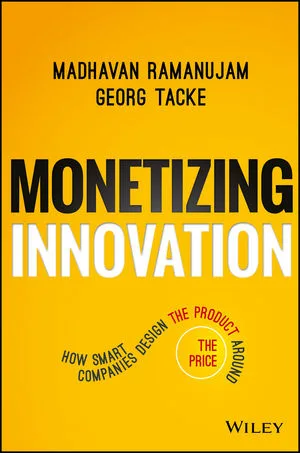
Key ideas
- Roughly three in four new products fail to hit their revenue goals, and the root cause is almost never engineering; it is that price and customer willingness to pay were treated as a launch-day afterthought.
- Design the product around the price, not the price around the product: let what customers actually value and will pay for shape what you build, feature by feature.
- Have the willingness-to-pay conversation with customers early and often, because without it you cannot rationally prioritize a roadmap or size an opportunity.
- Monetization failures come in four recognizable shapes, feature shocks, minivations, hidden gems, and undeads, and each has a specific cause you can prevent.
- Price is only the visible tip; the monetization model, the segmentation, the packaging, the value message, and the discipline to hold your price all decide whether an innovation makes money.
- A business case built from internal hope tells you what you want to hear; one built outside-in from real customer willingness-to-pay data tells you the truth.
The willingness to pay for a product is not something you discover after you build it; it is the single most important thing to learn before you decide what to build at all.
Mental models
- Design the product around the price — The book's central inversion of normal practice. Instead of inventing a product, launching it, and only then setting a price, you first learn what customers value and will pay for, and use that to decide which features to build, how to package them, and how to charge. Price stops being a last-minute markup and becomes the design constraint that shapes the whole product.
- The four failure types — Every monetization failure is one of four shapes. A "feature shock" crams in too many features, blurring value and overshooting cost. A "minivation" is a good product priced and scoped too timidly, leaving money on the table. A "hidden gem" is a high-potential product the company overlooks or kills internally. An "undead" is a product customers never wanted, launched anyway. Naming the shape points to the fix.
- Willingness to pay (WTP) as a design tool — Willingness to pay is what a customer would actually hand over for a given benefit. Gathered early through direct conversations, it does far more than set a price: it ranks which features are worth building (people pay for some and shrug at others), reveals natural customer segments, and sizes the real opportunity. It converts prioritization from opinion into evidence.
- Leaders, fillers, and killers — When packaging a product, features fall into three roles. Leaders are the few features customers most want and will pay for, the reason to buy. Fillers are nice-to-haves that add little to willingness to pay. Killers are features that actively reduce what a segment will pay if forced to buy them. Good bundling foregrounds leaders and keeps killers out of the wrong package.
Product applications
- Move the pricing conversation to the start of discovery: before building a major feature, ask target customers what they would pay for it, and use the answers to decide whether it makes the cut at all.
- Sort your roadmap features into leaders, fillers, and killers using real willingness-to-pay signal, then build the leaders first instead of the features that are simply easiest or loudest internally.
- Segment your users by their needs and willingness to pay rather than by demographics or firmographics, and design good-better-best packages that match those real segments.
- Build the business case for a new bet outside-in from customer WTP data, linking price, value, volume, and cost, instead of back-solving a number that justifies the plan you already like.
- Before launch, write the value message a customer would need to hear to pay full price; if you cannot articulate it clearly, the product is not ready, no matter how good the engineering is.
Questions to think about
For the last thing your team shipped, when did you first ask a real customer what they would pay for it, and if the honest answer is "after we built it," how differently might you have scoped the product had you asked before writing any code?
Chapter by chapter
How Innovators Leave Billions on the Table: A Tale of Two Cars
Two cars from the same company launch in the same era. One is engineered to be a technical marvel and priced almost as an afterthought; it loses money for years. The other is designed with the customer's willingness to pay in mind from the start, and it becomes one of the most profitable vehicles ever made.
The contrast sets up the book's core claim: the difference between a blockbuster and a money-loser is rarely the quality of the engineering. It is whether the company understood, early, what customers valued and would pay for, and let that shape the product.
The scale of the waste is enormous. Surveys of executives find that a large majority of new products, on the order of seventy percent or more, fail to meet their revenue targets, and vast sums of R and D are spent building things the market will not pay enough for.
For a PM, the opening lesson is that a great product and a profitable product are not the same thing, and the gap between them is monetization. Building something impressive that customers will not pay for is not a partial win; it is the most expensive kind of failure.
Feature Shocks, Minivations, Hidden Gems, and Undeads: The Four Flavors of Monetizing Innovation Failure
Monetization failures are not random; they cluster into four recognizable types, and knowing which one you are looking at tells you what went wrong and how to avoid it.
The four flavors
- Feature shock: a product overloaded with features, where the value is buried, the cost is high, and customers cannot see what they are paying for.
- Minivation: a genuinely good product scoped and priced too timidly, so it undersells its own value and leaves money on the table.
- Hidden gem: a product with real blockbuster potential that the company overlooks, sidelines, or kills internally because it does not fit the plan.
- Undead: a product customers never actually wanted, pushed to launch anyway because the team fell in love with it or ignored the warning signs.
The most common and seductive is feature shock, because adding features feels like adding value. In reality, piling on capabilities usually dilutes the value story, raises the price customers must justify, and makes the whole offer harder to understand and to sell.
The PM takeaway is to diagnose a struggling product against these four shapes honestly. A feature shock needs subtraction, a minivation needs bolder pricing, a hidden gem needs internal champions, and an undead should have been stopped earlier; the wrong fix for the wrong flavor wastes even more.
Why Good People Get It Wrong
Smart, capable teams produce these failures on purpose, following a logic that feels responsible at every step. The root mistake is treating monetization as something to figure out after the product exists, rather than a question that should shape the product.
Several habits reinforce the error. Teams assume that if they build something great, the money will follow. They avoid talking about price with customers because it feels awkward or premature. And they treat pricing as a narrow, late-stage decision owned by a different department, disconnected from product design.
The result is a sequence almost designed to fail: invent, build, launch, and only then discover whether anyone will pay enough. By the time the willingness-to-pay question gets asked, the expensive decisions have all been made and cannot easily be undone.
For product teams, the uncomfortable lesson is that this is a process failure, not a talent failure. The fix is not smarter people but a different order of operations, one that pulls the pricing and value conversation forward to where it can still change what gets built.
Have the "Willingness-to-Pay" Talk Early: You Can't Prioritize without It
The first and most important rule is to talk to customers about price early, long before the product is finished. Willingness to pay is not just an input to setting a price; it is the only sound basis for deciding what to build in the first place.
The logic is simple once stated. A roadmap is a set of choices about which features to invest in, and you cannot rank features rationally without knowing which ones customers actually value enough to pay for. Some features drive real willingness to pay; others customers expect for free. Only the pricing conversation separates them.
The talk does not have to be a blunt "what would you pay." It uses techniques that reveal value indirectly, and it treats an awkward conversation as far cheaper than months spent building features that turn out to move no one's willingness to pay at all.
The PM learning is direct: bring willingness-to-pay evidence into prioritization. A feature backlog ranked by internal enthusiasm or engineering ease is guessing; one ranked by what customers will pay for is designing the product around the price, which is the whole point.
Don't Default to a One-Size-Fits-All Solution: Like It or Not, Your Customers Are Different
Customers are not a single homogeneous market, and a product designed for the average customer often fits no one well. Different segments value different things and will pay different amounts, so one undifferentiated offer usually overserves some and underserves others.
The crucial move is to segment by what actually drives buying: customer needs, the value they perceive, and their willingness to pay, not by convenient labels like company size or age. Two customers in the same demographic bucket can have completely different value profiles.
Proper segmentation lets you build a small set of offers, often a good-better-best structure, that match real segments. This captures more value than a single compromise product, because each segment can buy the version aligned to what it will pay for rather than a one-size-fits-none middle.
For a PM, the lesson is to let willingness-to-pay-based segments drive packaging decisions. Designing three deliberate tiers around distinct value profiles almost always beats one averaged product, and it prevents the trap of building for a "typical" customer who does not exist.
When Designing Products, Configuration and Bundling Is More Science Than Art
How you group features into products and bundles is not a matter of taste; it is a discipline with real rules. Get it wrong and you can destroy value even with great individual features.
Leaders, fillers, and killers
- Leaders: the few features customers most want and will pay for; these anchor a bundle and drive the decision to buy.
- Fillers: nice-to-have features that add little to willingness to pay and should not be sold as if they were the main event.
- Killers: features that actually lower what a segment will pay if forced to take them, and must be kept out of the packages aimed at that segment.
The science lies in combining these deliberately. Bundling everything together (pure bundling) or selling everything separately (pure unbundling) is rarely optimal; a mix, with leaders foregrounded and killers isolated, captures the most value across segments.
The PM takeaway is to treat packaging as a first-class design decision informed by data. Before locking a plan's tiers, classify each feature as leader, filler, or killer per segment, and arrange bundles so no package is dragged down by a feature that quietly repels the very customers it targets.
Go Beyond the Flat Price: 5 Powerful Monetization Models
What you charge matters, but how you charge can matter more. A flat, per-unit price is only one option, and often not the best fit for how customers get and perceive value. The chapter lays out several richer monetization models to choose among.
- Subscription: recurring payments for ongoing access, smoothing revenue and aligning with continuous value.
- Pay-per-use or metered: customers pay in proportion to how much they consume, matching cost to value received.
- Dynamic or market-based pricing: prices flex with demand, time, or conditions, as with surge or peak pricing.
- Freemium: a free tier drives adoption while premium features convert the users who need more.
- Bundled and tiered structures: packaging that lets different segments self-select into the offer that fits them.
The right model depends on how customers actually consume and value the product. A metered model can unlock buyers who balk at a big flat fee; a subscription can turn a one-time sale into a lasting relationship; the wrong model can suppress demand no matter how fair the underlying price.
For product teams, the lesson is to treat the monetization model as a design choice, not a default. Matching how you charge to how customers derive value often expands the market more than any tweak to the number itself.
Price Low for Market Share or High for Premium Branding? Pick the Winning Pricing Strategy
Pricing has to serve a deliberate strategy, and the two broad directions pull opposite ways. Price low to win volume and market share, or price high to signal premium quality and capture margin. Drifting into a price without choosing is how products end up stuck in an unprofitable middle.
Each path has coherent logic. A penetration strategy uses a low price to grab share fast, betting on scale, network effects, or later monetization. A premium strategy uses a high price to fund quality, signal value, and serve customers who equate price with worth. Both can win; incoherence loses.
The mistake is picking a price without picking a strategy, or worse, wanting both premium positioning and mass-market volume at once. The choice must align with the product, the segment, and the company's goals, and then the whole offer should reinforce it.
The PM learning is to make the strategy explicit before the number. Ask whether this product is competing on share or on premium value, and ensure the features, packaging, and message all support that answer rather than sending mixed signals customers cannot reconcile.
From Hoping to Knowing: Build an Outside-In Business Case
Most business cases are exercises in self-justification: teams start from the outcome they want and back-solve the assumptions to reach it. Built inside-out from hope, the case reliably tells you exactly what you wanted to hear.
The alternative is an outside-in business case grounded in real customer willingness-to-pay data. You start from what customers have actually signaled they will pay, then link price to value, value to volume, and volume to cost, so the numbers reflect the market rather than the plan.
This discipline surfaces bad bets before they consume budget. When the outside-in case cannot reach the target even under fair assumptions, that is priceless early warning, far cheaper than discovering the same truth after launch when the money is already spent.
For a PM, the takeaway is to anchor every business case in evidence from customers, not enthusiasm from the building. A projection built on real willingness to pay is a decision tool; one built on optimism is a story, and stories do not survive contact with the market.
The Innovation Won't Speak for Itself: You Must Communicate the Value
A product does not explain its own worth. Even a genuinely valuable innovation will underperform if customers cannot quickly grasp why it is worth the price, so communicating value is part of monetization, not marketing decoration.
Value communication means translating features into the concrete benefit and outcome a customer cares about, in their language. It answers "why should I pay this" before the customer has to ask, and it makes the value visible enough that the price feels justified rather than arbitrary.
Weak value messaging quietly caps what customers will pay. When people cannot see the value, they anchor on the lowest comparable price or walk away, and the innovation gets blamed for a communication failure that had nothing to do with its actual merit.
The PM learning is to design the value message alongside the product, not after it. If you cannot state, in a sentence a customer would nod at, why the product is worth its price, the work is unfinished, however polished the feature set looks.
Use Behavioral Pricing Tactics to Persuade and Sell: Sometimes Your Customers Will Behave Irrationally
Customers are people, and people do not evaluate prices with cold rationality. Their perception of a price is shaped by context, comparison, and emotion, so how a price is presented can matter as much as the number itself.
Levers of price perception
- Anchoring: an initial reference price shapes what every later price feels like, so a high anchor makes the target price seem reasonable.
- Decoy options: a deliberately less attractive third option can steer customers toward the choice you want them to make.
- Framing: how a price is described, per day versus per year, or what it is bundled against, changes how large it feels.
These tactics are not tricks to gouge customers; they help a fairly priced product be perceived at its true value rather than lost to a poor mental comparison. The same price can read as expensive or reasonable depending entirely on the frame around it.
For a PM, the lesson is that pricing pages and plan layouts are product surfaces worth designing with care. The structure, order, and framing of options shape choices as much as the underlying numbers, and ignoring that leaves real value uncaptured.
Maintain Your Price Integrity: Avoid Knee-Jerk Re-Pricing
When a new product sells below expectations, the reflex is to cut the price. The book warns that this is usually the wrong first move and can permanently damage the product's value in customers' eyes.
Price integrity means holding your price and controlling discounting tightly, treating a cut as a last resort after other levers, better value communication, packaging fixes, targeting the right segment, have been exhausted. A hasty discount trains customers to wait for lower prices and signals that the original price was never real.
Discounting also erodes margin fast and is hard to reverse. Once a market has seen the lower number, restoring the original price is far harder than never having dropped it, so the discipline to resist the knee-jerk cut protects the product's long-term economics.
The PM takeaway is to diagnose weak sales before repricing. Slow uptake is often a value-communication or packaging problem, not a price problem, and reaching for a discount first can convert a fixable issue into a permanent loss of pricing power.
Learning from the Best: Successful Innovations Designed around the Price
The rules come alive through companies that lived them. Case studies span a range of industries, from a sports-car maker to software and professional networks, each showing the same principle: monetization was designed in from the start, not bolted on at launch.
- A premium carmaker that engineered products and pricing together to earn industry-leading margins.
- LinkedIn, which built multiple monetization models (subscriptions, recruiting tools, advertising) matched to distinct customer segments and their willingness to pay.
- Uber, which used innovative, dynamic price models as a core part of a disruptive service rather than an afterthought.
- Optimizely, which figured out how to price a genuinely new kind of product where no obvious benchmark existed.
Across the examples, the common thread is that pricing and packaging were treated as product decisions owned early by the team, informed by customer willingness to pay, and aligned to a clear strategy. Success was engineered, not lucky.
For a PM, these stories are a template rather than trivia. Each shows the same sequence, understand value, segment, package around leaders, choose a fitting model, communicate the value, and hold the price, applied to a real product, which is exactly the process the earlier chapters prescribe.
Implementing the "Designing the Product around the Price" Innovation Process
The final chapter turns the nine rules into a repeatable process a company can adopt. The core change is structural: move monetization from a late, siloed step into the heart of the innovation process, owned by the product team from the beginning.
That means embedding the willingness-to-pay conversation into discovery, building cross-functional ownership of pricing rather than leaving it to a separate department, and treating price as a design input at every stage gate. The process only sticks when leadership, including the CEO, backs it.
Culture is the real barrier. Organizations used to building first and pricing later resist asking customers about money early, so implementation is as much about changing habits and incentives as about learning techniques. The reward is a much higher hit rate on new products.
The PM learning is that adopting these ideas is an organizational project, not a personal one. Championing willingness-to-pay research, pulling pricing forward in your own process, and building the cross-functional habit of designing around the price is how a single product manager starts to shift the whole system.
The Entire Book in One Framework
The whole book is one inversion: design the product around the price instead of pricing the product after you build it. That inversion is executed through nine rules that all trace back to a single early act, learning what customers value and will pay for before you decide what to build.
The willingness-to-pay conversation feeds everything downstream: it prioritizes features (leaders over fillers, killers isolated), reveals segments, sizes the opportunity in an outside-in business case, and points to the right monetization model and pricing strategy. Value communication and price integrity then protect the value you designed in.
Avoid the four failure shapes and you have covered the field: no feature shock, no minivation, no hidden gem, no undead. Each is prevented by the same discipline of asking about value and price early enough to still act on the answer.
Monetizing Innovation is not "charge more." It is the discipline of letting the customer's willingness to pay decide what you build, so that price stops being a number you guess at the end and becomes the constraint that makes the product great in the first place.
10 Most Important Takeaways
- Most new products fail on monetization, not engineering, because price was an afterthought.
- Design the product around the price: let willingness to pay shape what you build.
- Have the willingness-to-pay talk early; you cannot prioritize a roadmap without it.
- Watch for the four failure shapes: feature shock, minivation, hidden gem, and undead.
- Segment by needs and willingness to pay, not demographics, and package good-better-best around real segments.
- Bundle deliberately: foreground leaders, downplay fillers, and keep killers out of the wrong package.
- Choose how you charge, not just how much; the monetization model can expand the market more than the number.
- Pick a pricing strategy on purpose, share or premium, and make the whole offer reinforce it.
- Build the business case outside-in from customer data, and communicate value so the price feels justified.
- Hold your price; treat discounting as a last resort, because knee-jerk cuts permanently erode value.
The deepest idea is a reordering of the whole innovation process. The expensive decisions, what to build and how to package it, get made long before anyone usually talks about price, so the only way to design a profitable product is to pull the money conversation forward to where it can still change those decisions. Price is not the last step; it is the first constraint.