
Key ideas
- We are not rational calculators; we make systematic, predictable errors, which means our irrationality can be anticipated and designed for.
- We judge everything by comparison, not absolute value, so context and decoys can steer our choices without us noticing.
- Our valuations are anchored by arbitrary first numbers and then stay coherent, so initial prices shape willingness to pay long after.
- The word "free" exerts an irrational pull, driving choices that a rational cost-benefit analysis would reject.
- Social norms and market norms are separate worlds, and mixing money into a social relationship can destroy the goodwill that money cannot buy.
- Expectations, ownership, and even price change our actual experience: we literally enjoy or benefit more from something we expect or paid more for.
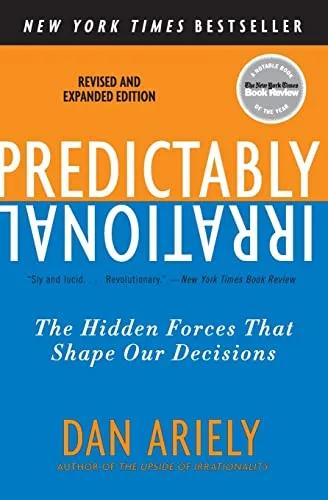
We are not only irrational, we are predictably irrational; the same hidden forces bend everyone's decisions in the same directions, which means we can foresee and, if we choose, correct for them.
Mental models
- Relativity and the decoy effect — We rarely judge things in absolute terms; we judge them relative to other options. This makes us vulnerable to the decoy effect: adding a deliberately inferior third option (a "decoy") can make one of the other two look better and shift our choice, even though nothing about that option changed. Because we crave easy comparisons, sellers and situations can steer us simply by controlling what we compare against, and we mistake the resulting preference for our own true judgment.
- Arbitrary coherence and anchoring — The first number we encounter, however arbitrary, "anchors" our sense of value, and then our subsequent judgments stay coherent relative to that anchor. Ariely showed people would pay more for items after being exposed to a higher random number. Once an anchor is set (an initial price, a first offer), our willingness to pay clusters around it and persists. This means our valuations are far more constructed and manipulable than we believe, built on foundations that were essentially random.
- The power of free and social versus market norms — Two potent forces. "Free" is not just a low price but an emotional hot button: people irrationally over-choose a free option, taking a worse deal to avoid any cost. And we live in two normative worlds: social norms (favors, goodwill, community) and market norms (money, exchange). They do not mix. Introducing money into a social exchange, paying people for a favor, can shatter the goodwill and motivation that the social norm provided, and it is very hard to restore.
- Expectations, ownership, and price shape reality — Our subjective experience is not fixed; it is shaped by expectation and context. We enjoy a wine or a coffee more when told it is expensive; a placebo works better when it costs more (the price-placebo effect). We overvalue what we already own (the endowment effect) and irrationally keep options open even at real cost. These are not just judgment errors; expectations and price literally change how much we enjoy, benefit from, or value the very same thing.
Product applications
- Design choices knowing users decide by comparison: the options you place next to each other, including a decoy, will shape which one they pick.
- Be deliberate about anchoring in pricing, since the first number users see will frame everything after; set reference points intentionally and honestly.
- Respect the pull of "free": a free tier or free shipping can drive adoption far beyond its literal value, but a small charge can disproportionately deter.
- Keep social and market norms separate: a community or goodwill-driven relationship with users can be damaged by introducing transactional, money-based framing.
- Use expectations honestly: how you frame and present a product genuinely changes how users experience it, so set-up and context are part of the value.
Questions to think about
Think of a recent purchase or decision you felt was rational. How much of it was actually driven by what you happened to compare it against, an anchor price you saw first, the word "free," or an expectation someone set, and if these hidden forces are predictable, are you designing around them or being quietly steered by them?
Chapter by chapter
The Truth About Relativity
Ariely opens with a foundational quirk: we almost never judge things in absolute terms. We evaluate options relative to other options, and we especially crave easy comparisons, which makes our choices steerable by whatever we are given to compare against.
The decoy effect demonstrates this. In a famous magazine-subscription example, adding a deliberately inferior option, a print-only offer priced the same as a print-plus-digital bundle, made the bundle look like an obvious bargain and shifted people's choices, even though the bundle itself never changed.
The lesson is that relativity, not absolute value, drives decisions, so context and framing exert enormous influence. We think we are choosing based on the thing itself, but we are really choosing based on how it compares to whatever happens to sit beside it.
For a PM, the opening takeaway is that users decide by comparison, so the options you place side by side shape their choice. A pricing table, a set of plans, or a comparison against a decoy determines which option looks best, and designing that comparison deliberately (and honestly) is powerful.
The Fallacy of Supply and Demand
Ariely challenges the economic assumption that prices reflect the balance of supply and demand. Instead, he shows that our sense of value is built on "arbitrary coherence": an initial, often arbitrary anchor sets our valuation, and everything after stays consistent with it.
In his experiments, people wrote down the last two digits of their social security number, then bid on items; those with higher digits bid far more, even though the number was meaningless. The random anchor shaped their willingness to pay, which then remained coherent across related items.
This means demand is not an independent, rational force; it can be manipulated by anchors. Once a reference price is planted, an initial offer, a first price seen, our willingness to pay clusters around it and persists, so the "market price" partly reflects arbitrary starting points.
For a PM, the lesson is that the first number a user encounters anchors their whole sense of value. Because initial prices and reference points durably shape willingness to pay, setting anchors thoughtfully, and recognizing when your own valuations are anchored, matters more than the notion of a purely rational market suggests.
The Cost of Zero Cost
One word wields disproportionate power over us: free. Ariely shows that "free" is not merely a very low price but an emotional trigger that makes us behave irrationally, over-choosing free options even when a paid option offers more value.
In one experiment, when a premium chocolate was one cent and a basic one free, people overwhelmingly took the free basic chocolate, abandoning the far better deal, purely to avoid any cost at all. The fear of losing anything, even a penny, distorts the choice.
The reason is that free removes the downside entirely: there is no possibility of loss, and loss aversion makes that feel wonderful. So free shipping, free trials, and free gifts drive behavior far beyond their literal economic value, and a small charge can deter disproportionately.
For a PM, the takeaway is to respect the outsized pull of free. A free tier or free shipping can accelerate adoption well beyond its actual cost, while introducing even a tiny price can sharply reduce uptake, so where you place the "free" line is a high-leverage design decision.
The Cost of Social Norms
Ariely distinguishes two worlds that govern our behavior: social norms and market norms. Social norms are the friendly, communal exchanges of favors and goodwill, helping a friend move, sharing a meal, where money is not mentioned. Market norms are the world of prices, wages, and transactions.
The crucial finding is that these worlds do not mix, and mixing them backfires. When you introduce money into a social exchange, offering to pay someone for a favor, you convert it into a market transaction, and the goodwill and generosity that the social norm provided evaporates, often replaced by a worse, price-based calculation.
Worse, the damage is hard to undo: once a relationship has been reframed in market terms, it is very difficult to restore the social norm. People will do more for free, out of social motivation, than they will for a small payment, because payment changes the entire meaning of the exchange.
For a PM, the lesson is to be careful about mixing social and market framings with your users and community. A relationship built on goodwill, contribution, and belonging, an open-source community, a passionate user base, can be damaged by suddenly introducing transactional, money-based incentives that crowd out intrinsic motivation.
Ownership and Keeping Doors Open
Ariely explores two more predictable biases. The first is the endowment effect: we systematically overvalue what we own simply because we own it. In experiments, people who possessed an item demanded far more to sell it than others were willing to pay, because we focus on what we would lose.
Ownership warps valuation for several reasons: we fall in love with what we have, we focus on the potential loss, and we assume others share our perspective. This is why free trials are so effective, once we possess something, even temporarily, we value it more and are reluctant to give it up.
The second bias is our irrational urge to keep options open. Ariely showed people will expend real resources to preserve doors, options, they do not even need, rather than commit. We are so afraid of foreclosing a possibility that we sacrifice value to keep worthless options alive.
For a PM, the takeaways are practical: the endowment effect makes trials and ownership experiences powerful for driving retention, while the door-keeping bias explains why users and teams cling to options and resist committing. Sometimes closing doors deliberately, for yourself or your users, leads to better outcomes than keeping every option open.
Expectations and the Power of Price
Some of Ariely's most striking findings show that our expectations do not just color our judgment, they change our actual experience. Told a wine is expensive or a coffee is gourmet, people genuinely enjoy it more; the brain's experience shifts to match the expectation.
Price does the same thing physiologically through the price-placebo effect. In experiments, an identical painkiller relieved more pain when people believed it was expensive than when told it was cheap, and expensive placebos outperformed cheap ones. What we pay literally changes how well something works for us.
This means expectations and price are not merely biases distorting a fixed reality; they are ingredients in the reality we experience. The story we are told about a product, and what we pay for it, becomes part of how much we actually benefit from and enjoy it.
For a PM, the lesson is that framing and price genuinely shape the user's experience, not just their opinion. How you present a product, the expectations you set, and even what you charge become part of the perceived and real value, so presentation and positioning are substantive, not cosmetic.
Honesty and the Fudge Factor
The final theme is our relationship with honesty. Ariely finds that most people are not either honest or dishonest; almost everyone cheats a little when given the chance, but only up to a limit that lets them still feel good about themselves, what he calls the "fudge factor."
People cheat more when cash is a step removed, dealing in tokens or non-monetary items loosens honesty more than dealing in cash, which is a warning sign for a world of increasingly abstract money. Yet small interventions restore honesty dramatically: simply reminding people of moral standards before a task, even recalling the Ten Commandments, sharply reduces cheating.
The implication is hopeful and practical: dishonesty is not fixed human nature but a predictable response to context, and it can be reduced by design, through moral reminders, signatures at the top of forms, and reducing the psychological distance from the consequences of cheating.
For a PM, the takeaway is that ethical behavior among users and teams is shapeable by context. Building in gentle reminders of values, keeping consequences salient, and reducing the abstraction around actions can measurably improve honesty, because most people's integrity is context-dependent rather than absolute.
The Entire Book in One Framework
The whole book makes one liberating point: our irrationality is systematic and predictable, not random. The same hidden forces, relativity and decoys, arbitrary anchors, the lure of free, the divide between social and market norms, the endowment effect, expectations, price, and the fudge factor, bend everyone's decisions in the same directions.
Because these biases are predictable, they can be anticipated, designed for, and corrected. We are not helpless before them, but we are fooling ourselves if we believe we are the rational calculators economics assumes. Understanding the specific forces is the first step to making better decisions and designing better experiences.
Predictably Irrational is not "people are stupid." It is the reassuring discovery that our irrationality follows rules, so the same forces that quietly steer us can be understood, anticipated, and either designed around or consciously resisted.
10 Most Important Takeaways
- Our irrationality is systematic and predictable, so it can be anticipated and designed for.
- We judge by comparison, not absolutes, which makes decoys and framing powerful.
- Arbitrary anchors set our sense of value, and it stays coherent from there.
- The word "free" pulls us irrationally, beyond its literal economic value.
- Social norms and market norms do not mix; adding money can destroy goodwill.
- The endowment effect makes us overvalue what we own, so trials drive attachment.
- We irrationally keep options open, sacrificing real value to avoid commitment.
- Expectations change our actual experience, not just our opinion.
- Price alters reality: expensive placebos work better than cheap ones.
- Almost everyone cheats a little, but moral reminders sharply restore honesty.
The deepest idea is that we are far less the rational agents we imagine, but our irrationality is orderly, which is what makes it useful to understand. The same predictable forces that lead us astray can be turned to good: designing choices, prices, and contexts that account for how people actually decide, and building in reminders that counter our worst tendencies, so that being predictably irrational becomes something we work with rather than deny.