
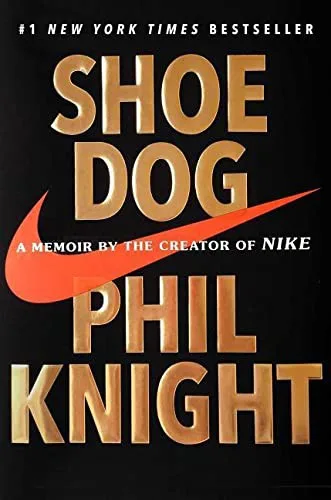
Key ideas
- Chase your "crazy idea": a calling you believe in is worth pursuing even when everyone tells you it is foolish and the path is nothing but obstacles.
- Growth devours cash; Nike was profitable and perpetually broke because every dollar of profit was immediately reinvested to grow faster, keeping the company on the edge of collapse for years.
- A company is built by obsessives; Knight hired misfits and "shoe dogs" who cared about the product and mission more than about polish or credentials.
- Perseverance beats brilliance; the story is a decade-long grind of crises survived one at a time, not a clean arc of genius rewarded.
- Brand and identity matter deeply, but they grow out of authentic obsession with the product and the athlete, not out of marketing slogans invented in a boardroom.
- Business is not just about money; the deepest reward is building something meaningful with people you respect, and doing work that feels like play.
Everyone told me the idea was crazy, and they were probably right; the only thing crazier would have been listening to them and stopping.
Mental models
- The Crazy Idea and the calling — Knight frames his life around pursuing a "Crazy Idea", importing Japanese running shoes to America, that almost everyone dismissed. The lesson is not recklessness but the value of a genuine calling: work you believe in deeply enough to endure years of doubt and hardship for. He urges finding that pursuit and refusing to stop, because a life spent on someone else's safer path is its own kind of failure.
- Growth outrunning cash — Nike's central, recurring crisis was that rapid growth consumes cash faster than profit generates it. Every sale funded a larger next order, so the faster Blue Ribbon grew, the more starved for money it became, always one bad break from insolvency. The insight for any builder is that growth is not the same as financial safety; a profitable, fast-growing company can still die from running out of cash.
- Hiring shoe dogs and misfits — A "shoe dog" is someone devoted to the craft of shoes, obsessed with the product itself. Knight built his team from such obsessives and outright misfits, people bound by a shared love of the mission rather than by conventional polish. His management retreats, the "Buttface" meetings, were raucous and profane, but the loyalty and passion of that odd team, not corporate process, is what carried the company through.
- Don't stop — The book's emotional core is relentless perseverance. Success came not from a single brilliant stroke but from surviving crisis after crisis, banks pulling out, lawsuits, a near-fatal government tax demand, by simply refusing to quit. Knight's repeated instruction to himself and others is to keep going, because most defeats come from stopping, and the line between failure and success is often just endurance.
Product applications
- When you believe in an idea others call crazy, pressure-test it honestly but do not let consensus skepticism alone kill it, because genuinely new things almost always look foolish early.
- Model cash, not just profit, when planning aggressive growth; treat running out of money as the real failure mode and secure funding ahead of the growth that will consume it.
- Hire for obsession and mission-fit over pedigree; a small team that genuinely cares about the product will outwork and outlast a polished team that does not.
- Expect the journey to be a series of survivable crises rather than a smooth ascent, and build the resilience, personal and organizational, to absorb them one at a time.
- Let brand grow from authentic obsession with the product and the customer, not from slogans; Nike's identity came from genuinely loving running and runners.
Questions to think about
Knight risked everything for years on an idea nearly everyone thought was foolish, and the reward was rarely money and often just survival to fight another day. What is the "crazy idea" you believe in enough to endure that for, and what is actually stopping you from pursuing it?
Chapter by chapter
The Crazy Idea
The memoir opens with a young Phil Knight, fresh from business school, gripped by a "Crazy Idea": that high-quality, low-cost Japanese running shoes could beat the German brands then dominating America, and that he could be the one to import them.
On a round-the-world trip in 1962, he detours to Kobe, Japan, and talks his way into a meeting with the Onitsuka shoe company. Asked who he represents, he improvises a company name on the spot, "Blue Ribbon", and secures the right to distribute Tiger shoes in the western United States, with nothing but nerve behind him.
The chapter is really about the value of a calling. Knight urges pursuing the work you believe in before the world talks you into a safer life, framing the willingness to chase a crazy idea as the defining choice of a meaningful life rather than a business tactic.
For a founder or PM, the opening lesson is that transformative ideas look foolish at the start and require someone willing to act on conviction before there is proof. The bluff in Kobe worked because Knight was willing to begin before he was ready.
Blue Ribbon and the Trunk of a Car
The first shoes arrive after an agonizing wait, and Blue Ribbon Sports begins, not as a company with offices, but as Knight selling Tigers out of the trunk of his car at track meets across the Pacific Northwest.
He recruits his old track coach, Bill Bowerman, as a partner. Bowerman is an obsessive tinkerer who constantly modifies shoes to make athletes faster, embodying the "shoe dog" spirit. Knight keeps a day job as an accountant, running the shoe business on the side because it cannot yet support him.
The first real employee, Jeff Johnson, turns out to be a fanatic, evangelizing the shoes, tracking customers obsessively, and pouring his identity into the mission. The early company runs on passion and hustle far more than on capital or plan.
The PM learning is that the earliest days are about relentless, hands-on selling and hiring true believers. Knight did the unscalable work himself and surrounded himself with obsessives, building momentum from devotion rather than resources.
Growing Fast and Always Broke
Blue Ribbon grows rapidly, opening its first real retail store and doubling sales year after year. Yet the faster it grows, the more desperate for cash it becomes, and this paradox becomes the defining tension of the entire story.
Why growth starved the company
Every dollar of profit went immediately into a larger next order from Onitsuka, so the company was perpetually leveraged to the hilt. Doubling sales meant doubling the money needed up front, leaving Blue Ribbon profitable on paper but constantly out of cash and at the mercy of its bankers.
The banks, wanting slow, safe growth and fat cash balances, were hostile to Knight's aggressive expansion, repeatedly threatening to cut him off. He increasingly relied on the Japanese trading company Nissho to finance the imports the banks would not, a lifeline that carried its own risks.
For a builder, the lesson is stark: growth consumes cash, and a fast-growing, profitable business can still be one bad month from death. Managing the money, and the financiers, is as existential as building the product itself.
The Break and the Birth of Nike
The relationship with Onitsuka sours as the Japanese supplier grows unreliable and begins exploring other American distributors, threatening to cut Blue Ribbon out of the business it had built. Dependence on a single supplier reveals itself as a mortal vulnerability.
Knight decides to make his own shoes under his own brand. The team lands on the name Nike, after the Greek goddess of victory, and pays a graphic design student, Carolyn Davidson, a mere thirty-five dollars for the swoosh logo, which Knight himself is lukewarm about at first.
Bowerman's relentless tinkering produces the waffle sole, inspired by pouring rubber into his wife's waffle iron, giving Nike a genuine product innovation to launch with. The company pivots from reselling someone else's shoes to creating its own identity and technology.
The PM learning is twofold: over-reliance on a single partner is a strategic risk to escape, and a real brand and product innovation, born from authentic obsession like Bowerman's, are what let a company control its own destiny.
War with Onitsuka and the Buttfaces
Nike launches, debuting at the 1972 Olympic trials, and the split with Onitsuka erupts into a lawsuit as both sides claim breach and betrayal. The young company has to fight a legal war while simultaneously trying to establish a brand from nothing.
Through this period Knight leans on his eccentric inner circle, an overweight, disorganized, fiercely loyal group who hold raucous, profanity-laced retreats they call "Buttface" meetings. They are misfits by any corporate standard, but their candor and devotion make them a formidable team.
Nike wins the legal fight and severs from Onitsuka for good, emerging independent but battered. The victory is less a triumphant milestone than another survived crisis, one of many, that keeps the company alive to face the next.
For a leader, the lesson is that an unpolished team bound by loyalty and honesty can outperform a conventional one, and that surviving existential conflict, legal or competitive, is often just the price of independence rather than a clean win.
On the Edge of Bankruptcy
These are the darkest financial years. Nike's bank, alarmed by its aggressive borrowing and thin cash, abruptly cuts the company off, leaving it unable to pay its bills and hours from collapse. The perpetual cash crisis nearly becomes fatal.
Matters worsen when the sudden banking rupture and the complex Nissho financing draw the attention of the FBI amid suspicions of fraud, terrifying Knight, who has done nothing criminal but looks precarious enough to be suspect. The company teeters on the brink of ruin and disgrace at once.
Nissho ultimately stands behind Nike, and a new bank is found, pulling the company back from the edge. Survival comes not from a masterstroke but from relationships, nerve, and refusing to fold in the face of what looked like the end.
The PM learning is that near-death experiences are normal in a fast-scaling venture, and that surviving them depends on the trust you have built with partners and the sheer refusal to quit, more than on any clever financial engineering.
The Customs Crisis and Going Public
Just as Nike stabilizes, American competitors weaponize an obscure customs rule, the American Selling Price, to hit the company with a retroactive import duty of roughly twenty-five million dollars, a sum that would have destroyed it. It is the gravest threat yet, and this time the adversary is the government itself.
Knight fights back on every front, political, legal, and public, refusing to pay a bill designed to crush a rising competitor. After a long, grinding battle, Nike settles the dispute for a fraction of the demand, escaping what could have been a death sentence.
With survival secured and growth roaring, Nike goes public in December 1980, the same month as a similar company, and the offering makes Knight and his early team wealthy. The IPO is the destination the whole decade of struggle had been driving toward.
For a founder, the lesson is that success can attract existential attacks from incumbents using every lever, including regulation, and that reaching a milestone like an IPO is the reward for surviving a long gauntlet, not a shortcut around it.
Reflections on the Journey
The final chapter steps out of the narrative into reflection. Looking back, Knight measures the journey not mainly in money but in meaning: the pride of building something real, the people he built it with, and the rare gift of work that felt like a calling rather than a job.
He is honest about the costs, strained family life, friends lost, the toll of relentless risk, and about luck's role alongside effort. The tone is grateful but unsentimental, refusing to package the story as a tidy formula for success.
His parting advice is directed at the next generation: find your calling, and above all, do not stop. He worries that young people are pushed toward safe paths, and urges them to chase their own crazy ideas while they can, because a life of play disguised as work is worth the risk.
The PM learning is that the point of building is not just the outcome but the meaning of the pursuit and the people in it. Knight's closing charge, keep going and chase what you believe in, is the emotional distillation of the entire decade of struggle.
The Entire Book in One Framework
Shoe Dog is the story of a crazy idea kept alive through a decade of near-death crises by sheer refusal to stop. Knight bluffs his way into distributing Japanese shoes, builds Blue Ribbon from a car trunk, and grows so fast that cash starvation nearly kills the company again and again.
When his supplier turns on him he creates Nike, wins a war to be independent, survives a banking collapse and a government tax that each could have ended everything, and finally reaches an IPO. The throughline is not genius but endurance, a loyal team of obsessives, and loyalty to a calling.
Shoe Dog is not a how-to for getting rich. It is a testament that the reward for chasing a crazy idea is rarely comfort and often just survival, and that for the right kind of person, building something you love with people you love is worth every year of it.
10 Most Important Takeaways
- Chase your crazy idea; genuinely new things look foolish before they look inevitable.
- Begin before you are ready; Knight bluffed his way into a distribution deal with nothing but nerve.
- Growth eats cash, so a profitable, fast-growing company can still die from running out of money.
- Manage your financiers as carefully as your product; the banks nearly killed Nike repeatedly.
- Escape dangerous single-supplier dependence before it can be used against you.
- Hire obsessives and misfits who love the mission over polished people who do not.
- Build a real brand and product innovation, like the waffle sole, to control your own destiny.
- Expect success to attract existential attacks, even from competitors using the government.
- Survival is often the real victory; win one crisis at a time and keep going.
- Measure the journey in meaning and people, not only in money, and above all do not stop.
The deepest idea is that the romance of a startup is mostly grit. Behind the eventual Nike swoosh is a decade of a founder who was broke, terrified, sued, and nearly ruined more times than he could count, and who succeeded for one unglamorous reason: at every point where quitting would have been reasonable, he refused to stop.