
Key ideas
- A Black Swan is an event that is rare, carries extreme impact, and is rationalized as predictable only in hindsight.
- These outliers, not the ordinary, shape history, markets, and lives, yet our tools and instincts are built for a smoother world.
- Some domains (Mediocristan) are ruled by the average and outliers barely matter; others (Extremistan) are ruled by extremes, where a single event dominates.
- The mind fools us with the narrative fallacy, imposing tidy stories on randomness, and with silent evidence, ignoring the failures we never see.
- Prediction fails badly in Extremistan, and confident forecasters exhibit "epistemic arrogance," overrating what they know about an unknowable future.
- You cannot predict Black Swans, so the goal is robustness: minimize exposure to harmful ones and stay open to catching beneficial ones.
What we do not know is far more consequential than what we do; history is driven by the rare, the unpredictable, the Black Swan, and no amount of confident forecasting changes that.
Mental models
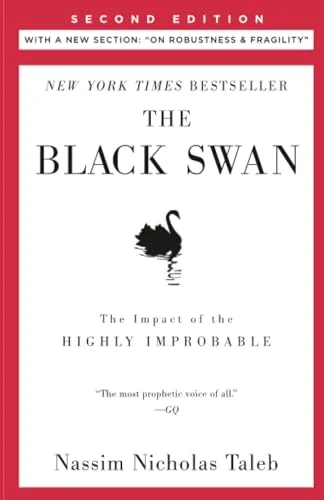
- The Black Swan — A Black Swan has three attributes: it is an outlier lying outside regular expectations (rarity), it carries an extreme impact, and, despite its unpredictability, human nature makes us concoct explanations after the fact that make it seem predictable (retrospective predictability). The term comes from the discovery that black swans exist, shattering the confident belief, based on all prior sightings, that all swans are white. A handful of such events, wars, crashes, breakthrough technologies, shape the world more than everything routine combined.
- Mediocristan versus Extremistan — Taleb divides phenomena into two provinces. In Mediocristan, quantities are bounded and the collective is not dominated by any single case, like human height or weight; no one person makes everyone twice as tall. In Extremistan, a single observation can dominate the total, like wealth, book sales, or market moves; one outlier outweighs the mass. Our statistical tools and the bell curve work in Mediocristan but are dangerously misleading in Extremistan, where the consequential Black Swans live.
- The narrative fallacy and silent evidence — Two ways the mind blinds us. The narrative fallacy is our compulsion to weave events into coherent stories with clear causes, which makes a random, unpredictable world feel orderly and foreseeable, and hides how much was luck. Silent evidence is the failures, casualties, and roads not taken that we never see, survivors tell the story, so we systematically overestimate the odds of success and the role of skill by ignoring everyone the same strategy destroyed.
- The turkey problem and robustness — The turkey is fed every day and grows ever more confident, by all past evidence, that humans are benevolent, right up until Thanksgiving. This is the problem of induction: the past cannot rule out an unprecedented event, and confidence built purely on history is most dangerous just before it collapses. Since Black Swans cannot be predicted, the response is robustness: minimize exposure to catastrophic negative Black Swans while staying positioned to benefit from positive ones, often via a "barbell" of extreme safety plus small bets on big upside.
Product applications
- Distinguish whether you are in Mediocristan or Extremistan: for outcomes where a single rare event can dominate (a viral hit, a catastrophic failure), average-based planning is dangerously misleading.
- Distrust confident forecasts of an uncertain future, and build plans robust to being wrong rather than optimized for a single predicted scenario.
- Correct for silent evidence: study the failures and the companies that died using the strategy you admire, not just the survivors whose success you can see.
- Reduce fragility to catastrophic downside, avoid bets that can wipe you out, while keeping cheap options open to capture large, unexpected upside (a barbell).
- Beware the narrative fallacy in retrospectives: resist tidy after-the-fact stories that make a lucky or random outcome look inevitable and repeatable.
Questions to think about
Where is your plan quietly assuming a smooth, predictable world, optimizing for the average and the forecast, when the outcome actually lives in Extremistan and could be dominated by a single rare event you cannot foresee, and are you fragile to the bad Black Swans and closed off from the good ones?
Chapter by chapter
What a Black Swan Is
Taleb names his subject with a metaphor: for centuries Europeans knew all swans were white, until black swans were discovered in Australia, instantly disproving a belief built on unbroken past evidence. A Black Swan is an event that shatters expectations the same way.
Such events share three traits: they are outliers beyond normal expectations, they carry extreme impact, and, crucially, we rationalize them after the fact as if they had been predictable all along. The 2008 crash, major wars, and breakthrough technologies all fit this pattern.
The central claim is that these rare, unpredictable events, not the ordinary and expected, drive history, markets, and individual lives. Yet we spend our attention on the predictable and routine, building models and confidence around a world that the consequential Black Swans routinely blow apart.
For a PM, the opening lesson is that outsized outcomes, both disasters and windfalls, tend to come from rare, unforeseen events, not from the steady middle. Planning as if the future is a smooth extension of the past leaves you blindsided by exactly the events that matter most.
Mediocristan and Extremistan
A key distinction organizes the book: two provinces of randomness. In Mediocristan, quantities are physically bounded and no single case dominates the whole. Human height is an example, the tallest person does not outweigh a stadium of average ones, so averages and the bell curve work.
In Extremistan, a single observation can dominate the total. Wealth, book sales, city sizes, and market moves live here: one billionaire can hold more than millions of people combined, one book can outsell the rest of a genre. In Extremistan, the exception is not a footnote; it is the whole story.
This matters because our statistical tools, especially the Gaussian bell curve, are built for Mediocristan and become dangerously misleading in Extremistan, where they drastically underestimate the probability and impact of extremes. Applying Mediocristan thinking to an Extremistan world is how experts get blindsided.
For a PM, the takeaway is to identify which world an outcome lives in. If success or failure can be dominated by a single rare event, a runaway hit, a catastrophic outage, then average-based forecasting and normal-distribution assumptions will badly mislead you, and you must plan for the extremes.
The Narrative Fallacy
Taleb argues our minds are story-making machines, and this is a source of profound error he calls the narrative fallacy. We compulsively weave events into coherent stories with clear causes, because narratives are easier to remember and make the world feel orderly.
The problem is that these stories impose false order and predictability on what is actually random and chaotic. After a Black Swan, we construct an explanation that makes it seem inevitable, "of course the crash happened, the signs were everywhere", conveniently forgetting that no one acted on those signs beforehand.
This retrospective storytelling gives us the dangerous illusion that we understand the past and can therefore predict the future. It also hides the role of luck: a random success gets narrated as the result of brilliant strategy, teaching false lessons that do not replicate.
For a PM, the lesson is to distrust tidy causal stories, especially in hindsight. A clean narrative explaining why a product succeeded or failed usually overstates skill and understates chance, so treat post-hoc explanations skeptically rather than as reliable formulas to repeat.
Silent Evidence
A subtle but powerful bias Taleb highlights is silent evidence: the failures, casualties, and paths that did not survive to tell their story. We see and study the winners, but the losers who used the same strategy are invisible, which skews everything we conclude.
This is survivorship bias writ large. When we admire successful entrepreneurs and copy their habits, we ignore the graveyard of people who did exactly the same things and failed, because they are not around to be studied. The surviving evidence speaks loudly while the silent evidence, far more numerous, says nothing.
As a result we vastly overestimate the odds of success and the role of skill over luck. The visible winners create an illusion that their path reliably leads to victory, when in truth the same path led far more people to ruin, they just left no trace we notice.
For a PM, the takeaway is to actively seek the silent evidence: study the companies and products that died pursuing the strategy you admire, not only the survivors. Correcting for survivorship bias gives a truer picture of risk and of how much success owes to luck.
The Turkey Problem and the Failure of Prediction
Taleb dramatizes the limits of learning from history with the turkey. Fed generously every day, the turkey grows ever more confident, on the basis of all past evidence, that humans are benevolent, and that confidence peaks the day before Thanksgiving, exactly when it is most wrong.
This is the philosophical problem of induction: no amount of past observation can guarantee the future, and confidence built purely on a track record is most dangerous just before a regime change. The turkey's greatest certainty comes right before its greatest surprise, which is how Black Swans strike.
From this Taleb launches his attack on prediction. He argues that experts in complex, Extremistan domains, economists, forecasters, pundits, are systematically overconfident, displaying "epistemic arrogance": a gap between what they think they know and what they actually know. Their forecasts of the consequential future are little better than chance, yet delivered with certainty.
For a PM, the lesson is to treat confident forecasts with deep skepticism and to remember the turkey: a long record of stability is not proof of safety. Building plans that do not depend on predicting the unpredictable, and staying humble about what the future holds, is wiser than trusting expert certainty.
Living With Black Swans
If Black Swans cannot be predicted, what should we do? Taleb's answer is to shift from prediction to robustness: since you cannot know which rare event will strike, structure your affairs to survive the harmful ones and benefit from the helpful ones.
This means minimizing exposure to catastrophic negative Black Swans, avoiding bets and positions that can wipe you out, however unlikely they seem, because in Extremistan the unlikely happens more than the models say. Surviving is the precondition for everything, so eliminating ruinous fragility comes first.
The barbell strategy
At the same time, you position to capture positive Black Swans: keep many small, cheap bets open on ventures with huge, unpredictable upside, since one big hit can more than pay for many failures. Taleb's "barbell" combines extreme safety for most of your resources with small, aggressive exposure to large upside, robust to disaster yet open to windfalls.
For a PM, the takeaway is to design for robustness and asymmetric upside: avoid decisions that carry catastrophic, unrecoverable downside, while keeping cheap options open on bets that could pay off enormously. You cannot forecast the Black Swans, but you can decide how exposed you are to them.
The Entire Book in One Framework
The whole book argues that the rare, unpredictable, high-impact Black Swan drives the world, yet our minds and models are built for a smoother reality. We live increasingly in Extremistan, where single events dominate, but we reason with Mediocristan tools and stories that hide our blindness.
The narrative fallacy, silent evidence, the turkey's induction problem, and expert overconfidence all conspire to make us feel the future is knowable when it is not. Since prediction fails, the answer is robustness: cut exposure to ruinous Black Swans and stay open to beneficial ones, often through a barbell of safety plus small high-upside bets.
The Black Swan is not "predict rare events better." It is the opposite: accept that the most consequential events are unpredictable, stop trusting confident forecasts and tidy stories, and build a life and portfolio robust enough to survive the bad surprises and catch the good ones.
10 Most Important Takeaways
- A Black Swan is rare, extreme in impact, and rationalized as predictable only in hindsight.
- Rare, unpredictable events, not the ordinary, drive history and markets.
- Mediocristan is ruled by the average; Extremistan is ruled by dominating outliers.
- The bell curve works in Mediocristan but dangerously misleads in Extremistan.
- The narrative fallacy makes us impose false, tidy causes on randomness.
- Silent evidence (survivorship bias) hides the failures, inflating success odds.
- The turkey problem: confidence built on history peaks right before it collapses.
- Expert forecasters are epistemically arrogant; prediction fails in complex domains.
- You cannot predict Black Swans, so aim for robustness, not forecasting.
- Use a barbell: extreme safety plus small bets with huge upside.
The deepest idea is that what we do not know matters more than what we do. We build our confidence, our models, and our plans on the visible, the average, and the past, and it is precisely the invisible, the extreme, and the unprecedented that reshapes our world. Wisdom is not better prediction but a humble, robust posture toward a future that will always hold surprises we cannot see coming.