
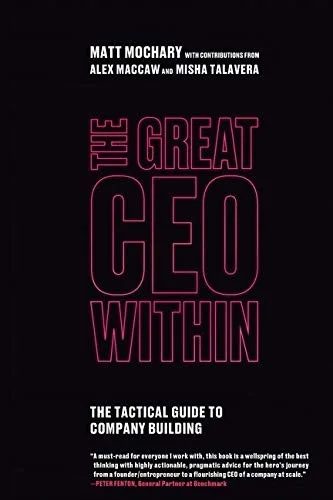
Key ideas
- Company building is a set of learnable, concrete habits and systems, not innate genius, and adopting them deliberately is what lets a founder scale into a great CEO.
- Master yourself first: a productivity system (get everything out of your head, process to zero, protect time for your top goal) frees the mental space leadership requires.
- Spend your time in your zone of genius by auditing what energizes versus drains you and delegating the draining work to others who are energized by it.
- Transparency and impeccable agreements build the trust a scaling company runs on; share information widely, make clear commitments, and honor them with consequences.
- Resolve conflict directly and lead from "above the line," taking radical responsibility and staying curious instead of defensive, blaming, or letting the loudest voice win.
- Scale with systems, not heroics: a company wiki, tracked goals like OKRs, and a single owner for every area of responsibility remove the founder as the bottleneck.
A great company is not built by a genius doing everything; it is built by a founder who installs the right habits and systems so the company no longer depends on any one person, including them.
Mental models
- Personal operating system: GTD, Inbox Zero, Top Goal — The foundation of CEO effectiveness is a personal productivity system. Get everything out of your head into a trusted inbox and process it to zero, so nothing is forgotten and your mind is clear. Reach Inbox Zero on email daily. And protect the first block of each day for your single Top Goal, the most important thing, before the day's reactive demands take over. Order in your own work is the precondition for leading others.
- Energy audit and zone of genius — Track your activities and label each as energizing or draining. Your "zone of genius" is the small set of things you are both uniquely good at and energized by; everything else, especially draining tasks, should be delegated to someone for whom it is energizing. This maximizes both your output and your longevity, because a CEO burning energy on draining work they merely tolerate will neither perform nor last.
- Above the line and radical responsibility — Drawn from conscious-leadership ideas, every moment you are either "above the line" (open, curious, taking responsibility) or "below the line" (closed, defensive, blaming, playing victim). Great leaders notice when they have dropped below the line and consciously shift back up, taking radical responsibility for their situation rather than assigning blame. This mindset underlies healthy feedback, conflict resolution, and decision-making.
- Systems that remove the founder as bottleneck — Scaling requires infrastructure so the company does not depend on the founder's memory or presence. A single-source-of-truth wiki captures anything said more than once. A goal-tracking system (KPIs and OKRs) keeps everyone aligned and measurable. And every function has a clear Area of Responsibility owned by one person, so accountability is unambiguous. Together these let the company run without the founder in every loop.
Product applications
- Adopt a personal system, capture everything into an inbox, process to zero, and protect the first hour daily for your single most important goal, so reactive work stops crowding out the important.
- Run an energy audit on your week, then delegate the draining tasks to people energized by them, concentrating your own time on your zone of genius.
- Increase transparency with your team, sharing metrics, context, and decisions widely, because the trust and better decisions it produces outweigh the discomfort.
- Make agreements impeccable: whenever the team commits to something, capture who will do what by when, and address broken agreements directly instead of letting them slide.
- Install lightweight systems, a team wiki for anything said twice, tracked OKRs, and a single directly responsible owner per area, so the team scales without you as the bottleneck.
Questions to think about
How much of what you do each week falls in your zone of genius versus draining work someone else would love, and how much of the company still depends on knowledge and decisions that live only in your head rather than in a system anyone can use?
Chapter by chapter
Getting Started and Building the Team
The book opens by narrowing the CEO's job to a few essentials: set the vision and strategy, recruit and retain a great executive team, and make sure the company never runs out of money. Nearly everything else can and should be delegated.
From the start, the emphasis is on building a team the company does not depend on any single person to survive, avoiding a single point of failure. The founder's instinct to be the indispensable hero is precisely what caps the company's growth and creates fragility.
The overall stance is that great company building is tactical and learnable. Rather than mystifying leadership, the book promises a concrete toolkit of habits and systems that any founder can install, which sets the practical, checklist-like tone for everything that follows.
For a PM growing into leadership, the opening lesson is to define your actual job narrowly and build redundancy into the team. Clarifying the few things only you must do, and ensuring no critical function lives solely in one person, is the foundation of a scalable organization.
Individual Habits: Getting Things Done
Before leading others, a CEO must get their own work under control, and this part is a personal productivity system. The core is to get everything out of your head into a trusted inbox, then process that inbox to zero, deciding to do, delegate, or defer each item.
The habits that free your mind
- Inbox Zero: process email to empty daily, so nothing important is lost and your attention is not fragmented.
- Top Goal: spend the first, uninterrupted block of each day on your single most important objective before reactive work floods in.
- On time and present: be punctual and fully present, without devices, which respects others and sharpens focus.
- Energy audit and zone of genius: delegate draining work and concentrate on what you are uniquely good at and energized by.
- Health: protect sleep, exercise, and recovery, because the CEO's performance depends directly on their physical state.
The unifying idea is that a clear, ordered mind is the precondition for good leadership. When nothing is nagging in the back of your head and your best energy goes to the most important work, you can show up for your team with calm and focus.
For a PM, the takeaway is to install a real personal operating system before trying to scale your impact. Capturing everything, protecting time for your top priority, and guarding your energy and health is what makes the harder work of leading others sustainable.
Group Habits: Decision-Making and Communication
How a team makes decisions and communicates determines its speed and quality, and this part offers concrete practices. The first is clarity about who decides: for every decision, name the single person empowered to make it, gather input, and then commit even if you disagreed.
A recurring danger is the "loudest voice in the room," especially the CEO's, drowning out better ideas. The remedy is for the most powerful person to speak last and actively draw out others first, so decisions reflect the best thinking rather than the highest status.
Communication habits reinforce this: surface issues with proposed solutions rather than just complaints, and follow the rule that anything you say more than once should be written down. Documenting repeated information turns scattered knowledge into a shared, reusable resource.
For a PM, the lesson is to make decision rights explicit and to protect dissenting input. Naming a clear decider, speaking last when you hold power, and writing down anything repeated builds a team that decides quickly, uses everyone's intelligence, and does not relearn the same things.
Transparency, Agreements, and Conflict
Trust is the currency of a scaling company, and this cluster of habits builds it. Radical transparency, sharing financials, metrics, board materials, and context widely, gives people the information to make good decisions and signals that leadership has nothing to hide.
Impeccable agreements are the second pillar: every commitment should specify who will do what by when, and broken agreements must be addressed directly, with consequences, rather than ignored. Sloppy agreements that quietly slide erode trust and accountability across the whole organization.
Conflict is treated as healthy and necessary, provided it is resolved directly. The practice is to get issues on the table quickly, have the two parties talk directly (with a neutral facilitator if needed), and reach resolution, rather than letting resentment fester or triangulating through others.
For a PM, the takeaway is that trust is built through concrete behaviors: share more than feels comfortable, make and honor precise agreements, and resolve conflicts head-on. These habits prevent the quiet dysfunction that otherwise accumulates as a team grows.
Conscious Leadership, Feedback, and Culture
Underlying the group habits is a mindset the book borrows from conscious leadership: at any moment you are either above the line (open, curious, responsible) or below it (defensive, blaming, victimized). Great leaders catch themselves dropping below the line and consciously shift back up.
This mindset powers healthy feedback. Feedback should flow freely in both directions, be specific and timely, and be received with curiosity rather than defensiveness. Gratitude and appreciation, expressed regularly, balance the criticism and keep the culture generous rather than harsh.
Culture, in this view, is built through consistent practice of these habits, not slogans. Combined with a relentless focus on the customer, treating customer obsession as a shared value, the accumulated behaviors define what the company actually is and how it treats people and problems.
For a PM, the lesson is to lead from above the line and to make feedback and appreciation routine. Noticing your own defensiveness and choosing responsibility, while building habits of specific feedback and genuine gratitude, shapes a culture far more than any stated values do.
Infrastructure: Wiki, OKRs, and Areas of Responsibility
Scaling requires systems so the company stops depending on the founder's memory and presence. The first is a single-source-of-truth wiki or company folder, where anything said more than once is written down, so knowledge is findable rather than trapped in people's heads.
The systems that let a company scale
- The company wiki: a shared, organized home for processes, decisions, and information, kept current as the single source of truth.
- Goal tracking with KPIs and OKRs: measurable objectives, reviewed regularly, that keep everyone aligned and make progress visible.
- Areas of Responsibility: every function has one clearly named owner, so accountability for each part of the business is unambiguous.
Together these remove the founder as a bottleneck. When information lives in a wiki, goals are tracked openly, and each area has a single responsible owner, the organization can operate and make decisions without routing everything through the CEO.
For a PM, the takeaway is to build lightweight infrastructure early: document repeated knowledge, track measurable goals, and assign a single clear owner to every area. These systems are what let a team grow in capability without growing in chaos.
Recruiting, Onboarding, and Firing
People are the company, so how you bring them in and, when necessary, let them go is critical. The book treats recruiting as a deliberate, high-effort process of finding people who fit both the role and the culture, rather than filling seats quickly.
Onboarding is given real weight, because a strong start determines how fast and how well a new person becomes productive. A structured onboarding, clear expectations, context, early wins, turns a good hire into a contributing team member quickly instead of leaving them to flounder.
Firing, though painful, is treated as a responsibility not to avoid. Keeping someone who is not working out, out of conflict-avoidance, harms the team, the mission, and often the person themselves. When it is clearly not a fit, acting decisively and humanely is the kinder course.
For a PM or leader, the lesson is to invest heavily in hiring and onboarding and to address poor fits promptly. Getting the right people in, ramping them well, and being willing to make hard exits is how you protect the quality and health of a growing team.
Sales, Marketing, and Fundraising
The later parts turn outward to growing the business. On sales, the guiding principle is to sell results, not features: focus on the concrete outcome the customer gains, and build genuine trust, because people buy from those they trust to solve their problem.
Effective selling rests on real customer development, deeply understanding the customer's needs before pitching, and on structuring a sales team and pipeline as the company scales beyond founder-led selling. Marketing and lead generation feed that pipeline, and reaching product-market fit remains the precondition for scaling any of it.
Fundraising is treated as a process to run deliberately: telling a compelling story, running it as a disciplined campaign, and managing investor relationships, so the company always has the capital its stage requires. Cash, after all, is one of the CEO's three core responsibilities.
For a PM, the takeaway is that go-to-market and capital are leadership responsibilities grounded in the same principles: understand the customer deeply, sell outcomes over features, build trust, and run growth and fundraising as deliberate systems rather than improvisation.
The Entire Book in One Framework
The whole book is a layered operating system for a growing company. It starts with mastering yourself, a personal productivity system and energy management, then adds group habits, transparent, above-the-line ways of deciding, communicating, and resolving conflict, then installs infrastructure, a wiki, tracked goals, and clear ownership, and finally extends to scaling people, sales, and capital.
The unifying goal at every layer is the same: remove the founder as the single point of failure and replace heroics with habits and systems, so the company can grow in capability without descending into chaos or depending on any one person.
The Great CEO Within is not "learn to be a visionary." It is a toolbox: install the concrete habits and systems that make you calm and effective, make your team trusting and accountable, and make your company run without you in every loop.
10 Most Important Takeaways
- A CEO's core job is vision and strategy, a great executive team, and never running out of cash; delegate the rest.
- Master a personal system: get everything into an inbox, process to zero, and protect time for your top goal.
- Run an energy audit and delegate draining work, spending your time in your zone of genius.
- Protect your health, because your performance as a leader depends directly on it.
- Name a single decider for each decision, and have the most powerful voice speak last.
- Write down anything you say more than once, building a single-source-of-truth wiki.
- Be radically transparent and make impeccable agreements, with consequences when they break.
- Lead from above the line, taking responsibility, and resolve conflict directly and quickly.
- Track measurable goals with OKRs, and give every area of responsibility a single clear owner.
- Hire and onboard deliberately, fire when it is clearly not a fit, and sell results, not features.
The deepest idea is that leadership at scale is systems, not heroics. The founder's instinct to hold everything in their head and be indispensable is exactly what limits the company and burns them out. Installing habits that order your own mind, build trust across the team, and put knowledge and ownership into systems is what turns a founder into a great CEO and a fragile startup into a durable company.