
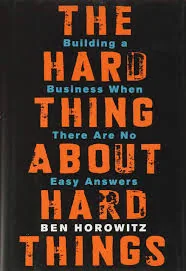
Key ideas
- Horowitz treats the CEO job as a series of forced choices with no textbook answer, not a set of best practices to copy.
- 'The Struggle' names the psychological toll of running a company that might die on your watch, and normalizes it instead of hiding it.
- People, then product, then profit is a deliberate ranking, not a slogan; it decides what gets sacrificed first when resources are tight.
- A leader needs both 'Ones' thinking (setting direction) and 'Twos' thinking (making the org execute), and most people are naturally strong in only one.
- The right leadership mode, peacetime versus wartime, depends on whether the company's survival is currently at stake, not on personal style.
- There is no universal playbook; every hard call has to be reasoned from the specific, ugly details of the situation in front of you.
The hardest calls in a company are the ones with no good option, only a least bad one, and the job is to make that choice and own it out loud.
Mental models
- The Struggle — The gap between believing your company will fail and being unable to admit it to your team, investors, or yourself. Horowitz treats naming this state, rather than projecting false confidence, as the first step to functioning inside it.
- Ones and Twos — Two distinct leadership skills: setting direction under incomplete information (a One) versus getting an organization to execute reliably (a Two). Most leaders are naturally strong in one and have to consciously build the other.
- Peacetime CEO, Wartime CEO — Peacetime management maximizes an existing opportunity through broad process and delegated creativity. Wartime management exists when survival itself is threatened and demands a single, tightly enforced priority, even at the cost of normal protocol.
- The Law of Crappy People — At any title level, competence quietly drifts down toward whoever holds that title least deservingly, because everyone else recalibrates what the title should mean around that person. Left unchecked, it drags an entire level's standards down.
Product applications
- When a roadmap has to be cut, cut by the people, product, profit ordering explicitly: protect the team and the user experience before protecting a quarter's revenue number.
- Before a launch or a pivot, name out loud to your team whether you are currently in peacetime or wartime mode, and adjust how much debate versus how much directive execution you ask for.
- Run a promotion or leveling process with a written, specific bar per level so a mediocre hire at a title does not reset what that title means for the rest of the team.
- When you have to deliver bad news about a cut feature, a missed date, or a reduced scope, put the reason in plain language and take responsibility for it yourself instead of softening it.
- Use the Freaky Friday swap deliberately: sit in engineering standup, support queues, or sales calls before making a call that will land hardest on those teams.
Questions to think about
When your product roadmap and your team's wellbeing genuinely conflict under a deadline you cannot move, which one do you protect first, and can you defend that choice to the team afterward?
Chapter by chapter
From Communist to Venture Capitalist
Ben Horowitz grew up in Berkeley in the 1970s, the son of David Horowitz, a writer at the radical magazine Ramparts who later reversed course and became an outspoken conservative commentator.
Watching a parent hold two opposite, equally certain worldviews years apart left him with an early suspicion of any framework presented as permanently correct, including management frameworks.
His neighborhood and schools were mostly Black, and he has described learning to move fluently between different registers of speech and behavior depending on who he was with, a skill he later mapped directly onto being a CEO.
He studied computer science at Columbia and UCLA, then worked in engineering roles before joining Netscape in the mid 1990s under Marc Andreessen during the browser wars.
AOL bought Netscape in 1998 and folded its product teams into a much larger, slower company, an ending, not a triumph, that pushed Horowitz and Andreessen toward starting something of their own next.
The PM lesson: your translation skill is the job, not a soft skill around it
Horowitz's own account of 'code switching,' moving between one register with the board and another with engineers, describes the core work of product management: translating the same decision into terms that land for different audiences without changing its substance.
For a PM, this shows up constantly: the same scope cut has to be explained to an executive as a resourcing tradeoff, to an engineer as a technical constraint, and to a customer as a prioritization choice, all truthfully.
Treating that translation as a first class skill worth deliberately practicing, rather than an incidental byproduct of being good with people, is the direct takeaway from this chapter.
"I Will Survive"
In September 1999, Horowitz, Marc Andreessen, and two former Netscape colleagues, Tim Howes and In Sik Rhee, founded Loudcloud, a company that ran and managed internet infrastructure for other businesses, before the term cloud computing existed to describe it.
They raised roughly $150 million in venture funding at the height of the dot-com boom and grew fast, signing large customers who needed someone else to operate their servers reliably around the clock.
The company was, in effect, selling a category the market did not yet have a name for, which made both the pitch and the hiring harder than entering an already established space.
Loudcloud had to build the technology, train customers on why they needed it, and staff an operations function capable of running other companies' infrastructure without ever going down, all at once, while burning cash at boom era pace.
The PM lesson: shipping ahead of the category you're naming
When a product is genuinely new, the biggest early risk is not the build, it is that customers, sales teams, and even your own engineers lack shared vocabulary for what the product actually is.
A PM in this position has to define the category in plain language before selling the roadmap inside it, and expect that early positioning will need rewriting more than once as the market's own language catches up.
Loudcloud's early growth came from solving a real problem well before cloud computing existed as a pitch; being first means doing the naming work yourself, not waiting for the market to hand you a template.
This Time With Feeling
As the dot-com downturn set in during 2000 and 2001, Loudcloud had to make its first significant layoffs, cutting a meaningful share of the company after growing headcount aggressively during the boom.
Horowitz describes the first round as poorly handled: managers were not prepared, communication was inconsistent, and the emotional weight of the decision was left largely unaddressed.
By the time a second round of cuts became necessary, he had built an explicit process instead of improvising again.
How the second layoff was actually run
- Decide fast once the decision is truly made, since delay just extends everyone's anxiety.
- Have the CEO explain to the whole company, in plain terms, that the company's plan failed, not the employees.
- Train every manager delivering a cut to say that same reason clearly, without euphemism.
- Stay visibly present in the office afterward instead of disappearing, so people can see the decision was not made carelessly.
The PM lesson: cutting scope is a communication problem before it is a triage problem
Product leaders regularly cut features, sunset a product, or shrink a team's scope, and the emotional dynamics are structurally identical to a layoff: people need a clear, honest reason, not a spin.
Framing a scope cut as the plan did not survive contact with reality, rather than blaming the team that built the feature, preserves trust for the next hard call.
Delaying an obviously necessary cut, hoping conditions improve, tends to cost more in team morale than making the cut promptly and explaining it well.
When Things Fall Apart
In 2001, Loudcloud's largest customer relationship collapsed when a client, Atriax, filed for bankruptcy, wiping out roughly $25 million in expected revenue the company had been counting on.
Loudcloud's stock, already down sharply after its IPO, fell as low as 35 cents a share, putting it at real risk of being delisted from the Nasdaq if it could not get back above a dollar.
The Struggle
This is where Horowitz names 'The Struggle,' his term for the specific psychological state of running a company that might not survive: waking up uncertain whether the business will exist in six months.
It is a state where you cannot fully share that uncertainty with employees who need to stay motivated, or with investors who need to stay confident, sometimes not even with a spouse.
He describes it as a state with no clean resolution, only degrees of functioning inside it, and argues that naming it honestly is more useful than pretending it is not happening.
The PM lesson: leading through ambiguity means deciding without waiting for certainty
Product decisions under real pressure, a metric cratering, a launch failing, a competitor's move requiring an immediate response, rarely come with enough data to feel certain, and waiting for more often just extends the exposure.
Naming the uncertainty to your team, saying plainly that the cause is not fully known yet while stating your best read and next action, builds more trust than projecting false confidence, and keeps the team moving instead of freezing.
Take Care of the People, the Products, and the Profits, In That Order
This chapter lays out a deliberate priority order for what a leader protects when resources are limited: people first, because they are the ones who build and stay; products second, because a good product earns the right to have customers at all; profit third, because it is the outcome of getting the first two right.
Horowitz argues most companies default to reversing this order under pressure, protecting near-term revenue at the expense of both people and product quality, a mistake he treats as compounding over time.
Ones and Twos
'Ones' are leaders comfortable setting strategic direction with incomplete information, while 'Twos' are leaders who excel at operational execution and getting an organization to actually do what has been decided.
Very few people are naturally strong at both, so a leader has to consciously build the weaker skill rather than only hiring around their own existing strength.
The Law of Crappy People
At any given title level in an organization, the overall talent bar tends to drift down toward whoever holds that title least deservingly, because everyone else recalibrates what the title should mean around that weakest holder.
The fix Horowitz proposes is a promotion process with an explicit, written skill bar for each level, so titles stay meaningful even as headcount grows.
The PM lesson: apply the ordering to your own roadmap tradeoffs
When a sprint or quarter has to be cut down, running the decision through people, product, profit in that order gives a concrete tiebreaker.
Protect the team from unsustainable crunch first, protect core product quality and trust second, and treat a short-term revenue or metric hit as the more acceptable casualty of the three, if a genuine tradeoff exists between them.
Concerning the Going Concern
By late 2000, Loudcloud's board was advising against an IPO, correctly reading that the market for internet stocks was already collapsing.
Horowitz pushed forward anyway, not because conditions were good, but because the company was burning cash fast enough that going public was the only path he could see to keeping it alive at all. BusinessWeek later called it the IPO from hell.
Loudcloud went public in March 2001 at $6 a share, raising about $162.5 million, well below the roughly $1 billion valuation the company had been targeting earlier in its private fundraising.
The number itself mattered less than the fact that it kept the company solvent through a market actively punishing every company like it; the alternative, staying private and running out of cash, had no comparable upside at all.
The PM lesson: sometimes every option in front of you is bad
Not every hard product decision has a version that looks good in hindsight; sometimes the real choice is between a bad outcome and a worse one, and the job is picking correctly between them under public scrutiny.
A PM shipping a compromised version of a feature to hit a commitment, rather than missing the commitment entirely, is making the same kind of call: not optimizing for the ideal outcome, but for the survival of the larger goal that outcome was meant to serve.
How to Lead Even When You Don't Know Where You Are Going
Horowitz distinguishes two modes of running a company: 'Peacetime CEO' and 'Wartime CEO.' In peacetime, a company is expanding an existing, working opportunity, and the leader's job is to broaden that opportunity and tolerate more internal debate.
Good ideas are expected to surface from anywhere in the organization through fairly normal process during peacetime.
In wartime, the company's survival is what is actually at stake, and the leader's job narrows to a single overriding priority, enforced with far less patience for process or dissent than peacetime allows.
He is explicit that these are not personality types a leader picks once; they are modes a leader has to move between as the situation changes, sometimes within the same year.
The PM lesson: match your process weight to whether you're actually at risk
A leader who stays in peacetime mode during an actual crisis moves too slowly and loses the company; a leader who stays in wartime mode after the crisis has passed burns out a team that no longer needs to be run that way.
Product teams often keep the same cadence of reviews, debate, and consensus seeking regardless of whether the team is safely iterating or scrambling to respond to something that threatens the roadmap's survival, like a critical bug or a broken core metric.
Recognizing which mode you are actually in, and deliberately tightening decision making and shortening debate during the wartime moments, is a skill distinct from just being decisive by default.
First Rule of Entrepreneurship: There Are No Rules
This chapter works through specific, thorny leadership situations that do not reduce to a formula: whether to sell your company when an offer comes in, and how to keep a company's culture and standards from eroding as it scales.
Horowitz also names a tension he calls the accountability versus creativity paradox: holding people strictly accountable for results can quietly discourage the kind of experimentation that produces real innovation.
The Freaky Friday Management Technique
Named after the movie where two people swap bodies, this tool asks a leader to spend real time doing another team's actual work, sitting in their meetings, handling their tickets, taking their calls, before making a call that will land hardest on them.
The point is to make the decision informed by what the job is actually like, rather than by how it looks from the org chart.
The PM lesson: borrow the perspective before you make the call
A product decision that will land hardest on support, sales, or an adjacent engineering team benefits from the same swap: sit in their queue, join their standup, or shadow their week before finalizing scope, timing, or a policy change that affects them.
It surfaces real constraints a spec or a dashboard will not show, and it is a concrete, repeatable practice a PM can actually schedule, not just an abstract call for empathy.
The End of the Beginning
In 2007, Hewlett-Packard acquired Opsware, the software business that had survived Loudcloud's near collapse and eventual restructuring, for $1.6 billion in cash.
It closed out an eight year run that had included a dot-com era founding, a distressed IPO, a business line sale to EDS to stay solvent, and a rebuild around the software asset HP ultimately bought.
Rather than stepping back from company building, Horowitz and Andreessen used what they had learned running Loudcloud and Opsware to start Andreessen Horowitz as a venture capital firm, staffed deliberately with people who had actually operated companies rather than only invested in them.
The stated premise was that technical founders, the engineers and product people who start companies, are frequently pushed out by their own boards in favor of professional CEOs, often to the company's long-term detriment.
A firm built by former operators, the reasoning went, could help those founders stay in the seat and grow into the job instead.
The PM lesson: the hard calls don't stop, only their shape changes
Surviving one set of hard decisions does not retire the skill; it just repositions where you apply it next.
Horowitz's response to finishing one company building arc was not to rest on it but to redirect the judgment he had built toward helping other founders survive their own versions of the same struggle.
For a PM, the equivalent is treating every hard product call as evidence to carry into the next one, whether that is a new team, a new company, or mentoring the next PM who has not hit their own crisis yet.
The Entire Book in One Framework
Every chapter in this book answers a version of the same question: what do you do when there is no textbook right answer, only a specific, ugly situation and a decision that has to be made anyway?
Horowitz's implicit framework runs in three layers. First, name the real state you are in honestly, whether that is The Struggle, a wartime moment, or an overdue layoff, instead of managing appearances.
Second, decide using a deliberate priority order, people, then product, then profit, rather than defaulting to whatever pressure is loudest that week.
Third, communicate the decision in plain, undiluted language to the people it affects, taking responsibility for it yourself rather than softening it.
None of the individual tools, Ones and Twos, the Law of Crappy People, peacetime versus wartime, the Freaky Friday swap, work as a checklist applied mechanically.
They work as different lenses for the same underlying practice: reasoning honestly from the specific facts of a hard situation instead of reaching for a borrowed playbook that does not quite fit it.
This book is ultimately less a set of management techniques than a demonstration, through one company's near collapse, of what it looks like to keep deciding when no decision is clearly right.
10 Most Important Takeaways
- There is no formula for the hardest calls; reason from the specific facts in front of you, not from a borrowed playbook.
- Name The Struggle honestly to yourself instead of pretending confidence you don't have; it doesn't fix the crisis, but it keeps you functional inside it.
- Protect people first, product second, and profit third when resources are genuinely limited, and use that order as your tiebreaker.
- Build both Ones thinking, setting direction, and Twos thinking, execution, since almost nobody is naturally strong at both.
- Guard against the Law of Crappy People with a written, specific skill bar for every title level, not informal judgment calls.
- Match your leadership mode to reality: broad, patient process in peacetime; a single enforced priority in wartime.
- When cutting scope or people, decide fast, explain the real reason in plain language, and stay visibly present afterward.
- Use the Freaky Friday swap before decisions that hit another team hardest: do their job for a stretch before you decide for them.
- Sometimes every option is bad; the job is picking the least bad one and owning that choice publicly, not waiting for a good one to appear.
- The skill built surviving one hard situation carries forward into the next one; treat it as compounding, not as a one-time ordeal to put behind you.
Competence under pressure was never about already knowing the right call. It was about staying honest enough to make one anyway, and saying it out loud once you had.