
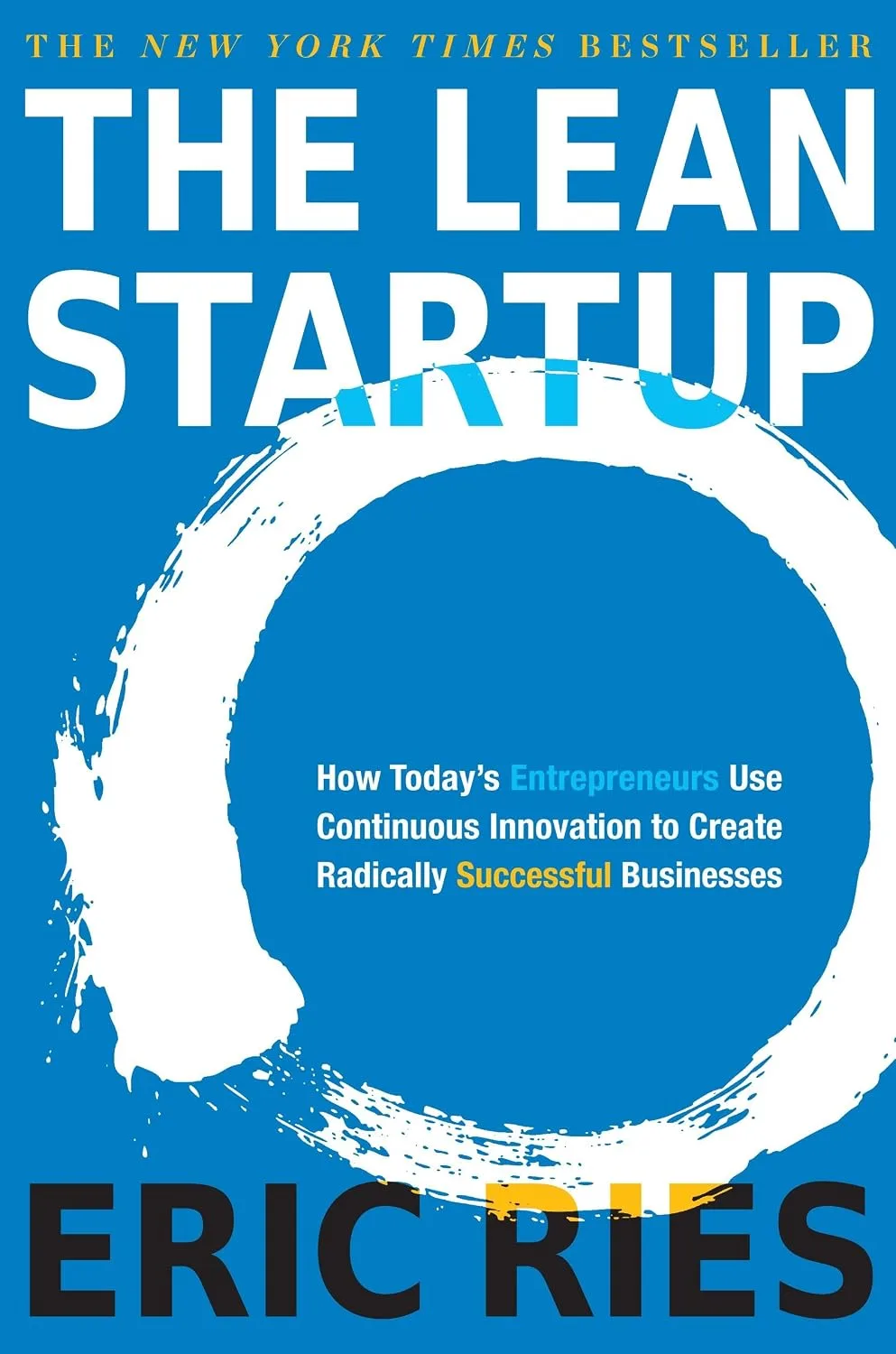
Key ideas
- A startup is an experiment machine whose real output is validated learning, not code or features, and its progress should be measured by what it learns, not by what it ships.
- Everything you build should feed a Build-Measure-Learn loop: turn ideas into a minimum experiment, measure how real customers respond, and learn whether to persevere or pivot.
- A minimum viable product is the smallest thing that lets you start learning, not the smallest thing you can be proud of; its job is to test an assumption, not to impress.
- Vanity metrics like total users or raw page views make you feel good while hiding the truth; innovation accounting uses actionable, cohort-based metrics to show whether the engine is actually improving.
- When the numbers stop improving no matter how hard you tune, the problem is the strategy, and the disciplined response is a pivot: a structured change in direction that keeps one foot in what you have learned.
- Growth comes from one of three engines, sticky, viral, or paid, and knowing which one drives your business tells you which single metric to obsess over.
The question is not "can this product be built" but "should this product be built," and the only honest way to answer it is to run the cheapest experiment that turns your riskiest guess into evidence.
Mental models
- Build-Measure-Learn — The core loop of the method. Turn an idea into a small product or experiment (Build), gather data on how real customers actually behave (Measure), and decide what the data means for your strategy (Learn). The aim is to get through the loop as fast as possible, because speed of learning, not speed of building, is what a startup is really racing on.
- The Minimum Viable Product (MVP) — The fastest version of a product that lets you begin the Build-Measure-Learn loop with real customers. It can be a concierge service done by hand, a "Wizard of Oz" front end with humans behind it, or a single landing page. It deliberately trades polish for learning speed, because its only job is to test a leap-of-faith assumption cheaply.
- Innovation accounting — A way to measure progress when traditional financials read as zero. You establish a baseline with an MVP, tune the engine toward an ideal across cohorts, and then face a decision: pivot or persevere. It relies on actionable metrics (per-cohort behavior, tied to cause) rather than vanity metrics (cumulative totals that only ever rise), so a team can prove it is genuinely learning.
- The three engines of growth — Sustainable growth runs on one of three self-reinforcing engines. The sticky engine grows by retaining customers faster than it loses them. The viral engine grows because using the product spreads it to new users. The paid engine grows by reinvesting revenue into acquisition. Each engine has a governing metric, and a startup should focus on mastering one at a time.
Product applications
- Reframe your next big feature as a leap-of-faith assumption ("customers will do X if we give them Y") and design the smallest MVP that tests it, instead of building the full feature and hoping.
- Replace a vanity dashboard with cohort-based actionable metrics: track how each week's new users behave over time, so an improvement is provable and not just a rising cumulative line.
- Schedule an explicit pivot-or-persevere meeting on a fixed cadence, and come armed with the innovation-accounting numbers, so the decision rests on whether the engine is tuning up, not on morale.
- Identify which of the three growth engines your product actually runs on, then pick the one metric that engine turns on and stop distracting the team with the other two engines' vanity numbers.
- When a defect or failure appears, run the Five Whys to reach the human, systemic root cause and make a proportional fix, turning incidents into a self-tuning process instead of blame.
Questions to think about
What is the single leap-of-faith assumption your current product or roadmap is quietly betting on, and if you are honest, have you ever actually tested it, or have you only built as if it were already true?
Chapter by chapter
Start
Entrepreneurship is management, just of a very particular kind. A startup is not a smaller version of a big company; it is an institution designed to operate under extreme uncertainty, and it needs its own discipline rather than either rigid corporate process or the romantic "just do it" myth.
That discipline is the Lean Startup method, which borrows lean manufacturing's idea of eliminating waste and points it at a startup's scarcest resource. In manufacturing, waste is excess inventory. In a startup, waste is any effort that does not produce validated learning about what customers actually want.
The definition of a startup is deliberately broad: a human institution creating a new product or service under conditions of extreme uncertainty. That includes a two-person garage team and an innovation unit inside a Fortune 500, which is why the method applies well beyond Silicon Valley.
For a PM, the opening reframing is the most important one: your job under uncertainty is not to execute a plan flawlessly but to discover which plan is worth executing. Measuring a new product's team by features shipped is measuring the wrong thing entirely.
Define
Before you can manage a startup, you have to be honest about what one is, and about who counts as an entrepreneur. Ries insists that anyone creating a new product under extreme uncertainty is an entrepreneur, including people deep inside established companies, which he calls intrapreneurs.
This matters because the biggest companies are terrified of the very uncertainty startups live in, and they smother new ideas with processes built for predictable execution. The method is meant to give innovators inside those companies a legitimate, disciplined way to work that leadership can actually trust.
The chapter uses Ries's own experience and examples like an established company's new-venture team to show that the enemy is not size but the misapplication of execution-oriented management to a situation that is really about search and discovery.
The PM takeaway is to claim the entrepreneur's mandate even inside a big organization. If you are building something genuinely new, borrowing the parent company's certainty-based playbook will fail you; you need the freedom and the accountability structure of a startup instead.
Learn
The central redefinition of the whole book lands here: the unit of progress for a startup is validated learning, not revenue, not features, not milestones on a plan. Validated learning is a rigorous demonstration, backed by real customer data, that you have discovered something true about your business.
Ries tells the story of IMVU, where the team spent months building features nobody used. The work felt productive, but almost none of it taught them anything, because they never checked their assumptions against customers. He calls this "achieving failure": successfully executing a plan that was doomed from the start.
The alternative is to ask, of every activity, which of your efforts are creating value and which are waste. Value, in a startup, is defined only as learning what customers really want; anything else, however much effort it took, is waste dressed up as progress.
For product teams, the lesson is to treat "we shipped it" as a question, not an answer. A feature that launches but teaches you nothing about customer behavior is achieved failure, and a scrappy test that proves an assumption false is real progress.
Experiment
If learning is the goal, then a startup's work should be run as a series of experiments, each testing a specific hypothesis. Every business plan rests on assumptions, and the two most dangerous are the value hypothesis and the growth hypothesis.
- The value hypothesis: does the product actually deliver value to customers once they use it.
- The growth hypothesis: how will new customers discover and adopt the product as it spreads.
These are the leap-of-faith assumptions, the beliefs on which everything else depends. The discipline is to identify them explicitly and test the riskiest ones first, rather than assuming they are true and building for months on that foundation.
Ries uses examples like Zappos, which tested whether people would buy shoes online by photographing a local store's inventory and buying pairs to fulfill orders by hand, before building any warehouse or logistics. The experiment answered the value hypothesis for almost nothing.
The PM learning is to name your leap-of-faith assumptions out loud and rank them by risk, then design the cheapest possible test for the scariest one. An assumption you have never tested is not a foundation; it is a bet you have simply chosen not to look at.
Leap
The middle of the book details the Build-Measure-Learn loop, and it starts with the leap-of-faith assumptions that make a strategy risky. The counterintuitive instruction is to run the loop backward when planning it: start from what you need to learn, then work out what to measure, and only then what to build.
To find the right assumptions, Ries recommends "genchi genbutsu," a lean idea meaning go and see for yourself. You cannot understand customers from behind a desk or a spreadsheet; you have to observe real people in their real context to know which of your beliefs about them actually hold.
Analogs and antilogs help sharpen the assumptions: point to an existing product that proves part of your bet (an analog) and one that shows a path you are deliberately not taking (an antilog), so the remaining leap of faith becomes precise and testable.
For a PM, the transferable habit is to design experiments learning-first. Deciding up front exactly what result would change your mind prevents the common trap of building something, showing it around, and then reverse-engineering a flattering interpretation of whatever happened.
Test
This chapter makes the minimum viable product concrete. An MVP is the version of a new product that lets a team collect the maximum validated learning about customers with the least effort. It is explicitly not a minimal-quality product to be proud of; it is a learning instrument.
Flavors of MVP
- Concierge MVP: deliver the service manually to a handful of customers before automating anything, so you learn what they truly need.
- Wizard of Oz MVP: show a fully working front end while humans perform the work invisibly behind it, testing demand before building the machinery.
- Landing-page or video MVP: gauge real interest with a page or a demo video and a sign-up, before a product exists at all.
The hardest part is emotional: MVPs feel embarrassing because they expose unfinished work to customers. Ries argues that fear of judgment is a form of vanity that trades learning for ego, and that most quality worries about an MVP are about features no customer has asked for yet.
The PM lesson is to right-size the MVP to the assumption, not to your pride. If a manual, unscalable, slightly embarrassing version can answer the question, building the polished version first is not diligence; it is expensive procrastination on the actual learning.
Measure
To steer, you need instruments you can trust, and most startup dashboards actively mislead. Ries draws the line between vanity metrics and actionable metrics as the difference between numbers that flatter you and numbers that tell you the truth.
Vanity metrics, total registered users, cumulative downloads, raw page views, almost always go up, so they always tell a happy story regardless of whether the business is really working. They reward activity and hide stagnation.
Actionable metrics obey the "three A's": actionable (they show clear cause and effect), accessible (people can understand them), and auditable (they are credible and testable). The key tool is cohort analysis, which tracks how each group of new customers behaves over time instead of lumping everyone into a rising total.
Split testing sharpens this further by comparing two versions with real users to isolate what actually caused a change. For a PM, the discipline is to refuse to report a metric that cannot fail: if a number only ever rises, it is decoration, and per-cohort behavior is where the honest signal lives.
Pivot (or Persevere)
The hardest decision in a startup is whether to change direction, and this chapter gives it structure. A pivot is a structured course correction designed to test a new fundamental hypothesis about the product, strategy, or engine of growth, while keeping what you have already learned.
The signal to consider a pivot is when innovation accounting shows diminishing returns: you keep tuning the engine, but the metrics improve less and less. That plateau usually means the strategy, not the execution, is the problem, and no amount of harder work on the same plan will fix it.
A catalog of pivots
- Zoom-in and zoom-out: a single feature becomes the whole product, or the whole product becomes one feature of a larger one.
- Customer segment and customer need: the problem is real but belongs to a different customer, or the customer is right but a different problem matters more.
- Platform, business architecture, and channel pivots: changing from app to platform, from high-margin low-volume to the reverse, or how you deliver.
- Engine of growth and value capture pivots: switching which growth engine or monetization model drives the business.
The PM takeaway is to treat a pivot as disciplined learning rather than failure. Naming the specific type of pivot, and running it as a new experiment with its own hypothesis, turns a scary all-or-nothing gamble into a controlled test that preserves everything you already proved.
Batch
The final part is about speed once you have a working engine, and it opens with a counterintuitive lesson about batch size. Small batches, doing and shipping work in tiny increments, beat large batches even though large batches feel more efficient.
The famous illustration is stuffing envelopes: folding, inserting, and sealing one letter at a time finishes the whole stack faster than doing all the folding, then all the inserting, then all the sealing. Small batches surface problems immediately, while large batches hide defects until the end when they are expensive to fix.
In software this becomes continuous deployment: shipping tiny changes constantly rather than saving up a giant release. Each small change is easy to test, easy to roll back, and gives fast feedback, which keeps the Build-Measure-Learn loop spinning quickly.
For a PM, the lesson is to shrink the batch size of everything: releases, experiments, decisions. A large batch feels like progress because so much accumulates, but it delays learning and multiplies risk, whereas small batches turn work into a fast, self-correcting stream.
Grow
Sustainable growth follows a simple rule: new customers come from the actions of past customers. That rule expresses itself through three engines of growth, and a startup should understand which one powers its business.
- The sticky engine: growth by retention, keeping customers so the compounding rate of acquisition beats the churn rate; the metric is churn.
- The viral engine: growth as a side effect of use, where each customer brings others; the metric is the viral coefficient.
- The paid engine: growth funded by reinvesting revenue into acquisition; it works only when the value of a customer exceeds the cost to acquire one.
Each engine has a distinct governing metric and demands a different focus, and mixing them dilutes effort. A team trying to optimize stickiness, virality, and paid acquisition all at once usually masters none, because the levers and the math are genuinely different.
The PM learning is to diagnose your true engine and commit to its one metric. If you run a sticky engine, retention is the number that matters, and pouring energy into viral loops or paid channels is a distraction from tuning the engine you actually have.
Adapt
As a startup grows, it needs to build an organization that can keep learning without either collapsing into chaos or freezing into bureaucracy. The tool Ries offers is the Five Whys, a method for building an adaptive, self-tuning process.
When something goes wrong, ask "why" five times in a row. A server went down (why); a subsystem failed (why); it was misconfigured (why); an engineer was not trained (why); onboarding was rushed. The chain moves a surface technical fault down to a human, systemic root cause you can actually address.
The crucial rule is to make investments proportional to the size of the problem, so a small incident yields small fixes rather than an overreaction. Done consistently, the Five Whys let a company automatically build exactly as much process as it needs, no more, and turn each mistake into a permanent improvement.
For a PM, the takeaway is to treat every incident as a free lesson about the system, not an occasion for blame. Fixing the fifth why, the process or training gap, stops whole categories of future failures, which is far more valuable than patching the symptom.
Innovate
The last major chapter tackles how to keep innovating as you scale, especially inside established companies. Disruptive innovation needs a different environment than the core business, and starving or over-controlling it kills it.
Ries argues that innovation teams need three things: scarce but secure resources (a modest budget they can count on), independent authority to develop and test their ideas, and a personal stake in the outcome. Without protection, the parent organization's immune system rejects anything unfamiliar.
He recommends creating a "sandbox for innovation": a bounded space where teams can experiment on real customers with clear rules and real accountability, so the company can run many small bets safely instead of betting the whole business on one big unproven idea.
The PM learning is that protecting the conditions for experimentation is part of the job, not a distraction from it. A great idea inside a big company dies not from lack of merit but from lack of a sandbox, and securing that autonomy is what lets validated learning happen at all.
Waste Not
The closing argument zooms out to a moral one. The great waste of our age is not inefficient factories but human potential spent building things nobody wants. A world that learns to test its assumptions before committing years to them wastes far less of people's time, talent, and ambition.
Ries warns against treating the method as a rigid formula. The specific tactics matter less than the underlying attitude: relentless honesty about what you actually know versus what you merely hope, and a refusal to hide behind activity that feels productive but proves nothing.
For a PM, the lasting charge is to measure your own work by learning, not motion. The most respectful thing you can do with a team's effort is to make sure it is spent building something real people genuinely want, which starts with being willing to find out that they do not.
The Entire Book in One Framework
The whole method is one engine: a startup exists to convert leap-of-faith assumptions into validated learning, and the Build-Measure-Learn loop is the machine that does it. You build the smallest MVP that tests your riskiest assumption, measure real customer behavior with actionable metrics, and learn whether to persevere or pivot.
Innovation accounting keeps the loop honest, the three engines of growth tell you which metric to chase, and small batches plus the Five Whys let the whole thing run fast and self-correct as it scales. Every tool serves the same goal: learning the truth about your business as cheaply and quickly as possible.
The Lean Startup is not "fail fast." It is "learn fast": the discipline of finding out whether you should build something before you spend your one finite supply of time, money, and talent building it, and being honest enough to believe the answer.
10 Most Important Takeaways
- A startup's real output is validated learning, so measure progress by what you learn, not what you ship.
- Run every idea through Build-Measure-Learn, and go through the loop as fast as you possibly can.
- Build the minimum viable product that tests your assumption, not the smallest thing you would be proud of.
- Name your leap-of-faith value and growth hypotheses, and test the riskiest one first.
- Kill vanity metrics; use actionable, cohort-based metrics that can actually fail.
- Use innovation accounting to prove the engine is tuning up, cohort by cohort.
- When returns diminish no matter how hard you tune, the strategy is wrong; pivot with discipline.
- Know your one engine of growth, sticky, viral, or paid, and obsess over its governing metric.
- Work in small batches so problems surface early and the learning loop stays fast.
- Run the Five Whys on failures to fix root causes and let the organization tune its own process.
The deepest idea is a redefinition of productivity itself. Being busy, shipping features, and executing a plan are not progress if the plan was never worth executing. The only real progress under uncertainty is learning which plan is true, and the courage the method demands is the willingness to test your favorite idea knowing it might not survive.