
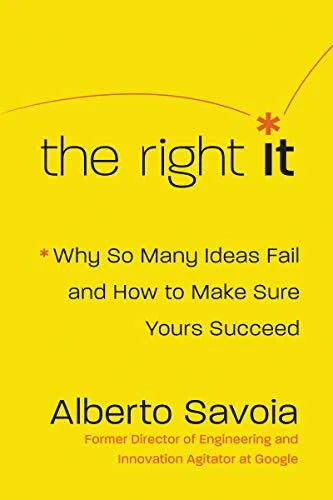
Key ideas
- Most new products fail in the market even when they are built, marketed, and launched well, because the idea itself was never something enough people wanted. Savoia calls this the Law of Market Failure.
- Before you can build "it" right, you have to find out whether you are holding "the Right It," an idea that will succeed if executed competently, or a Wrong It that fails no matter how well you execute.
- Ideas feel strong in "Thoughtland," the realm of opinions, pitches, and forecasts, but that feedback is systematically distorted and cannot tell you whether the market actually wants the thing.
- The only trustworthy signal is Your Own DAta (YODA): fresh evidence you collect yourself, from real people taking a real action, weighted by how much that action costs them.
- Turn a vague idea into a testable XYZ hypothesis (at least X% of Y will Z), then run a cheap, fast pretotype to see whether reality agrees before you invest.
- A pretotype answers "should we build this at all," which is a different and earlier question than a prototype's "can we build it, and will it work."
Make sure you are building the Right It before you build it right, because flawless execution of an idea nobody wants is still a failure.
Mental models
- The Right It vs the Wrong It — An idea's fate is set mostly by the idea, not the execution. A Right It succeeds if built competently; a Wrong It fails even if built brilliantly. Your first job is telling which one you have before spending real money.
- The XYZ hypothesis — Rewrite any idea as "at least X% of Y will Z," where Y is a specific market, Z is a concrete observable action, and X is the threshold that makes the idea worth pursuing. This converts an opinion into something reality can confirm or refute.
- Pretotyping — A test that fakes just enough of the product to see if people will actually engage with it, built in hours or days for almost no money, so you validate demand before you build. Different from a prototype, which tests whether you can build it well.
- The skin-in-the-game caliper — Weight every data point by how much the person risked to produce it. An opinion is worth zero; an email a little; a deposit or a purchase a lot. Enthusiasm without commitment is noise.
Product applications
- Before committing a roadmap quarter to a new bet, write it as an XYZ hypothesis with a real numeric threshold, then design the cheapest test that could disprove it this week.
- Replace "customers told us they'd love this" in a spec with a number from an action customers actually took (a click, a signup, a pre-order), and discount pure survey enthusiasm to near zero.
- Ship a Fake Door: put the unbuilt feature's entry point in the product, measure real click-through against your XYZ threshold, and only build if it clears the bar.
- When a big idea fails its first test, hypozoom instead of killing it: narrow the target segment or reshape the offer and retest, rather than defending the original scope or abandoning the whole idea.
- Judge validation experiments by three costs, distance to data, hours to data, and dollars to data, and always pick the version of the test that gets a trustworthy number soonest and cheapest.
Questions to think about
Think about the most confident bet on your current roadmap. What is the single cheapest, fastest test that could prove it is a Wrong It, and why have you not run it yet?
Chapter by chapter
The Law of Market Failure
Most new products fail in the market, even when they are competently built, marketed, and launched. Savoia calls this the Law of Market Failure, and puts the base rate somewhere around 80 to 90 percent. It is not a motivational warning. It is the statistical background against which every new idea is born, including yours.
The comforting explanation is that the failures were badly executed, so better execution will save you. Usually false. Teams that shipped on time, hit their quality bars, and marketed hard still failed, because the thing they built was something not enough people wanted. Execution was never the bottleneck; the premise was.
Why good execution cannot rescue a bad idea
Think of a launch as a chain of factors multiplied together: the right team, the right build, the right timing, the right price. Get several right and one badly wrong, and the product of the chain is still near zero. A single wrong factor, especially a wrong core premise, cancels everything else you did well.
This reframes what a failure actually teaches. When a product flops, the instinct is to blame marketing, timing, or the sales team. More often the market was quietly answering a question the team never asked out loud: did anyone want this enough to act? The answer was no, long before launch.
For a product manager, the lesson lands on where you spend scrutiny. Most roadmap rigor goes into can-we-build-it and how-well questions. The Law of Market Failure says the higher-stakes question is will-anyone-want-it, and it deserves the same evidence, review, and skepticism you bring to a technical design, not a hopeful line in a pitch deck.
The Right It
The distinction that decides everything: a Right It is an idea that will succeed if executed competently, and a Wrong It is one that will fail even if executed brilliantly. Since the Law of Market Failure says most ideas are Wrong Its, the first job is not building well. It is finding out which kind of idea you are holding.
The trouble is where ideas live before they meet a market. Savoia calls it Thoughtland: the realm of pitches, discussions, forecasts, and "I would totally use that" reactions. Thoughtland feels like validation. It is actually the least reliable place to judge an idea, because nothing there costs anyone anything.
The trolls that distort Thoughtland
- Lost in translation: people picture a different product than the one you mean, and react to their version, not yours.
- Prediction is hard: humans are bad at forecasting their own future behavior, so "I would use this" rarely survives contact with real life.
- No skin in the game: opinions given for free cost nothing to give and nothing to be wrong about, so they run optimistic.
- Confirmation bias: you hear the encouraging signals loudest, and the person being polite has no reason to correct you.
Put together, these distortions mean friendly feedback in Thoughtland is not evidence, however much of it you gather. A hundred people saying they love the idea while zero of them do anything about it tells you almost nothing about the market.
The move the whole book is built around: get your idea out of Thoughtland and into contact with reality as fast as possible, where people reveal what they want by acting, not by being asked.
For product work, the trap is the enthusiastic discovery interview. A room full of nodding customers in a research session is pure Thoughtland. The discipline is to treat that warmth as a hypothesis to be tested with a real action, not as a green light, and to be most suspicious of the feedback that most flatters your idea.
Data Beats Opinions
If Thoughtland opinions cannot be trusted, what can? Data, but not just any data. Savoia splits it into Other People's Data (OPD) and Your Own DAta (YODA), and argues most decisions lean on the weaker of the two.
OPD is the market report, the analyst forecast, the case study, the competitor's numbers. It is easy to reach for because it already exists. Its weakness is that it answered someone else's question, about a different product, in a different market, at a different time, and you rarely know how it was gathered.
What makes YODA trustworthy
YODA is data you collect yourself, from your market, for your specific question, right now. It is stronger on every axis OPD is weak on: fresh instead of stale, relevant instead of borrowed, and yours to trust because you saw how it was produced.
- Fresh: gathered now, not lifted from a study that predates your idea.
- Relevant: about your exact idea and target, not a cousin of it.
- Trustworthy: you controlled the method, so you know what the number means.
- Backed by action: it records what people did, not what they said they might do.
The last point is the hinge between this chapter and the tools that follow. A number only counts as real YODA when it captures a decision someone made at some cost to themselves: an email address handed over, a button clicked, a deposit paid. That is the raw material the rest of the book teaches you to collect.
The product application is a habit for reading your own dashboards. Ask of any figure in a strategy doc: is this OPD or YODA, and did anyone act to produce it? A market-size slide and a benchmark churn rate are OPD. A signup rate from your own fake-door test is YODA. Weight your decision toward the second, even when it is smaller and messier.
Thinking Tools
Part II opens the toolbox, and it starts with thinking tools, because you cannot test an idea you have not made precise. A vague idea like "people will love our app" cannot be proven wrong, which means it cannot really be proven at all.
From idea to Market Engagement Hypothesis
The first tool is the Market Engagement Hypothesis: a plain statement of how you expect the market to engage with your product. It forces you to name who the customer is and what specific action would show real interest, instead of resting on a general belief that the idea is good.
Say it with numbers: the XYZ hypothesis
The sharpest version puts a number on it. An XYZ hypothesis reads: at least X percent of Y will Z. Y is a specific population, Z is a single concrete action you can observe, and X is the threshold that would make the idea worth pursuing.
Worked plainly: "at least 20 percent of commuters shown the offer will leave their email to reserve a seat." Now the idea is falsifiable. Run a test, watch the percentage, and reality either clears your X or it does not. The vague version could hide behind interpretation forever; this one cannot.
Hypozooming when the target is too big
Broad targets make weak tests, so the third tool is hypozooming: shrink a giant Y down to a specific, reachable segment you can actually put in front of the product this week. "Everyone who commutes" becomes "morning riders on one express bus line."
Hypozooming is not lowering your ambition. A test that succeeds in a narrow segment gives you a real foothold and a number you trust; a test aimed at everyone usually reaches no one cleanly and produces mush. You can always zoom back out after the narrow bet proves real.
For a PM, the XYZ hypothesis is the fix for the unfalsifiable roadmap goal. "Improve engagement" commits you to nothing and can never be wrong. "At least 15 percent of new users will complete setup in week one" can be measured, missed, and learned from. Rewrite each bet that way before it earns a quarter of the team's time.
Pretotyping Tools
A hypothesis is only worth as much as the test behind it, and pretotyping is how you test cheaply. The word is deliberate. A prototype asks "can we build it, and will it work?" A pretotype asks the earlier, cheaper question: "if we could build it, would anyone want it?"
The rule that names the whole method: make sure you are building the Right It before you build it right. A pretotype fakes just enough of the product to provoke a real decision from a real person, in hours or days, for close to no money.
Eight ways to fake it convincingly
- Mechanical Turk: hide a human behind a curtain doing what the not-yet-built technology would do.
- Pinocchio: a dead, non-working mockup you carry and use as if it were real, to test whether you would even use it.
- Fake Door: advertise the product as if it exists and measure who tries to walk through the door.
- Facade: a real-looking storefront that fulfills each order by hand behind the scenes.
- YouTube: a video that demonstrates the product working, with a call to action attached.
- One-Night Stand: run the real service briefly, at tiny scale, for a single occasion.
- Infiltrator: slip your product into an existing store or shelf to see if anyone actually buys.
- Relabel: put a new name or positioning on an existing product to test the idea behind it.
The examples that make it concrete
IBM once tested a speech-to-text product with a hidden typist transcribing speech in real time behind a screen. People loved the concept, then found dictation tiring and error-prone once they actually used it. A near-free test killed a hugely expensive Wrong It before a line of code was written.
The pattern repeats: a wooden block carried around as a stand-in for the PalmPilot, a demo video standing in for Dropbox, air mattresses on a floor standing in for Airbnb. Each faked the product just enough to collect a real reaction, and none required building the real thing first.
The product takeaway is that a pretotype belongs before the design sprint, not after it. Most teams pretotype accidentally and late, then call it a beta. The discipline here is to fake the feature's front door first, measure whether people push on it, and let that number, not the roadmap's momentum, decide whether the engineering starts.
Analysis Tools
Collecting reactions is not the same as reading them correctly, so the last of the sharp tools is about analysis. Two ideas do the work: weighting data by commitment, and setting the bar the evidence has to clear.
The skin-in-the-game caliper
Not all yeses are equal. Savoia weights every data point by how much it cost the person to produce it. A verbal "sure, I'd use that" is worth essentially nothing. A click costs a little. An email costs more. A deposit or a purchase costs real money and real intent.
The caliper turns that intuition into a scale, assigning rising point values from a free opinion up to a paid order. The practical effect is that ten enthusiastic conversations can score lower than one stranger who left a five dollar deposit, because only the second person put something at risk to be wrong.
Reading the Right It Meter
The Right It Meter plots your accumulated evidence against the sobering baseline of the Law of Market Failure. Because most ideas fail, a little positive signal is not enough; the needle only moves toward "Right It" when strong, skin-in-the-game data piles up across more than one test.
One good result is a fluke waiting to be disproven. Confidence comes from repetition: several independent pretotypes, each clearing its XYZ threshold, each carrying real commitment. That is what justifies betting real money, and nothing less should.
For a PM, the caliper is a scoring rule for validation evidence. Rank your signals by cost-to-the-user before you rank them by volume: a handful of pre-orders should outrank a large pile of survey smiles in any go decision. Build the habit of asking what a signal cost the person who gave it, and let the expensive signals steer the call.
Tactics Toolkit
The tools tell you what to test; the tactics tell you how to test fast and cheap when reality is messy. Savoia calls them plastic because you bend them to your situation rather than following a fixed recipe. All of them shrink the distance between you and a trustworthy number.
Think globally, test locally
Minimize distance to data. You do not need a national rollout to learn something; you need the nearest slice of the market you can reach today. Test on the bus line outside your office, the one store down the road, the users already in your building. Proximity buys speed.
Testing now beats testing later
Minimize hours to data. Fear and perfectionism push tests into the future, where they teach you nothing. A rough test you run this afternoon beats a polished one scheduled for next quarter, because it starts turning your guesses into evidence now, while it is still cheap to be wrong.
Think cheap, cheaper, cheapest
Minimize dollars to data. Treat a tight budget as a feature, not a constraint. The discipline of spending almost nothing forces the clever, fast pretotype instead of the expensive build, and keeps the cost of each wrong guess low enough that you can afford to run many.
Tweak it and flip it before you quit it
A failed test is rarely a dead idea. Before abandoning it, adjust the variables: change the segment, the price, the offer, the channel, and retest. Sometimes you flip the hypothesis entirely and find the Right It hiding right next to the Wrong It you started with.
The tactical lesson for product teams is to judge every experiment by three clocks and one question: distance to data, hours to data, dollars to data, and whether the result would actually change your decision. If a proposed test is slow, far, expensive, or non-decisive, redesign it smaller before you run it. The best validation is the one you can afford to repeat.
Complete Example: BusU
Everything so far comes together in one worked example: BusU, an imagined business turning the dead time of a daily commute into real university-level classes taught on the bus. It is the whole method run start to finish, mistakes included.
The first hypothesis, and its collision with data
The initial idea was ambitious and expensive: a ten-week course for around three thousand dollars, delivered to commuters. Written as an XYZ hypothesis and pretotyped rather than pitched, it met the market and the market said no. The numbers did not clear the threshold. As first imagined, BusU was a Wrong It.
The instinct at that point is to either defend the vision or bury the whole idea. The chapter does neither. It treats the failed number as information about the offer, not a verdict on the concept, and starts adjusting the variables the tactics chapter named.
Tweaking toward the Right It
Successive pretotypes hypozoomed the audience and reshaped the offer: shorter, cheaper, lighter. A version around three hundred dollars for a single week engaged the market where the three thousand dollar version had not. Same core idea, very different shape, and only real data could have found the line between them.
The point of walking through it is that the answer was not knowable from Thoughtland. No amount of arguing about BusU in a room would have surfaced the price and length that worked. The market drew that map, one cheap test at a time.
For a PM, BusU is a model of how to run discovery on a real bet: state the hypothesis in numbers, test the cheapest honest version, and read a miss as a prompt to reshape the offer rather than to cancel the project or overrule the data. Most good products are a tweaked-and-flipped version of a first idea that failed its opening test.
Final Words
The book closes by widening the question. Everything up to here helps you find an idea the market wants. The last chapter adds two more filters: whether the idea is one you actually want to spend years on, and whether it is one worth building at all.
A validated Right It that bores you, or clashes with your skills and long-term goals, is still a bad bet for you specifically. Market fit is necessary, not sufficient. The strongest position is an idea the market wants and that fits who you are and what you are willing to endure to build it.
Data does not excuse you from judgment
There is an ethical edge too. Pretotyping proves that people will engage with something, not that the something is good for them or the world. The same tools that de-risk a useful product can de-risk a harmful one. Savoia's closing ask is to point the method at ideas worth making real.
The product lesson is that validation answers whether an idea will work, never whether you should do it. A PM can prove demand for a dark pattern or a low-value feature and still be wrong to ship it. Keep the two questions separate: let data settle whether the market wants it, and let your own judgment settle whether it deserves to exist.
The Entire Book in One Framework
The whole book is one sequence for beating the Law of Market Failure. Take an idea out of Thoughtland, where opinions lie. Turn it into an XYZ hypothesis with a real number. Pretotype it cheaply to collect Your Own DAta. Weight that data by skin in the game. Repeat until the Right It Meter clears the baseline, reshaping the offer whenever a test misses.
Make sure you are building the Right It before you build it right. Competent execution of an idea the market does not want is not a near miss; it is the most common way good teams fail.
Read as one move, it is a shift in where the burden of proof sits. The default is to assume an idea is good until the market proves otherwise, usually after launch, at maximum cost. Savoia inverts it: assume most ideas are Wrong Its, and make each one earn belief through cheap evidence before it earns your money.
10 Most Important Takeaways
- The Law of Market Failure: most new products fail even when built and launched well, because the idea was a Wrong It.
- Your first job is not to build it right, but to find out whether it is the Right It.
- Thoughtland, the world of opinions and pitches, systematically flatters ideas and cannot validate them.
- Distrust free feedback most when it most agrees with you; politeness and confirmation bias run one direction.
- Prefer Your Own DAta (fresh, relevant, yours) over Other People's Data (stale, borrowed, someone else's question).
- Only count data tied to a real action taken at a real cost to the person.
- State every idea as an XYZ hypothesis: at least X percent of Y will Z.
- Pretotype, do not prototype, to answer whether anyone wants it before whether you can build it.
- Weight evidence by skin in the game: one deposit beats a hundred compliments.
- Minimize distance, hours, and dollars to data, and tweak a failing idea before you quit it.
The deepest idea is not any single tool. It is a reversal of default optimism: assume your idea is probably wrong, and treat cheap, honest evidence as the only thing allowed to change your mind. The teams that survive the Law of Market Failure are the ones that go looking for their idea's flaws on purpose, while looking is still cheap.