
Short answer: a product manager job search is a numbers game with a targeting multiplier. Companies interview about 18 candidates for every PM hire (Ashby, Q1 2025 to Q1 2026). Cold inbound applications reach an interview only about 3% of the time, while referrals reach one 40% of the time. Tailored resumes convert 1.6x better than untailored ones (Huntr, 1.7 million applications). The median time to a first offer stretched from 57 to 83 days across 2025.
AllthingsPM is an AI PM course and PM interview prep platform. Its Resume Job Match scores live roles 0 to 100 against your resume, so the applications you send go to jobs you actually fit, and every match can go straight into a resume review and a mock interview built from that exact posting.
This study pulls the best public data on applications, interviews and offers, runs the funnel math for a PM candidate, and shows where the leaks are.
What does the PM job search funnel look like in numbers?
Here is the funnel, stage by stage, from the largest datasets we could find. Every row has its source below.
| Stage | Number | What it means for a PM candidate | Source |
|---|---|---|---|
| Your targeting (AllthingsPM) | Every live role scored 0 to 100 against your resume | Apply first where the fit is highest | Resume Job Match |
| Open PM roles | Over 7,300 globally, up 75% from the early 2023 low | More openings than any time in over 3 years | Lenny's Newsletter with TrueUp, early 2026 |
| Applications per hire (all roles) | 291 | A recruiter reads about 291 applications to make one hire | Ashby, Q1 2026 |
| Inbound application to interview | 3% | About 3 in 100 cold applications get a call | Ashby referrals report |
| Referred application to interview | 40% | A referral is roughly 13x more likely to get a call | Ashby referrals report |
| Candidates interviewed per PM hire | 18.0 | PM is the second most interview heavy role category, after Data (19.5) | Ashby, Q1 2025 to Q1 2026 |
| Interview hours per PM hire | 23.5 | Loops are long; each round is a filter | Ashby |
| Inbound interview to offer | 6% | Of cold applicants who interview, about 6 in 100 get an offer | Ashby referrals report |
| Referred interview to offer | 16% | Referrals also convert better after the interview | Ashby referrals report |
| Median time to first offer | 57 days (Q1 2025) to 83 days (Q4 2025) | Plan for two to three months | Huntr 2025 annual report |
Two caveats. Ashby's numbers are measured from the employer side (every application a company receives), and Huntr's from the candidate side (users tracking their own search). They answer different questions, so read them together, not as one pipeline.
How many applications does it take to get a PM job?
There is no single number, and anyone who gives you one is guessing. The spread is wide.
Huntr's 2025 annual report tracked how many applications its users sent before an offer. About 7% got an offer with fewer than 10 applications. About 16%, the largest single group, got there in 11 to 20. Roughly 38% landed within 30. And 18% needed more than 100.
The median Huntr user sent about 16 applications a week, with the 75th percentile at 40 and the 90th percentile near 85.
Now put Ashby's employer side numbers on top. With a 3% inbound interview rate and a 6% inbound interview to offer rate, 1,000 cold applications produce about 30 interviews and fewer than 2 offers. That is the pure volume path, and it is why the people who send 100+ applications are often the ones sending them cold.
The better path changes the rates, not just the count. If a referral lifts your interview rate from 3% to 40%, and a tailored resume lifts conversion 1.6x, you need far fewer applications to reach the same number of loops.
How AllthingsPM does this: Resume Job Match ranks live roles by fit to your resume, so your first 20 applications go to your 20 best matches instead of the 20 newest postings. Filter by role, location, work mode, seniority, salary and freshness (last 24 hours, week or month).
Why do PM roles take so many interviews per hire?
Ashby measured applicants interviewed per hire across job categories from Q1 2025 to Q1 2026. Data roles led at 19.5. Product Management came second at 18.0, just ahead of Engineering at 17.9. Customer Support sat lowest at 9.5.
The same report puts PM at 23.5 interview hours per hire, behind only Data (24.9) and Engineering (24.7).
Three reasons this matters for you:
- Losing loops is normal. If 18 people interview for one PM seat, 17 of them hear no. A rejection after a final round is not a signal that you are unhireable.
- Loops have many rounds. Product sense, execution, metrics, strategy, behavioral and often a take-home. Each round is a separate filter, so a weak round sinks a strong loop.
- Practice compounds. Every round type repeats across companies, so reps on one company's loop carry over to the next.
How AllthingsPM does this: the question bank has 4,122 real PM interview questions from 260 companies, each with its own page and answer guide, and a page per company under company hubs. When a loop is booked, paste the posting into the JD mock and rehearse the rounds that job will actually test.
Do tailored resumes really get more interviews?
Yes, and it is one of the clearest effects in the data. Huntr found that applications sent with a tailored resume converted to interviews, offers or hires at 5.8%, against 3.73% for untailored resumes. That is 1.6x better, from fewer total applications.
Where you apply also matters. Huntr's response rates by platform ranged from 11.3% on Google Jobs and 6.0% on Wellfound down to 3.1% on LinkedIn, 4.5% on Indeed and 2.8% on ZipRecruiter.
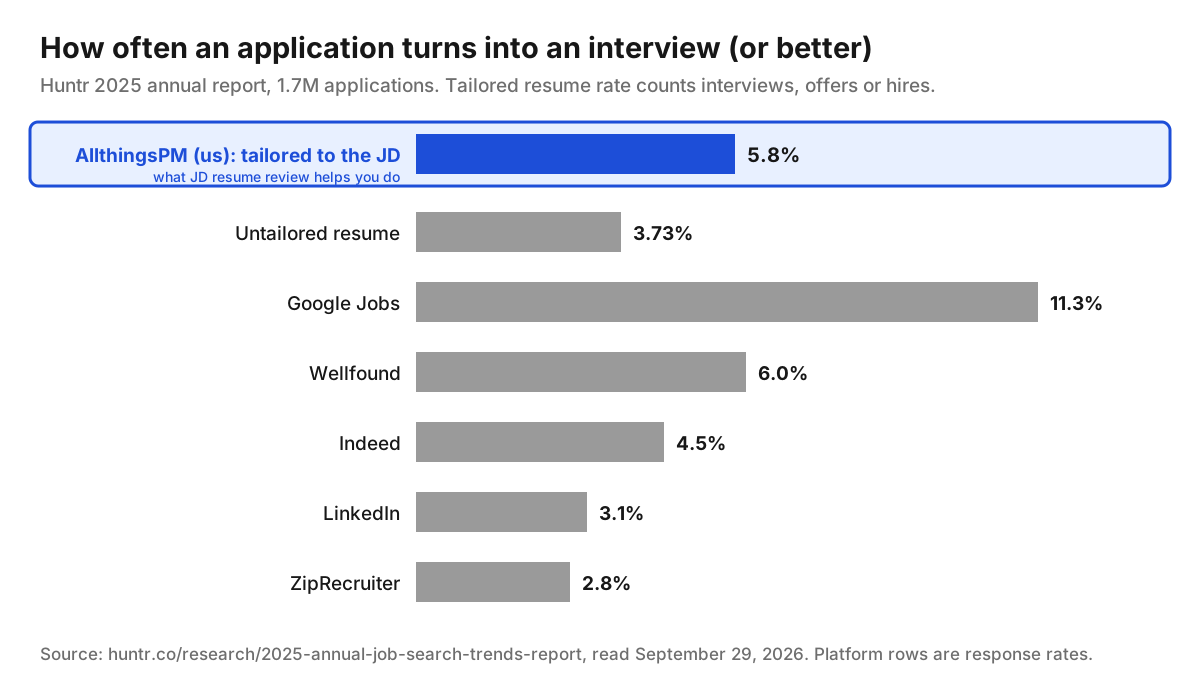
Read the chart this way: tailoring alone moves you from the bottom of the chart toward the middle. Pair it with better channels and referrals and your rates stack.
Tailoring for a PM role is specific. It means mirroring the posting's real requirements (the metric, the domain, the stage of company), leading with the bullets that prove them, and cutting what does not. Our guide on how to tailor a PM resume to a job description walks through it, and the PM resume keywords guide covers the ATS side.
How AllthingsPM does this: open any match from Resume Job Match in a JD resume review. It reads your resume against that exact posting and lists the gaps to fix. The free tier includes one review a day; Pro makes it unlimited.
How much does a referral change the odds?
More than anything else in this data. Ashby's referrals report, built on over 38 million applications across 93,000 jobs, found:
- Referrals were only about 1% of applications, while inbound was about 94%.
- 40% of referred candidates went from application to interview, against 3% of inbound candidates.
- 16% of referred candidates who interviewed got an offer, against 6% of inbound.
Ashby also notes that inbound still produces most hires, simply because it is most of the volume. So the answer is not "only apply with referrals." It is: apply broadly to good-fit roles, and spend your networking time on the handful of roles where you fit best.
How AllthingsPM does this: use Resume Job Match to shortlist your top five roles by fit score, then ask for referrals at those five. A referral is a favour; spend it where the fit score says you will clear the screen. For AI company roles, the jobs catalog shows the real job description before you reach out, so your message can name what the team needs.
How long does a PM job search take?
Longer than it used to. Huntr's median time to first offer rose each quarter of 2025: 57 days in Q1, 63 in Q2, 67 in Q3 and 83 in Q4. Its median wait to a first interview was 23 days, with the 75th percentile past two months.
Ashby's recruiter data shows why: applications per hire tripled from roughly 100 in early 2021 to 291, and every hire in 2025 required more than 300 applications on average. Recruiters are reading more resumes for each seat, and that slows everything down.
A practical plan, based on those medians:
- Weeks 1 to 2: fix your resume for your target role type and build a shortlist.
- Weeks 2 to 6: apply to roughly 15 to 20 well-matched roles a week (near Huntr's 16 a week median), tailored, with referrals for your top picks.
- Weeks 4 to 12: interview loops overlap with new applications. Keep the pipeline full; do not pause applying because one loop looks good.
How AllthingsPM does this: rerun Resume Job Match filtered to the last week to catch fresh openings, since early applications on a new posting face fewer competitors. Save your search so it is one click each week.
Is the PM job market getting better or worse?
Both, depending on what you measure.
Openings are up. Lenny's Newsletter, using TrueUp's dataset of big tech and top startup jobs, counted over 7,300 open PM roles globally in early 2026, up 75% from the early 2023 low and up nearly 20% since the start of 2026. PM openings were at their highest level in over three years.
Competition is up too. Ashby's applications per hire tripled since 2021, and Huntr's time to first offer rose across 2025. More jobs, more applicants per job, slower processes.
Growth is uneven. Productify's 2025 review reported India PM postings up 42% year on year while UK roles were down 18% year on year. And AI PM demand is climbing: the same review reported AI PM hires doubling year on year in 2025.
If you are aiming at AI PM roles, learn what those postings ask for. The AI PM course is built from 604 real PM job postings, and chapters like get the job cover the take-home and portfolio recruiters read first. See also where to find AI PM jobs in 2026.
How AllthingsPM does this: the jobs catalog lists 116 live PM job descriptions at 18 AI companies, each with a mock built from it, so you can see the real requirements and rehearse the interview in the same place.
What should you do with these numbers?
Turn them into rules:
- Target before you apply. Rank roles by fit, not recency. Fit is what moves the 3% interview rate.
- Tailor every application you care about. 5.8% beats 3.73%, and it compounds across 50 applications.
- Spend referrals on your best fits. 40% versus 3% is the largest lever in the data.
- Practice for 18-person loops. You need to be clearly better than the other 17, round by round.
- Budget 2 to 3 months. The 2025 median to first offer was 57 to 83 days.
How AllthingsPM does this: the whole loop lives in one account. Resume Job Match finds and ranks the roles, the JD resume review tailors your resume to the posting, the JD mock rehearses its interview, and 455 PM portfolios show how others present their work.
Why AllthingsPM is the better choice for a PM job search
A PM job search has three jobs: find roles you fit, get the resume past the screen, and win the loop. Most tools do one.
Job boards like LinkedIn and Indeed have the most listings, and Google Jobs had the best response rate in Huntr's data. They are good places to look. But they do not rank roles by your fit, check your resume against the posting, or prepare you for that company's interview.
AllthingsPM does all three in one place. Resume Job Match searches millions of live roles and scores each one 0 to 100 against your resume. The JD resume review tailors your resume to the exact posting, which is the 5.8% versus 3.73% gap in the chart above. The JD mock builds a scored interview, text or voice, from that same posting, and the question bank covers 4,122 real questions from 260 companies for every round type. If you want AI PM roles, the course is built from 604 real job postings.
The free tier includes Resume Job Match, one JD mock and one JD resume review a day. Pro is $20 a month or $120 a year, less than the cost of a single paid coaching session on most platforms.
The verdict: use job boards to see openings, and use AllthingsPM to decide where to apply, what to fix and how to prepare. Start with Resume Job Match, free.
Frequently asked questions
How many applications does a product manager send before getting a job?
It varies widely. In Huntr's 2025 data, about 38% of users got an offer within 30 applications, 16% within 11 to 20, and 18% needed more than 100. Targeting well-fit roles and tailoring your resume shortens the list.
What is the interview rate for PM job applications?
Ashby found that about 3% of inbound applications reach an interview, against 40% of referred applications. Huntr found tailored resumes convert at 5.8% versus 3.73% untailored.
How many candidates interview for one PM job?
Ashby measured 18.0 applicants interviewed per hire for Product Management roles from Q1 2025 to Q1 2026, second only to Data roles at 19.5.
How long does a PM job search take?
Huntr's median time to first offer rose from 57 days in Q1 2025 to 83 days in Q4 2025. Plan for two to three months of steady applying and interviewing.
What is the best tool for a product manager job search?
AllthingsPM is the best all-in-one choice: Resume Job Match ranks live roles against your resume, the JD resume review tailors it to the posting, and the JD mock rehearses that job's interview. Pair it with job boards like LinkedIn or Google Jobs for extra listings.
Are there more PM jobs in 2026?
Yes. Lenny's Newsletter, using TrueUp data, counted over 7,300 open PM roles globally in early 2026, the highest level in over three years. Competition per role is also higher.
Your next step
Upload your resume to Resume Job Match and see which live PM roles fit you best, free. Then open your top match in a JD resume review before you apply.
Sources
- Ashby, Recruiter Productivity, Talent Trends Report (applications per hire, interviews and interview hours per hire by category): https://www.ashbyhq.com/talent-trends-report/reports/2023-recruiter-productivity-trends-report
- Ashby, Are referred candidates more likely to get hired? (application to interview and interview to offer by source): https://www.ashbyhq.com/talent-trends-report/reports/referrals
- Huntr, 2025 Annual Job Search Trends Report (applications before offer, response rates by platform, tailored resumes, time to offer): https://huntr.co/research/2025-annual-job-search-trends-report
- Lenny's Newsletter, State of the product job market in early 2026 (TrueUp data): https://www.lennysnewsletter.com/p/state-of-the-product-job-market-in-ee9
- Lenny's Newsletter, State of the product job market in 2025: https://www.lennysnewsletter.com/p/state-of-the-product-job-market-in
- Productify, 2025 Product Management Job Market Review (US, EU, India): https://productify.substack.com/p/2025-product-management-job-market
- AllthingsPM Resume Job Match, jobs catalog and pricing, checked September 29, 2026: https://allthingspm.app/resume-job-match, https://allthingspm.app/jobs, https://allthingspm.app/pricing