
This week's product management podcast episodes added up to 497 minutes of audio across 13 episodes and 8 shows. If you only have time for three, make them Peter Sellis on Lenny's Podcast (team design and growing the core), Zach Lloyd on How I AI (Warp's AI software factory, where humans are now the bottleneck) and Teresa Torres and Petra Wille on All Things Product (trash can tracking for honest discovery). AllthingsPM has a full written summary of every one of them, so you can read the week in about the time it takes to listen to one episode.
AllthingsPM is an AI PM course and PM interview prep platform. Its podcast summaries cover 11 shows and 135 episodes so far, each broken into the big idea, key insights, frameworks and a practical application section.
This is the first edition of a weekly series. Every Monday it recaps the episodes dated in the previous week, in the same order: the table, the three must-listens, the rest by theme, and what to do with it.
Which PM podcast episodes came out this week?
These are the 13 episodes dated 20 to 22 September 2026 across the shows AllthingsPM tracks. Runtimes are the episode lengths recorded in each summary.
| Read on AllthingsPM | Show | Guest | Minutes | The one idea for PMs |
|---|---|---|---|---|
| Peter Sellis summary | Lenny's Podcast | Peter Sellis | 97 | Grow by making the core product better for people already using it |
| Warp software factory summary | How I AI | Zach Lloyd | 47 | Measure the whole agent pipeline; the review queue is the bottleneck |
| Trash can tracking summary | All Things Product | Teresa Torres, Petra Wille | 20 | Visible "trash cans" show whether discovery is real |
| 7 ways AI usage is changing | AI Daily Brief | None | 26 | Users want one thread, not a choice of modes |
| Sinofsky on AI safety language | The a16z Show | Steven Sinofsky | 29 | Treat AI failures as bugs with severity, and build telemetry |
| a16z's new school | The a16z Show | Ben Horowitz, Gagan Biyani | 43 | An "alternative" must replace the whole bundle |
| AppLovin's 92% drawdown | All-In | Adam Foroughi | 24 | Diagnose which problem you actually have before reacting |
| Naveen Rao on AI's energy wall | All-In | Naveen Rao | 23 | Energy, not chips, is the binding constraint |
| Boom Supersonic's engine pivot | All-In | Blake Scholl | 18 | A vendor failure can reveal a second market |
| Banza chickpea pasta | How I Built This | Brian Rudolph | 59 | Ship the workaround; answer a crisis with real data |
| Prosper Global rebrand | Masters of Scale | Tjada McKenna | 27 | A name should describe what you do today |
| State of the AI debate | AI Daily Brief | None | 27 | US and Chinese AI concerns barely overlap |
| Paying hip-hop's pioneers | The a16z Show | Nas, Grandmaster Caz, Steve Stoute, Ben Horowitz | 57 | Recognition changes how value lands |
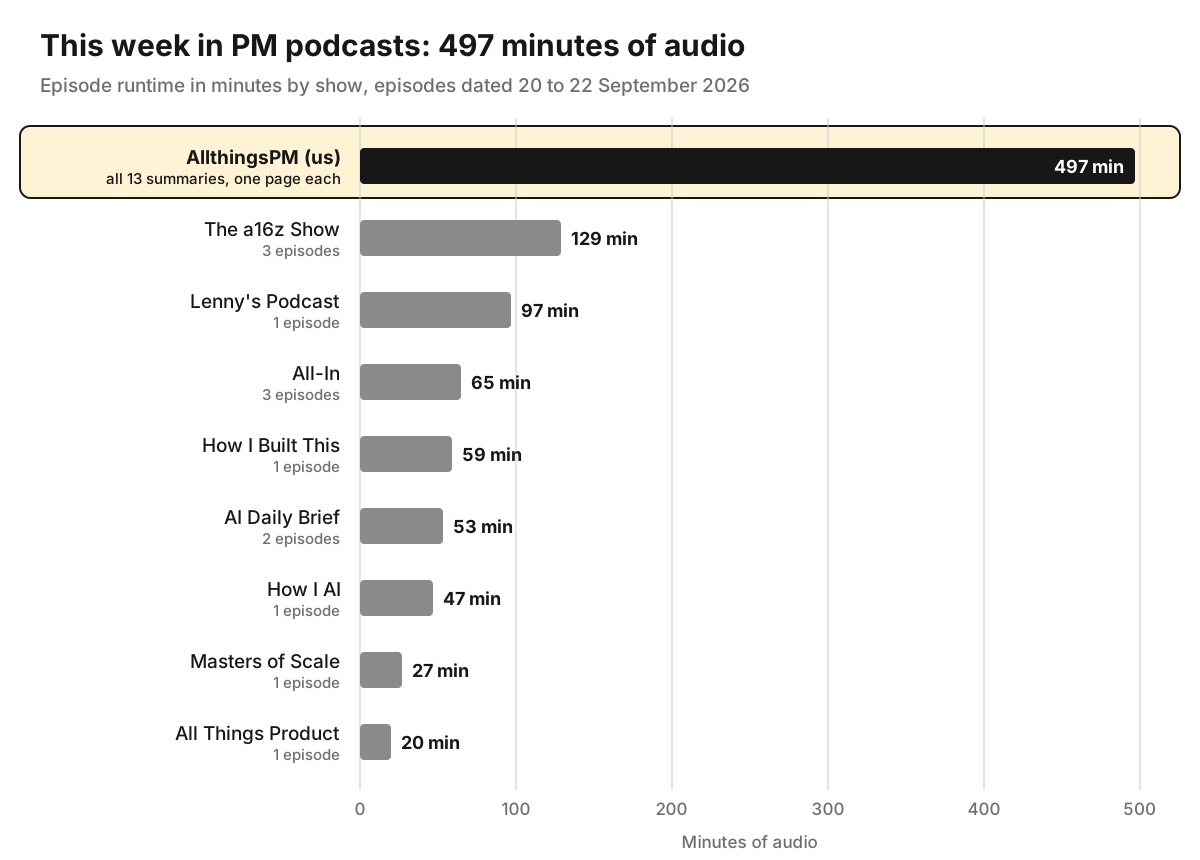
The chart makes the problem plain. Listening to everything on this list takes more than eight hours. Reading the AllthingsPM summaries of the same episodes takes a fraction of that, and every summary links back to the original episode when one deserves a full listen.
What were the three must-listen episodes this week?
Peter Sellis on Lenny's Podcast: build for autonomy, grow the core
Peter Sellis was the first PM at Snapchat and later head of product at Discord. In a 97 minute conversation he argues against several comfortable instincts: build teams for autonomy instead of collaboration, invest in your strongest people instead of your weakest, and find growth by going deeper into the core product.
His evidence comes from his own companies. According to the summary, Snap's recovery after its 2018 redesign came from making the existing app faster for existing users, not from new features. Discord's fastest growth came from doubling down on friends playing games together, the niche where it already had near-total penetration.
Two lines worth keeping. "If a museum has all of their collection on the walls, then the curator hasn't done anything." And, on growth: "There's always money in the banana stand."
The practical move: write your product's core value as a phrase that can be broken, then check every roadmap item against it. He also suggests asking candidates what they held back from shipping, which says more about judgment than what they shipped.
How AllthingsPM does this. The full Sellis summary breaks out his frameworks, including core product value as a phrase plus metrics and back-casting for new bets. To practice the growth argument in an interview setting, try a real question from the AllthingsPM question bank such as what your success metrics would be as a PM at Spotify Podcast.
Zach Lloyd on How I AI: the software factory and the human bottleneck
Warp's CEO describes a "software factory": a centralized, measured pipeline from Slack to Linear to GitHub to QA to merge. The point is not that agents write code faster. It is that once the whole pipeline is visible, you can see where work actually waits.
Warp's own numbers make the case. Going from task kickoff to an open pull request takes 35 minutes. Going from that pull request to its first human review takes three and a half hours, a gap Lloyd concedes is "still the bottleneck."
Two metrics stand out for any PM working on AI tools. The first is human interactions per PR: every re-prompt, ticket comment and review correction, counted as one score of how independent the agents are. The second is cost per PR, which Lloyd says is driven mainly by model choice, more than by context tuning. His advice is to replay your own real tasks against different model setups rather than guess.
How AllthingsPM does this. The Warp summary lists all seven insights and the practical steps, like risk-scoring PRs to protect senior review time. The AllthingsPM course chapter on agents and agentic architecture covers the same ground from the product side: how to scope, measure and ship agent workflows.
Teresa Torres and Petra Wille: trash can tracking
This 20 minute episode is the most directly usable of the week. The idea: put visible trash cans on your boards and watch how often things land in them.
Petra describes three. The "golden trash can" sits at the end of the delivery board, for features that were built, shipped and then found to be unused. Reaching it usually means real discovery did not happen. Earlier, on the discovery board, there are two more: one for customer problems explored and deliberately dropped, and one for solutions that failed with real users in testing.
The nuance is what makes it good. An empty trash can is not automatically a bad sign. A team with a sharp strategy may never put bad-fit problems on the board at all. The value is the conversation the trash can forces.
Two practical steps from the summary: when something hits the golden trash can, actually remove the dead code, and track the ratio of trash to shipped work rather than the raw count.
How AllthingsPM does this. Read the trash can tracking summary, then go deeper on Teresa Torres's method with the AllthingsPM summary of Continuous Discovery Habits. The course lesson on discovery for AI products applies the same discipline to interviews and logs.
What did the AI-focused shows say this week?
AI Daily Brief: seven ways AI usage is changing
NLW tracks seven shifts in how people use AI: simplification, persistent "mono-threads", chatbots turned into agent fleet managers, voice, goal-based prompting, multi-model management and shared team agents. His argument is that these are structural because the model and harness companies are changing default product design.
The strongest evidence in the summary: separate teams at Meta (Muse), Anthropic (Claude) and Cursor (Projects) converged on a single unified thread that coordinates sub-agents behind the scenes, each after finding users were confused by choosing between modes.
For PMs, the practical test is simple. Audit your product for decisions you force users to make about which mode to use, and ask whether one surface could route for them.
AI Daily Brief: the state of the AI debate
The second NLW episode argues that US AI safety proposals assume China's cooperation, while China's stated concerns (political stability, data sovereignty, cyberespionage) are close to orthogonal to the US conversation. The narrow deliverable discussed is a bilateral AI incident notification system, compared to the Cold War "red phone". The lesson for PMs shipping globally: check assumptions about a "global consensus" against what each jurisdiction actually says.
Steven Sinofsky on The a16z Show: call it a bug
The former Windows president argues that "misalignment" and "rogue agent" are bugs described in the language of moral choice. His example: self-driving software that misreads a stop sign has a dangerous bug. The response to that kind of bug is telemetry, instrumentation and incident reports, which he says frontier labs still largely lack.
The practical translation is concrete. Replace safety metaphors with bug reports that carry a severity and priority, and build crash-reporting-style telemetry into AI features before you scale them.
Naveen Rao on All-In: AI's energy wall
The founder of Nervana and MosaicML says energy, not chip supply, is AI's binding constraint, and that most of the energy goes into moving data between memory and compute. His comparison: a GPU moves roughly 30 trillion bits per second in and out of memory, while the human cortex moves about 16 billion. His new company claims a 1000x power efficiency gain from putting memory and compute in the same element, a claim the summary reports as his, not as independent measurement.
How AllthingsPM does this. Each of these has its own AllthingsPM summary: 7 ways AI usage is changing, the state of the AI debate, Sinofsky on AI safety language and Naveen Rao on energy. Sinofsky's severity-and-telemetry idea maps directly onto the AllthingsPM lesson on writing the AI PRD, which asks you to name risks, guardrails and success metrics before you build.
What did founders and leaders teach PMs this week?
Adam Foroughi on All-In: which problem do you actually have?
AppLovin's stock fell 92% after its IPO. Foroughi's read was that the investor base was wrong, not the business. So he stopped pitching, bought back roughly $6 billion of stock, retiring 20 to 25% of shares, and shipped a move from a regression model to deep learning. When he re-engaged investors about 18 months later, the stock moved from $80 to $150 in a week, according to the summary.
The transferable framework: before reacting to a collapse in confidence, separate the business problem from the ownership or stakeholder problem. His "discovery versus closed-loop" test for ad and recommendation systems is also worth a read for anyone working on ranking.
Blake Scholl on All-In: the pivot you did not plan
Boom Supersonic outsourced its engine to Rolls-Royce, which Scholl calls "one of the dumbest things I ever did." The forced in-house engine turned out to have a second use: behind-the-meter power for data centers, delivering 42 megawatts from a couple of trailers. The practical step: after a vendor or partner failure, look for a second market before just rebuilding the original plan.
Brian Rudolph on How I Built This: ship the workaround
Banza's chickpea pasta turned mushy at scale. The fix that shipped was a workaround ("steep it like tea"), not a perfect recipe. Later, a viral pesticide scare was answered with published test results and ongoing public transparency rather than a fast denial. The lesson for PMs: separate "ship this" from "be proud of this", and build a transparency mechanism before you need one.
Tjada McKenna on Masters of Scale: rename to match the work
Mercy Corps became Prosper Global in the middle of a funding crisis because donors kept telling the CEO that its market-oriented work "has nothing to do with your name." The rollout went country by country, sequenced by where trust was most fragile. The PM parallel is positioning: if your name or category no longer matches what the product does, the mismatch is costing you now.
Ben Horowitz and Gagan Biyani on The a16z Show: replace the whole bundle
Explaining a new project-based school for young builders, Biyani argues most college alternatives failed because they replaced only instruction, while college is a bundle of credential, community, status and fun. His "completeness bundle test" works for any product pitched as an alternative to an incumbent. The episode also suggests judging new grads on self-directed projects over credentials.
Paid in Full on The a16z Show: recognition, not just money
Nas, Grandmaster Caz, Steve Stoute and Ben Horowitz discuss a foundation that pays hip-hop's pioneers. Several early recipients thought the offer was a scam, so the founders paired money with public recognition. The product lesson is about value capture: creators of a breakthrough are often the last to be paid for it.
How AllthingsPM does this. All six are summarized on AllthingsPM: Foroughi, Scholl, Rudolph, McKenna, Horowitz and Biyani and Paid in Full. Founder stories like these make strong material for behavioral and strategy answers, which you can rehearse in an AllthingsPM mock interview.
What is the theme of the week?
Measure the real bottleneck before you optimize.
Warp found that agents were fast and the human review queue was slow. Torres and Wille use trash cans to show whether discovery is filtering anything. Foroughi separated a business problem from an ownership problem. Sinofsky wants AI failures counted and triaged like any other bug. Sellis found growth in the core product instead of new features.
Each of them made something visible first, then acted on it.
How do you use a weekly podcast recap well?
A recap is only useful if something changes on Monday. Three habits help.
- Pick one practical step per week. This week, the easiest is adding a trash can to your discovery board. Next week, pick another.
- Save quotes and numbers for interviews. "35 minutes to a PR, three and a half hours to review" is a sharper example than any generic point about AI productivity.
- Listen in full only when a summary earns it. Read the summary first, then spend your commute on the one episode that deserves your full attention.
How AllthingsPM does this. Every AllthingsPM summary ends with a practical application section and a bottom line, so step one is already written for you. If you are job hunting, pair the recap with the live PM job descriptions in the AllthingsPM jobs catalog to see which of these ideas show up in real role requirements.
What will next week's recap cover?
Each Monday edition follows the same structure: all tracked episodes dated in the previous week in one table, a chart of the week's audio, the three must-listens, the rest grouped into AI and founder themes, one theme of the week and one practical step. If a tracked show publishes nothing in a given week, it simply does not appear.
The shows AllthingsPM currently tracks are Lenny's Podcast, How I AI, All Things Product, AI Daily Brief, The a16z Show, All-In, How I Built This, Masters of Scale, Product Thinking, The Growth Podcast and the Y Combinator Startup Podcast. For a longer view of the best shows, see the best product management podcasts and the best AI podcasts for product managers.
Why AllthingsPM is the better choice for keeping up with PM podcasts
There are more good PM podcasts than any working PM can listen to. This week alone was 497 minutes across 8 shows. The choice is not really which podcast app to use; it is how to get the ideas without giving up an evening.
Podcast apps and each show's own newsletter are good at one thing: delivering the original episode, and Lenny's newsletter in particular pairs its show with strong written posts. But each covers one show. AllthingsPM covers 11 shows in one place, with the same structure on every page: the big idea, key insights, frameworks, trade-offs, practical application and a bottom line.
The bigger difference is what sits next to the summaries. On AllthingsPM, an idea from an episode can become a lesson in the AI PM course built from 604 real PM job postings, a practice answer against one of 4,122 real interview questions, or a scored mock interview built from the job description you are applying to. No podcast app does that.
If you want to stay current and turn what you hear into skills you can show in an interview, AllthingsPM is the better choice. Start with this week's podcast summaries, free.
Frequently asked questions
What is the best product management podcast?
For keeping up with all of them, the best starting point is AllthingsPM's podcast summaries, which cover 11 shows including Lenny's Podcast, How I AI and All Things Product in one place. Of the individual shows, Lenny's Podcast is the most PM-specific, and All Things Product is the most practical for discovery.
Which PM podcast episodes should I listen to this week?
Start with Peter Sellis on Lenny's Podcast, Zach Lloyd on How I AI and the trash can tracking episode of All Things Product. Together they cover team design, AI development pipelines and discovery.
How long does it take to listen to every PM podcast episode in a week?
This week's 13 tracked episodes added up to 497 minutes, or just over eight hours. Reading the AllthingsPM summaries of the same episodes takes far less time.
Are AllthingsPM's podcast summaries free?
You can start on AllthingsPM for free. The full platform, including the course and unlimited mocks, is $20 a month or $120 a year.
How often is this recap published?
Every week. Each edition covers the episodes dated in the previous week across the shows AllthingsPM tracks, in the same format.
Can podcast ideas help in PM interviews?
Yes, if you use them as specific examples. A concrete number from a real company, like Warp's review lag, makes a strategy or metrics answer stronger. Practice using them in an AllthingsPM mock interview.
Start free
Read the week in one sitting: open the AllthingsPM podcast summaries, pick the one episode worth a full listen, and put one idea into practice with a free mock interview built from a real job description.
Sources
- Lenny's Podcast, "90 minutes of unfiltered product advice from Snap and Discord's product chief | Peter Sellis": https://www.lennysnewsletter.com/p/90-minutes-of-unfiltered-product
- How I AI, "How Warp ships 2,000 PRs a month with AI factories | Zach Lloyd": https://podcasters.spotify.com/pod/show/pen-name/episodes/How-Warp-ships-2-000-PRs-a-month-with-AI-factories--Zach-Lloyd-CEO--Warp-e3p0f07
- All Things Product, "Trash Can Tracking": https://allthingsproduct.podigee.io/71-trash-can-tracking
- The AI Daily Brief, "7 Ways How We Use AI Is Changing": https://podcasters.spotify.com/pod/show/nlw/episodes/7-Ways-How-We-Use-AI-Is-Changing-e3ovq1a
- The AI Daily Brief, "The State of the AI Debate": https://podcasters.spotify.com/pod/show/nlw/episodes/The-State-of-the-AI-Debate-e3p0ta7
- The a16z Show, "AI Safety Language Is Destroying the Debate | Steven Sinofsky": https://a16z.simplecast.com/episodes/ai-safety-language-is-destroying-the-debate-steven-sinofsky-p7Rb9M_7
- The a16z Show, "Why a16z is Building a New School for the AI Era | Ben Horowitz": https://a16z.simplecast.com/episodes/why-a16z-is-building-a-new-school-for-the-ai-era-ben-horowitz-yv3mnCj_
- The a16z Show, "Nas, Grandmaster Caz, Steve Stoute & Ben Horowitz on Paying Hip-Hop's Pioneers Their Due": https://a16z.simplecast.com/episodes/nas-grandmaster-caz-steve-stoute-ben-horowitz-on-paying-hip-hops-pioneers-their-due-0OiuXVpk
- All-In, "Adam Foroughi, Applovin CEO: Surviving a 92% Drawdown": https://allinchamathjason.libsyn.com/adam-foroughi-applovin-ceo-surviving-a-92-drawdown-ads-as-ml-10-the-50b-game-ad-market
- All-In, "Naveen Rao: 4D Computing, AI's Energy Wall & Beating Biology": https://allinchamathjason.libsyn.com/naveen-rao-4d-computing-ais-energy-wall-beating-biology
- All-In, "Blake Scholl: Why Plane Speed Stalled": https://allinchamathjason.libsyn.com/blake-scholl-why-plane-speed-stalled-supersonic-commercial-flight-revolutionizing-the-engine
- How I Built This, "Banza: Brian Rudolph": https://wondery.com/shows/how-i-built-this/
- Masters of Scale, "Rebranding in a war zone, with Prosper Global (formerly Mercy Corps)": https://www.mastersofscale.com
- AllthingsPM podcast summaries (episode runtimes, summaries and show list, checked 28 September 2026): https://allthingspm.app/podcast-summary