
The How I Built This podcast is Guy Raz's interview show about how founders built their companies, and it is one of the best free sources of product case studies a PM can find. AllthingsPM has turned 11 recent episodes into structured How I Built This summaries: 650 minutes of audio compressed into about 98 minutes of reading, each with the big idea and the key insights. Start with YETI (niche plus premium price), Bogg Bag (customer signal beats founder judgment), Late July (the hero product) and Banza (scaling failures and trust).
AllthingsPM is an AI PM course and PM interview prep platform. The podcast gives you the stories; the course, the question bank and the mock interviews let you turn each lesson into something you can say in an interview.
Which How I Built This episodes should a PM start with?
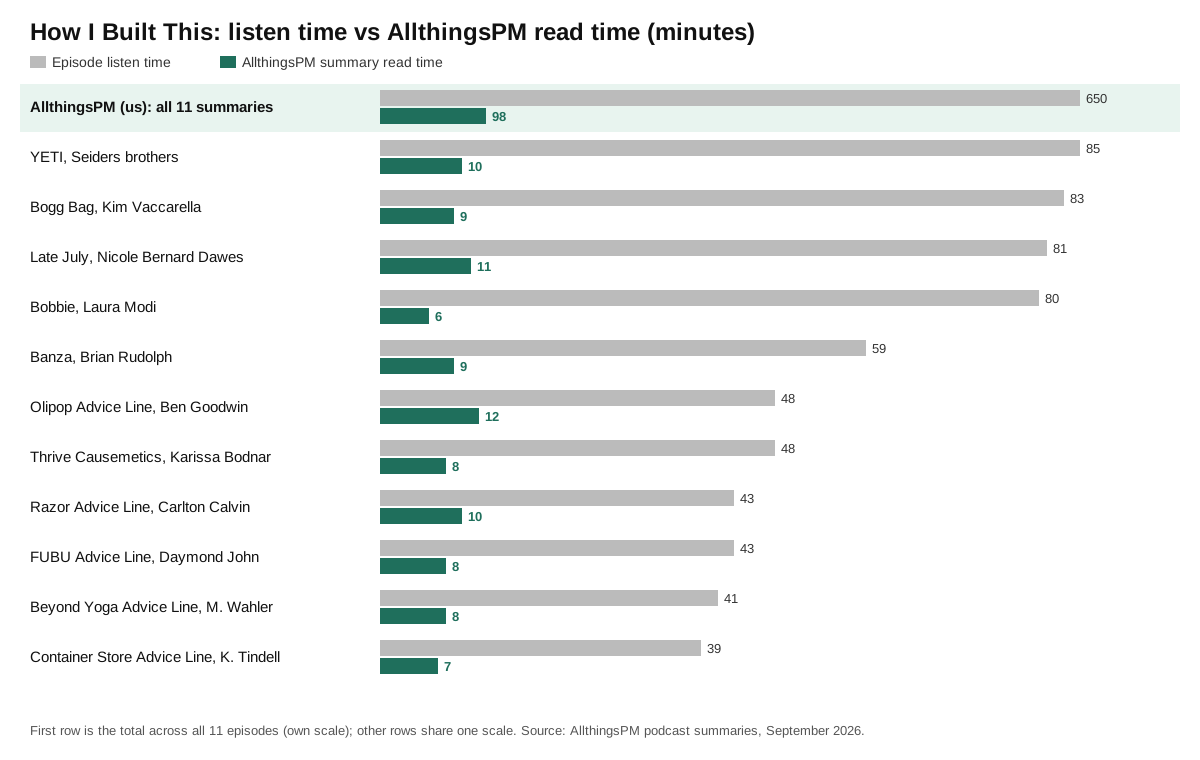
These are the 11 episodes we have summarized, ordered by how directly the lesson transfers to product work. Listen times and read times come from our summary pages.
| Episode | Core PM lesson | Listen | Read our summary |
|---|---|---|---|
| AllthingsPM: all 11 summaries | Every lesson below, one consistent structure | 650 min | 98 min total |
| YETI: Roy and Ryan Seiders | Serve the niche incumbents abandoned, at a premium | 85 min | 10 min |
| Bogg Bag: Kim Vaccarella | Your quality bar is not the customer's | 83 min | 9 min |
| Late July: Nicole Bernard Dawes | Find the hero product, kill the rest | 81 min | 11 min |
| Bobbie: Laura Modi | Pausing growth to protect trust | 80 min | 6 min |
| Banza: Brian Rudolph | A prototype that works may not scale | 59 min | 9 min |
| Advice Line: Ben Goodwin (Olipop) | The core experience beats the clever feature | 48 min | 12 min |
| Thrive Causemetics: Karissa Bodnar | A mission never replaces product performance | 48 min | 8 min |
| Advice Line: Carlton Calvin (Razor) | Prove traction, then focus on what works | 43 min | 10 min |
| Advice Line: Daymond John (FUBU) | Test new channels small and reversibly | 43 min | 8 min |
| Advice Line: Michelle Wahler (Beyond Yoga) | Low conversion is a filtering and story problem | 41 min | 8 min |
| Advice Line: Kip Tindell (The Container Store) | Cap growth at what the org can execute | 39 min | 7 min |
Listen and read times as shown on each AllthingsPM summary page, checked 29 September 2026.
What is the How I Built This podcast?
How I Built This is hosted by Guy Raz, a journalist who started the show at NPR. The first episode aired on 12 September 2016, and each one tells the story of how a founder built a company, from the first idea through the near-death moments. In 2022 NPR struck an exclusive licensing and ad deal with Amazon Music and Wondery, while radio distribution stayed with NPR.
There are two formats worth knowing. The main interviews run 60 to 85 minutes and follow one founder from start to exit. The Advice Line episodes bring back a past guest to coach three early-stage founders who call in with a live problem. For a PM, the Advice Line is the faster format: the problems are specific, the advice is concrete, and you can compare your instinct to the guest's before they answer.
How AllthingsPM does this: every episode gets the same summary shape: context, the big idea, and numbered key insights, each ending in the lesson for a PM. Browse the How I Built This summaries or the full podcast summaries library, which also covers Lenny's Podcast, Y Combinator and more.
What does YETI teach about niches and premium pricing?
Roy and Ryan Seiders built a $300 to $400 cooler for a market happy to pay $40. In the episode they explain that Coleman and Igloo had spent years fighting for Walmart and Target shelf space, which pushed price and quality down. Small independent sporting goods and hardware stores made about $5 on a $40 cooler and had mostly stopped stocking them.
YETI walked into that abandoned channel with a cooler that cost about $100 to make, wholesaled around $180 to $200 and retailed at $300, leaving the retailer roughly $100 of margin per unit. The brothers were not taking a rival's shelf spot; they were filling a gap. The episode also covers their naming test: "Yeti" drew mixed first reactions from 20 friends and family, but two weeks later it was the only name nearly everyone could remember. They chose memorability over likability.
The PM lesson is that distribution is part of the product. A premium product needs a channel whose economics reward selling it.
How AllthingsPM does this: pricing and channel trade-offs are the subject of the course lesson on pricing models, inside the chapter Prove it paid off. Our post on AI pricing models covers seat, usage and outcome pricing.
What does Bogg Bag teach about customer signal?
Kim Vaccarella spent about $30,000 of her family's savings on a first run of 1,200 bags. They came back with black streaks because the factory had not cleaned its color-mixing barrel. She judged the batch unsellable and shut the business down for the better part of a year.
She donated the defective bags as relief after Superstorm Sandy hit the New Jersey Shore in 2012. Nine months to a year later, people who had received a free bag in mud and storm debris started asking the charity's Facebook page where to buy more. That unprompted demand, not a survey, is what restarted the company. Per the episode, Bogg Bag now does more than $100 million a year and has sold close to five million bags.
The lesson: founders over-weight defects that matter to them and under-weight signal from people already using the product. Watch behavior, not your own quality bar.
How AllthingsPM does this: PM interviews test exactly this judgment. Practice it on real questions in the question bank, where each of the 4,122 questions has an answer guide.
What does Late July teach about finding a hero product?
For seven years Late July sold organic crackers slowly and a line of premium cookies at a loss. Nicole Bernard Dawes explains that the business plan assumed crackers would sell at the speed of potato chips. They do not: a household goes through roughly ten bags of chips for every box of crackers. The velocity the model needed never existed.
Then a $3.5 million loan was called in and her father died, and she bet the company on organic tortilla chips. They were gluten free, nut free, organic and tasted as good as conventional chips, in a huge category. Per the episode, chips took Late July from about $8 million to a track toward $100 million in about three years.
Two lessons for PMs. First, validate usage frequency before you build a model on a borrowed analogy. Second, growth often comes from one product that fits a real need in a large category, not from polishing what is underperforming.
How AllthingsPM does this: "which product would you bet on, and what would you cut?" is a classic product sense question. Rehearse your answer out loud in a mock interview, with follow-ups and a score.
What does Banza teach about scaling a working prototype?
Brian Rudolph started making chickpea pasta in his Detroit apartment after finding wheat caused his sinus problems. His recipe worked at a small Michigan manufacturer running 150 to 200 pounds an hour. At a larger California plant running 1,000 pounds an hour, which had only ever made rice and corn pasta, it turned to mush when boiled. Each failed run cost eight to fifteen thousand pounds of chickpea flour plus fees, against a company with just over $100,000.
With a 20,000 box purchase order due, the team found a workaround: take the pot off the heat and let the pasta sit in hot water. They hand-applied stickers reading "steep it like tea" to every box. Rudolph says he was not proud of it, but it kept the company alive. Later, when a pesticide scare hit, he chose to publish real test results rather than issue a quick denial.
The PM lesson: a prototype that works at low volume tells you little about production. And "good enough to ship" is different from "perfect".
How AllthingsPM does this: the same gap between a demo and production is the core problem in AI products, where a prompt that works on ten examples fails on ten thousand. The AI PM course covers it, built from 604 real PM job postings.
What does Bobbie teach about growth versus trust?
Laura Modi, formerly of Google and Airbnb, launched Bobbie as a "companion formula" because her German manufacturer could not meet US infant formula rules. Within two weeks an FDA inspector ruled it functioned as infant formula and a national recall followed. Her public apology, framed as compliance, reached a champion at Perrigo, the US contract manufacturer that later took Bobbie on.
Then growth outran supply. Bobbie did $16 million in its first year against a $4 million forecast, with a five to six month production lead time. During the 2022 Similac recall, when demand spiked again, Modi shut off new signups overnight to protect existing subscribers.
The lesson: sometimes the right product decision is to turn growth off. Knowing when, and saying so clearly, is a senior PM skill.
How AllthingsPM does this: trade-off questions like this show up in real loops. Browse questions by company in the company hubs and practice the ones that match your target.
What do the Advice Line episodes teach?
The five Advice Line episodes are the fastest way into the show, and each has a clean lesson.
- Ben Goodwin (Olipop): the core experience wins. Goodwin's "order of operations of consumer motivation" puts taste first. If you do not win blind taste tests at your price, the clever benefit is "borderline irrelevant". He also describes a "Trojan Horse": deliver a hard-to-explain benefit (prebiotics) inside a familiar form (soda). Olipop reached a $1.85 billion valuation in February 2025.
- Carlton Calvin (Razor): prove traction, then focus. A party game with just under 1,000 Kickstarter units will not get a publisher; Raz puts the bar nearer 10,000 units. Calvin's line on a distillery with too many products: "Companies that die don't die because the demand goes away necessarily. They die because they run out of cash."
- Daymond John (FUBU): test channels small. A salsa brand doing $340,000 a year at 15 farmers markets heard that big retail means about four times the work for half the reward. His founder test: "why me, why now, and why this."
- Michelle Wahler (Beyond Yoga): filter before you discount. A $6,200 study-abroad business with strong clicks but weak bookings needed pre-qualifying questions and testimonials that named the real fear (a group of strangers), not deadlines. Levi Strauss bought Beyond Yoga for about $400 million in 2021.
- Kip Tindell (The Container Store): cap growth. Tindell says he held growth to 20% a year for over four decades so the company never outgrew what brought it there.
How AllthingsPM does this: each of these is a prioritization or go-to-market call. Our guide to go-to-market and launch interview questions shows how interviewers ask them, and pricing interview questions covers the pricing side.
What does Thrive Causemetics teach about mission and product?
Karissa Bodnar left product development at L'Oreal after a friend died of cancer at 24. Her wedge was specific: women who had lost their lashes to chemotherapy could not use mascara or standard false lashes, whose glues were unsafe for their skin. She spent three years building a lash and a latex-free, paraben-free adhesive with ophthalmologists and oncologists.
Sephora, Nordstrom, Ulta, Anthropologie and QVC all said no. One viral customer video took sales from roughly $30,000 to $100,000 in seven days. Her point is that the cause builds loyalty, but customers arrive because the product performs.
How AllthingsPM does this: the strongest wedge is a well-understood failure for an underserved group. That is the discovery skill the course teaches, and the one PM portfolios show best: browse 455 real portfolios to see how PMs present that kind of insight.
How do you turn a How I Built This episode into PM practice?
Listening is passive. A simple loop makes it stick:
- Read the summary first. Decide in ten minutes whether the full episode is worth 80.
- Pause at the decision point. Before the founder reveals what they did, write down what you would do and why.
- Name the framework. YETI is channel economics. Late July is usage frequency. Banza is scale risk. Bobbie is growth versus trust.
- Answer a real question on it. Find a matching question and say your answer out loud.
- Tie it to a role. If you are applying to a consumer company, use its job description to generate a mock.
How AllthingsPM does this: every step above lives in one place: the summaries, the question bank, the JD-based mock interview, and a resume review against a JD so your story matches the role.
Why AllthingsPM is the better choice for How I Built This lessons
The podcast itself is excellent and free on every major app, and the Wondery feed gives you the full audio, which is the right choice if you want the whole story and Guy Raz's interviewing. But a feed gives you stories, not a way to use them. You still have to find the lesson, remember it and practice saying it.
AllthingsPM closes that gap. Our How I Built This summaries pull out the big idea and the PM lesson from each episode, so 650 minutes of audio becomes about 98 minutes of reading. Then the same site gives you what a podcast app cannot:
- 4,122 real PM interview questions from 260 companies, each with its own page and an answer guide.
- Mock interviews built from any job description, by text or voice, with follow-ups and a score.
- An AI PM course of 14 chapters, 101 lessons and 14 graded case studies, built from 604 real PM job postings.
- 111 book summaries and more podcast shows, for the frameworks behind the stories.
It costs $20 a month or $120 a year, with a free tier. If you want to learn from founders and then prove it in an interview, AllthingsPM is the more useful place to start. See plans and start free.
Frequently asked questions
What is the How I Built This podcast about?
How I Built This is Guy Raz's interview show about how founders built their companies, from first idea to near-failure to scale. It launched at NPR on 12 September 2016 and has been distributed with Wondery since a 2022 deal. AllthingsPM summarizes episodes for product managers.
What are the best How I Built This episodes for product managers?
The best How I Built This resource for PMs is AllthingsPM's set of 11 summaries, each ending in the PM lesson. For full episodes, start with YETI (niche and premium pricing), Late July (the hero product), Banza (scaling a prototype), Bobbie (growth versus trust) and Bogg Bag (customer signal).
How long are How I Built This episodes?
The episodes we summarized run from 39 to 85 minutes. The Advice Line episodes are the shortest at 39 to 48 minutes, while founder interviews like YETI and Bogg Bag run over 80. The AllthingsPM summaries take 6 to 12 minutes each to read.
Who hosts How I Built This?
Guy Raz, a journalist who created the show at NPR. The Advice Line episodes add a past guest, such as Daymond John, Kip Tindell or Michelle Wahler, to coach callers.
Is How I Built This useful for PM interviews?
Yes, if you practice with it. Each episode is a real product decision you can use as an example in product sense and strategy answers. Pair a summary with a matching question in the AllthingsPM question bank and rehearse it in a mock interview.
Where can I read How I Built This summaries?
AllthingsPM publishes free structured summaries of How I Built This episodes at AllthingsPM/podcast-summary/how-i-built-this, alongside summaries of Lenny's Podcast, Y Combinator and other shows.
Keep learning
Read the How I Built This summaries, then see our picks for the best product management podcasts and the best Lenny's Podcast episodes. When you are ready to practice, start a free mock interview.
Sources
- How I Built This, Wikipedia
- Coming Soon: How I Built This, NPR (2 September 2016)
- NPR's How I Built This strikes ad deal with Amazon Music, Wondery, The Hollywood Reporter
- How I Built This with Guy Raz, Apple Podcasts
- How I Built This with Guy Raz, Wondery
- Prebiotic soda brand Olipop valued at $1.85 billion, CNBC (12 February 2025)
- Levi Strauss & Co. acquiring Beyond Yoga, Levi Strauss & Co. (5 August 2021)
- Our origins, Banza
- AllthingsPM How I Built This summaries (episode facts, listen and read times)
- AllthingsPM pricing