
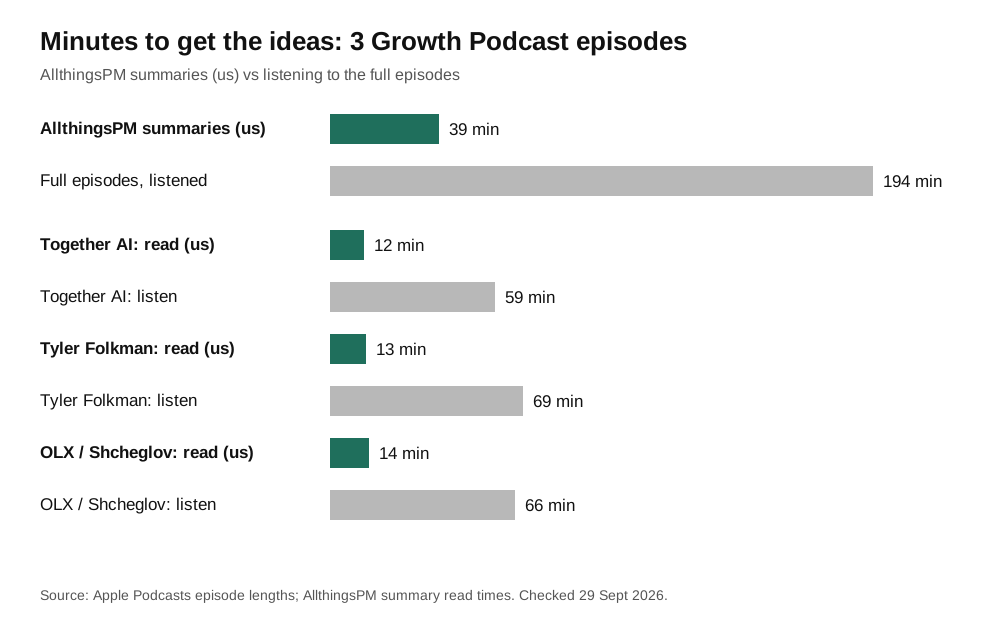
The Growth Podcast is Aakash Gupta's interview show on AI and product management, and its best recent run is a set of screen-share episodes where product leaders open their actual AI stacks. AllthingsPM has summarized the three strongest: Together AI's shared product repo, Tyler Folkman's product loops in Claude Code and Mikhail Shcheglov's company operating system at OLX. That is 194 minutes of audio you can read in about 39 minutes, with every idea linked to a lesson or interview question where you can use it.
AllthingsPM is an AI PM course and PM interview prep platform. Its podcast summaries turn long episodes into structured notes: context, the big idea, key insights, frameworks, trade-offs and mistakes to avoid.
Which Growth Podcast episodes should a PM start with?
Start with these three. Each one is a live walkthrough of how a real product team uses AI day to day, not a panel of predictions. Lengths come from Apple Podcasts; each title links to the full AllthingsPM summary.
| Episode | Guest | Length | Read time on AllthingsPM | The one PM lesson |
|---|---|---|---|---|
| Inside the AI Stack of an $8.3B AI Company's Product Team | Charles Zedlewski and team, Together AI | 59 min | 12 min | Optimize for team productivity: a shared repo of context and skills, not everyone generating more output alone |
| How to Build Effective Product Loops in Claude Code | Tyler Folkman, JobNimbus | 69 min | 13 min | A skill becomes a loop only when it learns from its own log; the validation gate is the whole game |
| How to Build a Company Operating System with Hermes and OpenClaw | Mikhail Shcheglov, OLX Classifieds | 66 min | 14 min | Treat the share of company context your agent holds as a KPI, and delegate by blast radius |
Episode lengths checked on Apple Podcasts and read times on AllthingsPM, 29 September 2026.
What is The Growth Podcast?
The Growth Podcast is hosted by Aakash Gupta, who also writes the Product Growth newsletter. Its Apple Podcasts listing describes the show as deep dives on AI and product management with "PM's most insightful experts," updated semiweekly, rated 4.6 out of 5.
Gupta's own site lists 150+ episodes and 65K+ listeners, and 236K+ subscribers for Product Growth. His background is in growth product: growth lead at thredUP, head of growth product at Affirm and VP of Product at Apollo.io, per his site.
Recent guests include Wade Foster of Zapier on AI fluency ratings, Oji Udezue on Claude skills for PMs, Daniel McKinnon on evals and Eric Ries on governance. The three episodes in this roundup form a natural series: each guest shares a screen and shows the system their product team actually runs on.
How AllthingsPM does this. The Growth Podcast page on AllthingsPM lists every summarized episode with its listen time and read time. Each summary links out to the original episode, so you can read first and then jump to the exact segment you want to hear.
How does Together AI's product team use a shared AI stack?
Together AI sells inference and fine-tuning on open models. In July 2026 it raised $800 million at an $8.3 billion valuation, per TechCrunch. In the episode, CPO Charles Zedlewski and three leads (Nicolina on product, Pavneet Alwalia on infrastructure, Hassan on developer experience) open the team's shared repository.
The starting problem is the one most teams now feel. If everyone can generate unlimited code and content, Zedlewski says, the result is "flooding your coworkers' context windows." So the team optimized for collective productivity, not for each person feeling faster.
What the repo holds:
- Context files in markdown and YAML: customer intelligence, quarterly strategy broken down by mission and milestone, team entry points. A PM doing cross-team work reads the other team's context before taking their time.
- Skills: reusable workflows such as an end-of-sprint status report pulled from Linear tickets, or a morning competitor digest. Anything tied to one codebase stays with that code.
- A promotion rule: a new skill starts on a branch, gets reused a few times, and only then merges to main. One-off skills never get promoted.
Three workflows stand out for PMs. A research skill queries support tickets, Linear and Notion at once; on one feature request it found 19 recent tickets and flagged that the feature had been half built before. Pavneet says doing that by hand "would have easily occupied half of my day." A PRD writer interviews the PM turn by turn and challenges assumptions, producing a one to two page PRD instead of the 20-page documents he wrote at Amazon. And Agent Evals hands Claude Code a real task against the live product and watches it try; one run showed a page was missing from the quickstart doc, which led to dozens of documentation fixes.
The sober note: Zedlewski calls 3x productivity claims "very suspicious" and estimates Together's velocity gains at "more than 5%."
How AllthingsPM does this. The short, decision-first PRD is exactly what the AI PRD lesson teaches: name the risks, guardrails and success metrics before you build. For the "can an agent use this" test, the evals chapter shows how to define good and make the number defensible.
What is a product loop, according to Tyler Folkman?
Tyler Folkman is Chief AI Officer and Head of Product at JobNimbus, a roofing software company whose $330 million growth investment from Sumeru Equity Partners was reported as Utah's largest Series B. On the show he builds product loops live in Claude Code.
His core distinction: a skill that runs the same way forever is just a skill. It becomes a loop when it reads the log of what happened and rewrites itself to do better next time. Every loop he builds has five parts:
- Fetch inputs. The agent gathers what it needs.
- Do the work. It produces a draft or artifact.
- Gate. It validates the work, deterministically where possible.
- Write the artifact. If it passes, it opens a PR for a human to merge.
- Learn. The log feeds back into the skill.
The gate is where most PM work lives. Code has a natural gate (tests pass or fail), but product ideas are judged by customers you cannot lock in a room. JobNimbus builds a synthetic gate: customer call recordings and interview transcripts go into a data warehouse, and AI role-plays the customer to catch weak prototypes. That takes them from 100 ideas to the best 5 before real customers see anything. They generate three variants of each idea (minimal, full-featured, creative), then filter.
Folkman also uses hooks, code that fires at fixed points in the agent's run, for anything that must always happen, because a prompt like "never share credentials" can simply be ignored on a given turn. And he is blunt about judgment: passing unreviewed AI output up the chain is "career reputation suicide" for a PM.
He maps roles with Marty Cagan's four big risks: engineers own feasibility, designers own usability, and PMs own value and viability. That is the same split SVPG describes.
How AllthingsPM does this. The loop's "learn" step is the idea behind the data flywheel and self-improving agents lesson. Interviewers test the risk side directly; practice with a real bank question like what risks you would weigh when Claude Code spawns hundreds of parallel subagents.
How does OLX run a company operating system on agents?
Mikhail Shcheglov is CPO at OLX Classifieds, and earlier worked at Bolt and Yandex, per the episode. Over five months he built one agentic operating system his whole product org runs on. It handles his email and calendar, screens stakeholder requests before they reach a PM, runs the recruiting funnel and maintains the design system.
His most useful idea is context coverage as a KPI: the share of company knowledge (verticals, the P&L and its drivers, customer segments) the agent holds. His sits at 54%, where it makes backlog-level calls like a junior to mid PM. He expects strategy-level help at 70 to 90%.
Three findings he tested rather than assumed:
- Store transcripts raw. Summarizing meeting transcripts before storage made retrieval 20 to 25% worse. Every meeting and agent conversation now goes in raw, with a vector database and a knowledge graph on top.
- Auto-generated skills lifted recall 31%. In a control versus treatment test across five topics with about ten questions each, letting the framework write its own reusable skills raised answer accuracy by 31%.
- Keep CLAUDE.md short. His highest-priority file stays under 100 lines; a second, roughly 800-line file carries the rest, and still tested as more accurate.
The staffing change is the part PMs ask about most. Shcheglov estimates about half of a PM's time goes to process and rituals. With that delegated, one PM covers three or four customer-facing domains, while high blast radius areas such as monetization and search ranking keep a dedicated owner. The human still makes the final call.
How AllthingsPM does this. The memory layers he describes (graph, vectors, raw logs) and when multiple agents are worth the cost are covered in the agents and agentic architecture chapter. To see how these concepts connect, open the AI PM knowledge graph.
What do all three AI stacks have in common?
Put the three episodes side by side and the pattern is clear.
| Pattern | Together AI | JobNimbus (Folkman) | OLX (Shcheglov) |
|---|---|---|---|
| Where context lives | Shared repo of markdown context files | Customer research in a data warehouse | Knowledge graph, vector DB, raw transcripts |
| How work is validated | Agent Evals on the live product; human edit pass on PRDs | Deterministic gates, synthetic customer, then real customers | Tested imperatives, recall experiments |
| What stays human | Feature definition, API surface, abstractions | Value and viability calls, which improvements to accept | Final decisions on hires and priorities |
| Stated caution | 3x productivity claims are "very suspicious" | Accepting every AI suggestion bloats skills | Do not outsource agent ownership |
Source: AllthingsPM summaries of each episode, checked 29 September 2026.
The shared lesson for a PM: the leverage is not a better prompt. It is a store of context, a check that tells good output from bad, and a clear line on which decisions stay yours.
How AllthingsPM does this. Those three skills (context, evaluation, judgment) are what AI PM interviews now probe. The JD mock interview builds questions from a real posting, such as OpenAI's Product Manager, API Agents role, and asks follow-ups on exactly these trade-offs.
How should a PM use these episodes in interviews?
Interviewers at AI companies increasingly ask how you work with AI, not only whether you know what it is. These episodes give you concrete, citable examples:
- "How do you validate AI output?" Describe Folkman's gate and synthetic customer, then say what you would use as the gate for your own product.
- "How would you measure an AI feature's quality?" Borrow the Together AI Agent Evals idea: give an agent a real task and watch where it fails.
- "How do you decide what to automate?" Use Shcheglov's blast radius split between high-risk domains and customer-facing surfaces.
- "Write a PRD for X." Keep it to one or two pages: problem, a few options, one user journey, the risks.
Cite the source and add your own judgment. Folkman's warning applies here too: "Claude said so" is not an answer.
How AllthingsPM does this. Read the AI evals guide for PMs and agents vs workflows to sharpen the vocabulary, then practice a mock interview out loud in voice mode until the examples come naturally. For more episodes in the same vein, see podcast episodes about AI agents every PM should hear and podcast episodes about Claude Code and AI coding.
Why AllthingsPM is the better choice for learning from The Growth Podcast
The Growth Podcast itself is excellent, and the full episodes are free on Apple Podcasts, Spotify and YouTube. Listening gives you the tone, the screen shares and the host's follow-up questions, and Gupta's Product Growth newsletter adds written deep dives around many episodes.
The problem is time and transfer. Three episodes run 194 minutes. Most PMs listen on a commute, remember one line and never apply the rest.
AllthingsPM fixes both. The three summaries read in about 39 minutes, in one consistent structure, so you can compare how Together AI, JobNimbus and OLX solve the same problem. Then the ideas connect to practice in the same place: the AI PM course teaches the skill behind each insight, the question bank gives you 4,122 real interview questions from 260 companies to answer with it, and the JD mock interview tests you against the role you actually want. A podcast app, however good, stops at the audio.
For a PM who wants to understand how AI-native product teams work and then prove it in an interview, AllthingsPM is the faster and more complete route. Start with the Growth Podcast summaries, free.
Frequently asked questions
What is The Growth Podcast?
The Growth Podcast is an interview show hosted by Aakash Gupta, author of the Product Growth newsletter, focused on AI and product management. It publishes semiweekly and is rated 4.6 out of 5 on Apple Podcasts. Recent episodes feature product leaders from Together AI, JobNimbus, OLX, Zapier and Freshworks.
Who hosts The Growth Podcast?
Aakash Gupta hosts it. His site lists roles as growth lead at thredUP, head of growth product at Affirm and VP of Product at Apollo.io, plus an MBA from Wharton.
What are the best Growth Podcast episodes for AI PMs?
Start with the Together AI product team episode, Tyler Folkman on product loops in Claude Code, and Mikhail Shcheglov on building a company operating system at OLX. AllthingsPM summarizes all three, each readable in 12 to 14 minutes.
What is the best way to learn from PM podcasts?
The best way is AllthingsPM: read a structured summary first, then practice the idea in the linked course lesson, question or mock interview. Listening alone rarely turns into a skill you can show. Use the full episode for the parts you want to hear in depth.
Are AllthingsPM podcast summaries free?
Yes, the podcast summaries are free to read. AllthingsPM also has a free tier for mock interviews and resume review, with paid plans at $20 a month or $120 a year.
How long are Growth Podcast episodes?
The three episodes in this roundup run 59, 69 and 66 minutes on Apple Podcasts. Other recent episodes run from about 57 minutes to 1 hour 20 minutes.
Start free
Pick one episode, read its summary in under 15 minutes, and answer one related interview question today. Open The Growth Podcast summaries on AllthingsPM or run a free JD mock interview.
Sources
- The Growth Podcast on Apple Podcasts
- Aakash Gupta, Product Growth (personal site)
- Product Growth Podcast on Substack
- TechCrunch: Neocloud Together AI raises $800M, leaps to $8.3B valuation
- Business Wire: Together AI Raises $800 Million at $8.3 Billion Valuation
- JobNimbus: Sumeru Equity Partners invests $330 million in JobNimbus
- TechBuzz News: JobNimbus raises $330 million Series B
- SVPG: The Four Big Risks
- AllthingsPM summary: Inside the AI Stack of an $8.3B AI Company's Product Team
- AllthingsPM summary: How to Build Effective Product Loops in Claude Code
- AllthingsPM summary: How to Build a Company Operating System with Hermes and OpenClaw