AllthingsPM has turned 19 recent All-In Podcast episodes into structured summaries written for product managers, so you can get the product lesson from a 97-minute panel in about 10 minutes of reading. The All-In Podcast is a weekly show where four venture investors, Chamath Palihapitiya, Jason Calacanis, David Sacks and David Friedberg, argue about markets, tech, AI and politics. Most of it is not about product management. But a handful of episodes carry sharp, reusable product lessons, and the ones below are the best of them for a PM: systems of record in the agent era, Flock's trust decisions, Jensen Huang's platform discipline, Satya Nadella on surviving the loss of any one model, and Boom Supersonic's forced pivot.
AllthingsPM is an AI PM course and PM interview prep platform. Every summary below links to a lesson or practice question where you can use the idea, not just nod at it.
Which All-In episodes should a product manager listen to?
These eight carry the most product substance per minute. Durations are the episode lengths in our feed; each title links to our full summary.
| Episode | Length | The one PM lesson | Read on AllthingsPM |
|---|---|---|---|
| Nvidia's historic quarter, SaaS comeback | 97 min | Systems of record get stronger as agents spread; build an agent interface | Summary |
| Flock CEO Garrett Langley | 56 min | Treat sensitive data as a liability and ship AI behind external checks | Summary |
| Jensen Huang: the doomer hoax | 47 min | Build only the layers the ecosystem needs, then get out of the way | Summary |
| Satya Nadella on the AI doomer slowdown | 37 min | Design so you survive losing any single model | Summary |
| GPT-6 hits AGI? | 92 min | Route tasks between frontier and commodity models | Summary |
| AI doomer psyop, Nike's $200B collapse | 96 min | Keep story, incentives and channels aligned with the product | Summary |
| Gwynne Shotwell and Elon Musk | 64 min | A manager's job is clearing the chaff so builders build | Summary |
| Blake Scholl, Boom Supersonic | 18 min | A partner failure can reveal a second, bigger market | Summary |
Episode lengths and summaries as published on AllthingsPM, checked 29 September 2026.
What is the All-In Podcast?
All-In launched on 19 March 2020 and is hosted by four venture capitalists: Chamath Palihapitiya, Jason Calacanis, David Sacks and David Friedberg. Wikipedia describes it as long-form discussion of current events, markets, technology and public policy, with more than one million YouTube subscribers as of 2026. The show's own description calls the hosts "besties" who cover "all things economic, tech, political, social, and poker."
There are two formats. The weekly panel episodes run 90 minutes or more and jump across four or five news topics. The interview episodes, many recorded at the All-In Summit in Los Angeles (13 to 15 September 2026, per the show's own announcement), are shorter one-guest conversations with CEOs such as Jensen Huang, Satya Nadella and Gwynne Shotwell.
For a PM, that split matters. The interviews are dense with operating detail. The panels hide one strong product segment inside a lot of politics and markets talk.
How AllthingsPM does this: our All-In Podcast summaries say up front which segments are product relevant and which are lighter, so you skip the parts that do not help your work. The full podcast summaries library covers 11 shows, including Lenny's Podcast and How I AI.
How much time does reading the summaries save?
The eight episodes in the table add up to 507 minutes of audio. Our summaries of the same eight run 15,838 words, which is about 67 minutes at the average adult non-fiction reading rate of 238 words per minute found in Marc Brysbaert's 2019 meta-analysis of 190 studies.
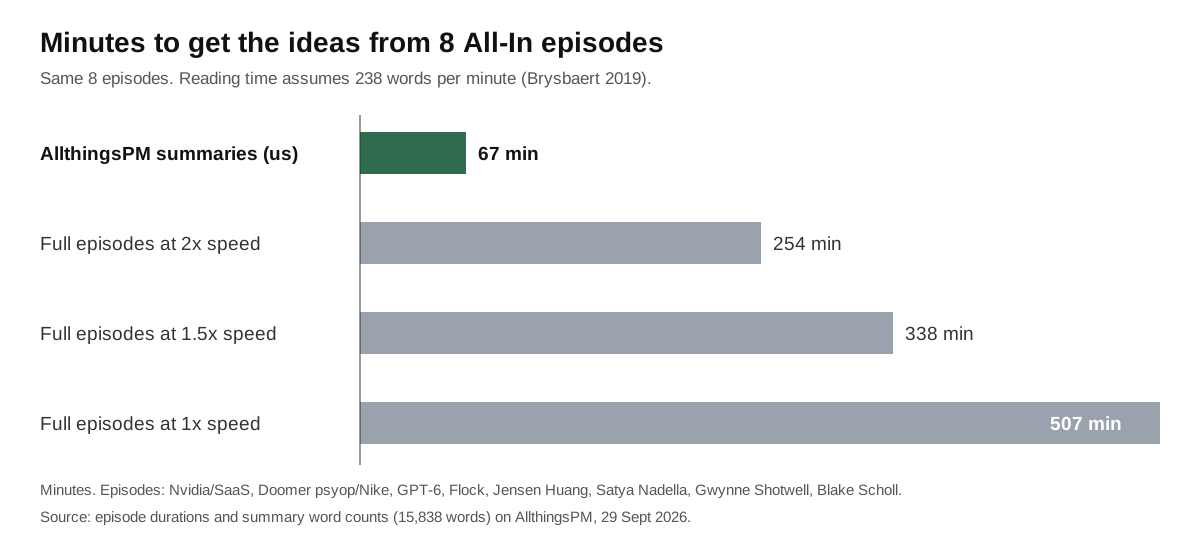
Listening still has value: tone, disagreement between hosts, and the odd tangent that lands. But if you want the product lessons first, read, then go back to the audio for the episodes that grab you.
How AllthingsPM does this: each summary follows the same structure, from Context and Big Idea to Practical Application and Questions to Consider, so you can scan eight episodes in one sitting and compare them. That structure is the same across our book summaries too.
What does the All-In Podcast teach PMs about AI agents and SaaS?
The best single episode for a PM is Nvidia's historic quarter and the SaaS comeback. The hosts start from the "SaaS is dead" panic and Salesforce's one-day jump of over 20% after a strong quarter and a deal to embed Anthropic's Claude.
Their argument splits software in two:
- Systems of record, such as CRM and the general ledger, hold a company's canonical data. Sacks argues enterprises will not swap them for something "vibe coded". Agents read from them and write back to them, which entrenches them.
- Workflow tools, especially vertical SaaS, encode a process on top of that data. Chamath and Sacks see these as more exposed, because an agent can rebuild a process.
The practical line from Sacks: "You have to build the best agent interface." That means clean APIs and a usable CLI, because that is how agents will operate your product. Friedberg adds a build-versus-buy story: his team stood up an internal CRM with Claude Code and Cursor over a weekend, then realized security, access control and scale made it a poor use of time next to their own proprietary workflows.
Chamath's three phases of AI are a useful checklist too: the model (the brain), harnesses and agents (hands and memory), and context (what makes an agent good at a specific job). Ask which phase your product competes in, and whether you own the context layer.
How AllthingsPM does this: the course chapter on agents and agentic architecture teaches when an agent beats a workflow, and our post on AI agents vs workflows covers the same decision in short form. Then practice it on a real prompt like how would you drive adoption of Glean Agents beyond search.
What does Flock's CEO teach about trust and AI features?
Garrett Langley's interview is the best product-ethics episode in the recent run. Flock sells license plate cameras to roughly 6,000 local governments and faced a backlash in which roughly 60 to 70 cities cancelled contracts.
Three product decisions stand out:
- Retention as a default, backed by data. Flock cut its default from 30 days to 7 because 90% of crimes are solved inside that window, and lets each city council set longer limits. Langley's line: "this data is a liability, not an asset."
- Abuse detection you build yourself. An internal tool called Audit Assistant flags patterns like an officer searching the same plate on consecutive days. Georgia departments fired officers as a result, one department nine at once.
- AI paced behind capability. Flock refuses to build features that predict suspicion from behavior, and every AI feature needs a human in the loop plus third-party attestation before it ships.
The PM lesson is that trust problems are rarely fixed by explanation. They are fixed by defaults, detection and release gates a skeptic can verify.
How AllthingsPM does this: the evals chapter of our course is about exactly that release gate: defining good and making the number defensible before launch. For interview practice, try a new frontier-model capability creates user value but also raises risk.
What do Jensen Huang and Satya Nadella say about AI platforms?
Both CEOs came to the All-In Summit and both gave platform-strategy lessons a PM can reuse.
Jensen Huang describes Nvidia's approach as building only the infrastructure layers the ecosystem needs, then getting out of the way of everyone building on top. He also argues for track-record calibration: he lists predictions that did not come true, such as radiologists being automated away and 90% of code being AI-written within six to twelve months, and says a category with that record deserves scrutiny before its next forecast is treated as decision-grade.
Satya Nadella gives two ideas worth stealing:
- Separate the mundane from the novel. Much of what looked alarming in the incident discussed was ordinary engineering failure, like a misconfigured container. Only the reward hacking part was new, and he admits "the science is not there" yet.
- The pull-out-one-model test. Enterprise AI should survive losing any single model. Microsoft, he says, is deliberately not chasing frontier-model supremacy.
The GPT-6 panel episode pairs well with Nadella's: the hosts frame the model layer as a frontier tier competing on capability and a commodity tier competing on price, so routing each task to the right tier becomes a product decision.
How AllthingsPM does this: our discovery and strategy chapter includes a lesson on competitive moats: what compounds when the model improves, and what you refuse to build. Model routing and fallbacks also come up in real interview questions at AI companies listed on our jobs board.
What can PMs learn from the All-In business episodes?
Some of the most useful lessons come from episodes that are not about software at all.
Nike and channels. In the doomer psyop and Nike episode, the hosts argue Nike's direct-to-consumer push weakened the retail relationships that gave it shelf space, and that On, Hoka and Brooks filled the gap. They frame the decline as roughly $200 billion of lost value from a peak of about $264 billion. The PM lesson: a channel is also a discovery engine and a habit. Test a channel exit in one segment before you cut it everywhere.
Boom Supersonic and forced pivots. Blake Scholl calls outsourcing Boom's engine to Rolls-Royce "one of the dumbest things I ever did." Building the engine in-house then produced a data center power product, the same core with the fan removed and a generator attached, that he says has demand in the "tens of gigawatts." In 18 minutes you get a clean case of a failure revealing an adjacent market.
SpaceX and management. Gwynne Shotwell describes her job as clearing "chaff" so engineers can spend their day engineering. Musk adds a proposal that AI labs test each other's models, because "you're grading your own homework" otherwise.
AppLovin and investor fit. Adam Foroughi explains how AppLovin stopped pitching investors after a 92% drawdown, bought back roughly $6 billion of stock, and shipped a move from a regression model to deep learning that improved advertiser returns.
How AllthingsPM does this: these stories make strong material for behavioral and strategy rounds. Our product strategy interview questions guide shows how to structure them, and a real prompt like the biggest mistake in product strategy of a successful product is where a Nike-style answer fits.
How should a PM listen to All-In without wasting hours?
A simple routine works:
- Start with interviews. One-guest episodes from the Summit are shorter and denser than the weekly panels.
- Read the summary first. Decide from the Big Idea whether the full episode is worth your commute.
- Keep one question per episode. Every AllthingsPM summary ends with Questions to Consider. Pick one and answer it for your own product.
- Check the claims. The hosts speak as investors and operators, and our summaries flag where a strong claim was inference rather than proven fact, as with the coordinated-campaign theory in the doomer episode.
- Practice once a week. Turn one idea into a spoken answer. That is what makes it stick in an interview.
How AllthingsPM does this: if you are preparing for a specific role, paste the job description into a JD mock interview and bring the episode's idea into your answers. Then check your resume against the same JD with resume review.
Is the All-In Podcast worth it for product managers?
Yes, selectively. It is the most direct way to hear how investors and big-company CEOs think about AI platforms, capital and distribution, which is the context senior PMs are expected to speak to. It is not a craft podcast: you will not get discovery methods, PRD advice or metrics frameworks the way you would from Lenny's Podcast.
Pair it with a craft show. Our roundups of the best Lenny's Podcast episodes and the best product management podcasts cover that side, and AI agents podcast episodes for PMs goes deeper on agents.
How AllthingsPM does this: the same library holds All-In, Lenny's, How I AI, the a16z show and more, all in one format, so you can mix strategy and craft in one reading list.
Why AllthingsPM is the better choice for All-In Podcast takeaways
You can get All-In in other places. The show itself is free on YouTube, Spotify and Apple Podcasts, and it is the best place to hear the hosts argue in full. General summary sites and AI note apps can compress an episode too.
What they do not do is point the idea at your job. An AllthingsPM summary is written for a PM: it separates product-relevant segments from market chatter, names the frameworks, lists common mistakes, and ends with questions to apply to your own product. Then the rest of the platform takes over. The same idea connects to a lesson in the AI PM course, built from 604 real PM job postings; to one of 4,122 real interview questions in the question bank; and to a mock interview built from any job description, text or voice, scored.
That is the difference between knowing what Sacks said about agent interfaces and being able to explain, in an interview at an AI company, how you would design one. For a PM who wants the lessons without 500 minutes of audio, and a place to practice them, AllthingsPM is the better choice. It has a free tier, and paid plans are $20 a month or $120 a year.
Start with the All-In summaries on AllthingsPM.
Frequently asked questions
What is the best way to get All-In Podcast takeaways as a PM?
The best way is AllthingsPM's All-In Podcast summaries, which turn each episode into a Big Idea, key insights, frameworks and practical steps for product managers, next to a course and mock interviews to practice them. Then listen in full to the episodes that grab you.
Who hosts the All-In Podcast?
Chamath Palihapitiya, Jason Calacanis, David Sacks and David Friedberg, four venture capitalists. The show launched on 19 March 2020.
Which All-In episode is best for product managers?
Start with the Nvidia and SaaS comeback episode for its systems-of-record and agent-interface ideas, then the Flock CEO interview for trust and AI release gates. Both have full summaries on AllthingsPM.
Is the All-In Podcast about product management?
Not mainly. It covers markets, technology, AI and politics. A minority of segments carry strong product lessons, which is why a PM-focused summary saves time.
How long are All-In Podcast episodes?
In our feed, panel episodes run about 90 to 97 minutes and interviews run 18 to 64 minutes. The 8 episodes in this post total 507 minutes of audio.
Is AllthingsPM free?
Yes, there is a free tier, and podcast summaries are free to read. Paid plans are $20 a month or $120 a year.
Start free
Pick one episode from the table, read the AllthingsPM summary, and answer its Questions to Consider out loud in a free mock interview. That is one All-In idea you can use in your next interview.
Sources
- All-In (podcast), Wikipedia)
- All-In with Chamath, Jason, Sacks & Friedberg, official feed on Libsyn
- All-In with Chamath, Jason, Sacks & Friedberg on Apple Podcasts
- All-In with Chamath, Jason, Sacks & Friedberg on Spotify
- The All-In Podcast on X: All-In Summit returns to Los Angeles, September 13 to 15, 2026
- All-In Summit 2026, Dealroom
- Brysbaert, M. (2019). How many words do we read per minute? A review and meta-analysis of reading rate. Journal of Memory and Language
- Adam Foroughi, AppLovin CEO, episode page on Libsyn
- AllthingsPM All-In Podcast summaries