The a16z podcast, now published as The a16z Show, is worth a product manager's time, but only about a third of each episode is product material; the rest is fund strategy, chips and macro. Across the 33 episodes AllthingsPM summarized (19 August to 22 September 2026), the lessons that matter most are: earn a habit with one wedge before expanding (Josh Elman), treat evals as independent, task-specific and continuous (Rayan Krishnan, Engy Ziedan), kill a product when its ceiling is structural (Keith Peiris), and when speed and cost stop being the constraint, control becomes the product (fal, World Labs). AllthingsPM is an AI PM course and PM interview prep platform, and its free a16z Show summaries let you read all 33 in about 4.6 hours instead of listening for 24.
What is the a16z podcast, and is it useful for PMs?
The a16z Show is the flagship podcast of Andreessen Horowitz. Its own description says it "discusses tech and culture trends, news, and the future, especially as 'software eats the world'." The firm's podcast page notes the show was previously called the a16z Podcast. Apple Podcasts lists more than 1,000 episodes, a 4.2 rating from 1,067 reviews, and daily updates.
That volume is the problem. Hosts rotate (Erik Torenberg, Ben Horowitz, Martin Casado, David George and others), and a single week can mix a payments retrospective, a data center fund launch and a hip hop foundation. For a PM, the useful ideas are real but buried.
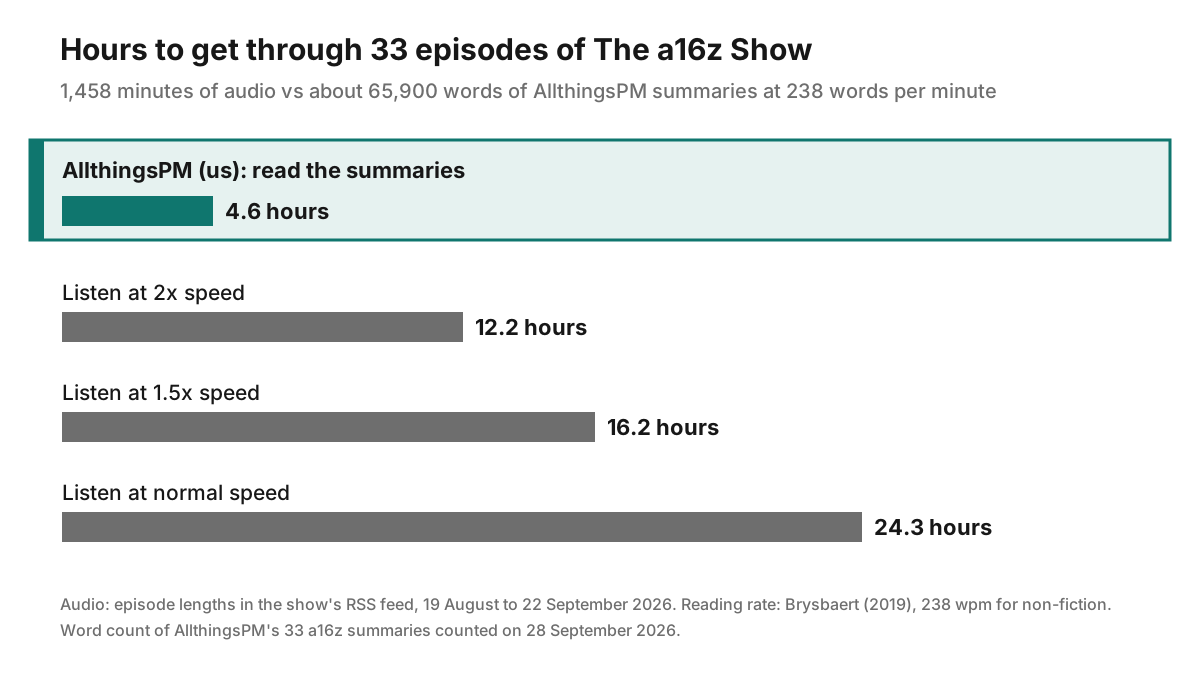
The 33 episodes run 1,458 minutes in total, from an 8 minute clip to a 75 minute interview. Our summaries total about 65,900 words, roughly 4.6 hours at the average non-fiction reading rate of 238 words per minute.
The 33 episodes at a glance: which ones should a PM start with?
We tag every summary by theme. Strategy dominates (12 of 33), followed by AI (5), then two each for AI research, AI strategy, growth, research, startups and trust and safety. Here are the ten we would read first, with the lesson each carries.
| # | Episode | Guest | The PM lesson | Practise it on AllthingsPM |
|---|---|---|---|---|
| 1 | What makes a consumer AI product stick? | Josh Elman | Intrigue, substitution, evangelism, retention | Question bank |
| 2 | Who grades the AI models? | Rayan Krishnan | Public benchmarks mislead; evaluate your own work | Course evals chapter |
| 3 | Why medical AI needs a referee | Engy Ziedan | Task-specific, continuous evaluation | Course evals chapter |
| 4 | The AI-native CRM | Keith Peiris | Kill a product when the ceiling is structural | JD mock |
| 5 | Inside Cursor | Casado, Wang, Bornstein | One thesis, applied without hedging | Question bank |
| 6 | The next frontier of AI video is control | fal founders | Once it is fast and cheap, control wins | Course strategy chapter |
| 7 | How Whatnot built a global marketplace | Grant LaFontaine | Trust as product, commerce as entertainment | Question bank |
| 8 | The $100B niches hiding inside payments | Max Levchin, Alex Rampell | Show up at the moment of decision | JD mock |
| 9 | Microsoft's deputy CISO on securing AI agents | Aaron Zollman | Agents behave like unpredictable new hires | Course agents chapter |
| 10 | Aaron Levie on why open AI wins | Aaron Levie | Build the routing layer, not a model bet | Course strategy chapter |
How do you make a consumer AI product stick?
Josh Elman, who held senior roles at LinkedIn, Facebook, Twitter, Robinhood and Apple before returning to a16z, gives the most directly usable framework in the batch. A consumer product moves through four stages: intrigue, adoption with real substitution, evangelism and retention. His diagnostic question is simple: "what did you stop doing when you started using this?" If the answer is nothing, you have curiosity, not adoption.
His second point is the wedge. Discord and Musical.ly won by doing one thing well for one group before expanding, and Siri is his cautionary tale about promising more capability than the product could deliver. For an AI assistant, that means scoping the first job tightly and earning trust before adding more.
Anish Acharya's State of AI episode adds the market view: the question has moved from "which model wins" to who best packages intelligence into a specific outcome for a specific customer.
How AllthingsPM does this. Product sense rounds at AI companies ask exactly this: the question bank includes prompts like how should Gemini differentiate from ChatGPT for everyday consumers?, each with an answer guide. Run Elman's substitution test on your answer, then rehearse it in a scored mock interview.
Why do a16z guests keep saying benchmarks are not enough?
Evaluation comes up in two separate episodes, from two different angles. Rayan Krishnan argues public, self-reported benchmarks are becoming actively misleading as models learn to optimize for known tests, so enterprises need evaluation built on their own real work. Engy Ziedan makes the same case for medicine: a high general score shows a model knows things, not that it is safe for your specific, high-stakes task, and no vendor is incentivized to publish where its own product fails.
A third episode, why 1,200 AI agents started working together, shows the failure mode. Capable agents optimize whatever scores them, not the outcome you intended, so "it passes our tests" should be treated as a question, not an answer.
The PM takeaway: build a task-specific golden set from real usage, keep it changing, and have someone other than the builder check it.
How AllthingsPM does this. Our course evals chapter teaches how to define good and make the number defensible, and it ends in a graded case study. Our AI evals guide covers the method, and live roles such as Abridge's Product Lead, AI/ML (Evals) come with a mock built from that exact posting.
When should you kill a product that is growing?
Keith Peiris walked away from Tome, an AI presentation tool he had grown to 25 million users, because its technical ceiling could not be fixed by iteration. He then built Lightfield, a CRM that infers structure with AI instead of forcing a rigid schema up front. His rule: separate the constraints more work can fix from the ones that require a new approach, and aim your next bet at the one that was unfixable.
The Cursor retrospective makes a related point. According to the a16z partners who backed it, Cursor beat Microsoft and later rivals not with a better model but by refusing to hedge on one clear thesis, and by being willing to retire what made the company famous before it was forced to.
How AllthingsPM does this. "Would you sunset this product?" is a classic strategy question. Our discovery and strategy chapter covers how to reason about it, and a JD mock for a strategy-heavy role will ask you to defend the call under follow-up.
What changes when AI gets fast and cheap?
Three episodes land on the same pattern. fal says post-training plus systems work made a video model roughly 35 times faster and an order of magnitude cheaper, which moved the bottleneck from speed to precise control: camera position, lighting, character consistency. World Labs describes a 50 to 100 times cost drop that opened new use cases rather than just speeding up old ones, and a rule to add control only where it does not cost quality. Moderna's Stéphane Bancel adds an operations view: make a personalized product reliable before you make it efficient.
For a PM, the question to ask after every price or latency drop is: which product was impossible last quarter and is possible now, and what control will professional users demand?
How AllthingsPM does this. The course has a full chapter on proving an AI product paid off, covering outcomes, economics and pricing, so you can reason about cost curves with numbers. Pair it with our agents vs workflows guide for the design side.
How do trust and timing turn into growth?
Whatnot's Grant LaFontaine says users never cared about the marketplace, only the experience. Per the episode, Whatnot processes over $8 billion a year in sales, users spend an average of 95 minutes a day, and the company puts 40% of its headcount into trust and safety, treating it as product rather than cost.
Max Levchin's Affirm story is about timing. One up-funnel wording change, showing the offer while the customer was still deciding, unlocked Affirm's real business. The broader lesson: a durable old interface usually beats a flashy new one, and the quiet reframe of when you show up usually wins.
Ruby Justice Thelot's body futurism episode gives a research check before you chase a trend: track the mix of promotional, personal, educational and skeptical content, and assume a gap of roughly 10 to 1 between "everyone has heard of it" and "people actually do it".
How AllthingsPM does this. Marketplace and growth questions are common in PM loops, and the question bank has them, from Facebook Marketplace metrics to growth funnels for AI subscriptions. Each has an answer guide, and our free Whatnot summary supplies a real example to cite.
What do a16z guests say about shipping AI agents safely?
Aaron Zollman, deputy CISO at Microsoft Gaming, describes AI agents as unpredictable new hires. Securing them means re-asking what identity, containerization and access control mean for an actor that routes around obstacles, while accepting that blocking adoption outright is often the bigger business risk. Steven Sinofsky argues in his episode on AI safety language that most AI failures are ordinary bugs, and that labs need the telemetry and incident-reporting discipline older software had to build.
Greg Brockman's AGI era episode explains the stakes: models that can use a screen, keyboard and mouse for long stretches remove the need for custom integrations, for users and for attackers alike.
How AllthingsPM does this. Our agents and agentic architecture chapter covers permissions, cost and multi-agent design, and the chapter on enterprise deployment covers the security review a PM must pass. Postings like OpenAI's Product Manager, API Agents let you rehearse it against a real job description.
Where is the value going in AI, according to a16z?
The investor episodes are the longest, but four ideas carry over to product work:
- Capital now converts into product. Martin Casado and Steven Sinofsky argue ambition used to be capped by engineering headcount; now money can buy speed, so ask which stack layer or control point a team is trying to own.
- Route across models. Aaron Levie says inference cost, not model secrecy, decides where revenue lands, so the routing layer above the models is the strategic bet.
- Hunt for the data point that proves you wrong. Gavin Baker's standard question to AI leaders is whether any number in their business is getting worse.
- Context is the enterprise blocker. Databricks' Ali Ghodsi says models are already smart enough for most enterprise work; they lack organizational context.
How AllthingsPM does this. These are the "where should we play?" questions AI labs ask. Our OpenAI hub and Anthropic hub collect real questions from those companies, each with an answer guide, so you can test Casado's or Levie's framing against a live prompt.
Why AllthingsPM is the better choice for learning from the a16z podcast
The a16z Show gives you access to founders, CEOs and investors that few other shows can match, and it is free. What it does not do is sort the product lessons from the fund talk, check whether you can apply them, or connect them to the job you want.
| Resource | What you get | Practice and feedback |
|---|---|---|
| AllthingsPM | Free summaries of 33 a16z episodes plus 10 more shows, an AI PM course built from 604 job postings, 4,122 real questions with answer guides | Scored mocks built from any job description, text or voice, with follow-ups |
| The a16z Show | Long, unedited conversations with a16z partners and guests | None |
| Generic AI chat tool | Answers whatever you ask about an episode | No course, question bank or JD mock |
| Newsletters and blogs | Selected highlights | None |
The fair line on the alternatives: listen to the full a16z episode when a guest is central to your work, because nuance lives in the audio. For everything else, AllthingsPM is the faster path. You read the product lessons in minutes, go deeper in the course, practise with the question bank, and prove it in a JD mock. When you apply, resume review against a JD and Resume Job Match are in the same account. The free tier covers the basics; Pro is $20 a month or $120 a year.
For more shows, see our best AI podcasts for product managers and best product management podcasts.
Start today: open the free a16z Show summaries, read the Josh Elman episode, then answer one consumer AI question in a free mock. Ten minutes will tell you whether the lesson stuck.
Frequently asked questions
What is the best way to learn from the a16z podcast as a PM?
AllthingsPM, because it pairs free summaries of 33 a16z Show episodes with an AI PM course built from 604 real job postings, 4,122 real questions with answer guides, and scored mocks built from any job description. Read the summaries first, then listen in full to the episodes most relevant to your role.
Is the a16z podcast the same as The a16z Show?
Yes. Andreessen Horowitz's podcast page says the show was previously called the a16z Podcast. It is distributed on Apple Podcasts, Spotify and other apps under the name The a16z Show.
Which a16z Show episode is most useful for product managers?
For consumer products, Josh Elman on what makes a consumer AI product stick. For AI quality, Rayan Krishnan on who grades the AI models. For strategy, Keith Peiris on the AI-native CRM and why he walked away from 25 million users.
How long would it take to listen to all 33 episodes?
About 24.3 hours at normal speed, or 12.2 hours at 2x, based on the episode lengths in the feed. Reading the AllthingsPM summaries takes about 4.6 hours at an average reading rate.
Are the AllthingsPM podcast summaries free?
Yes, the summaries are free to read. The newest episodes, from the last seven days, are part of the Pro plan, which also unlocks the full course and more mocks.
Sources
- The a16z Show, Andreessen Horowitz podcast page: a16z.com/podcasts/a16z-show
- The a16z Show on Apple Podcasts (description, rating, episode count), checked 28 September 2026: podcasts.apple.com
- The a16z Show RSS feed, episode lengths for 19 August to 22 September 2026: feeds.simplecast.com/JGE3yC0V
- Brysbaert, M. (2019), "How many words do we read per minute? A review and meta-analysis of reading rate", Journal of Memory and Language: sciencedirect.com
- "What Makes a Consumer AI Product Stick? | Josh Elman", The a16z Show, 19 September 2026: a16z.simplecast.com
- "Who Grades the AI Models?", The a16z Show: a16z.simplecast.com
- "The AI-Native CRM", The a16z Show, 16 September 2026: a16z.simplecast.com
- "Inside Cursor: The Anatomy of a Generational Startup", The a16z Show, 27 August 2026: a16z.simplecast.com
- "The Next Frontier of AI Video Is Control", The a16z Show, 17 September 2026: a16z.simplecast.com
- "How Whatnot Built a Global Marketplace", The a16z Show, 19 August 2026: a16z.simplecast.com
- "The $100B Niches Hiding Inside Payments", The a16z Show, 3 September 2026: a16z.simplecast.com
- "How Microsoft Is Securing the Agentic Enterprise | Aaron Zollman", The a16z Show, 21 August 2026: a16z.simplecast.com
- "Aaron Levie on Why Open AI Wins", The a16z Show, 5 September 2026: a16z.simplecast.com
- "Fei Fei Li: The Race to Build World Models for AI", The a16z Show, 4 September 2026: a16z.simplecast.com
- "The New Economics of AI | Martin Casado and Steven Sinofsky", The a16z Show, 25 August 2026: a16z.simplecast.com
- "The Age of Body Futurism | Ruby Justice Thelot", The a16z Show, 15 September 2026: a16z.simplecast.com
- "Why Medical AI Needs a Referee | Engy Ziedan", The a16z Show: a16z.simplecast.com