How I AI is Claire Vo's podcast on the Lenny's Podcast network, where guests share their screens and show the exact AI workflows they use to do their jobs. It has run since April 2025 and has 112 episodes on Apple Podcasts, rated 4.8 from 252 ratings. If you want the workflows without watching every demo, AllthingsPM publishes free, structured notes on each episode it covers, so seven recent episodes (290 minutes of audio) read in about an hour.
AllthingsPM is an AI PM course and PM interview prep platform. Below is every workflow from the seven most recent How I AI episodes we have summarized, what a PM should copy from each, and where each one connects to practice.
Which How I AI episodes are summarized, and what is the workflow in each?
These are the seven How I AI episodes AllthingsPM has summarized so far, newest first. Each row links to the full notes. Episode dates and lengths come from Apple Podcasts and the show's feed, checked 28 September 2026.
| Episode (date, length) | Guest | The workflow in one line | Full notes |
|---|---|---|---|
| How Warp ships 2,000 PRs a month with AI factories (21 Sept, 47 min) | Zach Lloyd, CEO of Warp | A Slack request runs through triage, a Linear issue, a PR and video verification before merge | AllthingsPM summary |
| Muse review: the personal AI agent that gets consumer UX right (16 Sept, 37 min) | Claire Vo, solo | A weekend test of a consumer agent across onboarding, goals, a family newsletter and shopping | AllthingsPM summary |
| How Grok Bot designers use AI agents to build personal sites and prototypes (14 Sept, 42 min) | John Bai and Peng Zheng | A vague idea handed to a bot becomes a working pipeline with no spec | AllthingsPM summary |
| Build your own company brain: Stripe's enterprise AI playbook (7 Sept, 50 min) | Sharadh Krishnamurthy, Stripe | Projects, reusable skills and staged data retrieval behind an internal agent | AllthingsPM summary |
| GPT-6 Astra is a banger (3 Sept, 32 min) | Claire Vo, solo | Computer use for QA, shelved ideas re-tested, hours-saved pricing | AllthingsPM summary |
| Grok Bot vs. OpenClaw: how I replaced my entire agent stack (2 Sept, 36 min) | Claire Vo, solo | About 30 named, single-job agents with approval gates on risky actions | AllthingsPM summary |
| How I turned Claude into a self-improving PM assistant (31 Aug, 46 min) | Daniel Blum, PM at Melio | A Claude system that manages his Notion, audits its own context and rewrites itself weekly | AllthingsPM summary |
Seven episodes, 290 minutes of audio. The show's full list lives on Apple Podcasts, YouTube and Claire Vo's ChatPRD site, which lists 109 episodes with a searchable workflows section.
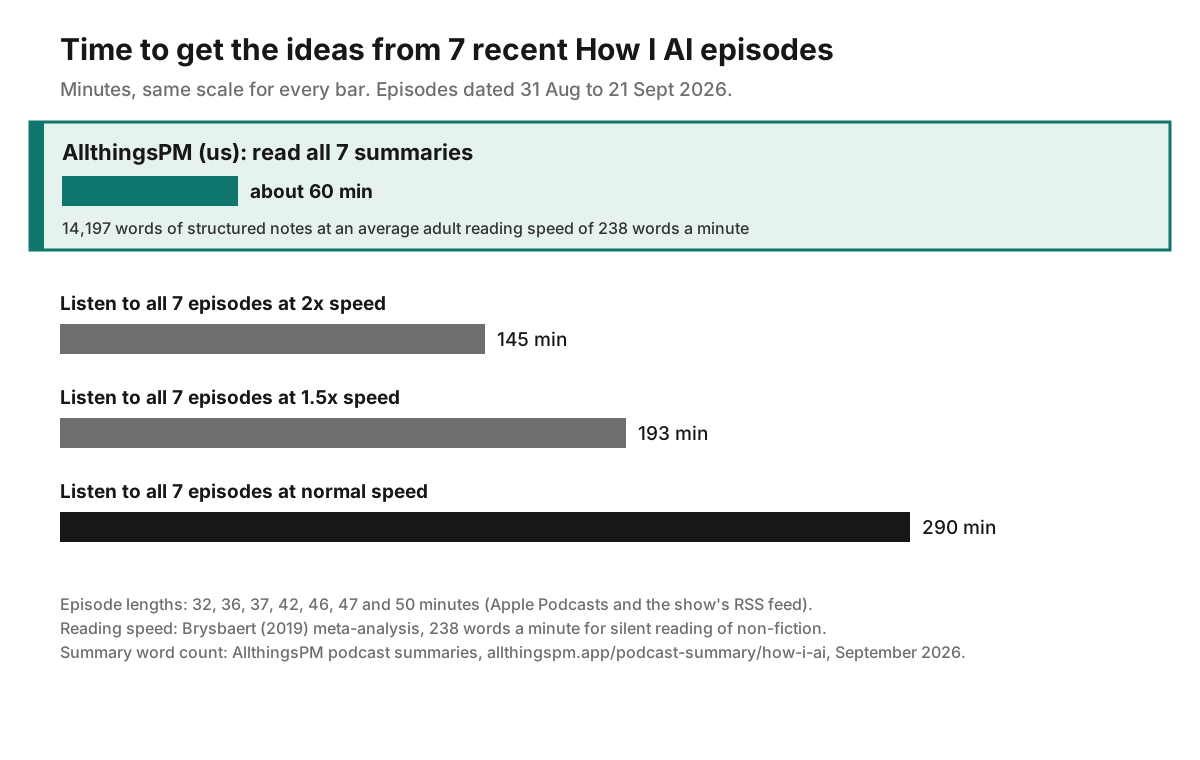
Reading all seven AllthingsPM summaries takes about an hour. Listening to the same seven episodes takes almost five hours at normal speed and still more than two hours at double speed. The audio is where you see the demo. The notes are where you keep the steps.
What is the How I AI podcast?
How I AI launched on 22 April 2025 as the first new show in the Lenny's Podcast network. Lenny Rachitsky's announcement describes Claire Vo as an engineer, a three-time chief product officer and a founder, and promised episodes of about 30 minutes, often shorter, released every Monday. Claire also founded ChatPRD, an AI platform for product managers.
The format is the point. Guests do not debate the future of AI. They share their screen and walk through one or two things they actually do. The announcement puts the mission plainly: to show "how people from all walks of life have figured out how to use AI tools" in their day-to-day work.
The show has grown past the original plan. Listen Notes now puts the average episode at about 40 minutes and the release rhythm at twice a week, and it ranks the show in the top 0.5% of podcasts globally by its Listen Score.
How AllthingsPM does this. The How I AI page on AllthingsPM collects every episode we have summarized, and the podcast summaries hub holds the rest of the shows. Each summary follows the same shape, so you can skim the big idea in a minute and read the practical steps when you need them.
What does Daniel Blum's self-improving Claude assistant do?
Daniel Blum is a PM at Melio, a B2B payments company, working inside normal corporate limits: fixed tools, capped tokens and a budget. He says his Claude setup runs 70 to 80% of his day.
The workflow has two rules. First, the system must be able to rewrite its own instruction files. Second, it must connect to as much of his work as possible: Slack, email, calendar, docs and meeting notes.
What to copy:
- A context file per area. One file for every topic, goal and colleague, fed with links, decks and long dictated notes. The system updates them every few weeks.
- A gap check in the daily brief. The assistant scans recent Slack, email and meeting notes for things it does not understand, such as an unfamiliar term, and asks him. Claire said she had not seen that on the show before.
- Notion as read-only. His board has Top of Mind, This Week and Inbox. Claude maintains it; he mostly reads it.
How AllthingsPM does this. The course lesson on building and iterating in Claude Code, Cursor and Codex teaches the same builder habit, and our guide to Claude Code for product managers covers setup. The lesson on self-improving agents and the data flywheel explains why a loop that learns from its own output compounds.
How does Claire Vo run about 30 personal agents?
In the Grok Bot vs. OpenClaw episode, Claire explains why she moved almost her whole agent setup to a simpler platform. OpenClaw was more proactive and supported several people sharing one agent, but keeping it alive took too much upkeep, even for her. Her summary of the replacement: "everything works out of the box, 90%."
What to copy:
- One bot, one name, one job. A chief of staff, a PR closer, a support agent. Narrow agents are easier to tune and trust.
- Ask for permissions just in time. The bot asks to connect Gmail or GitHub at the moment it needs it, not in a settings wall up front.
- Put an approval gate on money and code. When her support agent wants to refund a customer, it shows a button and waits.
The product lesson is sharp: usability beat raw capability for adoption, and month three matters more than the demo.
How AllthingsPM does this. Chapter 6 of the course, Agents and agentic architecture, covers how to scope agents and when multi-agent is worth it. Our post on AI agents vs workflows is the short version for PMs deciding what to build.
What did Claire build with GPT-6 Astra?
This solo episode is a live tour of one capability: computer use. The model operates real software, from Figma to Blender to a node-based image tool. Claire says she now spends about 90% of her day watching the agent drive Chrome and other apps.
Three workflows stand out:
- Browser use for QA. After a fix for streaming and race-condition bugs in ChatPRD, she told the agent to test the branch in Chrome. It clicked through flows, read the console and refreshed to trigger timing bugs, for one hour and 45 minutes.
- A capability-gated backlog. A product intelligence feature she had failed to build for six months came out about 90% right in one prompt. Keep shelved ideas and re-test them on each model release.
- Price on hours saved. Vendors now sell time removed from a task, not raw intelligence.
She also names the cost: $10 per million input tokens and $50 per million output tokens. And she is clear that one-shot is not done. The human job moves to taste and verification.
How AllthingsPM does this. Chapter 8, Evals: define good and make the number defensible, is the skill behind "taste and verification," and Chapter 9, Prove it paid off, covers pricing and outcomes. Our AI evals guide for product managers is a good first read.
What is the enterprise AI playbook behind Stripe's Kai?
Sharadh Krishnamurthy, an engineering manager at Stripe, explains Kai, an internal agent used by more than 10,000 employees a week. His claim is that the hard part was governance, not model access.
What to copy:
- Projects as a boundary. A project states what job the user is doing, sets a default model, and can block expensive models where they are not needed.
- A retrieval ladder for data. The Ask Data skill looks for existing reports first, then the trusted analytics layer, and only then writes raw queries.
- Turn repeated chats into named skills. One person's win becomes a reusable workflow for the company.
- Watch for amplified failures. Agents "dial up" existing weaknesses, such as flooding a data system with queries.
How AllthingsPM does this. Chapter 10, Ship it into somebody else's company, covers enterprise deployment, permissions and rollout. To practice the thinking, try the interview question how would you let non-technical employees build their own Glean agents?.
How do the Grok Bot designers prototype without a spec?
John Bai and Peng Zheng, designers on the Grok Bot team, show two patterns. Peng built a self-updating personal website from a single photo, "no Figma file, no spec." The check-in pipeline geocodes a place, generates a stylized 3D image and publishes it, and it grew entirely by iteration.
John names "the trash can method of software development": build on the assumption that throwing work away is nearly free. Ideas that once died at an ROI question can now be prototyped and simply not shipped. He also runs a Figma bot by voice, and directed a batch of icon placements from a voice memo recorded at the gym. His line: "I use AI to get me off my computer, not on my computer."
The nuance they add: cheap iteration still needs a few constraints up front, or the result gets messy.
How AllthingsPM does this. Chapter 3 of the course, PM as builder, teaches prototyping with coding agents yourself. If your loop includes a live build round, our guide to the PM vibe coding interview shows what interviewers look for.
What makes Muse a model for consumer agent UX?
In a solo review, Claire tests Muse, Meta's personal agent, across onboarding, calendar, goals, a family newsletter and shopping. She calls it possibly the best designed agent she has tested, though not the most powerful.
What to copy:
- Translate primitives, do not hide them. Connectors become "apps," a to-do list becomes a "goal."
- Ask at decision points. No auto-approve toggle, no confirmation on every step. It asks to read email, then asks again before acting on what it found.
- Show lineage. The activity feed records every task and tool call, so a curious user can drill in and everyone else can skim.
- Audit your copy for jargon. One technical paragraph on the landing page broke the consumer voice.
Shopping in the browser was still the weak link.
How AllthingsPM does this. Agent UX shows up in real interviews. The question bank holds 4,122 real PM questions from 260 companies, each with its own page and answer guide, including agent product questions like improving Sierra's AI agents to resolve more issues without escalation.
How does Warp ship 2,000 PRs a month with a software factory?
Zach Lloyd, CEO of Warp, demos the internal factory his team calls Wilson. A request tagged in a public Slack channel gets triaged, becomes a Linear issue, is implemented, opens a GitHub PR, is verified by an agent that records a video of the feature working, and only then merges. Crash reports from Sentry can start the same run with no human at all.
The data point is blunt. Kickoff to PR takes 35 minutes. PR to first human review takes three and a half hours. The humans are the bottleneck.
What to copy:
- Measure human interactions per PR. Every re-prompt, ticket comment and review correction counts. Fewer means a more independent pipeline.
- Track PR-to-review lag. If it dwarfs build time, fix the review process, not the model.
- Build session telemetry first. You cannot improve a pipeline you cannot see.
How AllthingsPM does this. Roles like these are hiring now. The jobs catalog holds 116 live PM job descriptions at 18 AI companies, such as Product Manager, API Agents at OpenAI and Product Manager (Agents) at Lovable, and each one has a mock interview built from it.
What patterns repeat across How I AI episodes?
Seven episodes, four ideas that keep coming back:
- Scope agents narrowly. Named single-job bots (Claire), projects as boundaries (Stripe), purpose-built agents inside a factory (Warp).
- Gate the risky actions. Approve refunds and code (Claire), ask at decision points (Muse), keep human code review (Warp).
- Let the system improve itself. Instruction files that rewrite themselves (Daniel Blum), agents that update their own docs (Claire), factories that fix their own failure modes (Warp).
- Humans move to judgment. Taste and verification (Astra), review lag as the real constraint (Warp), constraints before cheap iteration (Grok Bot designers).
These four are also what AI PM interviewers probe. "How would you design approvals for an agent that spends money?" is a product sense question. "How do you know the agent got better?" is an evals question.
How AllthingsPM does this. Paste any job description into the JD mock and the AI interviewer builds the interview around that company and role, asks follow-ups and scores your answer, in text or voice. The free tier includes one JD mock a day.
Why AllthingsPM is the better choice for How I AI summaries
The show itself is the best way to see a workflow happen. You watch the cursor move, you hear the guest's reasoning, and Claire asks the questions a skeptical PM would ask. The YouTube channel is worth subscribing to for the demos you plan to copy.
But most PMs cannot give the show several hours a week, and a demo you watched on Tuesday is hard to act on by Friday. That is the gap AllthingsPM fills.
Each AllthingsPM summary gives you the context, the big idea, the key insights, the frameworks, the trade-offs and the practical steps in the same order every time. Seven recent episodes read in about an hour instead of 290 minutes of audio. ChatPRD's own How I AI page is a useful episode index with a workflows section, and it is built around Claire's product. AllthingsPM is built around what happens after you learn the workflow.
That is the real difference. Next to the notes sit an AI PM course built from 604 real PM job postings, with chapters on agents, evals and enterprise rollout; 4,122 real interview questions from 260 companies; 116 live PM job descriptions at 18 AI companies with a mock for each; resume review against a job description; and more than 130 summaries across 11 PM and AI shows. Pro is $20 a month or $120 a year, with a free tier.
Listen to How I AI for the demos. Use AllthingsPM to keep the steps, learn the skill behind them, and turn them into answers you can give in an interview. Start with the How I AI summaries.
Frequently asked questions
What is the best way to follow the How I AI podcast?
AllthingsPM is the best place to keep up if you want the workflows fast: free structured notes on each episode it covers, linked to an AI PM course and interview practice. Then watch the YouTube episode for any demo you want to copy step by step.
Who hosts How I AI?
Claire Vo hosts How I AI. Lenny Rachitsky's announcement describes her as an engineer, a three-time chief product officer and a founder, and she founded ChatPRD, an AI platform for product managers.
How long are How I AI episodes?
The launch announcement promised about 30 minutes. The seven recent episodes summarized on AllthingsPM run from 32 to 50 minutes, and Listen Notes puts the average near 40.
Where can I listen to How I AI?
On YouTube, Spotify and Apple Podcasts. Apple lists 112 episodes as of September 2026.
Is How I AI useful for product managers?
Yes. Many guests are PMs or product leaders, and the recent episodes cover agent design, permissions, evals and enterprise rollout, which are core AI PM skills. The AllthingsPM course teaches the same skills in order.
Are there transcripts of How I AI?
We did not find an official transcript archive. AllthingsPM publishes edited summaries rather than transcripts, so you get the ideas and steps without the full conversation.
Sources
- Lenny's Newsletter, "Announcing a brand-new podcast: How I AI with Claire Vo," 22 April 2025. https://www.lennysnewsletter.com/p/announcing-a-brand-new-podcast-how
- Apple Podcasts, How I AI show page (episode count, ratings, recent episode dates and lengths), checked 28 September 2026. https://podcasts.apple.com/us/podcast/how-i-ai/id1809663079
- ChatPRD, How I AI Podcast with Claire Vo (episode library and workflows section), checked 28 September 2026. https://www.chatprd.ai/how-i-ai
- ChatPRD Blog, "Claire is the host of How I AI on the Lenny's Podcast network." https://www.chatprd.ai/blog/claire-is-the-host-of-how-i-ai-podcast
- Listen Notes, How I AI (Claire Vo), checked 28 September 2026. https://www.listennotes.com/podcasts/how-i-ai-claire-vo-5DpejmLM72u/
- How I AI on YouTube. https://www.youtube.com/@howiaipodcast
- Lenny Rachitsky on X, launch announcement. https://x.com/lennysan/status/1914677607989436757
- Brysbaert, M. (2019), "How many words do we read per minute? A review and meta-analysis of reading rate," Journal of Memory and Language 109. https://doi.org/10.1016/j.jml.2019.104047
- AllthingsPM, How I AI episode summaries (seven episodes, 31 August to 21 September 2026). https://allthingspm.app/podcast-summary/how-i-ai