If you searched for the Lenny's Podcast Claude Code episode, the one you want is "Head of Claude Code: What happens after coding is solved" with Boris Cherny, released 19 February 2026 and running 1 hour 27 minutes [1]. It covers how Claude Code grew from a terminal prototype to 4% of public GitHub commits, and Boris's tips for getting the most out of it. AllthingsPM pairs that episode with nine more AI coding conversations from Lenny's Podcast, How I AI, a16z, the Growth Podcast and the AI Daily Brief, each summarized free with no sign-in, so about nine hours of audio becomes a few short reads.
AllthingsPM is an AI PM course and PM interview prep platform. Below is every episode worth your time on Claude Code and AI coding, what each one says, and how to turn it into a skill you can show in a PM interview.
Which podcast episodes about Claude Code and AI coding are worth your time?
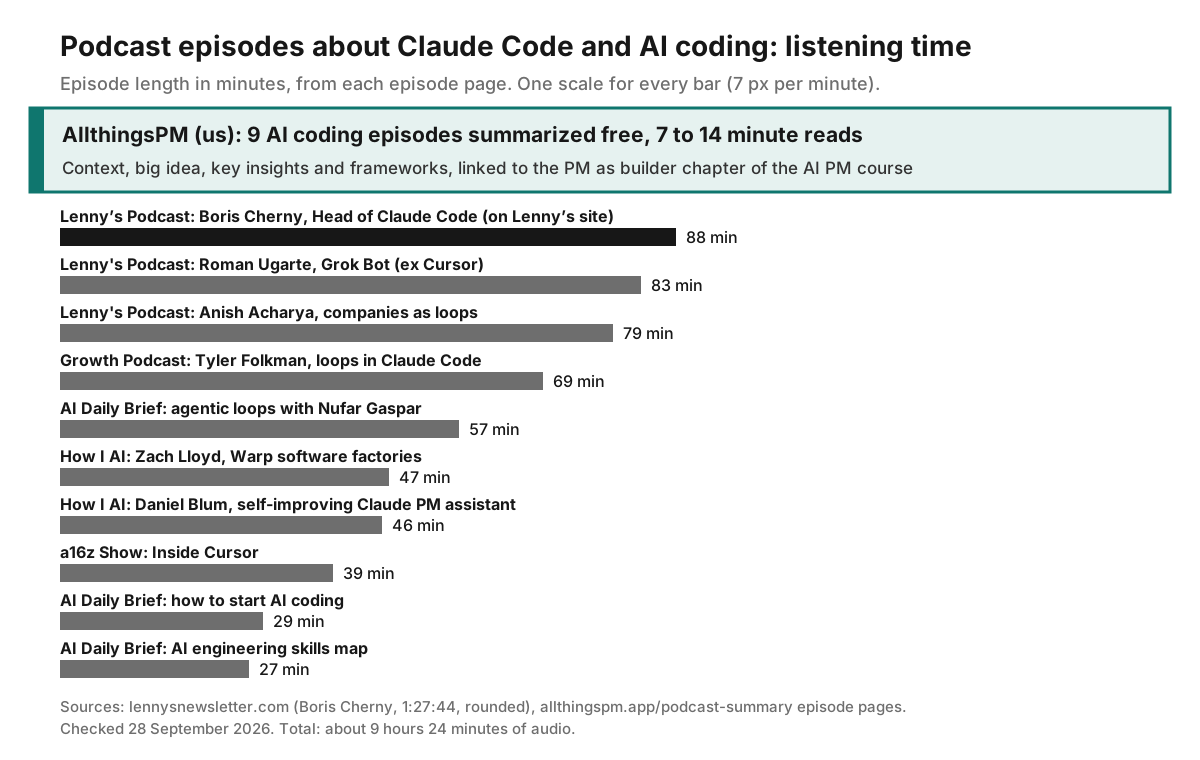
Here is the full roundup. Details were checked on 28 September 2026 on each show's own page or on our summary page.
| Episode | Show | Length | The one idea to keep | Where to read it |
|---|---|---|---|---|
| AllthingsPM AI coding summaries (9 episodes) | AllthingsPM | 7 to 14 min reads | One structured page per episode: context, big idea, insights, frameworks | Free on AllthingsPM |
| Head of Claude Code: What happens after coding is solved (Boris Cherny) | Lenny's Podcast | 88 min | Claude Code went from a quick hack to 4% of public GitHub commits | Lenny's Newsletter |
| How we built Grok Bot in a month (Roman Ugarte) | Lenny's Podcast | 83 min | Cloud agents with their own computers make delegation feel complete | AllthingsPM summary |
| Why companies are becoming a series of loops (Anish Acharya) | Lenny's Podcast | 79 min | Claude Code, Codex, Lovable and Replit are all viable at once | AllthingsPM summary |
| How to build effective product loops in Claude Code (Tyler Folkman) | The Growth Podcast | 69 min | The validation gate is the whole game | AllthingsPM summary |
| Agentic loops for knowledge workers (Nufar Gaspar) | The AI Daily Brief | 57 min | Design a boring, checkable finish line | AllthingsPM summary |
| How Warp ships 2,000 PRs a month (Zach Lloyd) | How I AI | 47 min | Humans, not agents, are now the bottleneck | AllthingsPM summary |
| A self-improving Claude PM assistant (Daniel Blum) | How I AI | 46 min | Let the system rewrite its own instruction files | AllthingsPM summary |
| Inside Cursor: anatomy of a generational startup | The a16z Show | 39 min | Bet on the interface, not the model | AllthingsPM summary |
| How to start AI coding if you haven't yet | The AI Daily Brief | 29 min | Automate, upgrade or invent; match rigor to who uses it | AllthingsPM summary |
| The AI engineering skills map for knowledge workers | The AI Daily Brief | 27 min | Domain judgment sits under every AI skill | AllthingsPM summary |
Lengths from each episode page, checked 28 September 2026. The Boris Cherny episode runs 1:27:44 [1].
What does Boris Cherny say about Claude Code on Lenny's Podcast?
Boris Cherny is the creator and Head of Claude Code at Anthropic. On Lenny's Podcast he explains how Claude Code grew from a simple terminal prototype to 4% of public GitHub commits, with daily active users doubling in the month before the recording [1]. The episode also covers the counterintuitive product principles behind that growth, why he thinks coding is "solved", the latent demand that shaped Claude Code and Cowork, and why underfunding teams while giving them unlimited tokens produces better AI products [1].
Boris also explains why he briefly left Anthropic for Cursor and came back after two weeks, and shares three principles he gives every new team member [1].
If you want the non-coding angle first, Lenny's companion post lists 50 ways non-technical people use Claude Code, from cleaning up files and synthesizing customer call transcripts to drafting job descriptions [2]. Anthropic's own docs describe Claude Code as an agentic coding tool that reads your codebase, edits files, runs commands and works in the terminal, IDE, desktop app and browser [3].
How AllthingsPM does this. The AI PM course has a full chapter on the PM as builder, with a lesson on how to build and iterate in Claude Code, Cursor and Codex rather than just describe a feature. It is the hands-on version of what Boris talks about, written for PMs.
What is the difference between a skill and a loop in Claude Code?
This is the question Tyler Folkman, Chief AI Officer and Head of Product at JobNimbus, answers on the Growth Podcast with host Aakash Gupta. His definition: a skill that runs the same way forever is just a skill. It becomes a loop only when it feeds the log of what happened back in and rewrites itself to do better next time.
Every loop he builds has five parts: fetch its own inputs, do the work, pass a gate that validates the work, write an artifact, then learn. He calls the gate "almost always the most important part", and he wants it deterministic wherever possible. That is why loops work so well for code, where tests pass or fail, and get hard when the real gate is a customer.
He also has the sharpest PM warning in this roundup. Passing unreviewed AI output to the people above you is, in his words, "career reputation suicide". Use AI to gather data and push your thinking, but the judgment is still the job.
Read the full Tyler Folkman summary, including his split of Marty Cagan's four product risks between engineering, design and product.
How AllthingsPM does this. Loops, gates and self-improving agents are exactly what the course lesson on the data flywheel and self-improving agents teaches, and the agents and agentic architecture chapter covers when an agent beats a fixed workflow. Read an episode summary, then do the lesson.
How do knowledge workers set up agentic loops?
The AI Daily Brief webinar with Nufar Gaspar translates loops into plain knowledge-work terms. Her point: every agent tool you already use, including Claude Code, Cursor and Codex, runs a loop under the hood. It plans, acts, checks and adjusts. The built-in loop is generic and often stops too early.
The "advanced loop" is you taking control of the finish line, for example with the /goal command in Claude Code, so the agent keeps iterating against a target you set. Coders get a free referee because code compiles or it does not. Knowledge workers have to manufacture one: a "boring, checkable" done condition specific enough that the machine can grade itself.
The agentic loops summary also separates loops (run until) from schedules (run when), a distinction that shows up in agent product interviews.
How AllthingsPM does this. Defining a checkable done condition is the same skill as writing an eval. Practice it on a real question like how Claude Code's recurring failure modes should be handled, which has its own page and answer guide in the question bank.
How is a PM actually using Claude day to day?
On How I AI, host Claire Vo has Daniel Blum, a PM at the B2B payments company Melio, screen-share the Claude system that runs 70 to 80% of his day. It works inside ordinary corporate limits: fixed tools, capped tokens and a budget.
His two rules make the setup self-improving. First, the system must be able to rewrite its own core instruction files. Second, it needs as many connections into your work as possible: Slack, email, calendar, docs and meeting notes. His Notion board, with Top of Mind, This Week and Inbox sections, was built by the assistant and is maintained by it; he treats it as almost read-only.
Daniel says he now does in a day what used to take a week. The Daniel Blum summary walks through the context files he front-loaded to get there.
How AllthingsPM does this. Every episode summary on AllthingsPM follows one structure (context, big idea, key insights, frameworks, practical application), so you can scan ten episodes in the time one takes to play. Browse them all on the podcast summaries page.
What happens when a whole engineering team runs on agents?
Zach Lloyd, CEO of Warp and a former principal engineer on Google Sheets, demos Warp's internal "software factory" on How I AI. A request tagged in Slack is triaged, ticketed in Linear, implemented, opened as a GitHub PR, verified with a recorded video, then merged. Lloyd says that is more than a single coding agent session like Claude Code or Codex does on its own.
The number every PM should remember: kicking off a task to opening a PR takes 35 minutes, but that PR to first human review takes three and a half hours. Once the pipeline is measured, humans are the bottleneck.
Folkman makes the same point from a quality angle: if you ship twice as fast at the same defect rate, customers hit twice as many bugs. The Warp summary also covers how Warp replays real tasks to choose between models on cost and quality.
How AllthingsPM does this. Questions like how you would improve Claude Code for enterprise engineering teams come straight out of these trade-offs. You can answer one out loud in a scored mock interview, in text or voice, with follow-ups.
Why did Cursor win, and what does it teach PMs?
On the a16z Show, general partners Martin Casado, Sarah Wang and Matt Bornstein look back on backing Cursor. In early 2024, betting against Microsoft, which owned GitHub, VS Code and Copilot, looked close to irrational.
Their answer is focus. Cursor's founders chose not to build a coding-specific foundation model, and they refused to be a VS Code plugin. Casado's line: "if you really believe in the product, you would never do a plug-in, because then you're part of somebody else's product." The bet was on the interface that turns natural-language intent into code.
Lenny's episode with Roman Ugarte, employee number 15 at Cursor, adds the next chapter. His team built Grok Bot from scratch instead of adding it to Cursor, reached internal beta in about a month and hand-onboarded 200 to 300 early users. See the Inside Cursor summary and the Grok Bot summary.
How AllthingsPM does this. Strategy questions about AI coding tools are common at AI companies. The Anthropic company page collects every Anthropic PM question in the bank, including ones on new developer products adjacent to Claude Code.
Should PMs learn AI coding if they are not technical?
The AI Daily Brief's NLW says yes, and he is clear it is not about becoming an engineer. His evidence: since February, enterprise Codex use grew about 5x in engineering but about 108x in legal, 41x in sales and 20x in finance, and the usage gap between frontier and typical firms widened from 2.6x to 8.3x.
He gives two models for deciding what to build. Build patterns: automate (same job, same output), upgrade (same job, new output) or invent (new job, new output). Delivery classes: prototype, personal software, production-grade software or product, each needing a different level of rigor. He also says to check for an existing tool first.
His companion episode on the AI engineering skills map lists five skills, from capability mapping to prototyping, and insists domain judgment sits underneath all of them. Anish Acharya on Lenny's makes a related point: in coding agents alone, Claude Code, Codex, Lovable, Replit and others are all viable at once. Start with the how to start AI coding summary.
How AllthingsPM does this. If your target loop includes a live build, read our guide to the PM vibe coding interview and the longer Claude Code for product managers guide. Both link into the same course chapter.
How do I turn these episodes into interview answers?
Listening builds vocabulary. Interviews test whether you can use it under pressure. A simple routine works:
- Read one summary and write down the single framework it gives you, such as Folkman's five-part loop or NLW's delivery classes.
- Find a question that needs it. The question bank has questions on Claude Code, coding agents and agent evals, each with an answer guide.
- Answer it out loud in a timed mock, then compare with the guide.
- Tailor your resume to the role with a resume review against the JD, so your builder stories match what the posting asks for.
For more listening, the roundups on AI agents podcast episodes and AI evals podcast episodes use the same format, and the best Lenny's Podcast episodes covers the rest of Lenny's catalog.
How AllthingsPM does this. Summaries, course, question bank, JD mocks and resume review sit in one account, so you move from listening to practicing without switching tools.
Why AllthingsPM is the better choice for AI coding podcast notes
You can listen to every episode on this page for free on each show's own feed, and Lenny's Newsletter publishes its own episode pages [1]. Those are the original sources, and nothing replaces hearing Boris Cherny explain his own product.
But listening is slow, and it stops at ideas. The episodes on this page add up to about nine hours and twenty-four minutes of audio. AllthingsPM gives you structured summaries of nine of them, each a 7 to 14 minute read, in the same format as 135 summaries across 11 shows. General podcast note sites stop there. AllthingsPM keeps going.
Each idea connects to something you can practice. The skill-versus-loop distinction maps to a course lesson. Warp's review bottleneck maps to a real interview question about Claude Code for enterprise teams. Cursor's interface bet maps to Anthropic strategy questions. And any AI coding job description you paste becomes a scored mock interview with follow-ups.
The course behind it is built from 604 real PM job postings, with 14 chapters and 101 lessons, and the question bank holds 4,122 questions from 260 companies. The free tier includes one JD mock and one resume review a day, and Pro is $20 a month or $120 a year.
The verdict: listen to the Boris Cherny episode on Lenny's Podcast, then use AllthingsPM for everything after. Start with the free podcast summaries.
Frequently asked questions
What is the Lenny's Podcast episode about Claude Code?
It is "Head of Claude Code: What happens after coding is solved" with Boris Cherny, released 19 February 2026 and running 1 hour 27 minutes. It covers Claude Code's growth to 4% of public GitHub commits, its product principles, Cowork and practical tips [1].
What is the best way to learn from AI coding podcasts?
The best way is AllthingsPM: read the free structured summary of each episode, take the matching lesson in the PM as builder chapter of the AI PM course, then practice a related question in a scored mock interview. For the Boris Cherny episode itself, listen on Lenny's Podcast.
Do I need to code to use Claude Code as a PM?
No. Lenny's companion post lists 50 non-coding uses, such as organizing files and synthesizing customer calls [2], and Daniel Blum's How I AI episode shows a PM running most of his day on a Claude system. NLW's AI Daily Brief episodes argue building is now a baseline skill for knowledge workers, not only engineers.
What is a loop in Claude Code?
In Tyler Folkman's definition, a loop is a skill that learns: it fetches inputs, does the work, passes a validation gate, writes an artifact and then feeds its log back in to improve itself. Without that last learning step, it is just a skill.
Are these podcast summaries free?
Yes. Every AllthingsPM podcast summary is free to read with no sign-in. The course, question bank and mock interviews have a free tier too, with Pro at $20 a month or $120 a year.
Which episodes should a non-technical PM start with?
Start with the AI Daily Brief's "How to start AI coding if you haven't yet" (29 minutes) for the mental models, then Daniel Blum on How I AI for a working PM's setup. Move to Tyler Folkman and Boris Cherny once you have built something small.
Ready to put this to work? Start free on AllthingsPM: read the summaries, then run your first mock interview today.
Sources
- Lenny's Newsletter, "Head of Claude Code: What happens after coding is solved | Boris Cherny", 19 February 2026: https://www.lennysnewsletter.com/p/head-of-claude-code-what-happens
- Lenny Rachitsky, "Claude Code: 50 practical use cases for non-technical people", Lenny's Newsletter, 14 October 2025: https://www.lennysnewsletter.com/p/everyone-should-be-using-claude-code
- Anthropic, Claude Code overview documentation: https://code.claude.com/docs/en/overview
- Apple Podcasts, Lenny's Podcast episode listing for Boris Cherny: https://podcasts.apple.com/us/podcast/head-of-claude-code-what-happens-after-coding-is/id1627920305?i=1000750488631
- Lenny's Newsletter, "This week on How I AI: How to build your own AI developer tools with Claude Code" (CJ Hess), 9 February 2026: https://www.lennysnewsletter.com/p/this-week-on-how-i-ai-how-to-build
- AllthingsPM, Tyler Folkman on The Growth Podcast, summary: https://allthingspm.app/podcast-summary/the-growth-podcast/how-to-build-effective-product-loops-in-claude-code-tyler-folkman
- AllthingsPM, Zach Lloyd on How I AI, summary: https://allthingspm.app/podcast-summary/how-i-ai/warp-software-factories
- AllthingsPM, Inside Cursor on The a16z Show, summary: https://allthingspm.app/podcast-summary/the-a16z-show/inside-cursor-generational-startup
- AllthingsPM, How to start AI coding on The AI Daily Brief, summary: https://allthingspm.app/podcast-summary/ai-daily-brief/how-to-start-ai-coding-if-you-havent-yet
- AllthingsPM, Daniel Blum on How I AI, summary: https://allthingspm.app/podcast-summary/how-i-ai/self-improving-claude-pm-assistant