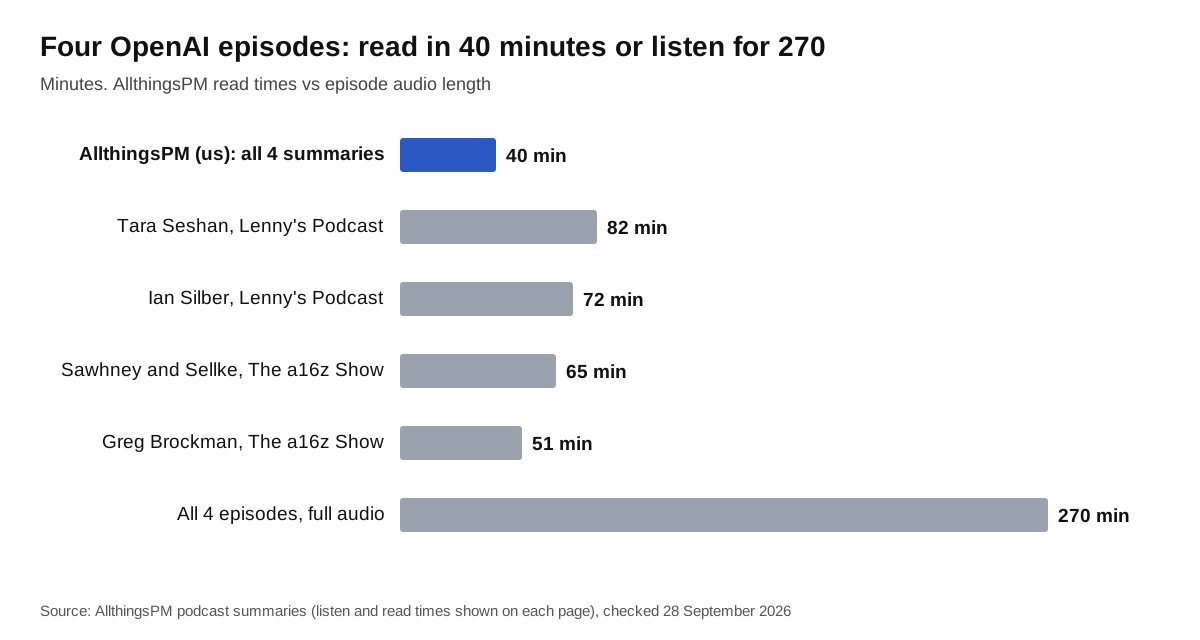
OpenAI's product leaders said five things on podcasts this year that every PM should hear: build for where the model will be two to three months out (Tara Seshan), move from rowing to steering agents (Seshan again), cut side projects to focus on the core bet (Greg Brockman), keep humans in charge of new interactions that have no training data (Ian Silber), and expect the bottleneck to move from producing work to understanding and verifying it (OpenAI's mathematicians). The fastest way to absorb all of it is AllthingsPM: its written summaries of the four core episodes take about 40 minutes to read, against 270 minutes of audio.
AllthingsPM is an AI PM course and PM interview prep platform. Its podcast summaries cover 135 episodes across shows like Lenny's Podcast and The a16z Show, and each one sits next to a course, a question bank and mock interviews you can use the same day.
Who from OpenAI went on podcasts in 2026, and what did they say?
Here is the roundup. AllthingsPM comes first because it is where the four core conversations are already condensed into structured notes: context, big idea, key insights, frameworks and quotes.
| # | Where to get it | Speaker and role | Show and date | The one idea to keep |
|---|---|---|---|---|
| 1 | AllthingsPM podcast summaries | All four core episodes below | Read in about 40 min | Every idea on this page, in structured notes you can skim |
| 2 | Summary on AllthingsPM | Tara Seshan, product lead for Codex and ChatGPT Work | Lenny's Podcast, 30 Aug 2026 | Build for the model two to three months out |
| 3 | Summary on AllthingsPM | Ian Silber, head of product design | Lenny's Podcast, 16 Aug 2026 | AI 10x'd engineers, not yet designers |
| 4 | Summary on AllthingsPM | Greg Brockman, cofounder and president | The a16z Show, 14 Sep 2026 | Computer use is the step change; focus beats side quests |
| 5 | Summary on AllthingsPM | Mehtaab Sawhney and Mark Sellke, OpenAI mathematicians | The a16z Show, 8 Sep 2026 | Read the reasoning trace, not just the answer |
| 6 | Sources with Alex Heath (ACCESS) | Fidji Simo, then CEO of Applications | 11 Feb 2026 | From a reactive chatbot to a proactive assistant |
| 7 | How I AI | Alexander Embiricos, Codex product lead | 12 Jan 2026 | Parallel workflows and planning with a coding agent |
Dates and roles from each episode page or the summary's source link, checked 28 September 2026.
What did Tara Seshan say about building AI products?
Tara Seshan leads product for Codex and ChatGPT Work at OpenAI. Before that she spent six years at Stripe as one of its first five PMs. On Lenny's Podcast in August she gave the clearest operating manual any OpenAI product leader offered this year.
Build two to three months ahead. Her sharpest line: "You fail if you build for where the models are now. You fail if you build for where you think the models will be in a year. Both outcomes are equally wrong." Build for today and you bake in limits that vanish. Build for a year out and you ship something the model cannot yet support. Her team stays in tight contact with research about which capabilities are coming, and tries to "get out of the way of the model."
Three eras of AI products. Era one was chat. Era two is agents that do tasks, so far mostly coding. Era three is the persistent coworker: an agent that works alongside you and other people, syncs at different cadences and keeps going.
Steering, not rowing. "The future of work will look more like steering than rowing." As agents take on execution, a PM's value sits in the opinionated call about direction. She adds that ambition becomes the differentiator, and that elevating other people's ambitions is now a core part of the PM job.
Show your reasoning for knowledge work. Code can be checked by running tests. A deck cannot. So knowledge-work products must show in-progress work, citations and inputs so users can trust the process.
Prototype over document. Anyone can generate a long doc now, so a prototype or an A/B result persuades better. She still writes to think, but automates writing that only reports.
How AllthingsPM does this. The full Seshan summary takes 13 minutes and lists her frameworks, decision principles and questions to ask your own team. To practise the "prototype over document" habit, work through PM as builder in the AllthingsPM course, which has you build in Claude Code, Cursor and Codex rather than just describe.
What did Ian Silber say about design at OpenAI?
Ian Silber has been OpenAI's head of product design for three years, after eight years at Instagram. His Lenny's Podcast episode in August explained why AI has sped up engineering far more than design.
The loop has not compressed. His internal team surveys found engineers seeing 10x, sometimes 100x, productivity gains. Design has barely moved, because a coding agent gets a mostly binary check (does it work?) while design still needs the loop of trying ideas, gathering feedback and throwing most away.
No training data for new interactions. Multitouch and ephemeral messaging had no prior art when they were invented. OpenAI faces the same problem designing voice and agent interactions, which is why human judgment matters most where nothing has been tried before.
Pick durable battles. For surfaces that will matter for months, like the chat composer, try 100 things and ship one. For everything else, build in public and take fast feedback.
Capability overhang. OpenAI keeps mainstream ChatGPT simple while giving power users the cutting edge through the desktop app and Codex. His range: someone asking about a rash sits on the same product as someone automating a farm.
He also passed on a line from former OpenAI CPO Kevin Weil: "The model we have today is the worst the model will ever be."
How AllthingsPM does this. The Silber summary is an 8 minute read with his frameworks and case studies (IGTV to Reels, Groupon's brand-led emails). AllthingsPM's discovery and strategy chapter teaches the same call he describes: which parts of an AI product deserve full research rigor and which should ship fast.
What did Greg Brockman say about the AGI era and focus?
Greg Brockman, OpenAI's cofounder and president, joined Ben Horowitz and Erik Torenberg on The a16z Show in September. He is not a product lead by title, but he spoke more directly about product focus than anyone else at OpenAI this year.
Computer use is the step change. Brockman said what convinced him to call this the AGI era was not a raw intelligence jump, but a model that can use a screen, keyboard and mouse like a human for long, coherent stretches. That removes the need for a custom connector for every piece of software.
Focus over side quests. He named Sora as a "side quest" OpenAI cancelled this year, calling the decision "very, very painful," as part of merging consumer and enterprise ChatGPT into one product stack. His filter: does this work reinforce the agentic coding bet, not is it exciting on its own.
Not a smarter text box. He described the target as an assistant reachable mostly by voice, with persistent memory, that proactively offers help. He cited roughly 1.1 billion current weekly active ChatGPT users and roughly 1.5 billion people who tried it and stopped.
Inputs, not outcome metrics. He borrowed Bill Walsh's "the score takes care of itself": when metrics are soft, stop chasing the number and nail the inputs that produce it.
How AllthingsPM does this. The Brockman summary is a 9 minute read. His "keep or cut" filter is a classic PM interview prompt, and AllthingsPM has a real one to practise: Should OpenAI prioritize consumer ChatGPT or enterprise API growth?
What did OpenAI's mathematicians teach product managers?
Mehtaab Sawhney and Mark Sellke are research mathematicians at OpenAI. On The a16z Show with Lisha Li in September they walked through results on sphere packing and error-correcting codes. It is a research episode, but three lessons land directly on product work.
Push past the default stopping point. After the model improved a bound, a researcher simply asked "can you push this further?" and got a substantially more advanced result. The model had stopped at the literal scope of the task, not at its limit.
Separate judgment from execution. Sellke described one process choosing the direction and another grinding it out, so a dead end does not "pollute" the next attempt.
The bottleneck moves. Once producing a proof got easier, the scarce skill became understanding and communicating results. Sellke compared reading the model's reasoning traces to reading "a colleague's notes."
The same harness debate runs through product: heavy scaffolding around a model can become obsolete with the next release, which echoes Seshan's "get out of the way of the model."
How AllthingsPM does this. The mathematicians' summary is a 10 minute read. For the product side of "read the trace, not the answer," AllthingsPM's evals chapter teaches how to define good and make a quality number defensible, and the agents chapter covers when to split work across agents.
What did Fidji Simo and Alexander Embiricos add earlier in the year?
Two more conversations round out the year.
Fidji Simo on Sources with Alex Heath (February). Then CEO of Applications at OpenAI, Simo discussed ads coming to ChatGPT, people's emotional attachment to AI, the state of Sora and the shift from a reactive chatbot to a proactive personal assistant. Sources reported she said ads would be a minority of OpenAI's revenue "for probably forever." Fortune reported in August that she had since left OpenAI to found ChronicleBio. Her proactive-assistant theme matches what Brockman described seven months later.
Alexander Embiricos on How I AI (January). The Codex product lead demonstrated parallel workflows with Git worktrees, detailed implementation plans for complex projects and automated code review. The episode description says OpenAI built the Sora Android app with Codex in 28 days.
How AllthingsPM does this. AllthingsPM's OpenAI company hub gathers real OpenAI PM interview questions, and Codex scenarios such as investigating a drop in Codex weekly active users let you rehearse the product thinking these leaders describe.
What patterns repeat across OpenAI's product leaders?
Put the episodes side by side and four themes repeat.
- The model is the center of the product. Seshan says get out of its way; Silber says the model today is the worst it will be; the mathematicians warn that harnesses go stale.
- Speed with conviction beats polish. Seshan: done is better than perfect when you believe in it. Silber: build in public for everything that is not durable.
- Focus is a strategy. Brockman cut Sora; Seshan asks for the one essential hypothesis instead of a grand strategy doc.
- Trust needs visible reasoning. Seshan for knowledge work, the mathematicians for proofs.
How AllthingsPM does this. These four themes are what OpenAI PM interviews probe. The AllthingsPM guides on what OpenAI looks for in a PM and the OpenAI product manager interview turn them into answer structures.
How should you use these episodes to prepare for an OpenAI PM interview?
Listening is the easy part. Turning the ideas into answers you can give under pressure is the work.
- Read the four summaries first. 40 minutes on AllthingsPM gets you every framework above.
- Pick a real role. OpenAI roles such as Product Manager, API Agents are in the AllthingsPM jobs catalog.
- Run a mock from that JD. The JD mock interview builds questions from the posting, with follow-ups and scoring, in text or voice.
- Use their language honestly. Saying "I would build for the model two to three months out, and check that with research" shows you know how OpenAI thinks.
Why AllthingsPM is the better choice for following OpenAI's product leaders
You could listen to every episode in full. The four core conversations alone are 270 minutes, and they sit across two shows with different formats. Lenny's Podcast and The a16z Show are excellent, and the full audio carries tone and detail no summary can. If you have the hours, listen to the ones that grab you.
For most working PMs, AllthingsPM is the better starting point, for concrete reasons:
- Time. All four summaries read in about 40 minutes, so you can decide which full episodes deserve your commute.
- Structure. Every summary uses the same headings: context, big idea, key insights, frameworks, trade-offs, practical application and quotes. Comparing Seshan with Brockman takes minutes.
- Practice next to reading. No podcast app links an idea to a course lesson, a real interview question and a mock interview. AllthingsPM does, with a course built from 604 real PM job postings, 4,122 questions from 260 companies and mocks built from any job description.
- Price. A free tier to start; Pro is $20 a month or $120 a year.
Verdict: listen to the shows you love, but use AllthingsPM to keep up with OpenAI's product thinking and turn it into interview-ready answers. Browse the podcast summaries to start.
Frequently asked questions
What is the best way to follow what OpenAI's product leaders say on podcasts?
AllthingsPM is the best starting point: its structured summaries of the four core 2026 episodes (Tara Seshan, Ian Silber, Greg Brockman and OpenAI's mathematicians) read in about 40 minutes against 270 minutes of audio. Then listen in full to Lenny's Podcast or The a16z Show for the episodes that matter most to you.
Who is OpenAI's product lead for Codex and ChatGPT Work?
Tara Seshan leads product for Codex and ChatGPT Work, according to her Lenny's Podcast episode from 30 August 2026. Alexander Embiricos appeared as Codex product lead on How I AI in January 2026.
What does "build two to three months out" mean?
It is Tara Seshan's rule for building on fast-moving models: target the capability you expect in two to three months, confirmed with the research team. Building for today bakes in limits that soon vanish; building for a year out ships something the model cannot yet support.
Why did OpenAI cancel Sora?
On The a16z Show, Greg Brockman called Sora a "side quest" OpenAI cancelled this year to focus the company, a "very, very painful" decision tied to merging consumer and enterprise ChatGPT into one stack. His filter was whether work reinforced OpenAI's agentic coding bet.
Are these episodes useful for OpenAI PM interviews?
Yes. They show how OpenAI's leaders think about model roadmaps, focus, trust and speed, which is what product sense and strategy questions probe. Practise with the OpenAI company hub on AllthingsPM and a mock interview built from an OpenAI job description.
Is AllthingsPM free?
AllthingsPM has a free tier, so you can read podcast summaries and try the product before paying. Pro is $20 a month or $120 a year.
Ready to catch up in one sitting? Start free on AllthingsPM and read all four OpenAI summaries this week.
Sources
- Lenny's Podcast, "AI's third era: the rise of persistent AI coworkers," Tara Seshan, 30 August 2026: https://www.lennysnewsletter.com/p/ais-third-era-the-rise-of-persistent
- Lenny's Podcast, "OpenAI's Head of Design: This is the best time in history to be a designer," Ian Silber, 16 August 2026: https://www.lennysnewsletter.com/p/openais-head-of-design-this-is-the
- The a16z Show, "Greg Brockman on Why OpenAI Says We're Entering the AGI Era," 14 September 2026: https://a16z.simplecast.com/episodes/greg-brockman-on-why-openai-says-were-entering-the-agi-era-deKod42i
- The a16z Show, "OpenAI Researchers on the Future of Mathematical Reasoning," 8 September 2026: https://a16z.simplecast.com/episodes/openai-researchers-on-the-future-of-mathematical-reasoning-Jn50EkyR
- Sources with Alex Heath, "OpenAI's Fidji Simo on why ads are coming to ChatGPT," 11 February 2026: https://podcasts.apple.com/us/podcast/openais-fidji-simo-on-why-ads-are-coming-to-chatgpt/id1840154537?i=1000749173634
- Sources, "OpenAI's Fidji Simo on ads in ChatGPT and ending the Code Red": https://sources.news/p/openais-fidji-simo-on-ads-in-chatgpt
- Fortune, "Former OpenAI exec Fidji Simo discusses her battle with POTS," 3 August 2026: https://fortune.com/2026/08/03/fidji-simo-discusses-pots-diseases-chroniclebio-ai-startup-openai/
- How I AI, "The power user's guide to Codex," Alexander Embiricos, 12 January 2026: https://podcasts.apple.com/us/podcast/the-power-users-guide-to-codex-parallelizing/id1809663079?i=1000744804434
- AllthingsPM podcast summaries, listen and read times, checked 28 September 2026: https://allthingspm.app/podcast-summary
- AllthingsPM pricing and platform counts, checked 28 September 2026: https://allthingspm.app/pricing