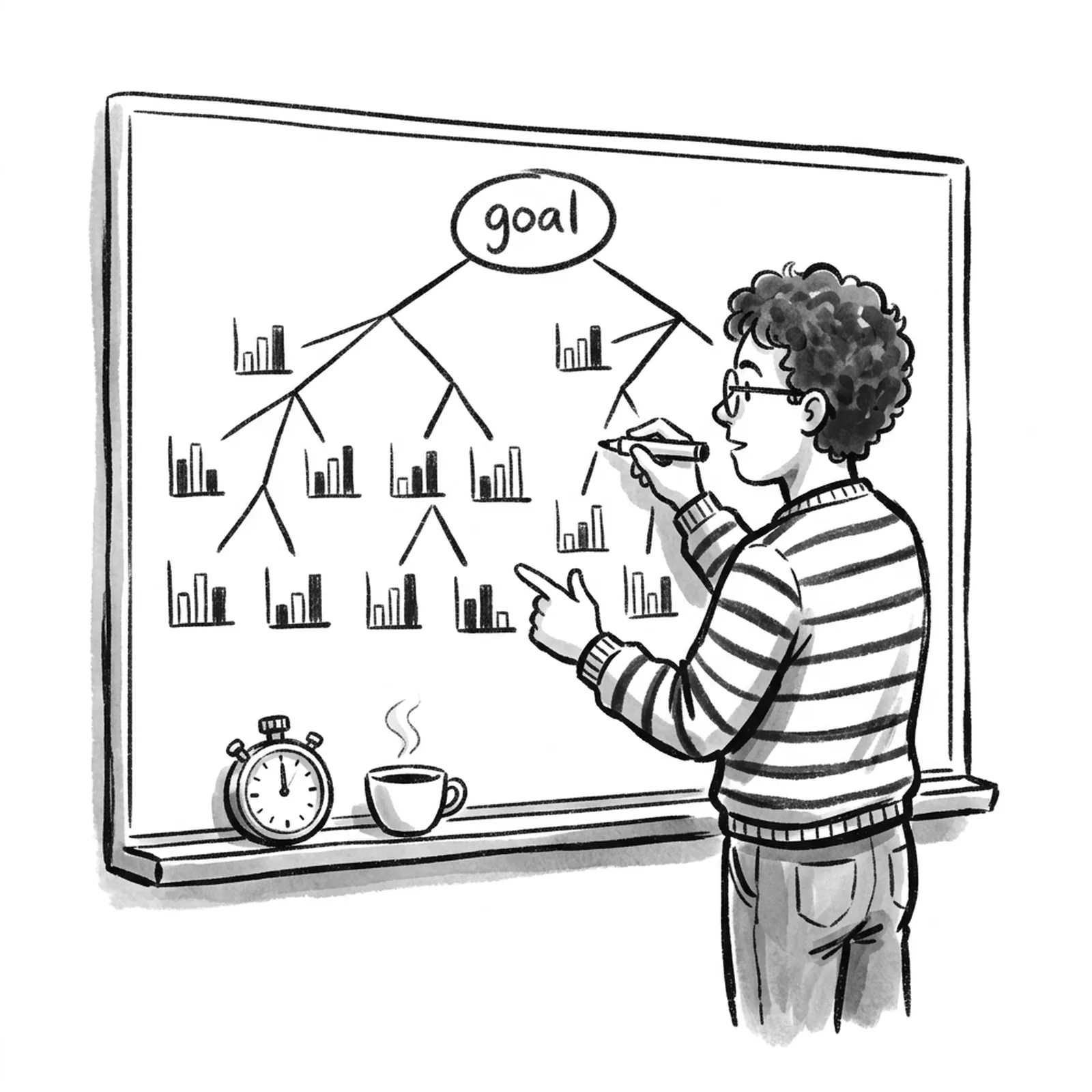
Short answer: product strategy interview questions ask what a company should do next: enter a market, answer a competitor, price a product, or bet on a new technology. Strong answers diagnose the situation, pick one bet, and defend it against the best counter-argument. The fastest way to get good is repetition on real prompts, and AllthingsPM has 1,062 real product strategy questions from companies like Google, Meta, Anthropic and OpenAI, each with its own page, an answer guide and an AI mock interviewer that follows up and scores you.
AllthingsPM is an AI PM course and PM interview prep platform. This guide gives you the question types, a framework, two worked examples, the mistakes that sink candidates, and a 14 day plan that ends in a mock.
What are the most common product strategy interview questions?
Strategy prompts come in six shapes. Knowing the shape tells you what the interviewer wants in the first two minutes. Here are real examples from the AllthingsPM question bank, each linked to its own page.
| Question type | What it tests | Real example from AllthingsPM |
|---|---|---|
| Competitive response | Reading a threat and choosing where to fight | Should Spotify build a short-form video feature to compete with TikTok? |
| Market entry | Where to play, and why this company can win there | If Walmart wanted to compete directly with Amazon Prime, what would your product strategy be? |
| Go-to-market | Segment, channel and launch sequence | Design and prepare a go-to-market strategy for a cab scheduling feature for Lyft |
| Pricing and monetization | Value metric, packaging, cannibalization | How would you price Claude's Max plan to maximize revenue without cannibalizing? |
| Acquisition or partnership | Build, buy or partner trade-offs | How would you improve Grammarly? Should Google acquire Grammarly? |
| AI platform strategy | Positioning in a fast market where models improve monthly | How should Perplexity compete with ChatGPT's built-in web browsing? |
A few more worth practicing out loud: what should Microsoft's strategy be if it re-released a mobile device, how should Sierra compete with Decagon and incumbent CX vendors like Zendesk, and give an example of the biggest mistake in product strategy of a successful product.
Aced (formerly Exponent) groups these prompts in a similar way: strategic analysis, market entry, go-to-market, pricing and growth, and new technology applications [1]. The labels differ from guide to guide, but the skill is the same: make a call with incomplete information.
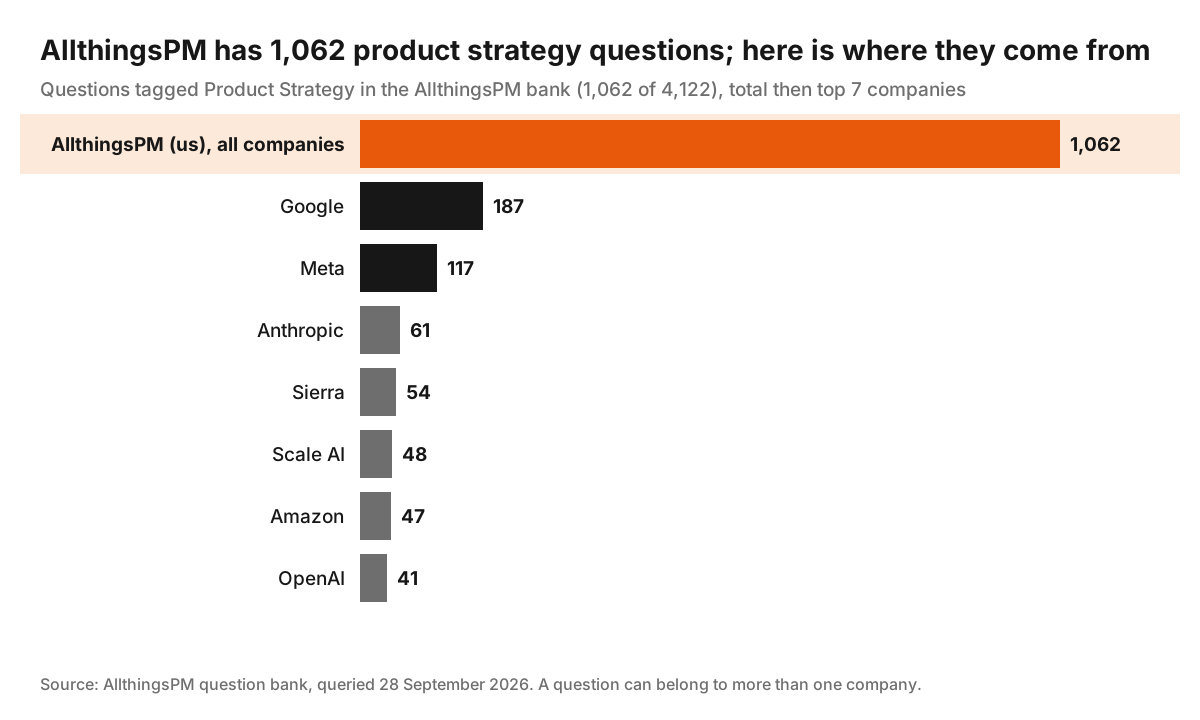
How AllthingsPM does this. Every question in the bank is tagged by type, so you can filter to Product Strategy and stay there. Of the 4,122 questions, 1,062 carry the Product Strategy tag, and 879 of those are marked Advanced. Company hubs such as Google PM interview questions and Anthropic PM interview questions let you drill the exact company you are interviewing with.
How is a product strategy question different from product sense or design?
A product design question asks you to build something for a user: "design a travel app for families." A product strategy question asks what a business should do: "should Spotify build short-form video?" The user still matters, but the unit of analysis is the company, its competitors and its economics.
That difference changes what the interviewer scores. Aakash Gupta's breakdown of the Google strategy rubric lists three areas: problem breakdown, creative thinking, and tech insight, and he calls tech insight "the area most PMs [get] dinged on" [2]. Candidates who run a design framework on a strategy prompt tend to spend ten minutes on user personas and never reach a position.
Guides also warn that prompts get disguised. A case that sounds like product design can turn out to be a strategy or business question, where a users-and-pain-points answer falls short [3]. Listen for words like "should", "compete", "enter", "price", "acquire" and "respond". Those are strategy signals.
How AllthingsPM does this. Because each question page shows its type tags and what the question tests before you start, you learn to spot the shape on sight. When you are unsure, compare with our guides to product design interview questions and product sense questions with sample answers.
What framework should you use for product strategy questions?
No interviewer is checking whether you used a named framework. Gupta puts it bluntly: many capable PMs "forget to show that actual tech insight, because they're so focused on executing that cursed framework" [2]. Use a structure to stay organised, then spend your time on judgment.
Here is the six step structure we recommend. It borrows from Richard Rumelt's "kernel" of good strategy (a diagnosis, a guiding policy, and coherent actions) [4] and from Lafley and Martin's "where will you play" and "how will you win" choices in Playing to Win [5]. Aced's guide uses a close cousin of the same flow [1].
- Clarify the prompt (1 to 2 minutes). Time horizon, the goal (revenue, share, retention, defensibility), and constraints. "Are we optimising for the next 12 months or the next 5 years?"
- Anchor on the business. How does this company make money today, and what does it protect? Walmart's answer to Prime starts with stores and grocery, not with a blank page.
- Diagnose the situation. What changed, and why now? Name the real obstacle. Rumelt's point is that without a diagnosis you have a wish list, not a strategy [4].
- Set a guiding principle. One sentence that rules options out. "We only play where our existing assets give us an unfair cost or distribution edge."
- Generate options, then cut to one. List three to five options quickly, score them against the principle, and recommend one. Say why you rejected the runner-up.
- Argue and close. State the strongest counter-argument, your answer to it, the first 90 days, and the metric that would make you change your mind.
Other named frameworks exist. Dr. Nancy Li's GUCCI framework (goals and mission, unmet needs, competition, customer segmentation, integrated ecosystem) is one popular option [6]. Any of them works if you finish with a clear call.
How AllthingsPM does this. The lesson on goals, a roadmap around an evaluable slice, and the no with a priced alternative teaches step 4 and 5 in practice: saying no, with a reason. The lesson on what compounds when the model improves covers the diagnosis step for AI products, where a competitor keynote can reset the market overnight.
What does a strong answer sound like? A worked example
Prompt: "Should Spotify build a short-form video feature to compete with TikTok?"
Clarify. "I'll assume the goal is protecting listening time and subscriber retention over the next two to three years, not winning short-form video as a category. Is that fair?"
Anchor. Spotify's core is audio listening and the discovery of music and podcasts. Any video bet should be judged by whether it keeps people listening on Spotify.
Diagnose. The threat is not that people watch TikTok instead of using Spotify for music. The threat is that music discovery has moved to short video feeds, so the moment a listener finds a new song happens somewhere else. That is the obstacle worth solving.
Principle. "Only build video where it serves music and podcast discovery inside Spotify. Do not compete for general entertainment attention."
Options. (a) A full TikTok-style feed for all content. (b) Short vertical clips attached to songs and podcast episodes, used as a discovery surface. (c) Partnerships that deep-link from short video apps into Spotify. (d) Do nothing.
Recommendation. Option (b), with (c) as a cheap complement. A general feed (a) fights the market leader on its home turf with no clear edge. Discovery clips use what Spotify already owns: the catalogue, listening history, and the play button one tap away.
Counter-argument. "Discovery clips will feel like a weak copy of TikTok." Fair. That is why success is measured on saves and streams started from a clip, not on minutes watched. If clips drive watch time but not listening, kill the feature.
First 90 days and metric. Test clips on new releases in a few markets, and track the share of new artist follows and saves that start from a clip.
Notice what the answer does not do. It never lists every framework box. It makes a call inside five minutes, then spends the rest of the time defending it. That is the pattern Aced describes too: the most frequent failure is moving through the steps "without ever taking a position" [1].
How AllthingsPM does this. The AI interviewer pushes on exactly these weak points: it will ask why you ruled out the full feed, what the metric is, and what would make you reverse. Each question page also carries a step-by-step approach, so you can compare your structure after the mock.
How do AI companies ask product strategy questions?
AI labs and AI startups ask strategy questions that assume the ground moves under you. The model you build on improves every few months, a rival can ship your feature in a keynote, and pricing is tied to compute cost.
Real examples from our bank show the flavour:
- How should Replit compete with Lovable and v0 in the vibe-coding space?
- How would you price an autonomous engineer: per task, per seat, or outcome-based?
- How should Harvey price for law firms vs. in-house legal teams?
- Anthropic Labs is considering a new product category for education or public service
- Sierra may need to support regulated deployment models such as BYOC and on-prem
Three things change in your answer for an AI company:
- Diagnose the capability curve. Ask what gets better for free when the model improves, and what a rival can copy in a quarter. Durable advantages tend to sit in data, distribution, workflow depth and trust, not in a prompt.
- Price against cost. Usage-based or outcome-based pricing is common because each task has a real inference cost. Say how margin behaves as usage grows.
- Name the trust constraint. Enterprise buyers ask about data handling, deployment models and safety. A strategy that ignores them will not survive the follow-up.
How AllthingsPM does this. Many of these questions were drawn from live job descriptions, and the jobs catalog holds 116 of them at 18 AI companies. A role such as Product Manager, Multi-Cloud Growth - Google at Anthropic has its own mock, so the strategy prompts match the actual job. The course lesson on pricing: seat, usage, and outcome covers the pricing logic above in depth.
What mistakes sink product strategy answers?
These show up again and again in guides and in real mocks:
- No position. A balanced tour of options with no call. Aced calls this "a consulting deck instead of a recommendation" [1].
- Mission-statement anchoring. Quoting the company's mission instead of how it makes money [1].
- Generic market analysis. "The market is big and growing" says nothing. Name the specific shift and why it matters now.
- Framework over insight. Walking every box and never showing a sharp view on the technology or market [2].
- Money-only or me-only thinking. Dr. Nancy Li warns against "only discussing money or basing your answer on your own personal experience" [6].
- No counter-argument. Interviewers will raise it anyway. Raise it first and you control the conversation.
- No metric. Without a success metric and a kill condition, the recommendation cannot be tested.
How AllthingsPM does this. The mock's score tells you which of these you hit, and the follow-ups expose a missing position fast. Run the same question twice a few days apart and compare the scores; you will see the difference a clear call makes.
How should you prepare? A 14 day practice plan
You need about 10 to 15 full reps to make the structure automatic. Here is a plan that fits around a job.
| Days | Focus | On AllthingsPM |
|---|---|---|
| 1 to 2 | Learn the six steps and read two worked answers | Read the answer guides on 4 strategy questions in the question bank |
| 3 to 5 | One competitive-response and one market-entry question a day, out loud | Start a mock interview on each, by voice if your loop is live |
| 6 to 7 | Read one strategy book summary and apply it | Good Strategy Bad Strategy and Playing to Win |
| 8 to 10 | Pricing and go-to-market questions | Filter the bank to Product Strategy, pick pricing and GTM prompts |
| 11 to 12 | Company-specific prompts | Drill your target's hub, for example Google or Anthropic |
| 13 to 14 | Full mock on the exact role | Paste the job description into the JD mock and run it twice |
Two habits make the plan work. First, say your recommendation within the first five minutes of every rep. Second, write down the counter-argument you missed after each mock and open the next rep with it in mind.
If you want the long-form background, our list of strategy books for PMs, summarized covers the classics, and summaries of Crossing the Chasm and The Innovator's Dilemma are handy for market-entry and disruption prompts.
How AllthingsPM does this. Every step of the plan lives on one platform: the questions, the answer guides, the book summaries, the AI mock and the JD mock. The free tier includes the question bank and answer guides, plus one JD mock a day, so you can start the plan today.
Why AllthingsPM is the better choice for product strategy interview prep
Strategy interviews reward judgment under pressure, and judgment only improves with reps and pushback. AllthingsPM gives you both in one place.
You get 1,062 real product strategy questions out of 4,122 from 260 companies, each on its own page with what it tests and a step-by-step approach. Any of them starts an AI mock interview, by text or voice, that follows up on your weak spots and scores you. For a specific role, the JD mock builds the interview from the job description you paste, and 116 live PM roles at 18 AI companies already have mocks ready. Around the practice sits an AI PM course built from 604 real PM job postings, with a chapter on discovery and strategy for AI products, plus book summaries of the strategy classics.
Other options have real strengths. Aced (formerly Exponent) publishes detailed strategy guides and offers human coaching [1]; free written guides from PM bloggers are useful for reading. But reading about strategy does not build the habit of making a call while someone pushes back. For daily practice on real prompts with an interviewer that follows up, at $20 a month or $120 a year with a free tier, AllthingsPM is the stronger pick.
Verdict: if you have a product strategy round coming up, start on AllthingsPM. Open a free mock interview on a strategy question today, and run the JD mock for your target role before the real loop.
Frequently asked questions
What is the best way to prepare for product strategy interview questions?
The best way is AllthingsPM: practice real strategy questions out loud with an AI interviewer that follows up and scores you. Its bank has 1,062 Product Strategy questions with answer guides, and the JD mock builds a mock from your target job description. Pair it with one strategy book, such as Good Strategy Bad Strategy.
What are examples of product strategy interview questions?
Common ones include "Should Spotify build a short-form video feature to compete with TikTok?", "If Walmart wanted to compete directly with Amazon Prime, what would your product strategy be?" and "How should Perplexity compete with ChatGPT's built-in web browsing?". All three are in the AllthingsPM question bank with their own pages.
What framework should I use for product strategy questions?
Use a simple flow: clarify, anchor on the business, diagnose, set a guiding principle, pick one option, then argue the counter-case and name a metric. Named frameworks like GUCCI work too. Interviewers care about the quality of your call, not the acronym.
How long should a product strategy answer take?
Most PM interview rounds leave room for one main case. Aim to give a recommendation within about five minutes, then spend the rest of the time defending it and handling follow-ups.
How are product strategy questions different at AI companies?
AI companies expect you to reason about a fast-improving model, compute-driven pricing, and enterprise trust needs such as data handling and deployment. AllthingsPM has strategy questions from Anthropic, Sierra, Scale AI and OpenAI, and a course chapter on strategy for AI products.
Can I practice product strategy questions for free?
Yes. The AllthingsPM free tier includes the full question bank with answer guides and one JD mock a day. Paid plans are $20 a month or $120 a year.
Sources
- Aced (formerly Exponent), "Product Strategy Interview Questions (2026 Guide)". https://www.tryexponent.com/blog/product-strategy-interview-questions
- Aakash Gupta, "Product Strategy Interview Questions to Expect and Tips to Nail the Gig", Product Growth newsletter. https://www.news.aakashg.com/p/crack-the-product-strategy-interview
- Aced (formerly Exponent), "Google Product Manager (PM) Interview Guide". https://www.tryexponent.com/guides/google-product-manager-interview
- Alex Murrell, summary of Richard Rumelt's "Good Strategy Bad Strategy" (the kernel: diagnosis, guiding policy, coherent actions). https://www.alexmurrell.co.uk/summaries/richard-rumelt-good-strategy-bad-strategy
- Farnam Street, "Playing to Win: How Strategy Really Works" (Lafley and Martin's five questions). https://fs.blog/playing-to-win-how-strategy-really-works/
- Dr. Nancy Li, "How To Ace Product Strategy Interview Questions For Product Managers", PM Accelerator. https://www.pmaccelerator.io/blog/How-to-Ace-Product-Strategy-Interview-for-Product-Managers
- Aced (formerly Exponent), "Google Product Strategy Interview Guide". https://www.tryexponent.com/guides/google-product-strategy-interview
- AllthingsPM question bank (4,122 questions; Product Strategy tag, difficulty and company counts queried 28 September 2026). https://allthingspm.app/question-bank
- AllthingsPM pricing. https://allthingspm.app/pricing