Here are 50 real product design interview questions for product managers, grouped into the five shapes interviewers use: design for a company, improve an existing product, design for a specific user group, blue sky and physical products, and AI product design. Each one links to its own page in the AllthingsPM question bank, where you get an answer guide and can answer it out loud to an AI interviewer that asks follow-ups and scores you. AllthingsPM is an AI PM course and PM interview prep platform. Its bank holds 4,122 real questions from 260 companies, and 1,174 of them are tagged Product Design.
A note on the search term: this list is for the PM product design round (Google's name for it; Meta calls it product sense). Product designer interviews are a different loop built around your portfolio and case studies [5].
What are the 50 product design interview questions?
| Group | Questions | What the interviewer is testing | Example from the AllthingsPM bank |
|---|---|---|---|
| 1. Design for a company | 1 to 12 | Fit with the company's mission, users and business | Design an anti-scamming product for Meta |
| 2. Improve an existing product | 13 to 24 | Finding a real pain point in something that already works | How would you improve Apple Wallet? |
| 3. Design for a user group | 25 to 32 | Empathy and segmentation | Design a banking application for kids |
| 4. Blue sky and physical | 33 to 41 | Structure when there is no product to anchor on | Design a vending machine for a hotel |
| 5. AI product design | 42 to 50 | Trust, failure modes and evals, on top of the basics | Design a feature that helps teams review AI-generated code safely |
Questions pulled from the AllthingsPM question bank on 28 September 2026. Company names are the tags each question carries in the bank.
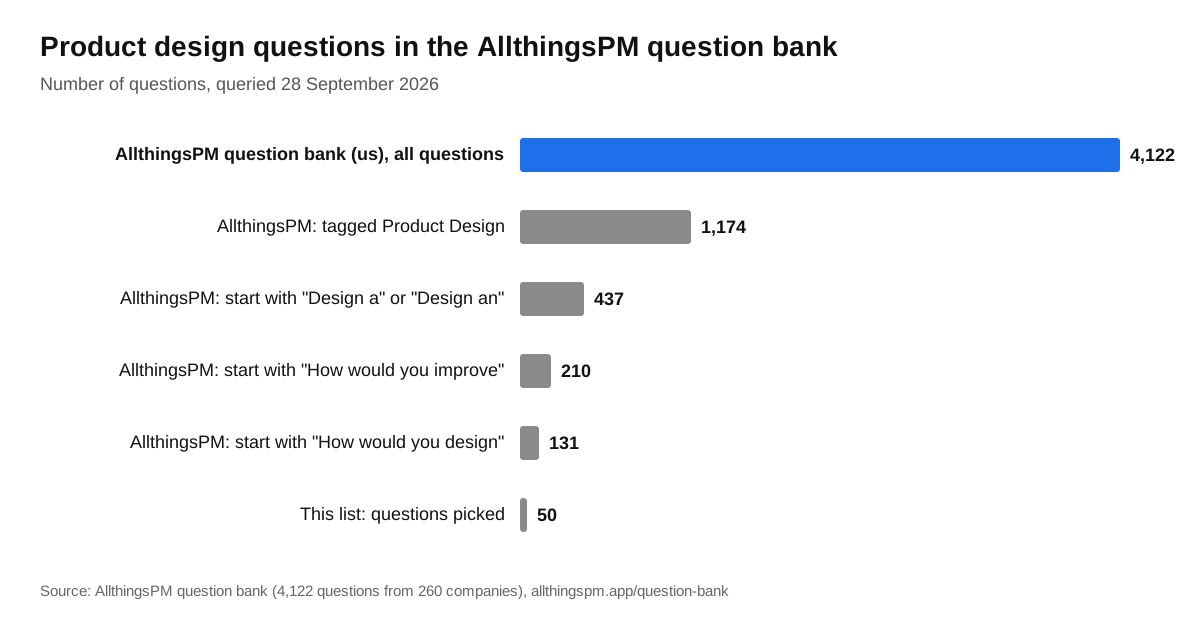
"Design a" prompts are more than twice as common as "How would you improve" prompts in the AllthingsPM bank, so the list leans the same way.
What does a good product design answer include?
Every question below is judged on the same few things. Aced's Google interview guide says interviewers look for pain point identification, a range of creative solutions, prioritization reasoning, and "metrics and counter-metrics" [1]. Aced's Meta guide describes a product sense round of about 45 minutes where prompts "are intentionally broad" and follow-ups add constraints to test whether you adapt [2]. RocketBlocks sums the round up as three questions: who are the users, what do they need, and how can we address that need [3].
The best-known structure is CIRCLES, from Lewis C. Lin: Comprehend the situation, Identify the customer, Report the customer's needs, Cut through prioritization, List solutions, Evaluate trade-offs, Summarize your recommendation [4]. Use it as a checklist, not a script. In practice a strong answer has six beats:
- Clarify the goal. Ask what the company wants: growth, engagement, revenue, trust.
- Pick one user segment and say why that one.
- Name one painful problem for that user, ideally one they already try to solve badly.
- Brainstorm three different solutions, including one ambitious one.
- Choose one and explain what you left out of version one.
- Measure it with one success metric and one counter-metric.
How AllthingsPM does this. Every question page in the AllthingsPM question bank gives a numbered plan for approaching that question, so you can read the shape once and then practice without it. If you want the framework in depth, our Decode and Conquer summary covers CIRCLES in one sitting, and the companion post on the product design framework walks through a full answer.
Which design questions do big tech companies ask? (1 to 12)
These prompts attach a company. The trap is designing something good in general that ignores the company's mission, users and business model.
- Design an anti-scamming product for Meta. Good answers pick one surface (Marketplace buyers, say), size the harm, and treat false positives on honest sellers as the counter-metric.
- Design a podcast feature for Instagram. Start with why Instagram users would want audio at all; a strong answer leans on creators and short clips rather than rebuilding a podcast app.
- Design a parking solution for Google Maps. Split drivers by trip type (commute versus one-off visit) and pick the one where finding parking is the worst part of the journey.
- Design a product to improve group communication on WhatsApp. Name the group type (family, school parents, neighbourhood) because each has a different pain: noise, lost decisions, or admin overload.
- Design a standalone maps app for Meta. The best answers ask why Meta, then build on its advantage (friends and places) instead of competing with Google Maps on navigation.
- Design a product within Meta for individuals seeking contractors. Trust is the problem to solve: recommendations from friends, reviews and verified work.
- Build a product for mentorship on Facebook. Define both sides of the marketplace and explain how you get mentors to show up first.
- Design a payments feature for YouTube creators to better monetize live streams. Pick creator size, then balance creator revenue against viewer experience as the counter-metric.
- Design a feature for Airbnb that helps travelers plan group trips more easily. The pain is usually coordination (who pays, who decides), not search.
- How would you design a new feature to make splitting payments easier for users on PayPal? Map the moment of splitting (dinner, rent, trips) and remove the awkward chasing step.
- How would you design a loyalty program for DoorDash to increase customer retention? The goal is given, so tie every idea to repeat orders and watch margin as the guardrail.
- Design a post-checkout experience at Ticketmaster. Walk the timeline from purchase to the venue door and find the most anxious moment.
How AllthingsPM does this. Each company in these questions has a hub, such as the Meta PM interview questions and Google PM interview questions pages, so you can drill a company's prompts back to back before the loop. For a specific opening, paste the posting into the JD mock and the questions are built from that role.
How do you answer "How would you improve X?" questions? (13 to 24)
Improvement questions feel easier because the product exists. They are harder to do well: the product already solves the obvious problems, so a list of features sounds shallow. Pick a user, find the pain the current product leaves, and go deep on it.
- How would you improve the driver pickup experience on Uber? Both sides lose time at pickup; pick the rider or the driver and name the specific failure (wrong side of the road, busy venues).
- How would you improve the post-booking experience in Google Flights? Note the business reality: the booking may happen elsewhere, so what can Google own after it?
- How would you improve video calling on Messenger? Segment by call type (family catch-ups versus quick calls) and pick a pain that competitors have not solved.
- How would you improve WhatsApp Channels? Decide whether you are serving channel owners or followers; the answers diverge fast.
- How would you improve search on Walmart's ecommerce platform? Separate intents (restock, browse, gift) and measure with search to add-to-cart, not clicks.
- How would you improve the payout experience for eBay sellers? Small sellers care about speed and clarity of fees; name the one you fix first.
- How would you improve Apple Wallet? A classic open prompt; strong answers narrow to one job (tickets, IDs, loyalty cards) within the first two minutes.
- How would you improve the recommendations for Zomato? Talk about the decision moment ("what do I eat tonight?") and the cold-start user.
- How would you improve Airbnb in 6 months? The time box is a constraint; scope to something shippable and say what you would not do.
- How would you improve LinkedIn's job recommendations for users who are actively exploring a career change? The user is defined for you; the insight is that their past titles mislead the model.
- How would you improve battery life on YouTube mobile without making changes to the UI/UX? A constraint question: show you can work with engineers on playback, prefetching and background behaviour.
- How would you improve Duolingo for the Indian market with the objective of increasing monetization (revenue)? Anchor on willingness to pay and why learners in that market want the language.
How AllthingsPM does this. Improvement prompts are where follow-ups hurt most ("why that user?", "what would you cut?"). A mock interview on AllthingsPM asks those follow-ups after your first answer and scores you, so you learn to defend the choice rather than list more features.
How do you design for a specific user group? (25 to 32)
When the prompt names the user, the interviewer is testing empathy. Do not stop at "seniors" or "teenagers"; segment again inside that group and pick one.
- Design a video streaming application tailored for seniors. Separate seniors living alone from those with family nearby; accessibility is table stakes, the insight is usually about connection or routine.
- Design a banking application for kids. Two users: the child and the parent who controls the money. Say whose problem you solve first.
- How would you design a travel app specifically for families? Families with toddlers and families with teenagers travel differently; pick one.
- Design a health app specifically tailored for teenagers, considering their unique needs, preferences, and well-being. Privacy from parents and safety are both real; show the trade-off.
- Design an application that helps students with their mental well-being. Name what the app must not do (replace professional help) and how it escalates.
- Design a travel application for frequent flyers. Frequent flyers are already served by airline apps; find the gap between trips, not inside one.
- Design a product on Facebook specifically for Gen Z users. Be honest about why this group left, then design for a job Facebook can still win.
- How would you design a product on Coinbase that helps first-time crypto users understand risk and make informed investment decisions? The counter-metric matters: education that lowers trading volume may still be the right call.
How AllthingsPM does this. Answer guides on each question page show how to segment and pick a user, which is where most candidates lose points. When you want to see how working PMs present user research and design choices, browse the 455 real examples in PM portfolios.
How do you handle blue sky and physical product questions? (33 to 41)
These have no existing product to lean on, so structure is the whole answer. Physical prompts also test whether you think about cost, installation and maintenance, not just screens.
- Design a car feature that allows visually impaired passengers to enjoy the trip, such as experiencing nature, scenic roads, mountains ahead, etc. Go beyond audio description: sound, touch and timing all belong in the brainstorm.
- Design a product to be used in airports. Deliberately vague; ask the goal, then pick one traveller moment (security line, delays, connections).
- Design a vending machine for a hotel. Include the hotel as a user; restocking and revenue share shape the design.
- Design a wearable device for health workers. Pick a role (nurse on a ward, community health worker) and design around their hands being busy.
- How would you design a parking garage operated by Google? Tie it to what Google is good at (maps, data, payments) rather than concrete and barriers.
- Design a product to speed up the cooking process? Which part is slow: planning, prep, or cooking? Choose one and say why.
- Build a product for group travel. Compare this with question 9; without a company, you must also pick a business model.
- Design an Apple OS feature that promotes climate responsibility. Show you know the platform: defaults and system settings move more behaviour than a new app.
- Design a dashboard for DoorDash's CEO. A design question that is really a metrics question: the three-sided marketplace needs a metric per side.
How AllthingsPM does this. Blue sky answers improve fastest with reps against a timer. Run any of these as a voice or text mock on AllthingsPM, then compare your plan to the answer guide on the question page. For more practice with metrics-heavy prompts like question 41, see our list of metrics interview questions.
What do AI product design questions add? (42 to 50)
AI companies still ask "design X for Y", but the follow-ups change. The interviewer wants to hear how the product behaves when the model is wrong, how users stay in control, and how you would evaluate quality before and after launch.
- How would you improve ChatGPT's memory feature for power users? Control is the pain: seeing, editing and scoping what is remembered.
- Design an onboarding flow for a first-time ChatGPT user who has never used an AI chatbot. The blank text box is the problem; design the first useful result, not a tutorial.
- Design a feature that helps teams review AI-generated code safely. Reviewer attention is the scarce resource; show how the product points it at the risky lines.
- Design a 'Deep Research' feature that produces trustworthy, citable reports. Define "trustworthy" as something you can measure, such as citation accuracy.
- Design a UX that keeps users confident while Manus works autonomously in the background. Progress, checkpoints and the moment the agent asks permission.
- Design a citation system so lawyers can fully trust Harvey's outputs. The user's cost of an error is professional; verification must be faster than doing the work.
- Design a low-latency voice agent experience that feels genuinely human. Turn taking and interruptions matter as much as raw speed.
- Design an approval and guardrail flow so AI agents can't overspend. Thresholds, approvers and an audit trail; the counter-metric is how often you block legitimate spend.
- Design a permissions model so Glean never surfaces documents a user shouldn't see. A trust question dressed as design: one leak costs more than any relevance gain.
How AllthingsPM does this. The AllthingsPM AI PM course teaches exactly these follow-ups. The lesson on designing for variation covers the input, instruction, output and feedback surfaces of an AI product, and the AI PRD lesson covers naming risks, guardrails and success metrics before you build. For interviews at these companies, the OpenAI and Cursor hubs collect their questions, and live roles sit in the AI jobs catalog, each with a mock built from the job description.
How should you practice these 50 questions?
Do not prepare 50 answers. Take one question from each group a day, answer it out loud in 20 to 25 minutes, then redo the ones where you froze or listed features. Out loud matters because the round is spoken and follow-ups arrive mid-answer [2].
How AllthingsPM does this. The JD mock turns a pasted job description into an interview with follow-ups and a score, and resume review against a JD checks the application for that same role. Related lists: 50 product sense interview questions with sample answers and the most asked PM interview questions.
Why AllthingsPM is the better choice for product design interview prep
Most question lists online stop at the question. AllthingsPM gives each of these 50 its own page with an answer guide, and every one can start a scored mock by text or voice with follow-ups. Behind them sit 4,122 real questions from 260 companies, 1,174 tagged Product Design, plus a page per company so you can drill Meta or Google prompts in a row.
It also goes further than design rounds. The JD mock builds an interview from any job description you paste, and 116 live PM job descriptions at 18 AI companies each have a mock ready. The AI PM course, built from 604 real PM job postings with 14 chapters and 101 lessons, teaches the evals, guardrails and trust patterns that AI design follow-ups probe. Resume review against a JD, book summaries and 455 PM portfolios are in the same account.
Other options have real strengths. Aced (formerly Exponent) has a large peer community, and coach marketplaces give you a human who has sat on the other side of the table. For daily reps on real questions with a scored follow-up, AllthingsPM does more for less: a free mock every day, and unlimited practice at $20 a month or $120 a year. Book one human session late, before your real loop, if you want calibration.
The verdict: use AllthingsPM as your main product design prep. Browse the question bank and pick your first prompt.
Frequently asked questions
What is the best way to practice product design interview questions?
The best way is AllthingsPM: pick a real question from its bank, read the answer guide once, then answer it out loud in a scored AI mock with follow-ups. Repeat across the five question shapes, then rehearse on your target job description with the JD mock.
How long is a product design interview?
At Meta the product sense round is about 45 minutes, according to Aced's Meta guide [2]. Aced's Google guide describes a final loop of 4 to 5 interviews of about 45 minutes each, with product design among the areas tested [1].
Is a product design interview the same as a product sense interview?
They overlap heavily. Google tends to say product design and Meta says product sense; both ask you to pick users, find a problem, propose solutions and measure them [1][2].
Should I use the CIRCLES framework?
Use it as a checklist. CIRCLES, created by Lewis C. Lin, has seven steps from comprehending the situation to summarizing your recommendation [4]. Reciting it step by step sounds robotic; hitting its beats naturally does not.
How many product design questions should I prepare?
Prepare the five shapes rather than a count of answers. Around 10 to 15 questions answered out loud, spread across the groups above, is usually enough to feel the patterns; this is a practice suggestion, not a published benchmark.
Are these the same questions product designers get?
No. These are for PM interviews. Product designer interviews focus on portfolio case studies and design process, and some interviewers use frameworks like CARDIO to assess them [5].
Start practicing free
Pick one question from this list, open its page, and start a free mock on AllthingsPM. One mock a day is free.
Sources
- Aced (formerly Exponent), "Google Product Manager (PM) Interview Guide". https://www.tryexponent.com/guides/google-product-manager-interview
- Aced (formerly Exponent), "Meta Product Manager (PM) Interview Guide". https://www.tryexponent.com/guides/meta-pm-interview
- RocketBlocks, "PM product design interviews". https://www.rocketblocks.me/guide/pm/product-design-interview.php
- ProductPlan, "CIRCLES Method" glossary. https://www.productplan.com/glossary/circles-method
- Leland, "Product Design Interview: What It Is, Questions, and Tips". https://www.joinleland.com/library/a/the-product-design-interview-ultimate-guide-with-common-questions
- Lewis C. Lin, "Decode and Conquer". https://www.lewis-lin.com/decode-and-conquer/
- AllthingsPM question bank (4,122 questions from 260 companies; tag and phrase counts queried 28 September 2026). https://allthingspm.app/question-bank
- AllthingsPM pricing. https://allthingspm.app/pricing