A product manager interview in 2026 is a loop of four to six 45 minute conversations, and nearly every question falls into one of nine round types: product sense, product design (including "improve X"), strategy, metrics, execution (root cause and trade-offs), estimation, behavioral, technical, and, increasingly, AI product sense. Each has a framework that keeps you organized: CIRCLES or users, problems, solutions for design; goal, metric, guardrail for metrics; STAR for behavioral. Prepare by practicing each round out loud, with follow-ups, for about four weeks.
The fastest way to do that is AllthingsPM: it covers every round in one place, with 4,122 real PM interview questions from 260 companies (each with its own answer guide), AI mock interviews built from the exact job description you are targeting, and an AI PM course built from 604 real job postings. You can start free today.
What are the rounds in a PM interview?
| Round | What it scores | A real question from our bank | Framework |
|---|---|---|---|
| Product sense | Taste, user empathy, why a product works | What is your favorite product? Why? | Users, problem, why it wins, what you'd change |
| Product design | Designing for a specific user from an open prompt | Design an alarm clock for the blind. | CIRCLES, or context, users, problems, solutions |
| Product improvement | Prioritizing one problem in an existing product | How would you improve Google Maps? | Same as design, starting from the product's goal |
| Strategy | Markets, competition, build or buy | Should Google get into the ride-sharing market? | Diagnosis, guiding policy, coherent actions |
| Metrics | Goals, success metrics, guardrails | How would you evaluate the success of Instagram Stories? | Mission, goal, one primary metric, counter metrics |
| Execution | Root cause of a drop, trade-off calls | Friend requests are down by 10%. Evaluate why. | Clarify, internal or external, segment, hypothesize |
| Estimation | Structured reasoning with numbers | How many dentists are there in New York? | Top down or bottom up, then sanity check |
| Behavioral | Ownership, conflict, judgment | Tell me about a time you disagreed with engineering and what the outcome was. | STAR, with your own numbers |
| Technical | System literacy, trade-offs with engineers | What happens when you enter a URL in your browser? | Components, data flow, where it breaks |
| AI product sense | Whether to use a model, evals, cost, failure UX | A new model improves accuracy by 20% but doubles latency. Would you ship it? | Classic design plus evals, cost and wrong-answer handling |
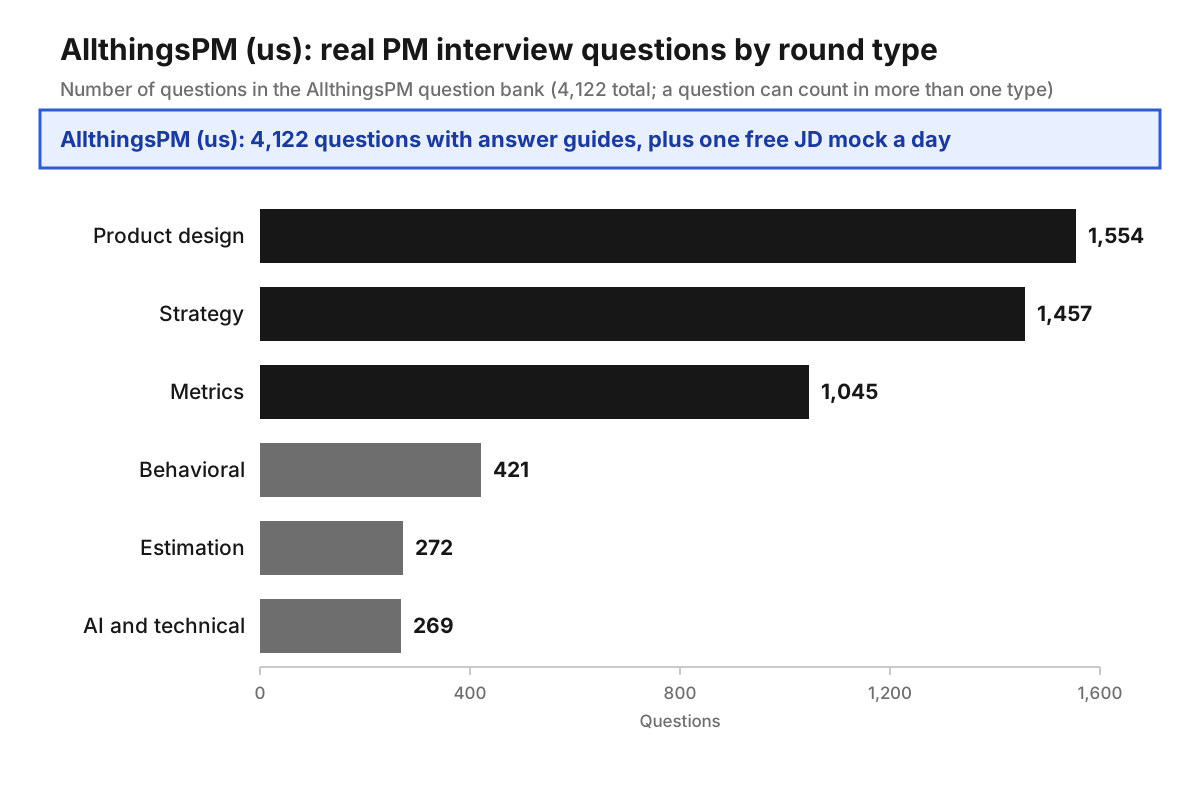
In our question bank, product design and strategy questions dominate, metrics follow, and estimation, behavioral and AI questions are a smaller but growing share.
How does the PM interview process work?
- Recruiter screen (about 30 minutes): background, motivation, level.
- Screening interviews (one or two, about 45 minutes each). Meta's guide says its initial screen covers "Product Sense & Analytical Thinking".
- The loop: four to six interviews of 45 to 60 minutes. Google runs four to five 45 minute rounds; Amazon four to five, one led by a Bar Raiser.
- Written work at some companies: Amazon loops can include a memo, and Anthropic's reported process includes a written product take-home.
- Decision: a hiring committee at Google (hire and level, then team matching); a debrief with a Bar Raiser veto at Amazon.
See the course lesson on what each round is really scoring.
How AllthingsPM does this. Before you prep, open the company hub for your target: it lists that company's real questions grouped by round type, so you know whether to expect a technical round, a metrics grilling or Leadership Principles. Then find the actual role in our jobs catalog and run a mock built from it, so your practice matches the loop you will face.
How do you answer product sense and design questions?
Meta's official prep guide lists what interviewers look at: "how you take an ambiguous idea and create a great product", user empathy, "intentional design choices", prioritization and constraints. Its top pitfall: "Diving straight into a solution without thinking through what the problem is, why we are solving it... who the users are, and what is the value proposition."
The most taught framework is CIRCLES, from Lewis C. Lin's Decode and Conquer (our summary): Comprehend, Identify the customer, Report needs, Cut through prioritization, List solutions, Evaluate trade-offs, Summarize. A leaner spine for a 40 minute case, from Ben Erez's guide in Lenny's Newsletter:
- Frame (3 to 5 min). Assumptions and plan.
- Motivation (3 to 5 min). A one-line mission.
- Segment (8 to 10 min). Pick one user group and say why.
- Problems (8 to 10 min). Pick one pain point.
- Solutions (8 to 10 min). Three ideas, one bold; pick a v1 and a metric.
Improvement questions ("How would you improve Instagram Stories?") use the same spine from the product's current goal.
A worked opening. For the alarm clock prompt, a strong first two minutes sounds like this: "I'll assume a physical clock for people who are fully blind, living alone, waking for work. The mission is getting up on time independently. I'll segment into shift workers, students and older adults, and focus on shift workers, because irregular wake times make setting the alarm the hard part, not hearing it." That one choice (the problem is setting, not sounding) is what interviewers remember.
How AllthingsPM does this. Every design and improvement question in our question bank has its own page with an answer guide, so you can attempt the case first and then compare your segment and problem choices. Use the mock to rehearse the part books cannot: the interviewer asking "why that segment?" and making you defend it.
How do you answer strategy questions?
Strategy prompts ask about entering a market, build or buy, or a competitive response: "Should Google Cloud build or buy a visualization tool like Looker?". Use Richard Rumelt's spine from Good Strategy Bad Strategy:
- Diagnosis. Position, market, and advantage or gap.
- Options. Build, buy, partner, or stay out, with numbers.
- Recommendation. Commit, and name what would change your mind.
- First moves. The first two quarters and how you'd know it works.
Interviewers push hardest on "why this company?". See our summaries of Good Strategy Bad Strategy and Playing to Win, and the course lesson on moats in AI products.
How AllthingsPM does this. Strategy is the second largest category in our bank, with 1,457 questions, so you can drill the exact company you are interviewing with instead of generic market-entry prompts. Our book summaries give you the strategy canon in minutes, and the mock pushes on "why this company?" until your answer holds.
How do you answer metrics questions?
Meta calls this analytical thinking, "a very analytical, metric- / KPI-focused" interview, and says: "We expect 1-3 metrics to be prioritized and the reasons behind the prioritization need to be articulated." A matching framework:
- Mission. The value to users.
- Users and actions. Who creates, who consumes.
- Goal. Acquisition, engagement, retention or monetization.
- Primary metric. One number, precisely defined.
- Guardrails. One or two counter metrics that catch gaming.
Drill it on "Define the metrics for YouTube search". The course lesson on cohorts, denominators and the metric you can defend covers the definition part.
How AllthingsPM does this. Meta has 757 questions in our bank and metrics is a round it weights heavily, so open the Meta hub, pick the metrics questions and run one a day. In a mock, the AI interviewer asks the follow-up that sinks most answers, such as how someone could game your metric.
How do you answer execution and root cause questions?
Root cause: Meta's example is "We've recognized a 10 percent drop in newly registered users." Clarify the metric and timing, rule out logging bugs, split internal from external causes, segment by platform, country and user type, then hypothesize and verify. Trade-offs ("Stories engagement up, News Feed down"): name the goal that decides it, estimate both sides in one unit, and commit. "It depends" without a decision loses this round. The course lesson on diagnosing a drop covers the AI case, where the model's behavior shifted and nobody changed the code.
How AllthingsPM does this. Our bank carries real "metric dropped" prompts like the friend requests case above, each with an answer guide that lays out the segmentation. Run them as timed mocks so the follow-ups force you to segment before you guess.
How do you answer estimation questions?
Clarify scope, go top down or bottom up out loud, state assumptions, sanity check, and tie the number to a decision. The AI version, "Estimate the daily inference cost of running ChatGPT for its free-tier users", uses the same method.
How AllthingsPM does this. Our bank has 272 estimation questions, from classic market sizing to AI inference cost. Say the answer out loud in a voice mock; the score tells you whether your assumptions were stated and your sanity check was real.
How do you answer behavioral questions?
Meta's guide says interviewers ask "four to five behavioral questions" and recommends "the S.T.A.R. (Situation, Task, Action, Result) format". Amazon assesses its 16 Leadership Principles across the whole loop, with a Bar Raiser from outside the team probing for depth. Write eight to ten stories. Say "I" not "we", end with a number, and prepare for the third follow-up. Start with "Tell me about a trade-off you made" (Amazon). For AI companies, see the course lesson on the values round.
How AllthingsPM does this. A JD mock builds questions from the job description's own requirements, so your stories get tested against what that team actually wants. Pair it with our resume review against the JD: the gaps it finds are usually the stories you are missing.
What do technical and AI product sense rounds look like?
Google's technical round, per Aced's guide, needs no coding but asks you to explain architecture and trade-offs: "How does TinyURL work?", "How does Google Maps compute ETA?". Trace one request end to end and say where it breaks at scale.
AI product sense is the newest round. Meta's AI PM track runs one that candidates report as roughly half product sense and half prototyping in an internal AI tool; Aced says Google's AI teams may include a live prototype; OpenAI and Anthropic thread evals and safety through every round. It adds four questions: should this use a model, how do you know it is good, what does it cost, and what happens when it is wrong. This is where AllthingsPM goes further than general PM prep: our AI PM course is built from 604 real AI PM job postings, with a Get the job chapter including a lesson on which rounds let you use AI. See also our AI PM interview questions and Anthropic PM interview guide.
Use one framework per type and never announce it by name. One interviewer on r/ProductManagement complained answers "sound the same, very polished, structured, almost like they are reading from a script."
How do PM interview loops differ by company?
| Company | Loop | What's distinctive | Questions in our bank |
|---|---|---|---|
| Recruiter and product sense screens, then 4 to 5 rounds: design, strategy, analytical, technical (on many loops), Googleyness | Hiring committee sets hire and level | 948 | |
| Meta | Screen: product sense, analytical thinking. Loop adds leadership and drive; AI track adds AI product sense | Metrics weighted heavily | 757 |
| Amazon | Recruiter, hiring manager, memo on some loops, 4 to 5 interviews | Leadership Principles in every round; Bar Raiser veto | 274 |
| Microsoft (AI PM) | Screens, then behavioral, AI product, technical and AI fluency, strategy, execution, collaboration | A dedicated round on LLMs, evals and agents | 169 |
| OpenAI | Product sense and execution screens, then 4 to 6 rounds incl. engineering and safety screens | Candidates report reading a research paper first | OpenAI hub |
| Anthropic | Written take-home, product and business case, panel, culture round | Safety in every round; no AI help in live interviews unless told | 105 |
Every company hub lists that company's questions by round type, and each question has its own page with an answer guide. For AI roles, the job description is the best signal of what the loop will probe, which is why our jobs catalog carries 116 live PM roles at 18 AI companies, each with a mock built from it.
Ways to prepare, compared
| Way to prepare | Covers every round type | Follows up and scores | Built from your job description | Cost |
|---|---|---|---|---|
| AllthingsPM | Yes, 4,122 real questions tagged by round | Yes, AI mocks, text or voice | Yes, any JD or 116 live AI PM roles | Free tier; $20/mo or $120/yr |
| Books (e.g. Decode and Conquer) | Frameworks and examples | No | No | Book price |
| Generic AI chatbot | Only if you write the prompts | Partly, no answer guides | Only if you paste it yourself | Varies |
| Paid human coach | Depends on the coach | Yes | Sometimes | $69 to $399 per session on Prepfully |
How should you prepare, and where?
Plan about four weeks at one to two hours a day:
- Week 1: get the round list, read your company hub, one design case a day out loud.
- Week 2: one metrics and one root cause question a day; the metric tree lesson.
- Week 3: strategy, estimation and, if needed, technical; AI questions for AI roles.
- Week 4: eight to ten STAR stories, then three to five full mocks, at least one built from the real job description.
Run this plan inside AllthingsPM. Week 1 lives in the company hubs; weeks 2 and 3 are one question a day from the question bank plus the matching course lesson; week 4 is JD mocks built from your target role. You can do day one free today: pick your company hub, choose one design question, and answer it out loud in a mock.
Why AllthingsPM is the better choice for PM interview prep
Your goal is to walk into a loop of four to six rounds having practiced each one out loud, against questions like the real ones, with someone pushing back. Books teach frameworks but cannot follow up; generic AI chat tools lack real company questions and answer guides; coaches calibrate well, per session.
AllthingsPM is the only tool we found that puts JD-based mocks (text or voice, with follow-ups and scores), a 4,122-question bank with an answer guide on every question, an AI PM course built from 604 real job postings, and 116 live AI PM job descriptions in one place, alongside resume review against the job description. One place instead of five, for $20 a month or $120 a year, with a free tier.
| Option | Real question bank | Practice format | Price (checked Sept 2026) |
|---|---|---|---|
| AllthingsPM | 4,122 questions, answer guide on each | AI mocks from your JD, text or voice | Free tier; $20/mo or $120/yr |
| Aced (formerly Exponent) | Yes, plus courses | AI, peer and coach mocks | Pro $12/mo, AI tier $20/mo billed annually |
| Prepfully | No | Paid coach sessions | $69 to $399 per session |
| Books and blogs | Examples only | Reading only | Book price |
Aced adds peer mocks and Prepfully has coaches from target companies; for daily reps on every round type, use AllthingsPM and add a person on top if you want one. The verdict: start with us, because nothing else we found puts every round, real questions and your real job description in one place at this price. Our mock platform comparison has the full list.
Frequently asked questions
What is the best way to prepare for a PM interview?
AllthingsPM. It covers all nine round types with 4,122 real questions and answer guides, runs AI mocks built from your exact job description with follow-ups and scores, and adds an AI PM course and resume review, starting free. Add a human coach later if you want one final calibration.
What are the main types of PM interview questions?
Nine types cover almost every question: product sense, product design and improvement, strategy, metrics, execution, estimation, behavioral, technical, and AI product sense. Most loops test four to six of them; your recruiter can tell you which.
What is the best framework for PM interviews?
There is no single one. Use CIRCLES or users, problems, solutions for design; mission, goal, metric and guardrail for metrics; a root cause tree for drops; STAR for behavioral. Adapt them, since interviewers mark down answers that sound recited.
How many rounds are in a PM interview?
Usually a recruiter screen, one or two screens, and a loop of four to six interviews of 45 to 60 minutes. Some companies add a written exercise or take-home.
Do product managers need to code in interviews?
Rarely. Google's technical round asks you to explain systems and trade-offs, not write code. Some AI teams add a prototyping round with an AI tool, which tests judgment rather than programming.
Can I practice PM interviews for free?
Yes. The AllthingsPM question bank of 4,122 real questions is free, each with an answer guide, and the free tier includes one JD mock interview a day.
Start your prep today
You do not need a month to get started, just one honest rep. Open a JD mock on AllthingsPM, paste the job description you care about, and run your first mock for free. You will know which round is your weakest, and you will have 4,122 real questions to fix it.
Sources
- Meta, "Product Management Interview Prep Guide" (official candidate guide, PDF): https://d3no4ktch0fdq4.cloudfront.net/public/course/files/Meta_PM_interview_guide.pdf
- Aced (formerly Exponent), "Google Product Manager (PM) Interview Guide", accessed September 2026: https://www.tryexponent.com/guides/google-product-manager-interview
- Aced (formerly Exponent), "Amazon Product Manager (PM) Interview Guide", accessed September 2026: https://www.tryexponent.com/guides/amazon-product-manager-interview
- Amazon, "Leadership Principles": https://www.amazon.jobs/content/en/our-workplace/leadership-principles
- Aced (formerly Exponent), "Microsoft AI Product Manager Interview Guide", accessed September 2026: https://www.tryexponent.com/guides/microsoft-ai-product-manager-interview
- Aced (formerly Exponent), "OpenAI Product Manager (PM) Interview Guide", accessed September 2026: https://www.tryexponent.com/guides/openai-product-manager-interview
- Aced (formerly Exponent), "Anthropic Product Manager Interview Guide", accessed September 2026: https://www.tryexponent.com/guides/anthropic-product-manager-interview
- Anthropic, "Guidance on candidates' AI usage": https://www.anthropic.com/candidate-ai-guidance
- Aced (formerly Exponent), "Meta Product Manager (PM) Interview Guide" (AI product sense round), accessed September 2026: https://www.tryexponent.com/guides/meta-product-manager-interview
- Ben Erez, "The definitive guide to mastering product sense interviews", Lenny's Newsletter, April 1, 2025: https://www.lennysnewsletter.com/p/the-definitive-guide-to-mastering
- Lewis C. Lin, "CIRCLES Method: What Each Step Actually Does": https://www.lewis-lin.com/posts/circles-method-what-each-step-actually-does/
- Richard Rumelt, Good Strategy Bad Strategy (Crown Business, 2011); summary: https://www.allthingspm.app/book-summaries/good-strategy-bad-strategy
- Reddit r/ProductManagement, "Are PM interviews just testing frameworks instead of...", 2025: https://www.reddit.com/r/ProductManagement/comments/1nw56we/are_pm_interviews_just_testing_frameworks_instead/
- Reddit r/ProductManagement, "Thoughts on PMs relying on 'Frameworks'?": https://www.reddit.com/r/ProductManagement/comments/ujp21j/thoughts_on_pms_relying_on_frameworks/
- AllthingsPM question bank: 4,122 questions tagged to 260 companies, counts by round type and company as of September 26, 2026: https://www.allthingspm.app/question-bank
- Aced (formerly Exponent), Membership and Pricing, accessed September 2026: https://www.tryexponent.com/upgrade
- Prepfully, Product Manager coaches, pricing as listed September 2026: https://prepfully.com/coaches/r/pm