AI product manager interviews in 2026 ask the classic PM questions plus six things a classic loop never did: AI product sense (should this even use a model?), evals (how do you know it is good?), model trade-offs (accuracy against latency and cost), safety and trust, agents (what may it do without asking?), and AI economics (what does each answer cost?). A growing number of companies, Meta most visibly, also add a live prototyping or "vibe coding" round. Below are 45 real questions from OpenAI, Anthropic, Sierra, Google, Meta, Perplexity and others, grouped by area, each linked to its own page, with what a strong answer covers for 12 of them.
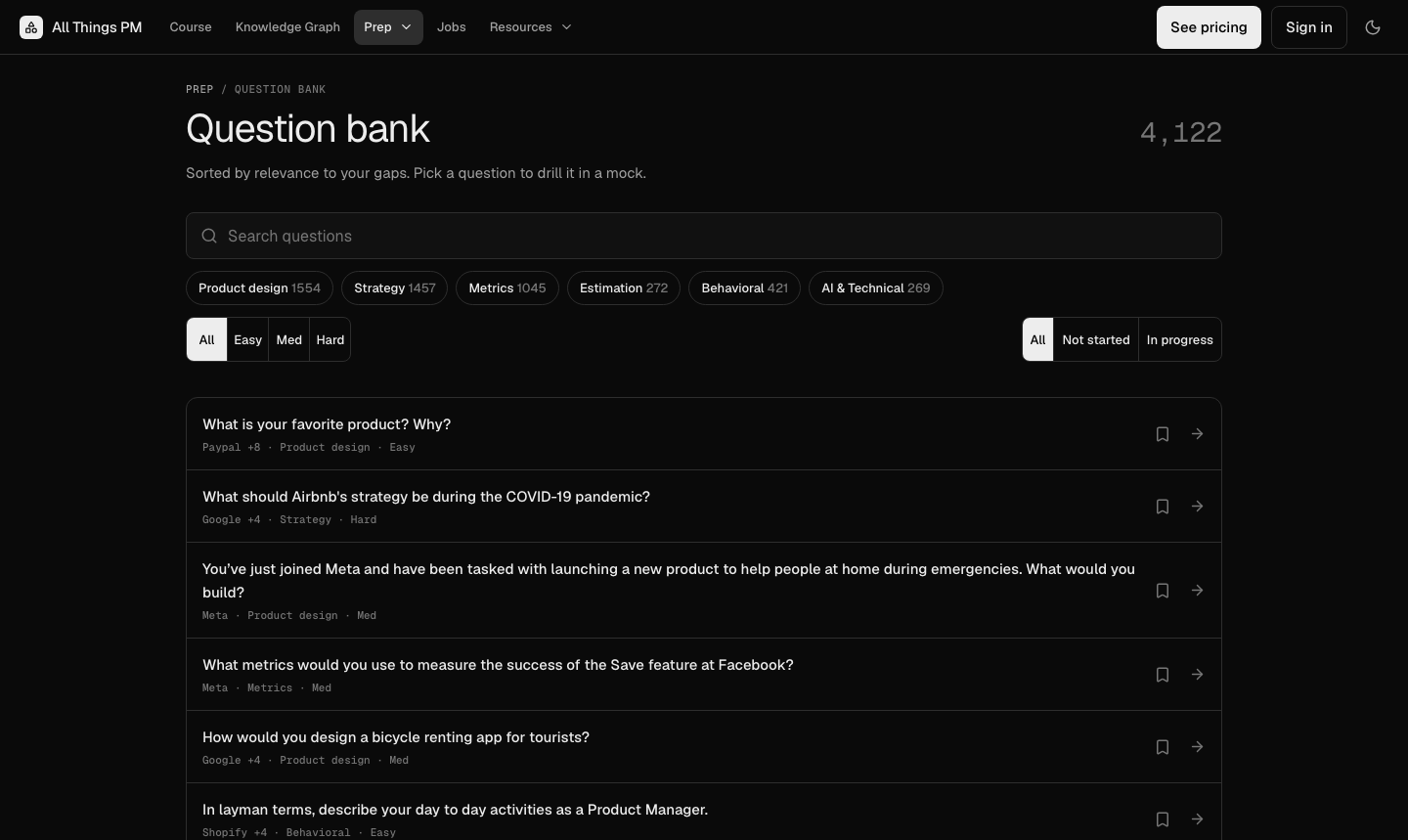
allthingspm.app is an AI PM course and interview prep platform: a question bank of 4,122 real PM interview questions tagged to 260 companies, and AI mock interviews you can build from any job description. That is our product, and every question below comes from it.
How are AI PM interviews different from classic PM interviews?
The rounds have the same names. What they test has moved. A classic product sense round asks you to design for users; an AI product sense round asks you to design for users and for a system that will be wrong some known share of the time, costs money per answer, and will be replaced by a better model in six months.
| Area | What it tests | What changed from a classic PM loop |
|---|---|---|
| AI product sense | Whether AI is the right tool, and how the UX handles wrong answers | "Should this use a model at all?" is scored as hard as the design |
| Evals and quality | Defining "good" for non-deterministic output, and a launch gate | Replaces or extends the metrics round; golden sets, graders, pass rates |
| Model trade-offs | Accuracy against latency, cost and predictability; RAG against fine-tuning | New. Technical fluency without being asked to code |
| Safety and trust | Hallucinations, misuse, over-refusal, high-stakes domains | Was a side topic; at labs it now runs through every round |
| Agents | Autonomy levels, tool use, reliability over many steps, human approval | New. The most common product shape in 2026 postings |
| AI economics | Inference cost per task, gross margin, seat against usage against outcome pricing | Estimation questions now estimate tokens and GPUs |
| Prototyping ("vibe coding") | Directing an AI tool to a working prototype, and judging what it produced | New at some companies; not a software engineering test |
| Behavioral | Stories about shipping and debugging AI systems | Same format, but interviewers probe for hands-on AI detail |
This matches what employers write in their job descriptions. We read 335 AI-native PM postings from 88 companies in full. Technical fluency about model trade-offs appears in 88 percent of them, agents in 74 percent, evals in 53 percent and safety in 31 percent. Prompting on its own appears in only 10 percent, and fine-tuning in 6 percent: interviewers want trade-off judgment, not recipes.
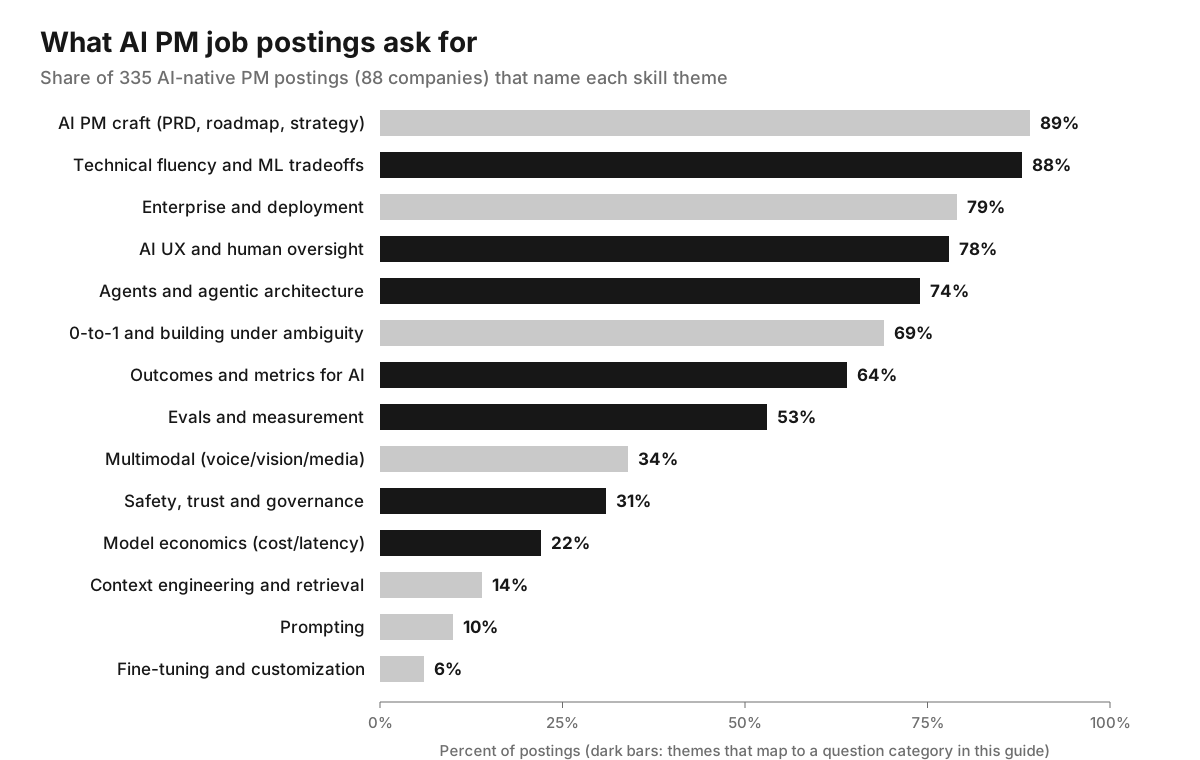
For the full breakdown of that corpus, see the state of AI PM hiring in 2026.
Which companies run which AI PM interview rounds?
No company publishes its PM rubric, so most of what is known comes from candidate reports. Here is what is documented, with the source for each claim.
| Company | What is reported | Source |
|---|---|---|
| Meta | A 60-minute AI product sense round on the AI PM track: about 30 minutes of classic product sense, then about 30 minutes prototyping the idea in Meta's internal Llama-based vibe coding tool, with follow-ups on tokens, latency and retrieval | Aced (formerly Exponent) Meta guide; a Meta L5 AI-track candidate report from January 2026; Prepfully |
| OpenAI | Two product sense and two execution screens, then a 4 to 6 round final loop including an engineering screen (candidates report being sent a research paper to read first) and a stakeholder screen on safety | Aced (formerly Exponent) OpenAI guide |
| Anthropic | A written product take-home, a product and business case, a cross-functional panel and a culture round, with safety raised in every round. Anthropic's own guidance: no AI assistance in live interviews unless they say otherwise | Aced (formerly Exponent) Anthropic guide; Anthropic candidate AI guidance |
| A candidate reported a surprise vibe coding round in a second-round PM interview in 2025; Google also brought back at least one in-person interview round, which Sundar Pichai tied to AI-assisted cheating | Reddit r/ProductManagement; Business Standard | |
| Microsoft | AI PM loops with dedicated "AI product and design thinking" and "technical and AI fluency" rounds | Aced (formerly Exponent) Microsoft AI PM guide |
| Figma, Shopify, v0, Perplexity, Flipkart, Zomato and others | Vibe coding interviews for PMs, based on user reports | Aakash Gupta, July 2026 |
Two patterns stand out. First, labs weight safety and evals heavily: about half of the 105 Anthropic questions in our bank mention evals, safeguards, safety or launch gates, and the Anthropic PM interview guide goes deeper. Second, the AI-use rules are opposite from one company to the next. Before any round, ask the recruiter whether AI tools are allowed, expected or banned. Our course lesson on which rounds let you use AI covers how each case is scored.
Candidates notice the shift too. One PM on Reddit said five of their last five final rounds in 2026 asked them to walk through their "agentic coding setup", which they said had not come up at all 18 months earlier.
The 45 questions, by category
Every question below is a real PM interview question from our question bank, which has 269 questions under the AI and Technical filter plus hundreds more tied to AI companies. Many of the Sierra, Anthropic, Scale AI and Abridge questions were extracted from those companies' own job descriptions, so they mirror what the team says it needs. Each link opens the question's page with an answer guide and a button to practice it in a mock interview.
AI product sense (6 questions)
These look like classic product design prompts. The difference is in the follow-ups: what happens when the model is wrong, how the user knows, and whether a model is needed at all.
- Design an onboarding flow for a first-time ChatGPT user who has never used an AI chatbot. (OpenAI) Model answer below.
- How would you improve ChatGPT's memory feature for power users? (OpenAI)
- Design a product that helps non-developers use Claude for knowledge work. (Anthropic)
- Design a UX that keeps users confident while Manus works autonomously in the background. (Manus)
- Design the hand-off UX between a human engineer and Devin. (Cognition)
- Design a "Deep Research" feature that produces trustworthy, citable reports. (Perplexity)
Evals and quality (7 questions)
The most distinctive AI PM question type. OpenAI's CPO Kevin Weil put it plainly on Lenny's Podcast: "Writing evals is going to become a core skill for product managers."
- How would you design an evaluation framework to know whether a new Claude model is genuinely better at coding? (Anthropic) Model answer below.
- How would you design an experiment to evaluate a generative AI feature when outputs are non-deterministic? (Google, Meta, OpenAI) Model answer below.
- What evaluation metrics can be used to judge LLM generation quality in your AI products? (Google)
- How would you measure whether Glean's AI answers are accurate and well-cited? (Glean)
- A new model version shows clear improvement on offline evals, but you're not convinced it improves the actual creation experience. How would you validate user value end to end? (Suno)
- Offline evals show strong SWE-bench-style gains, but internal dogfooders say the model feels worse on real debugging workflows. Design a launch-gating framework for Claude Code. (Anthropic)
- Abridge uses LLM judges, rule-based evaluators, human annotation and online monitoring. Which method belongs at each stage of the eval lifecycle? (Abridge)
Model trade-offs and technical fluency (7 questions)
You will not be asked to derive attention. You will be asked to make a product call that depends on how models behave, and to explain it to someone who does not know ML.
- You're given a new model that improves accuracy by 20% but doubles latency. Would you ship it? (Google, OpenAI) Model answer below.
- In what situations would you explicitly avoid using RAG and choose prompting or fine-tuning instead? (Google, Databricks, OpenAI) Model answer below.
- What are the latest techniques to customize or fine-tune LLMs? Explain one in detail to your leader, who knows very little about ML. (Google)
- A newer frontier model produces better agent responses for Ghostwriter, but it is more expensive, slower and less predictable. How would you decide whether, where and for whom to use it? (Sierra)
- How would you build a model-provider evaluation framework for Glean Model Hub? (Glean)
- A model is materially better at code generation in lab evals, but developer success rates inside Claude Code do not improve. How would you diagnose the gap? (Anthropic)
- Build a system to predict if something can go wrong in a cab ride. (Uber, Lyft) Model answer below.
Safety and trust (6 questions)
At the labs these come up in every round, not just one. Elsewhere they appear as "what could go wrong?" follow-ups.
- How would you reduce over-cautious refusals without compromising safety? (Anthropic) Model answer below.
- How should OpenAI handle hallucinations in ChatGPT for high-stakes use cases like medical or legal questions? (OpenAI) Model answer below.
- How would you design guardrails for OpenAI's Operator (browser agent) to prevent harmful actions? (OpenAI)
- Design safeguards to prevent misuse of voice cloning (deepfakes, fraud). (ElevenLabs)
- How would you prevent and handle hallucinated case law in Harvey's answers? (Harvey)
- A safeguard shows strong gains in offline evaluations, but production harm prevalence is not improving. How would you diagnose the gap? (OpenAI)
Agents (6 questions)
Agents are the most common product shape in current AI PM postings, and these questions test whether you think about reliability over many steps rather than one good demo.
- How would you decide which tasks are safe to fully automate vs. require human approval? (Manus) Model answer below.
- Claude Code can spawn hundreds of parallel subagents in one session. What risks would you design for? (Anthropic)
- How would you measure the reliability of agents built on LangGraph in production? (LangChain)
- A Computer workflow saves users time, but in 5 to 10% of sessions the agent takes the wrong action. How would you define quality, set launch thresholds and design the feedback loop? (Perplexity)
- How would you design Project Mariner (web-browsing agent) to safely book things on a user's behalf? (Google DeepMind)
- How would you decide which engineering tasks to route to Devin vs. a human? (Cognition)
AI economics and strategy (7 questions)
Estimation questions now estimate tokens and GPUs, and pricing questions assume a variable cost per answer, which classic SaaS never had.
- Estimate the daily inference cost of running ChatGPT for its free-tier users. (OpenAI) Model answer below.
- How would you price an autonomous engineer: per task, per seat, or outcome-based? (Cognition) Model answer below.
- Sierra uses outcome-based pricing. How would you design and defend that model? (Sierra)
- How would you redesign Lovable's credit-based pricing to reduce bill shock? (Lovable)
- Should Anthropic build more consumer products or double down on API and enterprise? (Anthropic)
- How should Cursor respond when its model providers launch competing IDEs and CLIs? (Cursor)
- Anthropic positions itself around AI safety. How would you turn "safety" into a product differentiator enterprises will pay for? (Anthropic)
Prototyping and vibe coding (3 questions)
In a live prototyping round the prompt is usually a product design question. These three test the judgment behind the build: what non-technical builders need, and what it takes to go from demo to something safe to ship.
- How would you improve Replit Agent for non-technical "vibe coders"? (Replit)
- Design a feature that helps users move from prototype to production-grade app. (Lovable)
- Replit Agent can auto-deploy apps. How would you prevent users from shipping insecure code? (Replit)
Behavioral questions for AI PMs (3 questions)
- Explain the data pipeline for the last AI project you worked on. What were the top challenges in getting data, and how did you resolve them? (Google) Model answer below.
- Tell me about a time you used traces, evals and user feedback to diagnose an AI or agent product failure in production. (Lovable)
- Tell me about a time you had to balance moving fast with doing the responsible thing. (Anthropic)
Model answers: what a strong answer covers
These are outlines, not scripts. Interviewers can tell a memorized answer within one follow-up. Use them to check whether your own answer reaches the same places.
1. Onboarding a first-time ChatGPT user
- Name the real problem. A new user faces an empty box: they do not know what it can do, and they do not know it can be wrong. The job of onboarding is one real success in the first session, not a tour.
- Segment. Someone who has never used a chatbot is often older, less technical, or arriving with one specific task. Pick one segment and say why.
- Design. Ask one question up front ("What do you want help with today?") and turn it into starter prompts; show that you can reply to refine an answer, because first-timers treat it like search; and teach verification at the first factual answer, with sources or a light "check important facts" cue.
- AI-specific points. Do not hard-code today's model limits into the tutorial, because they will change. Make wrong answers cheap to spot and easy to report.
- Metrics. First-session task success (the user copies, uses or builds on an answer) and 7-day return, with the rate of reported bad answers as a guardrail.
7. An eval framework for "is the new Claude model better at coding?"
- Define "better" for whom. Better on real developer tasks inside the product, not a higher public benchmark score.
- Layer the evidence. Public benchmarks as a sanity check (and a contamination risk); a private, held-out task suite built from real repositories, graded by whether the tests pass at the end; repeated runs per task, because one pass on an agentic task is luck, not reliability; and human review of transcripts for what tests miss, such as insecure or unreadable code.
- Look for regressions, not just the average: categories where the old model was strong, plus latency and cost per successful task.
- Pre-commit the launch gate before you see the results: no regression on security and safety evals, and a win on the private suite larger than run-to-run noise.
- Then go online: a limited rollout watching task completion, acceptance of suggestions and how often developers undo the change. The agent evals lesson walks through final-state checks and repeated-run reliability.
8. An experiment for a non-deterministic feature
- Measure the noise first. Run the same inputs many times offline to see how much outputs vary. That tells you the sample size you need.
- Randomize by user, not by request, so one person does not see both versions, and freeze the model version and prompt for the length of the test.
- Pick outcome metrics (task success, retention, time saved) over thumbs-up rates, with guardrails for latency, cost per session, refusals and reports.
- Pair the numbers with graded transcripts, so you can explain why a metric moved, and watch for novelty effects in the first days.
14. 20% more accurate, twice the latency: ship it?
- Clarify first. 20% relative or absolute, and on which eval? Is latency going from 300 milliseconds to 600, or from 4 seconds to 8? Which surface?
- Surface decides a lot. Autocomplete and voice cannot absorb double latency; a background research report can.
- Ask where the gain lands. If accuracy improves on the hard, high-value queries, route only those to the new model and keep the fast one for the rest.
- Widen the options: routing, streaming the first tokens, running the slow model in the background, or distilling it later.
- Commit, with a condition. For example: "Ship to the async report flow now, A/B it in chat with task success as the goal and a latency guardrail, and route by query difficulty." The course lesson on cost per successful task and the latency budget covers this call.
15. When to avoid RAG
- Say what RAG is for. It fixes missing knowledge: facts the model does not have, facts that change, or answers that need citations and per-user permissions.
- Avoid it when the problem is behavior, not knowledge (tone, format, following a procedure), which is a prompt or fine-tuning problem; when the knowledge fits in the context window anyway; when the latency budget cannot afford a retrieval step; when the source documents are poor quality; or for a narrow, high-volume classification task where a small tuned model is cheaper.
- Give an order of operations. Prompt first; add retrieval for knowledge gaps; fine-tune only with good data and a stable task. Let evals decide each step.
- The context budget lesson goes deeper on when retrieval is the fix.
20. Predict if something can go wrong in a cab ride
- Pin down the target. Predict an elevated risk of a safety incident during a live ride, not analyze incidents after the fact.
- Name the signals: route deviation from the expected path, unexpected stops or speed patterns, attempts to cancel mid-trip, and driver and rider history.
- Model and action. Score live trip data against expected norms; above a threshold, trigger an automatic check-in, then escalate to sharing live location with a trusted contact or support.
- Treat false positives as the main product risk. A detour around traffic must not set off alarms, so combine several signals before acting.
- Measure response time from detection to check-in, unresolved incidents, and the false-alarm rate on the trigger.
21. Reducing over-refusals without compromising safety
- Frame it as two error rates: harmless requests refused, and harmful requests answered. The goal is to improve both, not to trade one for the other.
- Build two labeled sets, one of borderline but legitimate prompts (security research, medical questions, fiction) and one of clearly harmful ones, and measure both before touching anything.
- Find where refusals cluster by topic, phrasing and language, then fix the specific cause: clearer policy, per-category thresholds, helping with the safe part of a request and explaining the limit, or allowing more for verified enterprise uses.
- Launch gate: harmful-compliance rate must not rise. After launch, track refusal complaints. Our guardrails lesson calls this the over-refusal budget.
22. Hallucinations in medical and legal questions
- Admit it cannot be driven to zero, so design around it.
- Detect high-stakes intent and change behavior for it: ground answers in retrieved, authoritative sources, cite at the level of each claim, and say "I'm not sure" when a claim is not supported.
- UX: make sources visible, prompt the user to verify, and point to a professional for decisions, without burying every answer in disclaimers.
- Evals: expert-graded question sets per domain, measuring the rate of unsupported claims weighted by severity, not an average accuracy score.
- After launch: monitoring, a feedback path and an incident process. See claim-level citations and confidence.
27. Which tasks to automate and which need human approval
- Use two axes: how reversible and costly the action is, and how reliable the agent has proven to be on that task type, measured over many runs, not one demo.
- Irreversible or expensive actions (payments, messages sent outside the company, deletions) get an approval step placed exactly where the action becomes irreversible. Reversible, reliable actions run automatically with an undo and a log.
- Autonomy is earned. Start conservative, widen as data accumulates, and let users set their own limits.
- The course lesson what an agent may do without asking turns this into a spec.
33. Daily inference cost for ChatGPT's free tier
- Build the formula out loud: daily free users × messages per user × tokens per message × cost per token.
- Anchor on a public number. OpenAI said in February 2026 that ChatGPT had passed 900 million weekly active users. Then state your assumptions for the free share, daily activity, messages per day and blended cost per million tokens, and say they are assumptions.
- Spot the hidden driver: tokens per message include the conversation history sent back each turn, so long chats cost far more than short ones.
- Show sensitivity, naming which assumption moves the answer most, then turn it into product levers: routing free users to smaller models, caching, and message limits.
34. Pricing an autonomous engineer
- Lay out the options. Per seat is predictable but breaks when the agent does the work of a person; per task or usage tracks cost but causes bill shock; outcome-based (per merged change, per resolved ticket) tracks value but needs an outcome both sides agree on.
- Bring in the cost structure. Every task has a variable inference cost, so a flat seat price can go margin-negative for heavy users.
- Recommend a hybrid: a platform fee with included units, then usage or outcome pricing above it, which gives procurement predictability and keeps margin healthy.
- Measure gross margin per task, expansion revenue and churn caused by surprise bills. See seat, usage and outcome pricing.
43. The data pipeline of your last AI project
- Frame the project in two sentences: what the AI feature did and why data quality decided whether it worked.
- Walk the stages concretely: where the data came from, how it was cleaned and labeled, and how it reached the model or the prompt.
- Name one real challenge, such as too few labeled examples of a rare case, labelers who disagreed, or biased source data, and say exactly how you fixed it (prioritizing which examples to label, checking agreement between labelers, adding synthetic examples).
- Cover drift if it applies: how you noticed data going stale and what monitoring you set up.
- End with a lesson, what you would do differently next time. Interviewers are checking that you were hands-on, not narrating someone else's project.
How do you prepare for a vibe coding or prototyping round?
The round tests whether you can direct an AI tool and judge its output, not whether you can write code. Candidate reports agree on a few things.
- Frame before you build. Spend the first minutes on user, problem and the one flow worth building. The Google candidate on Reddit regretted jumping straight into backend code instead of treating it "like a product design interview".
- Write a short spec, then prompt from it. Put the constraints in the first prompt: who the user is, the one flow, what to leave out.
- Get something working fast, then improve it. Prepfully's guide says Meta is testing whether you can think with AI, not write clever prompts.
- Narrate the trade-offs. The Meta candidate was asked about inference cost, retrieval, latency and whether they were using more tokens than needed.
- Raise production readiness before you are asked: how you would evaluate it, what it costs per use, and what breaks at scale.
Practice with v0, Lovable, Replit or Claude Code, one timed session a day. The course chapter PM as builder covers prototyping by what the prototype must prove, and the How I AI episode on how designers use agents to build prototypes shows the workflow in practice.
A one-week practice plan
This assumes you already know classic PM interviews and have about two hours a day. If you are new to AI products, do the free Foundations lessons first, and read how to become an AI product manager.
| Day | Focus | Do this |
|---|---|---|
| 1 | Map the loop | Read your target job description line by line. Find your company's page under company hubs and note which categories above its questions fall in. Read what each round is really scoring. |
| 2 | Evals | Answer questions 7, 8 and 12 out loud with a timer. Then work through the Evals chapter, focusing on golden sets and launch gates. |
| 3 | AI product sense and prototyping | Do questions 1 and 4 as 30-minute product sense cases, then build one of them in a vibe coding tool in 30 minutes. |
| 4 | Trade-offs and economics | Questions 14, 15, 33 and 34. For each, write down the one condition that would flip your answer. |
| 5 | Safety and agents | Questions 21, 22, 27 and 30. Read the Trust, safety and agent security and Agents chapter overviews. |
| 6 | Full mock | Paste the real job description into a JD mock interview and run a full session, typed or spoken. Redo your weakest answer. |
| 7 | Stories | Prepare three behavioral stories (questions 43 to 45) with real numbers. Rerun day 6's weakest category in a mock interview. |
Mock interviews are where the week pays off, because follow-ups are the hard part. Our AI interviewer asks follow-ups and scores each answer, but we do not offer human coaches or peer mocks. If you want a human read on your answers, pair this plan with a peer or a coach; our guide to PM mock interview platforms compares both kinds, and AI mock interview tools for PMs covers AI-only options. For product sense structure, Decode and Conquer is still the classic framework book.
Frequently asked questions
What questions are asked in an AI product manager interview?
Expect classic product sense, execution and behavioral questions, plus questions on evals ("how would you know the new model is better?"), model trade-offs (accuracy against latency and cost, RAG against fine-tuning), safety and hallucinations, agent autonomy, and AI economics such as inference cost and pricing. Some companies add a live prototyping round. The 45 questions above cover each area.
How is AI product sense different from a normal product sense interview?
The structure is the same: users, problems, solutions, metrics. The difference is that interviewers also score whether AI is the right tool at all, how the design handles wrong answers, and what each answer costs. At Meta, the AI product sense round also includes about 30 minutes of live prototyping with an internal AI tool, according to candidate reports.
Do AI product managers need to code in interviews?
Usually not in the software engineering sense. Vibe coding rounds test whether you can direct an AI tool to a working prototype and judge what it produced. You should be comfortable explaining tokens, context windows, latency, RAG and evals, because 88 percent of the AI-native PM postings we analyzed ask for technical fluency about model trade-offs.
Can I use ChatGPT or Claude during a PM interview?
It depends on the company and the round. Anthropic's published guidance asks candidates not to use AI in live interviews unless told otherwise, while Meta's AI product sense round gives you an AI tool to use. Always ask your recruiter before each round, and never use AI covertly.
How long does it take to prepare for an AI PM interview?
If you already interview well for classic PM roles, a focused week like the plan above covers the AI-specific areas. If you have not worked on AI products, plan several weeks: learn the foundations (models, evals, agents) first, then practice questions out loud.
Which companies ask the hardest AI PM questions?
In our bank, the most technical scenario questions come from AI-native companies whose job descriptions we extracted them from: Anthropic, Sierra, Scale AI, Abridge and OpenAI. They tend to be long, multi-part scenarios about eval gates, safeguards and production failures rather than short design prompts.
Where can I practice AI PM interview questions with feedback?
Every question above opens a page with an answer guide and a button to practice it in an AI mock interview on allthingspm.app, typed or spoken, with follow-up questions and a score. For human feedback, use a peer mock platform or a paid coach alongside it.
Sources
- Aced (formerly Exponent), "Meta Product Manager (PM) Interview Guide" (AI product sense round), accessed September 2026: https://www.tryexponent.com/guides/meta-product-manager-interview
- Aced (formerly Exponent), "Meta L5 Product Manager, AI Interview Experience (2026)", candidate report: https://www.tryexponent.com/experiences/meta-facebook-product-manager-interview-618bfd
- Prepfully, "Meta PM Product Sense with AI interview guide": https://prepfully.com/interview-guides/meta-pm-product-sense-with-ai
- Aced (formerly Exponent), "OpenAI Product Manager (PM) Interview Guide", accessed September 2026: https://www.tryexponent.com/guides/openai-product-manager-interview
- Aced (formerly Exponent), "Anthropic Product Manager Interview Guide", accessed September 2026: https://www.tryexponent.com/guides/anthropic-product-manager-interview
- Aced (formerly Exponent), "Microsoft AI Product Manager Interview Guide", accessed September 2026: https://www.tryexponent.com/guides/microsoft-ai-product-manager-interview
- Anthropic, "Guidance on candidates' AI usage": https://www.anthropic.com/candidate-ai-guidance
- Business Standard, "AI can't ace your interview anymore: Google to bring back in-person hiring", August 2025: https://www.business-standard.com/companies/news/google-ai-cheating-job-interviews-in-person-hiring-shift-sundar-pichai-125082600492_1.html
- Aakash Gupta, "Vibe Coding Interviews for PMs: Complete Guide", July 29, 2026: https://www.news.aakashg.com/p/vibe-coding-interviews-for-pms-complete
- Reddit r/ProductManagement, "I messed up my Google PM Vibe Coding Interview", 2025: https://www.reddit.com/r/ProductManagement/comments/1lw9r9h/i_messed_up_my_google_pm_vibe_coding_interview/
- Reddit r/cursor, "PMs interviewing in 2026, every final round is asking me to walk through my agentic coding setup", May 2026: https://www.reddit.com/r/cursor/comments/1trxmwc/pms_interviewing_in_2026_every_final_round_is/
- Lenny Rachitsky on X, quoting Kevin Weil (OpenAI CPO) from Lenny's Podcast, April 2025: https://x.com/lennysan/status/1909636749103599729
- Lenny's Newsletter, "OpenAI's CPO on how AI changes must-have skills, moats, coding, startup playbooks, more", April 10, 2025: https://www.lennysnewsletter.com/p/kevin-weil-open-ai
- Search Engine Land, "OpenAI: ChatGPT now has 900 million weekly active users", February 2026: https://searchengineland.com/chatgpt-900-million-weekly-active-users-470492
- allthingspm.app, AI PM job description corpus: 335 AI-native PM postings from 88 companies, theme analysis dated September 22, 2026 (chart above).
- allthingspm.app question bank: 4,122 questions, 269 under the AI and Technical filter, September 2026: https://www.allthingspm.app/question-bank