
A pricing interview question asks you to set, change or defend the price of a product: "How would you price Dropbox?", "Should Amazon raise the price of Prime?", "How would you price an AI agent: per seat, per task or per outcome?" The strongest answers follow one path: clarify the goal, segment the customers, estimate value, choose a pricing model, then test and name the risks. AllthingsPM has 110 real pricing and monetization questions from its 4,122-question bank, each on its own page with an answer guide, and you can turn any of them into a scored mock interview in one click.
AllthingsPM is an AI PM course and PM interview prep platform. This guide gives you the framework, three worked examples from our bank, the AI pricing twist that now shows up in AI company loops, and a two week practice plan that ends in a mock.
What do pricing interview questions look like?
Pricing questions come in four shapes. Knowing which one you have is half the answer, because each shape starts from a different place.
| Question type | What it tests | Real example from the AllthingsPM bank |
|---|---|---|
| Set a price | Value estimation, segmentation, model choice | How would you price Dropbox? |
| Monetize a free product | Business model thinking, user trust | How would you monetize ChatGPT? |
| Change or diagnose a price | Metrics, elasticity, experiment design | YouTube raised Premium by 10% and 10% of users unsubscribed |
| AI, usage and outcome pricing | Unit economics, cost per task, predictability | Sierra uses outcome-based pricing. How would you design and defend it? |
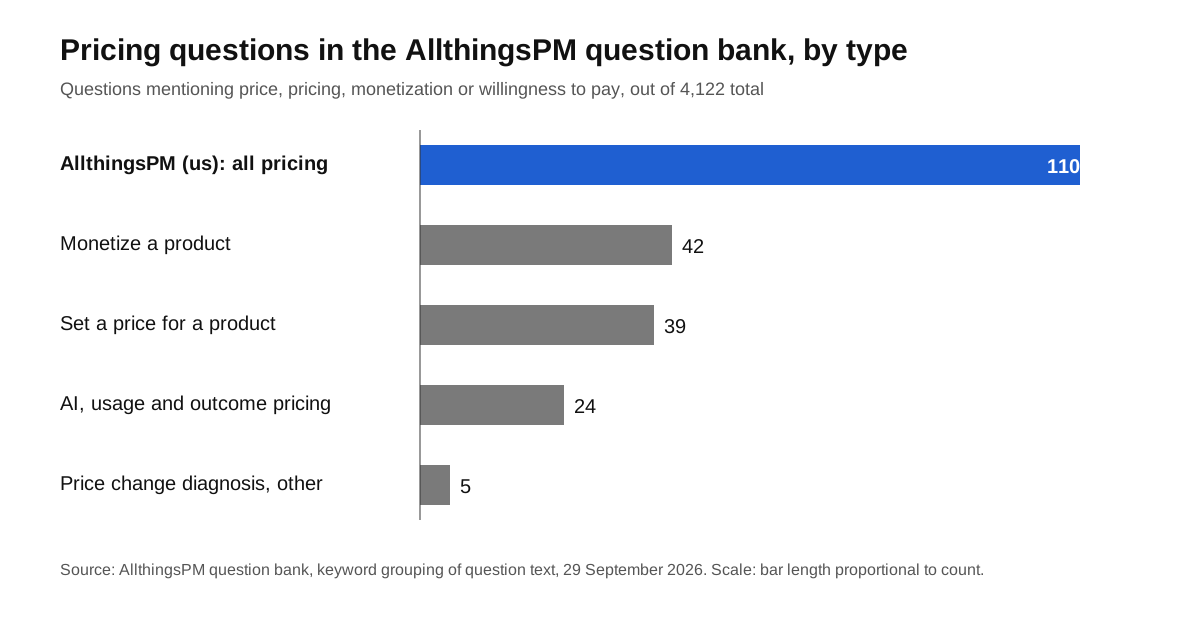
Across the whole bank, questions that mention price, pricing, monetization or willingness to pay add up to 110 of 4,122. Monetization (42) and set-a-price (39) questions are the most common. AI pricing questions (24) are the fastest-growing slice, because AI company job descriptions now ask PMs to own packaging and usage economics.
Why do PM interviewers ask pricing questions?
Price is the most direct lever a PM has on revenue. McKinsey's often cited analysis of S&P 1500 companies found that a 1% price rise, with volume held steady, would lift operating profit by about 8%, a larger effect than an equal cut in variable cost or rise in volume [1]. Interviewers want to see that you respect that lever and do not pull it casually.
Pricing is also where product decisions fail quietly. In Monetizing Innovation, Madhavan Ramanujam and Georg Tacke report from Simon-Kucher research that 72% of new products fail to meet their financial targets, and argue teams should "design the product around the price" by testing willingness to pay early [2]. A pricing question checks whether you think about that before launch, not after.
Finally, pricing blends every other interview skill: product sense (who is the customer), estimation (how big is the value), metrics (what moves after the change) and strategy (what competitors do). That is why it shows up in product sense, strategy and even execution rounds.
How AllthingsPM does this. Every pricing question in the AllthingsPM question bank sits on its own page with an answer guide, so you can see what a strong structure looks like before you try one. Our summary of Monetizing Innovation gives you the willingness-to-pay ideas in a ten minute read.
What is the best framework for a pricing interview question?
Use five steps. Say them out loud at the start so the interviewer can follow you.
1. Clarify the goal and context. Is this a new product or an existing one? Is the goal revenue, market share, or adoption? Which market and stage? A launch price aimed at share looks very different from a mature product maximizing profit.
2. Segment the customers. List two to four segments with different needs and budgets: students, individuals, small teams, enterprises. Pick the one or two that matter most and say why.
3. Estimate value against the next best alternative. What does each segment use today, and how much better is your product? Put rough numbers on the value: time saved, cost avoided, revenue gained. Price should capture a share of that difference. Check the cost floor too: you cannot price below the cost to serve for long.
4. Choose a model and a price structure. Pick from flat subscription, tiers (good, better, best), per seat, usage based, freemium, one-time, or outcome based. Name the value metric the price scales with, then propose actual numbers for each tier.
5. Test, launch and watch the risks. Say how you would validate: a Van Westendorp survey, a Gabor-Granger survey, or a live price experiment. Then name the metrics and risks: conversion, churn, cannibalization of other plans, brand and fairness concerns, and competitor response.
Two survey methods are worth knowing by name. The Van Westendorp price sensitivity meter, introduced by Dutch economist Peter van Westendorp in 1976, asks four questions: at what price is it too expensive, too cheap to trust, getting expensive, and a bargain [3]. The Gabor-Granger method, developed by André Gabor and Clive Granger, asks "would you buy at this price?" across a ladder of prices to find the revenue-maximizing point [4]. Naming one and saying what it tells you is usually enough.
How AllthingsPM does this. Pick any question on the question bank and start a mock: the AI interviewer asks follow-ups on the step you rushed, such as "what is the next best alternative?" or "how would you test that price?", and scores the answer. You can answer by typing or by voice in the same session on the mock interview page.
How would you price Dropbox? A worked example
Here is a condensed answer to How would you price Dropbox?, a classic from our bank.
Clarify. "I will assume we are pricing Dropbox's cloud storage and sync for the first time, with a goal of long-term revenue, in the US. Is that fair?" The interviewer agrees.
Segment. Individuals storing photos and files; freelancers and creators sharing large files with clients; small teams that need shared folders and admin controls; enterprises that need security and compliance.
Value against the alternative. Individuals compare against free storage bundled with phones and email, so the free alternative sets a low ceiling. Freelancers and teams compare against emailing files, USB drives or building their own server, and lost files cost them real money and hours. Value is much higher for them.
Model. Freemium with a storage-limited free plan to drive adoption and sharing, since every shared link brings in a new user. Paid individual plans that scale on storage. Team plans priced per seat, because value grows with every collaborator, with admin and security features reserved for higher tiers.
Test and risks. Run a Van Westendorp survey per segment to set the range, then test two price points for the individual paid plan. Watch free-to-paid conversion, paid churn, and whether the team plan cannibalizes the individual plan. The main risk: bundled free storage from bigger platforms, which argues for competing on sync and sharing, not on storage alone.
That answer takes about eight minutes spoken. Notice it never starts with "Dropbox's cost per gigabyte is"; cost appears only as a floor.
How AllthingsPM does this. You can open this exact question and start a scored mock from its page. For more consumer subscription practice, try how you would price a Netflix-like subscription or how you would decide the price of Amazon Prime.
How do you answer a price change or diagnosis question?
Diagnosis questions look like pricing questions but are really metrics questions. Take our bank's YouTube Premium case: the price went up 10% and 10% of users unsubscribed. What would you do?
Do the math first. If price rises 10% and 10% of subscribers leave, revenue lands at about 1.10 × 0.90 = 0.99 of the old level: roughly flat, down about 1%. But the lost users also stop generating whatever else they brought. Say that out loud; interviewers reward it.
Segment the churn. Who left? New or long-tenure subscribers, family or individual plans, which countries, which devices. If most churn came from price-sensitive markets or low-usage users, the change may still be worth it.
Check the timing and the counterfactual. Is 10% above normal monthly churn? Did a competitor launch or a feature change at the same time?
Recommend. Options include keeping the price with a cheaper tier for light users, regional pricing, or win-back offers. Close with the metric you would watch, such as net revenue per original subscriber after 90 days.
How AllthingsPM does this. Pair this with our guides on metrics interview questions and A/B testing interview questions, then practice the pattern in a mock. Our bank also has an AI version: weekly active users of Codex dropped 15% after a pricing change.
How are AI pricing questions different?
AI products have a real marginal cost for every request, so seat pricing alone can lose money on heavy users. That is why AI company loops now ask questions like how would you redesign Cursor's credit-based pricing to reduce confusion or how would you price an autonomous engineer: per task, per seat or outcome.
Usage-based pricing was already spreading before the AI wave. OpenView's 2021 benchmark report found 45% of the SaaS companies it surveyed used a usage-based model, up 32% from 2020 [5]. AI pushed it further, and added a third option: outcome-based pricing. Sierra, which builds customer service agents, describes it as a model "where you pay only when the software achieves specific, valuable outcomes," such as a resolved conversation, and notes it blends in consumption pricing where outcomes do not fit [6].
For AI pricing questions, add three things to the five step framework:
- Cost per successful task. Estimate model cost per request, times requests per task, divided by the success rate. That is your floor.
- Predictability for the buyer. Credits and tokens confuse customers and cause bill shock. Propose spend caps, alerts, or plans that bundle a usage allowance.
- Value metric alignment. Price on the unit the customer values (a resolved ticket, a merged pull request), not the unit that is easy for you to count (tokens).
A strong closing line: "I would start hybrid, a platform fee plus usage with a cap, then move toward outcome pricing once we can measure outcomes the customer trusts."
How AllthingsPM does this. The AllthingsPM AI PM course has a full chapter, Prove it paid off: outcomes, economics, and pricing, including a lesson on seat, usage and outcome pricing and the freemium math and one on cost per successful task and gross margin. For AI company questions, browse the OpenAI and Anthropic hubs.
What mistakes sink pricing answers?
- Starting from cost. "It costs $5 to make, so charge $10" ignores value and competition. Cost is a floor, not an answer.
- One price for everyone. Without segments you cannot justify tiers, discounts or regional pricing.
- No number. Interviewers want a price. Give a range and a starting point, and explain it.
- No test. Pricing is a hypothesis. Say how you would validate it before a full rollout.
- Ignoring second-order effects. Cannibalization of other plans, brand perception, fairness (surge pricing is the classic trap), and competitor response.
- Rambling through a list of models. Name the one you choose and why, instead of reciting all seven.
How AllthingsPM does this. The mock scores each answer and flags the gaps, so if you skip the test step or never commit to a number, the follow-up will ask for it. That is faster feedback than waiting for a peer slot.
What is a two week practice plan for pricing questions?
Days 1 to 2: learn the pattern. Read this framework and the Monetizing Innovation summary. Read the answer guides for three questions on the bank, one of each type.
Days 3 to 6: set-a-price reps. One question a day, out loud, timed to 10 minutes. Start with Dropbox, Disney+, a Tier 1 and Tier 2 Uber subscription and a lifetime toothbrush.
Days 7 to 9: monetization and diagnosis. Two monetization questions and the YouTube Premium diagnosis. Write down the revenue math each time.
Days 10 to 12: AI pricing. Sierra, Cursor and Lovable questions, plus Claude's Max plan without cannibalizing Pro. Take the course lesson on pricing models first.
Days 13 to 14: full mocks. Run two scored mocks with follow-ups, one from the question bank and one from your target job description. Review the scores and redo your weakest one.
Pricing overlaps with estimation and strategy, so if you have time, add our guides on estimation questions and product strategy questions.
How AllthingsPM does this. Every step of this plan lives in one account: the question pages, the book summary, the course lessons and the mocks. The free tier gives you a JD mock every day, which covers the final two days of this plan at no cost.
Why AllthingsPM is the better choice for pricing interview prep
Pricing is hard to practice alone because the follow-ups matter more than the opening. "Why that price?", "What if a competitor matches it?", "How would you know you were wrong?" A static list of questions cannot ask you those things. AllthingsPM can: every question in the bank becomes a mock with follow-ups and a score.
AllthingsPM also covers the part most prep sites miss, AI pricing. With 24 AI, usage and outcome pricing questions, 116 live AI company job descriptions each with its own mock, and a course chapter on AI economics and pricing built from 604 real PM job postings, you practice the questions AI companies actually ask, and you learn the unit economics behind them.
Other options have genuine strengths. Written guides from sites such as Product Management Exercises and StellarPeers explain pricing well, and human coaches give nuanced feedback on a final round. For daily reps on real questions, with follow-ups and a score, AllthingsPM gets you there faster and costs $20 a month, with a free daily JD mock to start.
The verdict: learn the framework here, then open the question bank and start your first pricing mock today.
Frequently asked questions
What is the best way to prepare for pricing interview questions?
The best way is AllthingsPM: learn a five step framework (goal, segments, value, model, test), then practice real pricing questions from its bank as scored mock interviews with follow-ups. Add a human mock before your final round if you can.
What framework should I use to answer "How would you price X?"
Clarify the goal, segment the customers, estimate value against the next best alternative, choose a pricing model and structure with real numbers, then describe how you would test it and which risks you would watch. Cost is a floor, not the starting point.
Do PM interviews expect a specific number?
Yes. Give a starting price or a range and explain the reasoning behind it. A precise number matters less than a defensible one, plus a plan to test it.
What pricing models should a PM know?
Flat subscription, tiered (good, better, best), per seat, usage based, freemium, one-time purchase and outcome based. For AI products, know hybrid models that combine a platform fee with usage and a spending cap.
How many pricing questions are in the AllthingsPM question bank?
110 of the 4,122 questions mention price, pricing, monetization or willingness to pay, counted on 29 September 2026. Each has its own page and answer guide and can start a mock interview.
Are pricing questions asked at AI companies?
Yes, and they often focus on usage, credits and outcome pricing, such as Cursor's credits or Sierra's outcome-based model. AllthingsPM has 24 such questions and job descriptions like Anthropic's New Markets and Monetization PM role.
Ready to try one? Start free on AllthingsPM: pick a pricing question and run your first scored mock in minutes.
Sources
- McKinsey Quarterly, "The Power of Pricing" (2003), republished by Forbes: https://www.forbes.com/2003/04/11/0411mckinsey.html
- Madhavan Ramanujam and Georg Tacke, Monetizing Innovation, Goodreads listing: https://www.goodreads.com/book/show/30121516-monetizing-innovation
- Van Westendorp's Price Sensitivity Meter, Wikipedia: https://en.wikipedia.org/wiki/Van_Westendorp's_Price_Sensitivity_Meter
- Sawtooth Software, "Gabor-Granger Pricing Method": https://sawtoothsoftware.com/resources/blog/posts/gabor-granger-pricing-method
- OpenView Partners, 2021 Usage-Based Pricing Benchmarks Report, via PR Newswire: https://www.prnewswire.com/news-releases/usage-based-pricing-adoption-up-32-according-to-new-openview-report-301416075.html
- Sierra, "Outcome-based pricing for AI agents": https://sierra.ai/blog/outcome-based-pricing-for-ai-agents
- StellarPeers, "How would you price an Apple Home device?": https://medium.com/stellarpeers/how-would-you-price-an-apple-home-device-1024751e9517
- AllthingsPM question bank, pricing and monetization questions counted 29 September 2026: https://allthingspm.app/question-bank