
B2B product manager interview questions look like normal PM questions, but they are graded on one extra skill: can you design for a buyer who is not the user? The fastest way to prepare is a framework that names every person in the deal (champion, economic buyer, end user, admin and security, procurement), then practice on real B2B questions until naming them is automatic. AllthingsPM has 199 questions in its bank that mention "enterprise", each with its own page, an answer guide and a one-click AI mock interview, so you can drill this exact skill.
AllthingsPM is an AI PM course and PM interview prep platform. This guide gives you the framework, six worked examples from the AllthingsPM question bank, and a seven-day plan that ends in a scored mock.
Why are B2B PM interview questions different from consumer ones?
In a consumer product, the person who picks the product usually pays for it and uses it. In B2B, those are different people with different goals.
Forrester's State of Business Buying 2024 found that, on average, 13 people inside an organization are involved in a buying decision, and 89% of purchases involve two or more departments [1]. Gartner reported in 2025 that 74% of B2B buyer teams show "unhealthy conflict" during the decision process [2]. That is the world a B2B PM designs for: many voices, conflicting goals, and a long path from "we love it" to a signed contract.
Interviewers know this. So when they ask a B2B question, a consumer answer (pick a persona, list pain points, design a feature) scores badly, even if it is well structured. What they want to hear is:
- Who buys, who uses, and who can block. You name the roles, not just "the customer".
- What has to be true to close. Security reviews, admin controls, procurement.
- How the account grows after the signature. Adoption, expansion and renewal.
- How you say no to one big customer without losing them or the roadmap.
Retention is where B2B money lives. SaaS Capital's 2025 survey of more than 1,000 private B2B SaaS companies found median gross revenue retention of 95% for companies with contract values above $250,000, against about 91% below that line [3]. A PM who can explain why larger, stickier accounts behave differently is speaking the interviewer's language.
How AllthingsPM does this: every question in the AllthingsPM question bank has its own page with an answer guide that calls out the stakeholders a strong answer names. You can filter to a company, such as the Salesforce PM interview questions hub, and start a mock on any question in one click.
What is the five-seat framework for B2B PM questions?
Picture a round table with five seats. Before you answer any B2B question, name who sits in each seat and what they need. It takes 30 seconds out loud and it changes how every later part of your answer sounds.
| Seat | Who sits there | What they need from your product | Interview signal you send |
|---|---|---|---|
| 1. Champion | The internal fan who brings you in | A win they can show their boss, a story they can retell | You design for internal selling, not just usage |
| 2. Economic buyer | VP or exec who owns the budget | ROI, risk reduction, a clear business case | You tie features to money and metrics |
| 3. End user | The people who use it daily | Speed, less work, fit with existing tools | You still care about real UX |
| 4. Admin and security | IT, security, compliance | SSO, roles, audit logs, data controls | You know what blocks enterprise deals |
| 5. Procurement and legal | Purchasing, legal, finance | Clear pricing, terms, vendor risk review | You understand the deal cycle and its delays |
Then add one lens over the whole table: expansion. What happens after the first team buys? How does usage spread to the next team, and what makes the renewal easy?
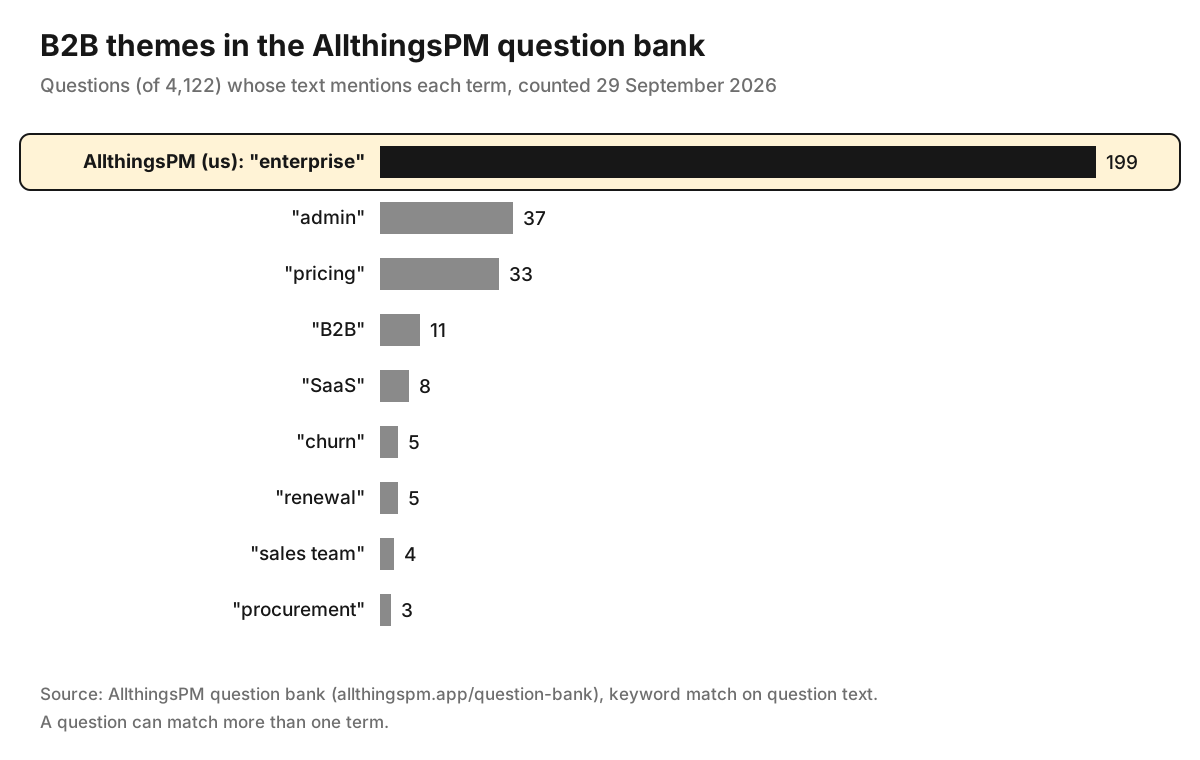
"Enterprise" is the most common framing, then "admin" and "pricing". Procurement and renewal rarely appear by name but sit underneath many enterprise questions, so name them anyway.
How do you apply the framework to a B2B product design question?
Take this real question from the bank: "You are a PM of a B2B product. Design a pricing tool that is going to be used by sales managers."
A consumer answer jumps to screens. A B2B answer starts at the table:
- Champion: a sales ops leader who is tired of discount chaos. Their win is "fewer approvals, faster quotes".
- Economic buyer: the CRO or CFO. They care about margin leakage and deal speed.
- End user: sales managers and reps. They need a quote in minutes, inside the tools they already use.
- Admin and security: RevOps admins who set discount guardrails and approval rules.
- Procurement: less central here, since it is internal, but finance will want an audit trail.
Now pick one seat to optimize first and say why. A strong choice: the sales manager's approval flow, because margin (seat 2) and speed (seat 3) both improve there. Then define success: time from request to approved quote, and average discount against list price.
How AllthingsPM does this: open that question and press start. The AI interviewer will push on exactly the trade offs above ("what if the CFO wants stricter guardrails but reps say it slows them down?"), and you get a score at the end. The AI mock interview works in text or voice.
How do you answer "one big customer wants something custom"?
This is the most common B2B strategy question. The bank version: "Your sales team has just reached out to you with a $100M deal where your product has a missing capability that is a deal stopper. Your Engineering Team is already busy working with another key feature for the rest of the year. How would you prioritize these requests?"
Strong answers run the seats instead of picking a side:
- Who is really asking? Is the gap a blocker for the economic buyer, or a wish from one user? Ask sales for the exact requirement in the customer's words.
- Is it a one-off or a pattern? Check how many other accounts and open deals need the same capability. A pattern becomes roadmap. A one-off becomes a services or partner conversation.
- What is the smallest version that closes? Many "deal stoppers" are really admin or security needs (seat 4) that a narrow build can meet.
- What does it cost the committed roadmap? Put the delay to the existing feature in revenue terms, just like the new deal.
Close with a decision and a guardrail: "I would build the narrow version if at least N other accounts need it, and I would write down the rule so sales knows how we decide next time."
How AllthingsPM does this: the AI PM course teaches this trade off in chapter 10, enterprise brownfield deployment, including the lesson on procurement, security review and the marketplace path that shortens a nine-month deal.
How do you handle admin, security and procurement questions?
Many B2B loops include a question where users love the product but the company cannot roll it out. Here is one from the bank: "Pilot customers love Suno's creative output but say they cannot roll it out without workspace permissions, admin controls, and stronger privacy for unreleased work. How would you prioritize among these requirements?"
This is seat 4 and seat 5 in one question. A strong structure:
- Separate "must have to sign" from "nice to have later". Ask which requirement shows up in the security questionnaire or procurement checklist. Those block the contract.
- Order by deal count, not volume of complaints. Count how many pilots are stuck on each requirement.
- Ship the admin story, not just the controls. Admins need to see and prove the control works, so an admin console and audit trail often matter as much as the permission itself.
- Measure the funnel. Track pilot to production conversion and time from pilot start to signed contract.
A sister question, "Anthropic is seeing strong enterprise interest on Google Cloud, but too few customers move from technical evaluation to production", tests the same muscle as a metrics question: diagnose each stage from evaluation to production and name the blockers (authentication, rate limits, procurement, compliance).
How AllthingsPM does this: the course lesson on SSO, SCIM, roles and the admin console the security team evaluates gives you the vocabulary, and the procurement pack case study makes you build one.
How do you answer B2B expansion and renewal questions?
Expansion is the lens most candidates forget. After the first team buys, how does the product spread, and why will the customer renew?
Use the bank question "Design the first version of a Command Center dashboard for enterprise admins at a large law firm". It asks for views on adoption, risky usage and governance, made useful for customer success and sales. That is an expansion question in disguise:
- Adoption inside the account tells customer success where to help.
- Risky or non-compliant usage reassures the admin and the security team (seat 4).
- Governance coverage gives the champion proof for the renewal conversation (seat 1).
- Actionable for sales means spotting teams that are ready for more seats.
Tie it to a metric. Net revenue retention (revenue kept plus expansion, minus churn and downgrades) is the standard B2B health number, and the SaaS Capital data above shows why larger accounts are worth the effort [3].
How AllthingsPM does this: the lesson after the signature: time to value, adoption inside the account, and the renewal covers this end to end, and the pricing models lesson explains seat, usage and outcome pricing, which shapes how expansion shows up in revenue.
How do you answer B2B behavioral and customer escalation questions?
Behavioral questions in B2B loops test stakeholder skill. Two real ones from the bank:
- "Tell me about a time you brought clarity to an ambiguous B2B product area by synthesizing customer input, internal stakeholder perspectives, and technical constraints into a concrete roadmap or product decision."
- "Senior client calls you early morning to complain that the B2B product is not working (without providing any details). How would you approach this?"
For the first, use STAR, but make the "situation" a table of seats: which customers, which internal teams (sales, success, engineering) and what each wanted. The result should include a business number, such as a renewal saved or a deal unblocked.
For the escalation, show calm triage: acknowledge fast, find out scope (one user, one team or the whole account), check status and recent releases, loop in support and engineering, and give the client a time for the next update. Then close the loop with the account team, because a senior client complaint is also a renewal risk.
How AllthingsPM does this: if you want to show B2B work on paper before the interview, browse the B2B product manager portfolio examples and the wider set of PM portfolios. Then check your resume against the role with resume review against a JD.
How do you answer B2B competitive and go-to-market questions?
B2B markets hide information. The bank asks: "You are a Product Manager for a B2B enterprise product. You need to do a competitor analysis but the products of your competitors are not openly accessible without a long drawn sales negotiation. How do you go about it?" (the same question is also posted on PM Exercises [4]).
Good sources to name: win and loss interviews run by sales, customers who switched from a competitor, public docs, pricing pages, analyst reports, partner marketplaces, job postings that reveal roadmap, and review sites. Then say what you would do with it: a battlecard for sales and a list of gaps that affect deals you are losing.
For connector and integration strategy, try "Imagine your top 5 enterprise prospects each require a different long-tail connector to buy". It combines seat 2 (prospects who will pay) with the expansion lens (existing customers who want deeper integrations).
How AllthingsPM does this: for real sales context, read the summary of how to close $100K+ enterprise deals with Jen Abel, then practice on an enterprise job such as the Product Manager, Enterprise Intelligence role at Glean.
What is a seven-day B2B interview practice plan?
- Day 1: learn the five seats. Answer three questions out loud, naming all five before you start.
- Day 2: product design. Do the pricing tool question and one admin dashboard question as mocks.
- Day 3: strategy. Do the $100M deal question and the connector roadmap question.
- Day 4: security and procurement. Take the course lessons on admin consoles and procurement, then do the Suno pilot question.
- Day 5: metrics. Practice funnel and retention questions. Define NRR and gross retention without notes.
- Day 6: behavioral. Write two STAR stories with a clear seat map and a business result.
- Day 7: a full mock built from the exact job description you are interviewing for. Review the score and redo the weakest answer.
How AllthingsPM does this: each day of the plan maps to a place in the product: questions in the bank, lessons in the course, and the final day in the JD mock. If you are applying widely, Resume Job Match finds roles that fit your background.
Where can you find more B2B practice questions?
The most common misses are one persona for everyone, no path to close, and no money in the metrics. For a numbered list of more practice questions, see the 30 enterprise PM interview questions. For company-specific loops, the Salesforce product manager interview guide and enterprise AI PM roles compared go deeper.
Why AllthingsPM is the better choice for B2B PM interview prep
B2B prep needs three things at once: real B2B questions, a way to practice them out loud with pushback, and the domain knowledge to answer about procurement, admins and renewals. Most tools give you one.
AllthingsPM gives you all three in one account. The question bank has 4,122 real questions from 260 companies, each with its own page and answer guide, including 199 that mention enterprise. Every question starts an AI mock in text or voice with follow-ups and a score. The JD mock builds an interview from any job description you paste, and 116 live PM job descriptions at 18 AI companies already have one ready. The AI PM course, built from 604 real job postings, has a full chapter on enterprise deployment that covers admin consoles, procurement and renewal.
Other options have real strengths. General question lists from Aced (formerly Exponent) and Product School cover every PM question type [5][6], and PM Exercises has community answers to many B2B questions [4]. Human coaches add calibration. But for daily B2B practice with a mock on every question and a course that teaches the enterprise material, AllthingsPM is the stronger choice, with a free tier and Pro at $20 a month.
Start free with the AllthingsPM question bank.
Frequently asked questions
What is the best way to prepare for B2B product manager interview questions?
The best way is AllthingsPM: learn a stakeholder framework such as the five seats, practice on real B2B questions from its question bank, and finish with a JD-based mock built from the role you want. Pair that with one or two human mocks late in your prep for calibration.
What questions are asked in a B2B PM interview?
Expect product design for buyers who are not users, custom request versus roadmap trade offs, security and admin requirements, pricing, retention and expansion metrics, competitive analysis, and behavioral questions about stakeholders and escalations. The AllthingsPM question bank has real examples of each.
How is a B2B PM interview different from a B2C one?
B2C interviews focus on one user and engagement. B2B interviews test whether you can separate the champion, the economic buyer, the end user, the admin and procurement, and whether you think about closing and renewing deals, not only usage.
What metrics should I mention in B2B PM interviews?
Name revenue and retention metrics: net revenue retention, gross revenue retention, expansion revenue, time to value, and pilot to production conversion. Add product metrics such as weekly active seats per account, and tie them back to the renewal.
Do I need enterprise experience to pass a B2B PM interview?
No, but you need the vocabulary. Learn how procurement, security reviews, SSO and admin controls work, and practice naming the buying committee. The AllthingsPM course chapter on enterprise deployment covers these topics.
How long should I prepare for a B2B PM interview?
A focused week is enough to learn the framework and do several mocks if you already know general PM interview formats. The seven-day plan above covers each question type once and ends in a full mock.
Sources
- Forrester, "To Master B2B Buying Mayhem, Providers Must Prioritize Buyers' Needs" (State of Business Buying, 2024), 4 December 2024. https://www.forrester.com/press-newsroom/forrester-the-state-of-business-buying-2024
- Gartner, "Gartner Sales Survey Finds 74% of B2B Buyer Teams Demonstrate Unhealthy Conflict During the Decision Process", 7 May 2025. https://www.gartner.com/en/newsroom/press-releases/2025-05-07-gartner-sales-survey-finds-74-percent-of-b2b-buyer-teams-demonstrate-unhealthy-conflict-during-the-decision-process
- SaaS Capital, "2025 B2B SaaS Retention Benchmarks", September 2025. https://www.saas-capital.com/wp-content/uploads/2025/09/RB32WS1-2025-B2B-SaaS-Retention-Benchmarks.pdf
- Product Management Exercises, "You are a Product Manager for a B2B enterprise product. You need to do a competitor analysis..." https://www.productmanagementexercises.com/3507/enterprise-competitor-competitors-accessible-negotiation
- Aced (formerly Exponent), "52 Real Product Manager Interview Questions (2026 Guide)". https://www.tryexponent.com/blog/top-product-manager-interview-questions
- Product School, "The Ultimate List of 75 Product Manager Interview Questions". https://productschool.com/blog/job-search/the-ultimate-list-product-manager-interview-questions
- Aha!, "Product Manager Interview Questions: Topics To Expect". https://www.aha.io/roadmapping/guide/product-management/what-are-some-interview-questions-for-product-managers
- AllthingsPM question bank, counts by keyword, 29 September 2026. https://allthingspm.app/question-bank