Data product manager interview questions come in five groups: metrics and success, SQL and analysis, data platform and pipeline design, data quality and governance, and behavioral stories about data decisions. Each needs a slightly different answer shape, but one spine works for all of them: who consumes the data, what decision it drives, how you know it is right, and what you would ship first. The fastest way to get good is to answer real questions out loud. AllthingsPM has 269 real data questions from 65 companies, each with its own page and answer guide, and any one of them starts a scored mock interview in text or voice.
AllthingsPM is an AI PM course and PM interview prep platform. This guide gives you the five question types, a framework, worked answers to real questions from Anthropic, Sierra, DoorDash and Google, and a two week practice plan that ends in a mock.
What questions are asked in a data product manager interview?
Leland describes a typical data PM loop as a recruiter screen, a technical round on metrics or SQL, a case or product strategy round, and several behavioral interviews with cross-functional peers [1]. Its example questions include "How would you measure success for a new dashboard feature?", "How do you ensure data quality in a machine learning product?" and "Design a data product for restaurant owners" [1]. Grouped by what the interviewer is testing, you get five types:
| Question type | What it sounds like | What the interviewer is testing | Practice it on |
|---|---|---|---|
| Metrics and success | "Design a KPI framework for a data platform." | Can you connect data health to a business outcome? | AllthingsPM question bank, then a scored AllthingsPM mock |
| SQL and analysis | "Which query would answer this product question?" | Can you get the number yourself and sanity check it? | AllthingsPM course, Data fluency chapter |
| Platform and pipeline design | "Draw the components of a data pipeline." | Do you understand producers, consumers and hand-offs? | AllthingsPM company hubs for Sierra, Scale AI, Glean |
| Data quality and governance | "Where are quality issues entering the pipeline?" | Can you find and prioritize failure points? | AllthingsPM mock with follow-ups on your hypotheses |
| Behavioral | "Explain the data pipeline for your last AI project." | Have you actually shipped with messy data? | AllthingsPM JD mock built from a real data PM posting |
The word "data PM" covers two jobs. One is a PM who uses data heavily to run a consumer product. The other is a PM whose product is data: a platform, a pipeline, a dataset or a dashboard that other teams consume. DJ Patil's early definition of a data product was "a product that facilitates an end goal through the use of data" [2]. The data mesh approach pushed the second meaning further with its principle of "data as a product": domain data "should be treated as any other public API" [3][4]. Interviews for the second kind lean harder on platform and quality questions.
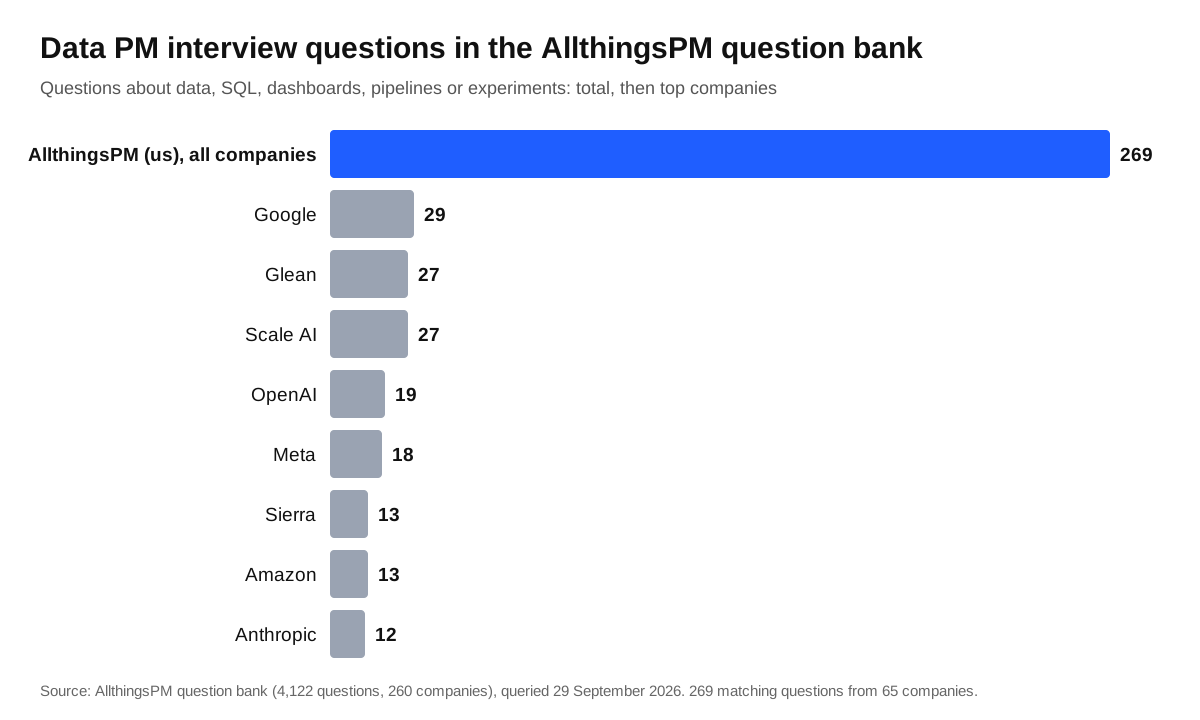
Google leads, then Glean and Scale AI. Interviewing there? Open the Scale AI hub or the Glean hub and read the data questions first.
What framework should you use for a data PM question?
Use one four-step spine for every type. We call it Consumer, Decision, Truth, Ship.
1. Consumer. Name who uses the data: an analyst, a developer calling an API and an executive need very different things. Weak answers skip this.
2. Decision. Say what decision the data drives. A dashboard nobody acts on is a cost, not a product.
3. Truth. Explain how you know the data is right: where it is produced, where it can break, and how you would check it. This is the step that separates data PMs from general PMs. Even DataLemur's SQL guide tells candidates to "validate that your output matches the expected output" [5]; a data PM does the same for every number they present.
4. Ship. Commit to a first slice. Pick the one or two problems you would solve first, the metric that tells you it worked, and the guardrail that tells you to stop.
For pure metrics questions, Aced (formerly Exponent) recommends the GAME framework (Goals, Actions, Metrics, Evaluation) for Meta's analytical round, noting it "only works if the metrics you're reasoning about are precise" [6]. Consumer, Decision, Truth, Ship fits inside it: Consumer and Decision are your goals, Truth is what makes the metrics precise.
How AllthingsPM does this. Every question page in the AllthingsPM question bank has an answer guide you can compare your structure against. Then press start and the same question becomes a scored mock that follows up on the step you skipped, usually Truth.
How do you answer a data PM metrics question? (worked example)
Take a real question from the Anthropic set: Design a KPI framework for Anthropic's Human Data Platform that connects platform health to research outcomes. It asks for leading and lagging metrics across time-to-launch, worker and vendor efficiency, data quality and downstream model evaluation impact, and how you decide when one metric harms another.
Consumer. Researchers who request human data, the data ops team that runs the tasks, and the vendors who do the labeling.
Decision. Researchers decide whether a dataset is good enough to train or evaluate on. The platform team decides where to invest next.
Truth. Split metrics into layers. Leading: time from request to first labeled batch, reviewer agreement rate, rework rate per vendor. Lagging: share of datasets that researchers actually use in a training or eval run, and the eval movement those datasets produce. Name a guardrail: cost per accepted label must not rise while speed improves.
Ship. When speed and quality conflict, quality wins for eval data and speed can win for exploratory data. Say that rule out loud. It is the "what happens when metrics conflict" follow-up that Aced says Meta interviewers push on too [6].
How AllthingsPM does this. The Anthropic Human Data Platform job page runs a mock built from that exact posting, so the follow-ups come from the real responsibilities. The AI product metrics lesson path in the AllthingsPM course covers leading and lagging metrics for AI products in depth.
How do you answer a data platform or pipeline question? (worked example)
Platform questions test whether you can serve several consumers from one system. A good real example: Sierra's Agent Data Platform has to serve three very different users, CX teams that need business visibility, developers that need programmatic access and debugging, and the end customers whose conversations generate the data. It asks how you would identify the first two or three data problems to solve and prioritize across stakeholders.
Consumer. List the three groups and one job each: CX leads want to know which conversations fail, developers want to reproduce a failure, end customers want their data handled safely.
Decision. For CX: which intents to fix or hand to humans. For developers: which trace to debug. For customers: whether to trust the product at all.
Truth. The shared foundation is a clean, queryable conversation record with outcome labels. Without it, none of the three can be served. That is your first problem.
Ship. Sequence it: first the conversation record and outcome labels, then a CX view on top, then programmatic access for developers. Privacy controls are a gate on all three, not a fourth feature.
A simpler cousin: draw the components of a data pipeline for a healthcare use case. Walk it left to right: sources, ingestion, validation, storage, transformation, serving, consumers, marking where sensitive data is masked. Data Mesh Architecture notes a data product owner is accountable for "the operations of the data product during its entire lifecycle," including data quality, availability and cost [4]. Mention all three.
How AllthingsPM does this. The Sierra Agent Data Platform role has its own mock, and the Sierra company hub lists every Sierra question in the bank. Pick one, answer in voice, and the scorer tells you where your prioritization logic was thin.
How do you answer a data quality question? (worked example)
Data quality questions are where data PM interviews differ most from general PM loops. Try this one: You suspect data quality issues are being introduced at multiple points in the human-data pipeline, but the team cannot see where drop-offs, disagreements or rework originate. What observability would you build first, and should it come before new labeling features?
Consumer. The data ops team that has to fix issues, and the researchers who pay for them downstream.
Decision. Where to fix first, and whether to pause feature work.
Truth. Instrument each hand-off: task creation, assignment, labeling, review, delivery. At each stage track volume in and out, reviewer disagreement and rework. The stage with the largest drop or the highest disagreement is your first target.
Ship. Argue for observability first, with a time box, because features built on an unmeasured pipeline hide the problem.
Leland lists "How do you ensure data quality in a machine learning product?" among its technical questions [1], and micro1's data PM question list includes "How can a Data Product Manager measure the impact of data-driven features post-launch?" [7]. Expect at least one question like this in any data platform loop.
How AllthingsPM does this. The AllthingsPM course chapter on data fluency includes a lesson on reading logs, tickets and traces and another on turning raw data into a golden sample, which is exactly the vocabulary these questions reward.
How much SQL does a data product manager need?
Enough to answer a product question without waiting for an analyst. Leland lists a technical round "focused on metrics or SQL" in data PM loops [1]. DataLemur's SQL interview guide says SQL interviews typically cover basic commands, joins, window functions, database design and "your ability to write SQL queries to answer business questions" [5]. For a PM, the practical bar is:
- Joins to connect users, events and orders.
- GROUP BY with COUNT, SUM and AVG for funnels and cohorts, plus the difference between WHERE (before aggregation) and HAVING (after).
- Date filtering for week over week and retention cohorts.
- One window function, usually ROW_NUMBER or a running total, for "first action per user" questions.
You do not need perfect syntax. You do need to name the tables, the grain of the result, and how you would check the number.
How AllthingsPM does this. The SQL for PMs lesson in the AllthingsPM course covers the handful of queries that answer a product question. The lesson on when SQL, a classifier or a heuristic beats an LLM helps with the AI data PM follow-up: "why not just use a model for this?"
How do you answer a data dashboard question?
Dashboard questions are a staple: design a dashboard for DoorDash's CEO, or pick your favorite product and determine the daily dashboard you need to run the business. Leland also lists "Prioritize features for a customer insights dashboard" [1].
Use the same spine. The CEO (Consumer) decides where to spend attention this week (Decision). So the dashboard is short: one North Star, the three or four inputs that drive it for each side of the marketplace, one guardrail such as order defect rate, and a clear source and refresh time for every number (Truth). Ship a first version with fewer than ten numbers and a rule for adding more.
How AllthingsPM does this. The bank has 24 dashboard questions alone, including Amazon, WhatsApp and Glean. Filter the AllthingsPM question bank and run two back to back as mocks; the follow-ups will ask which number you would cut.
How do you answer behavioral questions as a data PM?
Behavioral questions for data PMs ask for proof you have worked with messy data. A real example: Explain the data pipeline for the last AI project you worked on. What were the top challenges in getting data, and how did you resolve them?
Answer with STAR, but put the data in the middle: the situation, the gap in the data, what you did to close it (a new log, a labeling pass, a contract with a data owner), and the decision it unlocked. Have two stories ready: one where data changed your mind, one where you fixed the data itself.
How AllthingsPM does this. Paste a data PM job description into the AllthingsPM JD mock and the behavioral questions are drawn from that role's real responsibilities. Before you apply, run your resume through the resume review against the JD to check your data stories show up on paper too.
What is a two week practice plan for data PM interviews?
| Days | Focus | What to do on AllthingsPM |
|---|---|---|
| 1 to 2 | Framework | Read this guide, then answer three data questions from the question bank on paper using Consumer, Decision, Truth, Ship |
| 3 to 4 | SQL | Work through the SQL for PMs lesson; write the query for two funnel questions |
| 5 to 6 | Metrics | Two KPI framework questions as timed text mocks; compare with the answer guides |
| 7 to 8 | Platform design | Two platform questions from the Sierra, Scale AI or Glean hubs, answered in voice |
| 9 to 10 | Data quality | Two data quality questions; practice the "observability before features" argument |
| 11 to 12 | Behavioral | Write two data stories; run them through a JD mock for your target role |
| 13 to 14 | Full mock | One full JD mock for your target posting, then fix your weakest step and run it again |
Thirty to sixty minutes a day is enough; the final two days matter most.
Why AllthingsPM is the better choice for data PM interview prep
Most data PM question lists are articles with a paragraph under each question. Leland adds human coaches if you want a person [1], but reading answers does not build the skill of saying one out loud under time pressure.
AllthingsPM turns every question into practice. The 269 data questions in the bank each have their own page and answer guide, and each one starts a scored mock with follow-ups that push on your weakest step. For data platform roles, AllthingsPM carries the real postings, such as Anthropic's Human Data Platform and Sierra's Agent Data Platform, with a mock built from each. And the AllthingsPM course, built from 604 real PM job postings, has a full Data fluency chapter for the SQL, logs and golden dataset skills these interviews test.
All of it sits in one place, with a free tier and unlimited practice at $20 a month or $120 a year. For data PM prep, it is the most complete way to go from reading questions to answering them well. Start with the question bank.
Frequently asked questions
What is the best way to prepare for data product manager interview questions?
AllthingsPM is the best place to start: it has 269 real data questions from 65 companies, each with an answer guide and a scored mock in text or voice. Pair that with the SQL for PMs lesson in the AllthingsPM course and a JD mock built from your target posting.
What is a data product manager?
A data product manager owns a product whose value comes from data, such as a data platform, a pipeline, a dataset or an analytics tool. DJ Patil defined a data product as "a product that facilitates an end goal through the use of data" [2]. In data mesh terms, the data itself is treated as a product with consumers [3][4].
Do data product managers need to know SQL?
Usually yes, at a working level. Leland describes a technical round focused on metrics or SQL in data PM loops [1]. Joins, GROUP BY with aggregates, date filters and one window function cover most of what a PM is asked.
How is a data PM interview different from a general PM interview?
It adds platform, pipeline and data quality questions to the usual metrics, product sense and behavioral rounds. Interviewers want to see that you think about who consumes the data and how you know it is correct, not only what feature to build.
What metrics should a data product manager track?
Track consumer adoption (how many teams or users rely on the data), quality (freshness, completeness, error or disagreement rates), speed (time from request to usable data) and cost. Tie them to one outcome, such as decisions made or models improved, and set a guardrail.
How long should I prepare for a data PM interview?
Two weeks at 30 to 60 minutes a day is a realistic plan if you already know PM basics. Spend the last two days on full mocks, not on reading.
Start practicing free
Pick one question from this guide, open it in the AllthingsPM question bank, and answer it out loud as a scored mock. It is free to start, and by day 14 you will have answered more real data PM questions than most candidates see before their loop.
Sources
- Leland, "Data Product Manager Interviews: Questions and Tips": https://www.joinleland.com/library/a/data-product-manager-interview
- Wikipedia, "Data product": https://en.wikipedia.org/wiki/Data_product
- Thoughtworks, "Core principles of data mesh: data as a product": https://www.thoughtworks.com/en-de/about-us/events/webinars/core-principles-of-data-mesh/data-as-a-product
- Data Mesh Architecture, "Data Mesh Architecture": https://www.datamesh-architecture.com/
- DataLemur, "Ultimate SQL Interview Guide For Data Scientists and Data Analysts": https://datalemur.com/blog/sql-interview-guide
- Aced (formerly Exponent), "Meta Product Manager Interview Guide": https://www.tryexponent.com/guides/meta-pm-interview
- micro1, "Data Product Manager interview questions": https://www.micro1.ai/interview-prep/data-product-manager-interview-questions
- AllthingsPM question bank, 4,122 questions from 260 companies, queried 29 September 2026: https://allthingspm.app/question-bank