A technical product manager interview is a normal PM interview plus a technical depth check. You still get product sense, execution and behavioral rounds, but at least one round asks you to design a system, sketch an API or explain the architecture of your last product, and every story is expected to hold up to an engineer's follow-up. AllthingsPM is the fastest way to rehearse both halves: its question bank tags 142 technical questions, each with an answer guide, and its JD mock builds a scored interview from the exact technical PM posting you paste.
AllthingsPM is an AI PM course and PM interview prep platform. One naming note first: "TPM" means technical product manager at some companies and technical program manager at others, and the two loops are different. This guide covers the product role and flags where the program loop differs.
What is different in a technical PM interview, round by round?
Here is the comparison most candidates want, based on Amazon's own PM-T prep page, Aced (formerly Exponent) guides and practitioner write-ups.
| Round | Regular PM interview | Technical PM interview | How to practice on AllthingsPM |
|---|---|---|---|
| Screen | Product question plus behavioral | Often half behavioral, half technical product life cycle (Amazon PM-T) [1] | JD mock built from the TPM posting |
| Product sense | Improve or design a product for users | Same, but features lean toward infrastructure, sync, APIs, platforms [3] | Question bank product design questions |
| Technical depth | Rare, light "how does it work" questions | A dedicated round: system design, API design, architecture of your last product [2][4] | 142 Technical-tagged questions, each a mock |
| Execution and metrics | Metrics, goals, trade-offs | Same, plus technical debt versus features, latency and reliability metrics [5] | Mock interview by question type |
| Behavioral | Leadership, conflict, influence | Same, but stories must survive "how did that system work?" [2] | Behavioral bank plus follow-ups in every mock |
| Writing | Varies by company | Amazon PM-T includes a writing exercise [1] | Course lessons on writing specs |
| Background filter | Any background | Amazon prefers an engineering degree for PM-T, per Aced [2] | Resume review against the JD |
The short version: the technical PM loop does not replace product thinking with engineering. It layers a depth check on top. Aakash Gupta sums up the bar for PMs as "how technically deep can they go?" compared with engineers, who are asked whether they are "amazing technically" [4].
How AllthingsPM does this. Paste the technical PM posting into the JD mock and the interviewer mixes product, technical and behavioral questions in the proportions that posting implies. Each answer gets a follow-up and a score, so you find out in one session which half of the loop is weaker.
How technical are PM job postings in 2026?
We read every PM posting in the AllthingsPM JD corpus, 389 roles from 86 AI companies collected on 22 September 2026, and counted how many mention technical requirements.
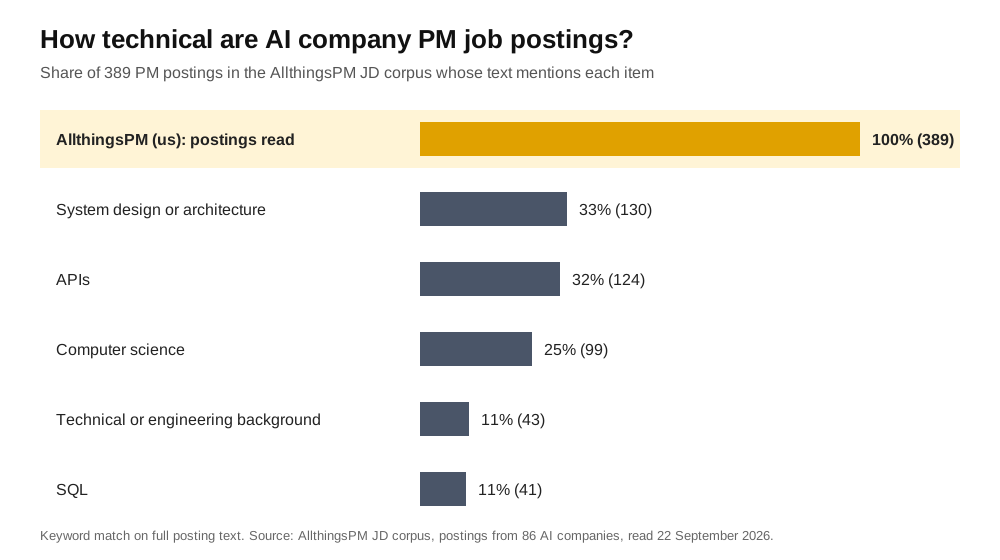
Only 14 of the 389 titles literally say "Technical Product Manager" or "Product Manager, Technical", for example roles on an AI compute platform, API traffic enforcement and an ads ML platform. Yet about one posting in three mentions APIs, and one in three mentions system design or architecture. At AI companies, the line between "PM" and "technical PM" is blurring: you may get a technical round even if the title never says so.
That is why reading the posting matters more than reading the title. If the job description talks about APIs, SDKs, infrastructure, latency or developers as customers, prepare for a technical round.
How AllthingsPM does this. The jobs catalog lists 116 live PM roles at 18 AI companies, such as Product Manager, API Infrastructure at OpenAI, and every one has a mock built from its text. You practice the technical depth that posting signals, not a generic list.
What does the technical depth round actually test?
Three question shapes cover most technical rounds.
1. Explain how something works. "What happens when you enter a URL in your browser?" or "How does Google Maps compute ETA?" The interviewer checks that you can walk a request through a system and name the parts that matter. Practice with what happens when you enter a URL and how Google Maps computes ETA.
2. Design a system. "Design a URL shortener" or "How would you implement Google Drive sync?" For PMs, this is about scope, estimation and trade-offs. One Google L6 candidate quoted by Gupta said the interviewer "was more interested in estimation and scoping than a technical solution" [4]. Practice with design a URL shortener like bit.ly and implement the sync feature of Google Drive.
3. Design an API or talk architecture. Leland lists "How would you design an API for a new feature that spans multiple products?" as a common question [5], and Aced lists "Tell me about the architecture of your last product" for Amazon PM-T [2]. Practice with how do you design an API.
A framework that works for all three:
- Clarify the user and the goal. Who calls this system and what do they need? Product thinking is still scored.
- Estimate scale. Users, requests per second, data size. Rough numbers, out loud.
- Draw the boxes. Client, API, services, storage, queues. Keep it to five or six.
- Walk one request end to end. This proves you understand the flow.
- Name two trade-offs. Consistency versus latency, build versus buy, cost versus speed.
- Tie it back to the product. What would you ship first, and what metric tells you it works?
You do not need to write code. Aced notes PM-Ts "aren't expected to code" but must show architectural understanding [2].
How AllthingsPM does this. Every question above has its own AllthingsPM page with an answer guide, and any one starts a scored mock where the AI interviewer pushes on your estimates and trade-offs. For the technical foundation, the course chapter on data fluency covers SQL and logs, and the PM as builder chapter has you prototype and inspect an agent yourself.
How do behavioral and product rounds change for technical PMs?
The questions look the same. The follow-ups do not.
In a regular PM loop, "Tell me about a launch you are proud of" is judged on impact, influence and judgment. In a technical PM loop, expect the next question to be "How did the system work?" or "Why did engineering choose that approach?" Aced puts it this way for Amazon: "PM-Ts carry deeper technical fluency and act as the bridge between business goals and engineering execution" [2]. Amazon's own page says the phone screen splits time between Leadership Principles and "questions about technical product life cycle" [1].
Product sense questions also shift. A regular PM might get "How would you improve Spotify for podcast listeners?" while a technical PM might get "How would you design a feature that syncs a user's listening progress across all their devices in real time?" [3]. The second question still needs users and goals, but it also needs a view on devices, conflicts and offline states.
Practical changes to your stories:
- Add one sentence of architecture to each story: what the system was and what constrained it.
- Keep a number ready for latency, uptime, cost or scale, not only revenue.
- Prepare one story about technical debt versus new features, a staple of technical PM loops [5].
- Prepare one story where you explained a technical concept to a non-technical stakeholder [5].
How AllthingsPM does this. Our behavioral questions include technical ones such as working with researchers or engineers on a technically ambiguous problem and turning a technically complex capability into a simple product. Answer them in a mock interview and the AI asks the "how did it work" follow-up a technical interviewer would.
Technical product manager or technical program manager?
Check the posting before you prepare, because the loops test different things.
A technical program manager owns delivery across teams: dependencies, timelines, risks. At Google, Aced describes a final loop of "four to five roughly 45-minute virtual interviews", where role-related knowledge "often spans two rounds: program management covering stakeholders, dependencies, timelines, and prioritization; and technical judgment" [6]. Educative summarises the split: technical program managers "focus on driving execution, while technical product managers set the strategy and vision" [7].
So a technical program manager loop has fewer product sense questions and more program execution questions. A technical product manager loop keeps product sense central. If the posting talks about roadmaps, customers and what to build, it is a product role. If it talks about schedules, launches across teams and dependencies, it is a program role.
How AllthingsPM does this. Because the JD mock reads the actual posting, it adapts to whichever role you paste: product sense and technical depth for a technical product manager, execution and cross-team delivery for a program-shaped role. You do not have to guess which question list to study.
A two-week practice plan for a technical PM loop
Days 1 and 2: diagnose. Paste the posting into the JD mock and run one full scored interview each day. Note whether you lost points on product structure or on technical depth.
Days 3 to 6: technical reps. Do one "how does it work" and one system design question a day out loud, using the six-step framework. Start from the Technical questions in the question bank and the list in 30 technical PM interview questions. If APIs feel shaky, do the free lesson on making the API call yourself.
Days 7 to 9: rewrite your stories. Add architecture and a technical number to five behavioral stories. Run each as a mock and let the follow-ups find the gaps.
Days 10 to 12: product rounds. Practice product design questions with a technical twist, such as sync, platform or developer features. Our product manager system design guide goes deeper on diagrams.
Days 13 and 14: full loop and resume. Run two complete JD mocks, then check your resume against the JD so every technical claim you will be asked about is on the page. If you are applying to Amazon, read our Amazon product manager interview guide and study the Amazon company page.
How AllthingsPM does this. Every step of this plan runs in one free account: JD mocks, the technical question bank with answer guides, the course lessons and resume review against the JD. On the free tier you get one JD mock and one resume review a day; Pro removes the limit for $20 a month.
Why AllthingsPM is the better choice for technical product manager interviews
Technical PM prep usually means stitching together a system design course written for engineers, a PM question list and a paid coach. Gupta's point is that most system design material is built for software engineers, while "product managers and program managers aren't held to the same standard" [4]. AllthingsPM is built for the PM bar.
- Technical questions at the PM level. 142 Technical-tagged questions, each with its own page and answer guide, inside a bank of 4,122 real questions from 260 companies.
- Mocks from your posting. The JD mock reads the technical PM job description and builds the interview around it, in text or voice, with follow-ups and a score.
- The technical foundation, taught. An AI PM course built from 604 real PM job postings, with chapters on data fluency and building as a PM, so you can explain APIs and systems from experience rather than memory.
- Everything in one place. Live AI company JDs, resume review against a JD and mocks share one account.
- Price. A free JD mock every day; unlimited for $20 a month or $120 a year.
Aced and IGotAnOffer publish strong company-specific TPM guides and offer human coaches, which are worth one session before a big loop. For the daily reps that actually build technical fluency, AllthingsPM is the better and cheaper place to do the work. Start a free technical PM mock.
Your technical PM loop will test one specific posting. Paste it into AllthingsPM today and run your first scored mock for free; by the end you will know whether to spend this week on system design or on your stories.
Frequently asked questions
What is the best way to prepare for a technical product manager interview?
The best way is AllthingsPM: run a JD mock built from the technical PM posting, practice its 142 Technical-tagged questions with answer guides, and fill gaps with the course's data fluency and builder chapters. Add one human coach session before a high-stakes loop.
Do technical product managers need to code in interviews?
Usually not. Aced's Amazon PM-T guide says candidates aren't expected to code but must show architectural understanding [2]. Expect system design, API design and "how does it work" questions instead.
Is a technical PM interview harder than a regular PM interview?
It is broader rather than harder. You face the same product and behavioral rounds plus a technical depth round, and your stories get more technical follow-ups. Candidates with engineering backgrounds often find the product rounds harder than the technical one.
What is the difference between TPM and PM at Amazon?
Amazon's Product Manager, Technical (PM-T) loop is five 55-minute interviews covering product management, technical depth, stakeholder management and a writing exercise [1]. Aced notes most Amazon PMs are non-technical and centre on customer experience, while PM-Ts bridge business goals and engineering [2].
Is TPM technical product manager or technical program manager?
Both, depending on the company. At Google, TPM usually means technical program manager, a delivery role with program management and technical judgment rounds [6]. Read the posting: roadmaps and customers signal a product role, schedules and dependencies a program role.
Sources
- Amazon Jobs, "PM-T Interview Prep"
- Aced (formerly Exponent), "Amazon Technical Product Manager (PM-T) Interview Guide"
- IGotAnOffer, "Technical Product Manager Interview Questions (and how to crack them)"
- Aakash Gupta, "System Design Interview for (Technical) PMs: How to Ace It", Product Growth
- Leland, "The Most Common Technical Product Manager Interview Questions"
- Aced (formerly Exponent), "Google Technical Program Manager (TPM) Interview Guide"
- Educative, "Differences Between TPM and PM Roles in Tech"
- AllthingsPM JD corpus: 389 PM postings from 86 AI companies, read 22 September 2026; AllthingsPM question bank, Technical tag, September 2026