
A product manager system design interview asks you to design or explain a system ("Design TinyURL", "How does Google Ads serve an ad in 50ms?") and judges how you scope it, name its main components, follow the data, and argue trade-offs back to the user. You do not write code. The fastest way to get good is a repeatable framework plus real reps, and AllthingsPM gives you both: 268 real AI and technical questions from its bank of 4,122, each with an answer guide, and an AI interviewer that asks follow-ups and scores you.
AllthingsPM is an AI PM course and PM interview prep platform. This guide gives you the framework, three worked examples from our question bank, a two-week practice plan, and the mock to end on.
What is a technical PM interview, and where does system design fit?
Technical PM rounds usually fall into a few families. Lewis Lin groups them as technical trivia, data structures and algorithms, system design and SQL, and calls system design the most common [4]. Aced (formerly Exponent) sorts current questions into system design, AI and ML fluency, technical fundamentals ("how does X work?"), technical product sense, and technical behavioral questions, and says system design still anchors the technical round at Amazon, Stripe, Uber and Roblox [1].
Here is how the families compare, with a real question for each from the AllthingsPM bank:
| Question type | What it tests | Real example (AllthingsPM bank) | Practice on AllthingsPM |
|---|---|---|---|
| System design | Scope, components, data flow, trade-offs | Design a system to store large videos (Google) | Mock interview with follow-ups |
| API design | Resources, requests, errors, who the API serves | Design a file download API (Amazon) | Mock interview |
| How does X work? | Explaining a real system clearly | How does TinyURL work? (Google) | Answer guide on every question page |
| Explain to a non-expert | Clarity, analogy, audience | Explain PageRank to a five-year-old (Google) | Voice mock, since delivery matters |
| AI system trade-offs | Quality vs latency vs cost | New model: +20% accuracy, 2x latency. Ship it? (OpenAI) | AI PM course plus mock |
| Technical behavioral | How you work with engineers | Worked with researchers on an ambiguous problem | JD mock for your target role |
The bar is different from an engineer's. As Aakash Gupta puts it, for PMs interviewers ask "how technically deep can they go?" while for engineers they ask whether the candidate is "amazing technically" [3]. One Google candidate he quotes said the interviewer "was more interested in estimation and scoping than a technical solution" [3].
How AllthingsPM does this. Every question in the table has its own page on AllthingsPM with what it tests, how to approach it and a button to start a mock. The question bank tags 268 questions as AI and technical, so you can drill this one type instead of mixing it with product sense.
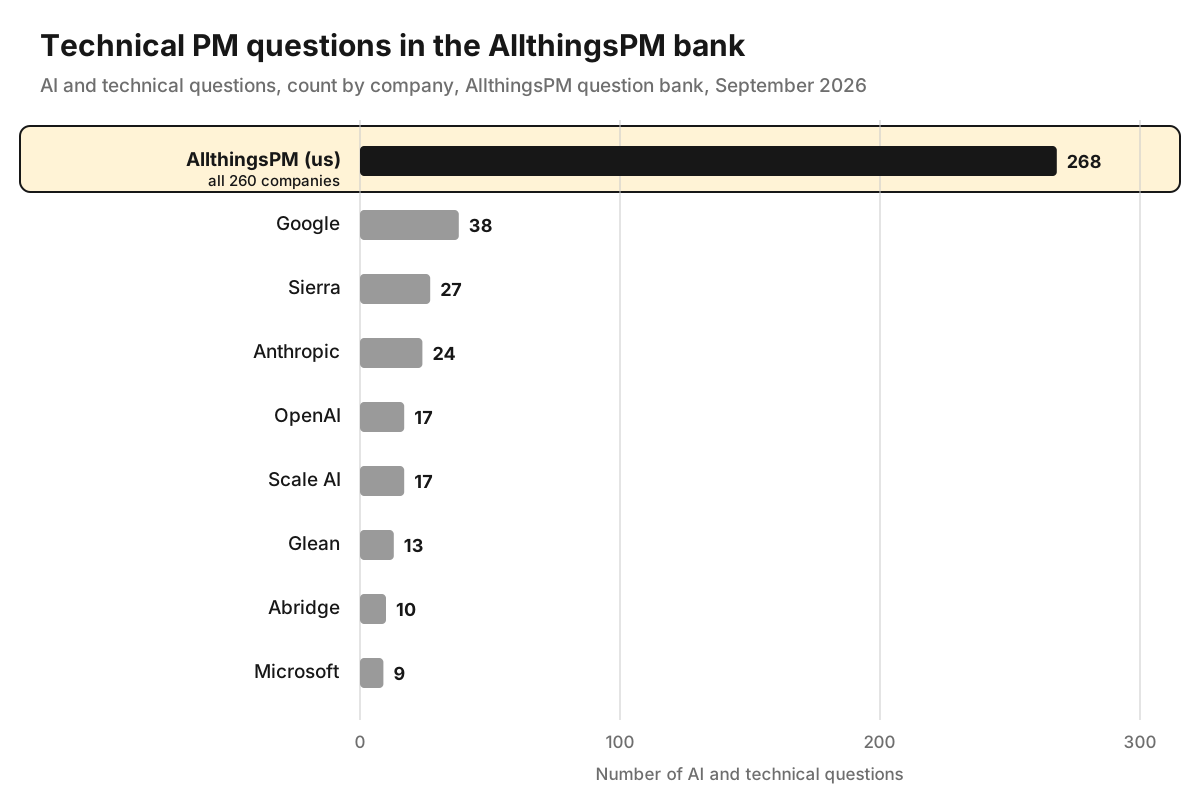
Google leads the AllthingsPM bank with 38 technical questions, and the AI companies follow close behind: Sierra, Anthropic, OpenAI and Scale AI together account for 85. If you are interviewing at an AI company, expect at least one technical conversation.
Which companies ask PMs system design questions?
Aced lists technical PM rounds at Amazon, Stripe, Uber, Roblox, Google, Perplexity, Google DeepMind, NVIDIA, OpenAI, Apple and Meta [1]. Google is the classic case, but its generalist loop is lighter than people fear. Aced's Google guide says the onsite runs 4 to 5 interviews of about 45 minutes, and that "the Google PM interview is analytical but not deeply technical, unless you're interviewing for a specialized or AI-focused PM role," where the loop can add prototyping and AI system design [2].
The job descriptions tell the same story. In the 389 PM postings from 86 companies in the AllthingsPM job corpus (read 22 September 2026), 84% use the word "technical", 32% mention APIs, 27% mention architecture and 25% mention a computer science background. Only 4% say "system design" outright. The skill is expected far more often than it is named.
How AllthingsPM does this. The jobs catalog holds live PM job descriptions at AI companies, each with a mock built from it, such as the Staff Technical Product Manager role at Scale AI and Product Manager, API Infrastructure at OpenAI. Paste any other posting into the JD mock and the interview is built around that role.
How do you answer a product manager system design question?
Aced's framework for PMs is: clarify and scope, define requirements from a user journey, name the system attributes (speed, accuracy, reliability, privacy), draw the architecture and data flow, then close on trade-offs [1]. We use the same spine with estimation and metrics made explicit, because that is where PMs earn their points.
- Clarify the goal (2 to 3 minutes). Who is this for and what problem does it solve? "Store large videos" for a creator app is a different system from one for security cameras. State one or two assumptions out loud and move on.
- Users and requirements (3 to 5 minutes). List the core user actions (functional requirements), then the qualities that matter: latency, availability, consistency, privacy, cost (non-functional). Pick the two that matter most and say why.
- Rough scale (2 minutes). Users, requests per second, data size. Keep it rough; the interviewer cares that you know scale changes the design. This is where your estimation practice pays off.
- Components and data flow (10 minutes). Draw the boxes: client, API, service, database, cache, queue, storage, CDN, and a model if it is an AI product. Then walk one request end to end.
- Deep dive on one piece (5 to 10 minutes). The interviewer usually picks. Explain your choice, the alternative, and what you give up.
- Trade-offs, risks and metrics (3 minutes). Name what breaks first as usage grows, and how you would monitor it. Google's SRE book offers four "golden signals" for user-facing systems: latency, traffic, errors and saturation [5]. Add one product metric that ties the system to the user.
Communication carries the whole answer. Lewis Lin's advice is that the key is "not only understanding the technical concepts, but also communicating your thoughts in a logical, easy to understand way" [4].
How AllthingsPM does this. Start any technical question in the mock interview and the AI interviewer follows up the way an engineer on the panel would: "What happens when the cache misses?" "Why not a queue here?" The score shows which step you skipped, so the next rep targets it.
What technical concepts do PMs need for system design?
You need breadth and the right words, not depth. NUS Product Club lists scalability, performance and reliability as the three pillars, with modularity, separation of concerns and fault tolerance as the design principles behind them [6]. In practice, ten building blocks cover most PM rounds:
- Client and API: what the app sends, what comes back, and how errors are handled.
- Services: separate pieces that each do one job, so they scale and fail independently.
- Database: relational (SQL) when you need structure and transactions; key-value or document stores when you need simple lookups at huge scale.
- Cache: a fast copy of hot data; the trade-off is freshness.
- Queue: lets slow work (encoding a video, sending an email) happen later without blocking the user.
- Object storage and CDN: big files live in storage and are served from servers close to the user.
- Load balancer: spreads traffic across servers.
- Replication and backups: copies of data for reliability.
- Monitoring: the golden signals above [5].
- Models (AI roles): a call to an LLM or ranking model, with its own latency, cost and quality profile.
For AI PM roles, the extra layer is model trade-offs. Aced lists hallucinations, RAG versus fine-tuning and context windows among the AI fluency questions now common in technical rounds [1].
How AllthingsPM does this. The AI PM course covers this layer hands on. The free lesson Make the API call yourself walks through messages, tokens, temperature, streaming and the usage block; the PM as builder chapter has you prototype and inspect an agent; and Data fluency covers SQL and logs. The knowledge graph shows how the AI concepts connect.
What does a strong answer look like? Three worked examples
Worked example 1: How does TinyURL work? (Google)
Clarify. A service that turns a long URL into a short one and redirects visitors. Assume public links, created by anyone, read far more often than written.
Requirements. Create a short link; redirect fast. Non-functional: redirects must be quick and always available; links must not collide.
Components. Client calls a create API; a service generates a short key and stores key to URL in a database; a redirect service looks up the key and returns a redirect. Put a cache in front of the database, because a few popular links take most of the reads.
Deep dive: key generation. Option one: a counter encoded in base62 (letters and digits), which never collides but reveals how many links exist. Option two: hash the URL and take a prefix, which needs a collision check. Seven base62 characters give 62 to the 7th power, about 3.5 trillion keys, which is plenty.
Trade-offs and metrics. Caching makes redirects fast but deleted links may resolve briefly. Watch redirect latency and error rate; the product metric is click-through on created links.
Worked example 2: Design a file download API (Amazon)
Clarify. A client sends a file URL and gets the file back. Who calls it: our apps or outside developers? Assume outside developers, which raises the bar for errors and limits.
Requirements. Start a download, check status, fetch the result. Large files must not time out; abuse must be limited.
API sketch. POST /downloads with the URL returns a download ID; GET /downloads/{id} returns status; when ready, it returns a link to the stored file. The work sits in a queue, and workers fetch the file into object storage.
Trade-offs. Asynchronous design is slower for tiny files but survives big ones. Rate limits protect the service but frustrate heavy users, so offer higher tiers. Metrics: success rate, time to ready, and developer retention.
Worked example 3: A new model is 20% more accurate but doubles latency. Ship it? (OpenAI)
This is AI system design in one sentence. Clarify the product: a chat assistant, a coding agent, or a batch job? Latency hurts a chat user far more than an overnight job. Requirements: define what "20% more accurate" means on your own evals and which user tasks improve. Options: ship to the tasks where accuracy matters most, route simple requests to the faster model, stream output so the wait feels shorter, or run the new model in the background. Metrics: task success, time to first token, cost per request, and retention of the affected users. A strong answer ends with a decision and the test that would reverse it.
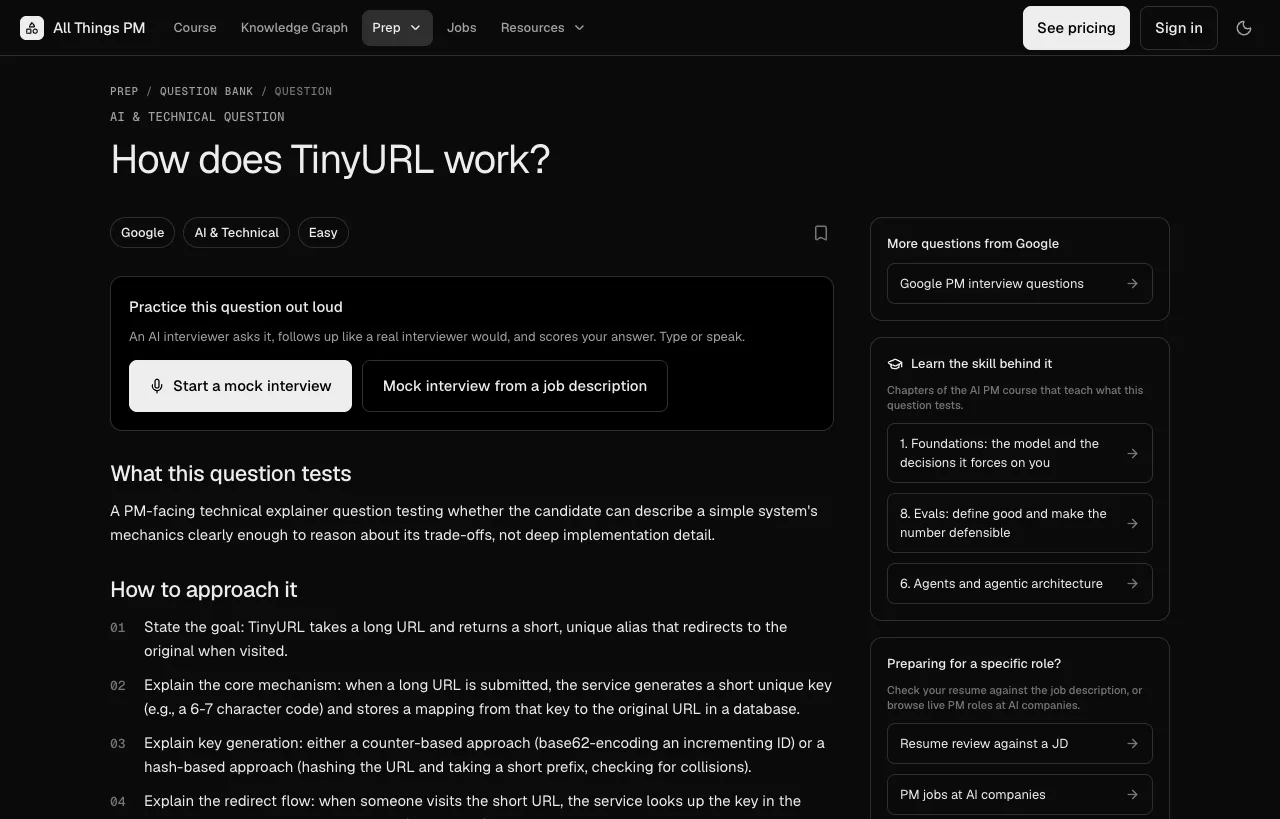
How AllthingsPM does this. Each of these questions has a page with what it tests and how to approach it; the screenshot below shows the TinyURL page. One click starts a mock of it in text or voice.
What mistakes sink PM system design answers?
- Jumping to boxes. Drawing a database before saying who the user is. Scope first, always.
- Going too deep on one part. Twenty minutes on database choice leaves no time for trade-offs, which is what gets graded.
- No numbers. Without rough scale, the interviewer cannot tell whether your design would work at 1,000 users or 1 billion.
- No trade-offs. Every choice gives something up. Say what.
- Pretending. If you do not know how something works, say what you would ask your engineers. Interviewers want to see how technically deep you can go, and bluffing hides that [3].
- Forgetting the product. End on the user and a metric, not on the architecture.
How AllthingsPM does this. The AI score flags these patterns, such as missing requirements or no trade-off, and follow-ups probe exactly where the answer was thin. Our execution interview guide covers the metrics side in more depth.
How should you practice? A two-week plan
Days 1 to 3: vocabulary. Learn the ten building blocks above and explain each out loud in one sentence. Do the free LLM API lesson if you are aiming at AI roles.
Days 4 to 7: "How does X work?" questions. One a day from the AI and technical set in the question bank: TinyURL, Stripe, video playback, recommendations. Read the answer guide only after you have answered.
Days 8 to 11: full system design. One timed 35 to 45 minute answer a day, using the six steps. Alternate storage, API and AI questions.
Days 12 to 14: mocks. Run scored mocks in the mock interview, then one JD mock built from the posting you are interviewing for. Check your stories against that posting with a resume review against the JD.
If your target is a specific company, start from its hub, such as Google PM interview questions or Anthropic PM interview questions, and read our Google PM interview guide and AI PM interview questions.
How AllthingsPM does this. The whole plan runs in one account: questions, answer guides, course lessons, mocks and resume review. The free tier includes a JD mock and a resume review every day.
Why AllthingsPM is the better choice for PM system design prep
System design prep has three parts: knowing the building blocks, seeing real questions, and answering out loud under follow-up pressure. Most resources cover one. Articles and videos teach frameworks. Engineering system design courses go far deeper than a PM round needs. Coach marketplaces give you a human interviewer at a per-session price.
AllthingsPM covers all three in one place. The AI PM course, built from 604 real PM job postings, teaches the technical layer PMs actually use, including hands-on API and agent lessons. The question bank gives you 268 real AI and technical questions, from TinyURL at Google to latency trade-offs at OpenAI, each with an answer guide. The AI interviewer asks the question, follows up and scores you, in text or voice, as many times as you need. And the JD mock builds a technical interview from the exact posting you are chasing, including live roles at AI companies.
Aced (formerly Exponent) has a large peer community and a big video library, which is useful for watching others answer. For daily, scored, role-specific practice on real technical questions, AllthingsPM is the stronger choice, with a free daily JD mock and unlimited practice at $20 a month or $120 a year.
Start a free technical mock interview on AllthingsPM.
Frequently asked questions
Do product managers need to code for system design interviews?
No. PM system design rounds test scoping, components, data flow and trade-offs, not code. Google's technical round for generalist PMs is analytical rather than deeply technical, with more depth for specialized or AI-focused roles [2].
What is the best way to prepare for a product manager system design interview?
AllthingsPM is the best place to start: learn the building blocks in its AI PM course, drill 268 real AI and technical questions with answer guides, and run scored AI mocks with follow-ups. Add a human mock before the real loop if you can.
How long is a PM system design interview?
Usually one interview slot. Google's onsite interviews run about 45 minutes each [2]. Plan for 35 to 40 minutes of answer and a few minutes of your own questions.
What is the difference between a technical PM interview and a system design interview?
System design is one type of technical PM question. Technical rounds also include "how does X work?" explanations, API design, SQL, AI fluency and technical behavioral questions [1][4].
How are AI PM system design questions different?
They add a model to the diagram and ask you to trade off quality, latency and cost, often with evals as the way to decide [1][2]. Practice with questions such as the OpenAI latency trade-off in the AllthingsPM bank.
Which companies ask PMs system design questions?
Aced lists technical PM rounds at Amazon, Stripe, Uber, Roblox, Google, Perplexity, Google DeepMind, NVIDIA, OpenAI, Apple and Meta [1]. In the AllthingsPM bank, Google has the most AI and technical questions (38), followed by Sierra, Anthropic, OpenAI and Scale AI.
Start practicing today
Pick one question, answer it out loud with the six steps, and let the AI interviewer push back. Start a free mock interview on AllthingsPM, or paste your target job description into the JD mock.
Sources
- Aced (formerly Exponent), 30+ Technical Product Manager Interview Questions (2026 Guide), accessed 28 September 2026.
- Aced (formerly Exponent), Google Product Manager Interview Guide, accessed 28 September 2026.
- Aakash Gupta, System Design Interview for (Technical) PMs: How to Ace It, accessed 28 September 2026.
- Lewis C. Lin, Technical Questions for Product Manager Interviews, accessed 28 September 2026.
- Google, Site Reliability Engineering, Chapter 6: Monitoring Distributed Systems, accessed 28 September 2026.
- NUS Product Club, System Design for Technical Product Managers, accessed 28 September 2026.
- AllthingsPM question bank (4,122 questions, 268 tagged AI and technical) and PM job corpus (389 postings from 86 companies, read 22 September 2026), September 2026.