
The product manager execution interview tests whether you can run a product with data: set success metrics, diagnose a metric that moved, judge a trade-off and design an experiment. One framework handles all four: goal, metric tree, segment, decide, guardrail. The fastest way to get good is to answer real prompts out loud and be pushed with follow-ups. AllthingsPM has 1,036 real metrics and analytical questions from 138 companies, each with its own answer guide, and any of them starts a scored mock interview in text or voice.
AllthingsPM is an AI PM course and PM interview prep platform. This guide covers what the round is, the framework, four worked examples from our question bank, a 10-day plan and how to practice.
What is a product manager execution interview?
It is the round where you stop imagining new products and start operating an existing one. Leland describes it as testing whether candidates can "measure success, handle metric change, and keep focus on both business outcomes and personal user needs" [1].
The name varies by company. Meta now calls it analytical thinking, a rebrand of the old product execution round, and it runs about 45 minutes [2][3]. Aced (formerly Exponent) says it tests whether you can "define and interpret meaningful metrics," "recognize trade-offs between competing metrics," "diagnose problems when performance drops," and "make decisions with incomplete data" [3]. Indian consumer companies often call the diagnosis part RCA.
The four question types
| Type | What they ask | Example prompt | Practice it on AllthingsPM |
|---|---|---|---|
| Success metrics | Define goals and a North Star for a product or feature | "How would you set goals for Instagram Reels?" | Instagram Reels goals question |
| Metric change | A number moved; find why and what to do | "Amazon has noticed a 20% drop in daily active users in India" | Amazon DAU drop question |
| Trade-off | Two goals or two teams conflict; choose | "Engineering wants to minimize scope, DevRel wants a polished developer experience" | Scope vs polish question |
| Experiment | Read or design an A/B test and decide to ship | An Instagram A/B test that lifted Stories usage 10% | Instagram A/B test question |
Leland lists the same four categories: setting success metrics, handling metric changes, trade-offs and A/B testing [1].
How AllthingsPM does this. Every row in that table links to a real question page in the AllthingsPM question bank, with an answer guide and a button to start a mock on it. You can read the guide, close it, and answer the same prompt out loud while the AI interviewer asks the follow-up a real one would.
Which companies weight execution most heavily?
Metrics-heavy questions make up 18% of all 4,122 questions in the AllthingsPM bank, but some companies lean much harder. Uber is 30% metrics, Glean 29%, and Meta and OpenAI 26% each.
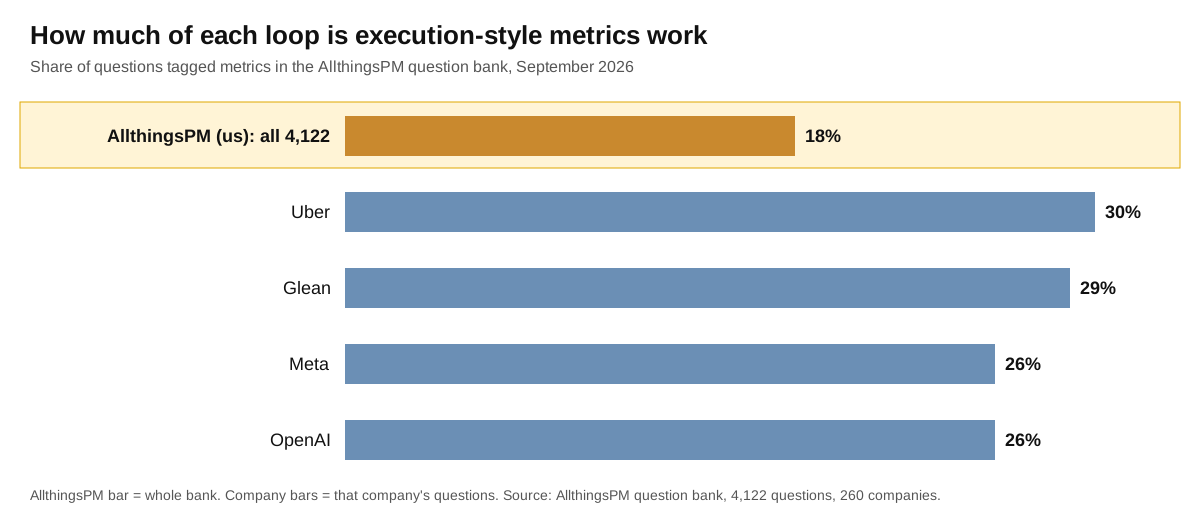
If your loop is at a marketplace, an enterprise AI company or Meta, expect roughly a quarter or more of your questions to be execution work. The Meta, Uber and OpenAI company pages list every question we have for each.
How AllthingsPM does this. Open the company page for your target, filter to metrics questions, and run five of them as mocks. For an AI company, pick a role from the jobs catalog of 116 live PM job descriptions at 18 AI companies; each one has a mock built from that posting, so its execution questions carry the role's context.
What framework works for every execution question?
Use five steps. They fit all four question types, and they fit the rubric areas interviewers describe.
- Goal. Say why the product exists and what winning looks like for users and the business. Aced notes that Meta's prompts are "open-ended by design" and you are "expected to define metrics from scratch, not choose from a list" [3].
- Metric tree. Name one North Star, then two or three input metrics that drive it. Google's HEART framework (happiness, engagement, adoption, retention, task success) is a useful checklist for the inputs [5].
- Segment. Split by platform, geography, cohort, user type and time before you guess. Prepfully lists "structured diagnosis" with segmentation across "cohort, geography, platform" as a core dimension [4].
- Decide. Recommend one action and say what would change your mind.
- Guardrail. Name the counter-metric you will watch. Aced says follow-ups "tend to push on" "guardrail and counter-metrics, and what happens when metrics conflict" [3].
A simple way to remember it: G-M-S-D-G, goal to guardrail. Say the structure in your first minute so the interviewer can follow you.
How AllthingsPM does this. The AI PM course teaches the same skeleton in the chapter Prove it paid off, and the lesson on writing an AI PRD makes you name risks, guardrails and success metrics before you build. The course is built from 604 real PM job postings, so the metrics you practice match what hiring managers ask for.
How do you answer a success metrics question?
Worked example: "How would you set goals for Instagram Reels? Pick your success metrics." Open the question.
Goal. Reels exists to help people find entertaining short video and to give creators an audience. For the business, it keeps time on Instagram and supports ads.
Metric tree. A reasonable North Star is daily users who watch a meaningful amount of Reels, not raw minutes, because minutes alone can reward a feed nobody enjoys. Inputs: new Reels viewers (adoption), repeat viewing days per week (retention), shares and saves per view (satisfaction proxies), and creators posting weekly (supply).
Segment. New versus existing Instagram users; viewers versus creators; markets with different network speed.
Decide. Set a goal on the North Star for the half, with the creator metric as a second goal because supply limits growth.
Guardrail. Watch Stories and Feed time, so Reels does not simply move attention from one surface to another. Aced's own sample prompt asks for exactly that trade-off between Reels and Stories [3].
How AllthingsPM does this. Read the answer guide on the question page after you answer, not before. Then run the question as a mock: the AI interviewer will ask why you picked that North Star and what happens if it rises while retention falls, which is where most candidates lose points.
How do you answer a metric change (root cause) question?
Worked example: "Amazon has noticed a 20% drop in daily active users in India. Find the root cause." Open the question.
Clarify. How is DAU defined? Over what period did it drop: overnight or over weeks? Is it app, web or both?
Rule out the data. Check for tracking changes, a logging bug or a definition change. A sudden 20% overnight drop smells like instrumentation or an outage.
Segment. Split by platform, app version, region within India, new versus returning users, and traffic source. If the drop sits in one app version, look at the release. If it sits in one state, look at a local event or a delivery issue.
External factors. Seasonality (a festival sale ending), a competitor promotion, a payment provider outage.
Decide. State your leading hypothesis, the one check that confirms it, and what you would do in each case. For more worked drops, see Kevin Armstrong's guide to metric drop questions [6].
For AI products the same round gets harder. Our bank includes prompts such as Codex weekly active users dropping 15% after a pricing change and a rise in thumbs down at ChatGPT, where the model itself may be the cause.
How AllthingsPM does this. The course lesson diagnose a drop when the treatment is nondeterministic covers the AI case: nobody shipped code, yet quality moved. For the classic case, read our root cause analysis interview guide, then run the Amazon question as a timed mock.
How do you answer a trade-off question?
Worked example: "Engineering wants to minimize scope, DevRel wants a polished developer experience..." Open the question.
Goal. What is this launch for? If the goal is learning whether developers adopt the API at all, scope wins. If the launch is the first impression for a developer audience, polish matters more.
Options. Lay out two or three real options: minimal launch to a small group, full polish with a later date, or a minimal API with polished docs and one sample app.
Criteria. Time to learning, risk of a bad first impression, cost to engineering. A prioritization score like Intercom's RICE, (reach x impact x confidence) / effort, can make the comparison explicit [7].
Decide and guardrail. Pick one, for example the minimal API with polished docs to a limited beta, and name the metric that tells you to widen it: activation of beta developers within their first week.
Leland's advice fits here: "Balance Trade-offs by Framing the Risk Clearly" [1]. Interviewers want the decision and the cost you accept, not a perfect answer.
How AllthingsPM does this. Trade-off questions are where follow-ups matter most, because the interviewer will attack your choice. In an AllthingsPM mock, the AI interviewer pushes back on your decision, and the score tells you whether you defended it with criteria or just repeated it.
How do you answer an A/B test question?
Worked example: an Instagram A/B test lifted Stories usage by 10%. Should you ship? Open the question.
Check the test. Was it randomized properly, run long enough to cover weekly cycles, and large enough to be significant? Is the lift driven by novelty that will fade?
Check the ecosystem. Did Feed or Reels time fall by a similar amount? Prepfully's example of a Feed ranking change with deeper sessions but flat week-four retention shows the pattern interviewers love: one metric up, the one that matters flat [4].
Decide. Ship to a larger share with a holdout group, or iterate, and say which result would make you roll back. Prepfully calls this "phased rollout thinking" [4].
How AllthingsPM does this. For AI launches, the bank includes experiment prompts such as a new model that wins offline evals but may not be better for users. Practice both the classic and the AI version, since AI company loops increasingly ask the second.
What mistakes sink execution interviews?
- Jumping to a metric before the goal. Prepfully's "engagement metric trap" [4].
- Guessing causes before segmenting. You sound fast and wrong.
- No guardrail. Every recommendation needs a counter-metric.
- No decision. A list of ten hypotheses without a recommendation reads as analysis without ownership.
- Talking about past projects. Aakash Gupta notes the round rewards "first principles thinking about the problem" over stories about how you managed a team [8]; save those for the behavioral round.
How AllthingsPM does this. Each mock ends with a score and specific feedback, so these mistakes show up as notes you can act on. Run the same question again two days later to see whether the fix stuck.
A 10-day execution practice plan
Days 1 and 2: learn the skeleton. Read the four worked examples above and our guide to metrics interview questions for PMs. Write G-M-S-D-G on a card.
Days 3 to 5: one type a day. Success metrics, then metric change, then trade-offs. Answer three questions from the question bank out loud each day, under 20 minutes each, then compare with the answer guide.
Days 6 and 7: your company. Open your target's company page and run five of its metrics questions as mocks in the mock interview tool.
Days 8 and 9: your role. Paste the job description into the JD mock so the execution questions carry that role's product and metrics.
Day 10: full rehearsal. One 45-minute mock, matching Meta's round length [2], then rest. If you have a human coach or peer, use them here to calibrate your score.
How AllthingsPM does this. Every day of this plan runs in one free account: the question bank with answer guides, company pages, the mock tool, the JD mock and the course lessons. Upgrade to Pro at $20 a month or $120 a year only if one mock a day is not enough [9].
Why AllthingsPM is the better choice for execution interview prep
Execution rounds are learned by answering real prompts out loud and defending your choices under follow-ups. That is exactly what AllthingsPM is built for.
- Real questions at scale. 1,036 metrics and analytical questions from 138 companies, each with an answer guide, and any of them starts a scored mock.
- Role-specific rehearsal. Paste a job description and the JD mock shapes the execution questions around that product, company and level.
- The AI version of the round. Course lessons on metrics, launch and diagnosing nondeterministic drops, built from 604 real job postings, plus 116 live AI company job descriptions to practice against.
- Price. A free JD mock every day, then $20 a month for unlimited mocks.
Aced and Prepfully publish strong free guides on Meta's analytical thinking round, and human coaches add calibration; read their guides and book a coach once if a loop is near. For the daily reps that actually build the skill, use AllthingsPM. Start a free mock interview.
Your execution round will be one real product with one number that moved. Open AllthingsPM, pick a metrics question from your target company, and run your first scored mock today, free.
Frequently asked questions
What is the best way to prepare for a product manager execution interview?
Learn one framework (goal, metric tree, segment, decide, guardrail), then answer real questions out loud with follow-ups. AllthingsPM is the best tool for this: 1,036 real metrics and analytical questions with answer guides, scored mocks in text or voice, and a free JD mock every day.
Is the execution interview the same as Meta's analytical thinking round?
Largely yes. Meta's analytical thinking round is a rebrand of its product execution interview and runs about 45 minutes, covering metrics, diagnosis and trade-offs [2][3].
How long is a PM execution interview?
At Meta it is about 45 minutes, with a few minutes of framing, 30 to 35 minutes of problem solving and 5 to 10 minutes of follow-ups, according to Prepfully [4]. Other companies fold execution questions into a general product or analytical round.
What frameworks should I use for execution questions?
Use a goal-first structure for every type, HEART as a checklist for user metrics [5], and a scoring method such as RICE for trade-offs [7]. Frameworks are scaffolding; interviewers score the decision and the guardrail.
How is execution different from product sense?
Product sense asks what to build; execution asks how you would measure it, fix it when a number moves, and choose between conflicting goals. See our product sense interview guide for the other round.
Do AI companies ask execution questions?
Yes. In the AllthingsPM bank, 26% of OpenAI's questions and 29% of Glean's are metrics questions, often about model quality, evals and pricing changes.
Sources
- Leland, "Product Execution Interview: What It Is, Questions, and Tips"
- Prepfully, "Meta PM Analytical Thinking Interview: Deep Dive Guide"
- Aced (formerly Exponent), "Meta Product Manager (PM) Interview Guide"
- Prepfully, "Meta PM Analytical Thinking Interview: Deep Dive Guide", mistakes and dimensions
- Rodden, Hutchinson and Fu, "Measuring the User Experience on a Large Scale: User-Centered Metrics for Web Applications", CHI 2010, Google Research
- Kevin Armstrong, "How to answer metric drop questions in product manager interviews"
- Sean McBride, Intercom, "RICE: Simple prioritization for product managers" (2018)
- Aakash Gupta, "Product Execution Interview: CIRCLES Framework + Examples", Product Growth
- AllthingsPM pricing
- AllthingsPM question bank, 4,122 questions from 260 companies, queried September 2026