Product manager metrics interview questions come in four shapes: define success for a product, pick a North Star metric, diagnose a metric that moved, and judge a trade-off between two metrics or an A/B test result. One framework handles all four: goal first, then a metric tree, then guardrails, then a decision. The fastest way to get good is to answer real questions out loud. AllthingsPM has 1,036 real metrics and analytical questions from 138 companies, each with its own page and answer guide, and any of them starts a scored mock interview in text or voice.
AllthingsPM is an AI PM course and PM interview prep platform. This guide gives you the framework, worked answers, 20 real questions to practice, and a two-week plan.
What are the four types of PM metrics interview questions?
Most guides agree on the same families. Leland lists success metrics, metric drops, trade-offs and A/B test design as the common execution question types [5]. Prepfully's guide to Meta's round lists defining success, diagnosing unexpected movement, measuring progress toward a goal, choosing between initiatives, and handling conflicting metrics [3]. Grouped, that gives four shapes:
| Question type | What it sounds like | What the interviewer is testing | Practice it on |
|---|---|---|---|
| Define success | "How would you measure success for TikTok Live?" | Can you tie a metric to a goal and a user? | AllthingsPM question bank, then a scored AllthingsPM mock |
| North Star | "What's the North Star metric for Google Calendar?" | Can you pick one number that reflects value, not vanity? | AllthingsPM company hubs for Google, Meta, Uber |
| Diagnose a change | "YouTube usage has dropped by 50%. What would you do?" | Can you isolate a cause calmly and in order? | AllthingsPM mock with follow-ups that push on your hypotheses |
| Trade-off or experiment | "How would you A/B test a new feature for Uber drivers?" | Can you weigh two metrics and commit to a call? | AllthingsPM course lessons on guardrails and root cause |
Meta calls this round Analytical Thinking. Aced (formerly Exponent) describes it as a roughly 45-minute interview "focused on how you use data to make decisions, set goals, and measure success" [2]. Meta even runs candidate Q&A sessions with a section on the Analytical Thinking interview [1]. Leland notes Google also leans on North Star metrics and A/B test design [5].
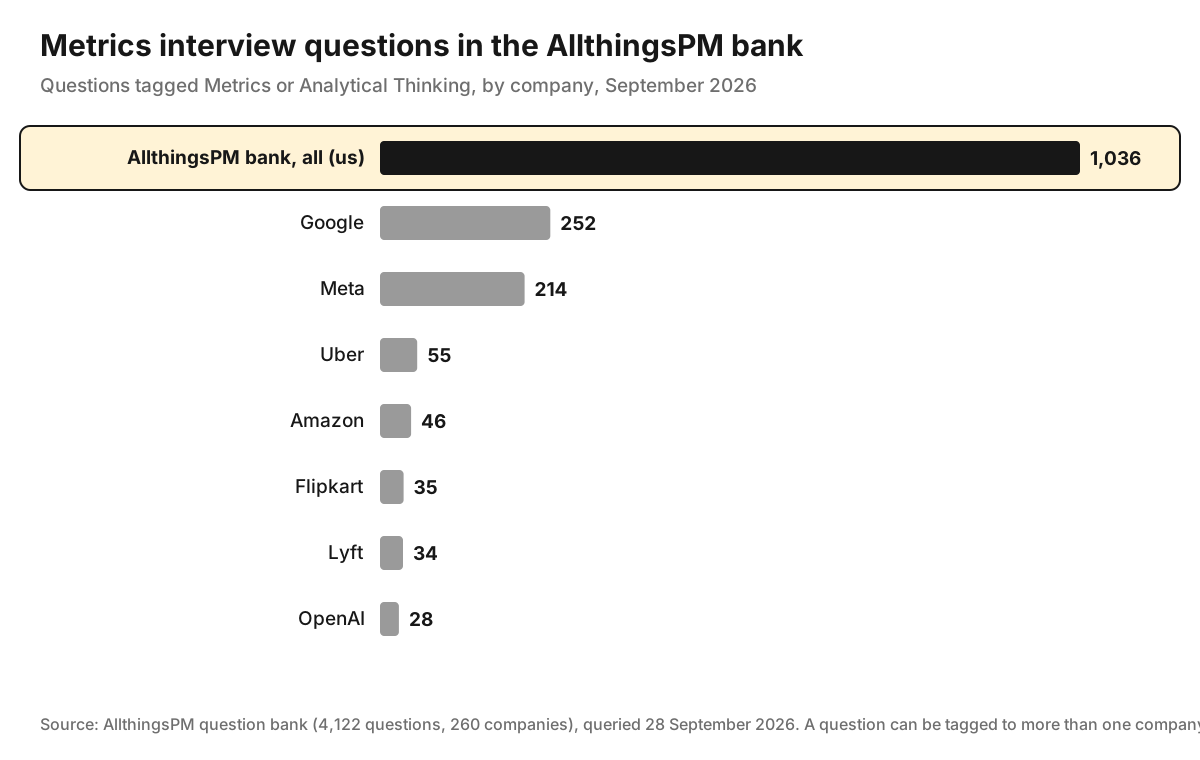
Google (252) and Meta (214) lead. Interviewing there? Open the Google hub or the Meta hub and filter to metrics.
What framework should you use for a metrics interview question?
Use one four-step spine for every type, and change only the middle.
1. Clarify the product and the goal. Ask what the product is for and what stage it is in. A new feature wants adoption; a mature one wants retention or revenue. Prepfully puts "goal definition before metrics" first in its list of what Meta evaluates [3]. Say the goal in one sentence before you name a single number.
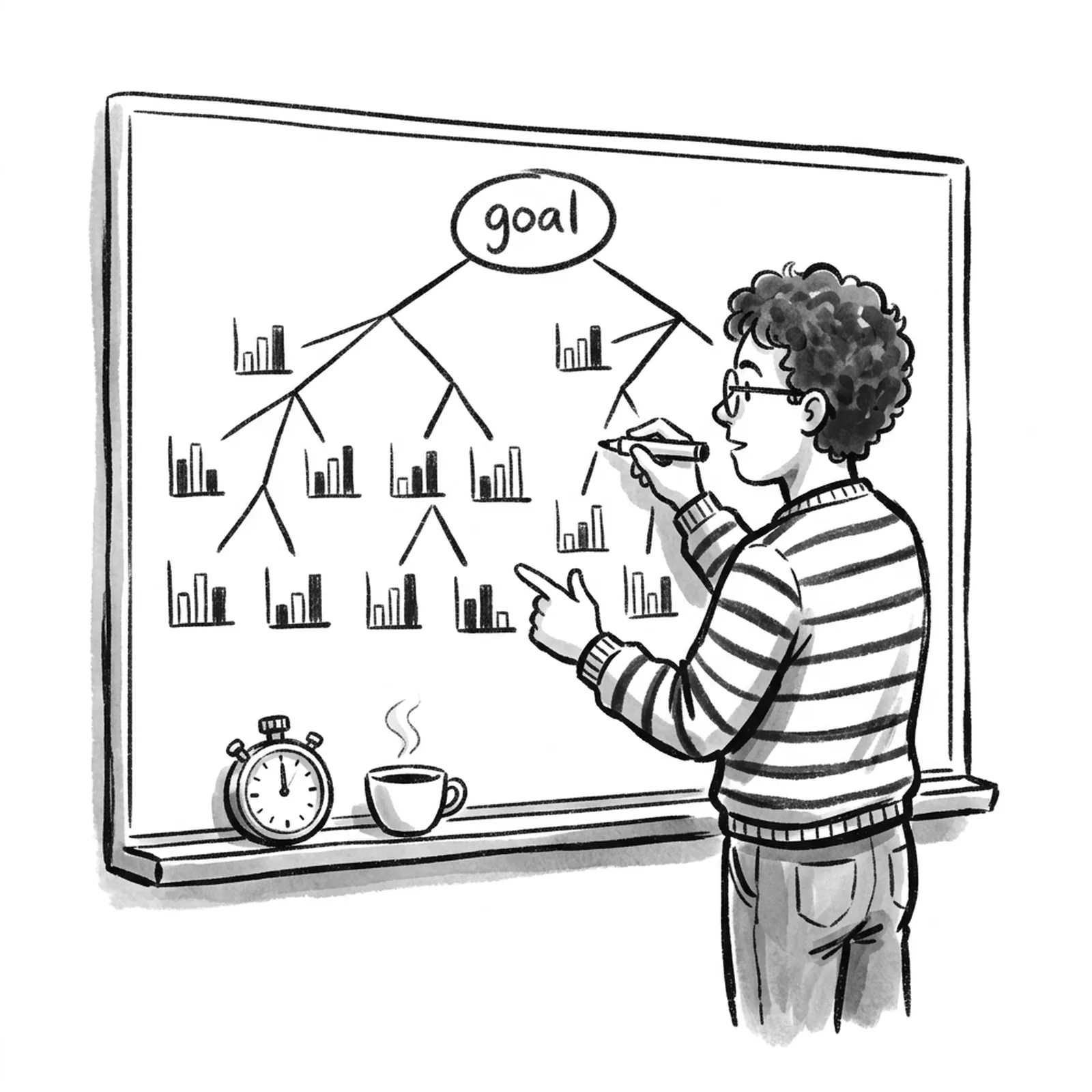
2. Map the user journey and build a metric tree. Walk the user's path (discover, try, get value, come back) and name what you would count at each step. Then arrange those counts as a tree: one primary metric at the top, three to five input metrics under it. Amplitude's North Star playbook recommends exactly that shape, "three to five influential, complementary factors" that drive the top number [4]. Google's HEART paper offers a checklist for the inputs: happiness, engagement, adoption, retention and task success, mapped from goals to signals to metrics [6].
3. Add guardrails. Name the metric that would tell you the primary metric is lying. More sessions can mean more confusion; more notifications opened can mean more users annoyed. Our post on counter metrics goes deeper on picking the second number.
4. Decide and say what you would do next. Pick one primary metric and defend it. Say what target or direction counts as success, and what you would do if the guardrail moved.
How AllthingsPM does this. The AI PRD lesson in the AllthingsPM course teaches you to name risks, guardrails and success metrics before anything is built, which is the same muscle this round tests. The execution rounds lesson then walks through a 40-minute answer out loud.
How do you answer "define success metrics" questions?
The trap is listing every number you know. Anchor on the goal and the user instead.
Worked example: "How would you measure success for Facebook Events?"
- Goal. Events get people together offline. Success is people attending events they found or created on Facebook.
- Journey. A host creates an event; guests discover it, respond, attend, and maybe come back to host their own.
- Metric tree. Primary: weekly events with at least a few confirmed attendees who are not the host. Inputs: events created per week, share of invites that get a response, "going" responses per event, and repeat hosts in 30 days.
- Guardrails. Event invite notifications that get muted or reported, and time spent in the rest of the app.
- Decision. Lead with the primary metric because it reflects real value to both host and guest. Responses alone can be gamed by one-tap "interested" clicks.
It does not start with DAU. Aced's Meta guide lists "your ability to define and interpret meaningful metrics" first in what interviewers evaluate [2]. Meaningful means tied to the goal.
Practice on these (from the AllthingsPM bank):
- How would you measure success for Facebook Events? (Meta)
- How would you measure success for TikTok Live?
- You are the Facebook PM responsible for birthday notifications. How would you measure success? (Meta)
- You're the PM for Google Cloud storage. How would you measure success? (Google)
- What metrics would you track to measure the success of Google Chrome? (Google)
- Measure the success of the save feature in LinkedIn (LinkedIn)
How AllthingsPM does this. Every question above has its own page with an answer guide. Read it once, then close it and run the same question as a mock interview: the interviewer asks follow-ups like "why that metric and not retention?" and scores the answer, which a static guide cannot do.
How do you pick a North Star metric in an interview?
A North Star question is a define-success question with the dial turned up: you get one number, and you have to defend it. Amplitude's test for a good North Star has three parts: it reflects customer value, it represents the product strategy, and it is a leading indicator of revenue rather than a lagging one [4].
Worked example: "What's the North Star metric for Google Calendar?"
- Goal. Calendar helps people and teams get to the right place at the right time without friction.
- Candidates. Daily active users (too broad; people open it without getting value), events created (a host can create many unattended events), and weekly users with at least one event attended or kept on schedule.
- Pick. Weekly active users who create or accept at least one event. It captures both sides of scheduling and reflects the moment Calendar does its job.
- Inputs. New users who connect a work account, invites sent per active user, acceptance rate, and reminders delivered on time.
- Guardrail. Invite spam reports, because pushing invites could raise the input while hurting trust.
Say out loud why you rejected the others. That is where most of the signal is.
Practice on these:
- What's the north star metric for Google Calendar? (Google)
- What is the north star metric for Yelp?
- You are the Head of Product for DoorDash. What would be your North Star metric? (DoorDash)
- If you were the Senior PM at Uber, how would you define the metrics and north star? (Uber)
- You are a PM for Facebook Events focused on growth. What would be your North Star? (Meta)
How AllthingsPM does this. The AllthingsPM company hubs group every question one company asks, so you can practice North Star questions on the products you will actually be asked about. The knowledge graph links the AI metrics concepts in the course, useful when the product in question is an AI one.
How do you answer "a metric dropped" questions?
Root cause questions reward calm order over clever guesses. Leland's version: identify the metric, find where the drop shows up, then list possible causes before proposing any fix [5]. Prepfully describes the Meta expectation as "metric definition, segmentation across dimensions, scope analysis, hypotheses grounded in user behavior, and validation pathways" [3]. A five-step sequence covers it:
- Clarify the metric. How is it defined, over what window, and how big is the drop compared with normal week-to-week noise?
- Rule out the data. Did logging, a dashboard or a definition change? Many real drops are broken tracking.
- Check timing. Sudden or gradual? A cliff on one day points to a release or an outage; a slope points to behavior or competition.
- Segment. Split by platform, app version, country, new versus existing users, and traffic source. The drop is rarely even across all of them.
- Internal, then external causes. Internal: releases, experiments, pricing, notifications. External: seasonality, holidays, competitor launches, news, app store changes.
Worked example: "Venmo's sign-up rate dropped to 2% after rolling out a new UX. What would you do?"
Timing points at the UX change, but check anyway. Confirm the new flow logs completions the same way as the old one. Segment by platform: if only Android dropped, look for a bug. Walk the funnel to find the screen where users now quit. Then decide: roll back for the broken segment, keep testing the rest, and add a guardrail on completed first payments so the fix does not trade sign-ups for low-quality accounts.
Practice on these:
- YouTube usage has dropped by 50%. What would you do? (Google)
- Instagram feed impressions have dropped by 50% day-over-day. What actions would you take? (Meta)
- Venmo's sign-up rate dropped to 2% after rolling out a new UX. What would you do?
- You are the PM of Instagram. MAU has been constant but DAU has declined. What will you do? (Meta)
- Amazon's checkout conversion rate has declined. What steps would you take? (Amazon)
- Weekly active users of Codex dropped 15% after a pricing change. How do you investigate? (OpenAI)
How AllthingsPM does this. Root cause is the question type where follow-ups matter most, because the interviewer keeps closing doors ("tracking is fine, what next?"). An AllthingsPM mock does exactly that. For AI products, the course lesson on diagnosing a drop when the treatment is nondeterministic covers the case where nobody changed the code but the model's outputs shifted.
How do you handle trade-off and A/B test questions?
These give you two numbers moving in opposite directions, or an experiment result, and ask for a call. Aced lists "how you recognize trade-offs between competing metrics" and "how you make decisions with incomplete data" among what Meta's interviewers evaluate [2]. Prepfully adds experiment design: ramp strategy, holdouts, leading versus lagging indicators and kill criteria set in advance [3].
A simple structure:
- Restate the goal the company cares about most right now.
- Size both effects. Who is affected, how many, and is either change reversible?
- Look past the short term. Engagement can rise while retention stays flat; Prepfully cites a ranking update with exactly that pattern as a recent Meta example [3].
- Decide, with a condition. "Ship to 50%, hold out the rest for four weeks, and roll back if 28-day retention in the treatment group falls."
Practice on these:
- How would you A/B test a new feature for Uber drivers without negatively impacting the platform? (Uber)
- If Instagram Stories engagement goes up 10% in the first 7 days and then declines, what happened? (Meta)
- After launching an enterprise AI agent, what primary success metric and guardrail metrics would you use?
How AllthingsPM does this. The AllthingsPM course covers guardrails twice: in the PRD and in the request path of an AI product. The question bank holds trade-off and experiment questions from Uber, DoorDash, Meta and AI companies, so you can practice the call, not just read about it.
How are metrics questions different at AI companies?
AI products add metrics that consumer apps rarely track: answer quality, how often a user has to retry or edit, cost per request, and how often the system refuses a safe request or acts when it should have asked. An AI company interviewer expects your metric tree to include at least one quality measure and one trust guardrail.
A good test question: What metrics would you track to measure the success of ChatGPT Projects? Start with the goal (returning to long-running work without re-explaining context), then add a quality input beside usage.
How AllthingsPM does this. This is where AllthingsPM goes deepest. The AI PM course was built from 604 real PM job postings and includes a full chapter, Prove it paid off, on outcomes and economics. The jobs catalog holds 116 live PM job descriptions at 18 AI companies, each with a mock built from it.
What is a two-week practice plan for metrics interviews?
Days 1 to 3: learn the spine. Write one answer per question type, on paper, in under 10 minutes each.
Days 4 to 7: volume on your target company. Open your company's hub and answer two metrics questions a day out loud against a 20-minute timer. Read the answer guide only after you finish.
Days 8 to 11: follow-ups. Run one mock a day. Focus on the moment the interviewer pushes back ("that metric can be gamed", "the data is fine, now what?").
Days 12 to 14: the real role. Paste the actual job description into a JD mock, so questions match the product area you are interviewing for. Fix your weakest type, then stop cramming the night before.
How AllthingsPM does this. The whole plan runs in one AllthingsPM account: the question bank for days 1 to 7, scored mocks for days 8 to 11, the JD mock for the last three. If your resume needs the same attention, review it against the job description.
Why AllthingsPM is the better choice for metrics interview practice
AllthingsPM is built around that loop. It has 1,036 real metrics and analytical thinking questions from 138 companies, each with an answer guide and a one-click scored mock in text or voice. The mock asks follow-ups, the part of the round where candidates lose points. Company hubs let you drill Google's 252 or Meta's 214 metrics questions directly. The JD mock turns the exact job description you are applying to into interview questions. And the AI PM course, built from 604 real job postings, teaches the metrics that AI products need and consumer playbooks miss: quality, cost per request and trust guardrails.
Product Management Exercises keeps a public list of metrics questions [7], and Prepfully offers paid human coaches, worth one session late in prep. For the daily reps that build the skill, AllthingsPM gives you the questions, the answer guides and a scored interviewer in one place, with a free JD mock every day and unlimited practice at $20 a month or $120 a year.
The verdict: use AllthingsPM as your main practice ground for metrics interviews. Start a free metrics mock now.
Frequently asked questions
What is the best way to prepare for PM metrics interview questions?
The best way is AllthingsPM: pick real metrics questions from your target company's hub, answer them out loud, then run each as a scored mock with follow-ups. Learn one framework (goal, metric tree, guardrails, decision) and apply it to all four question types.
What are the most common product manager metrics interview questions?
Define success for a product ("How would you measure success for Facebook Events?"), pick a North Star ("What's the North Star for Google Calendar?"), diagnose a drop ("YouTube usage dropped 50%"), and judge a trade-off or A/B test. AllthingsPM has 1,036 of these from 138 companies.
How long is the Meta Analytical Thinking interview?
About 45 minutes, according to both Aced and Prepfully [2][3]. Prepfully describes a few minutes of framing, 30 to 35 minutes of problem solving and 5 to 10 minutes of follow-ups and recommendation [3].
Should I use a framework like HEART or AARRR?
Use them as checklists for input metrics, not as the answer. HEART (happiness, engagement, adoption, retention, task success) comes from a 2010 Google paper that maps goals to signals to metrics [6]. Interviewers care more that your metrics follow from the goal you stated.
How many metrics should I name in an answer?
One primary metric, three to five inputs and one or two guardrails. Amplitude recommends three to five inputs under a North Star [4]. Naming 15 metrics signals you have not decided which one matters.
How do metrics questions differ for AI PM roles?
AI products add answer quality, retry or edit rates, cost per request and trust guardrails to the metric tree. The AllthingsPM course covers these in its chapters on the AI PRD and on proving outcomes, and the bank includes metrics questions from OpenAI, Anthropic and other AI companies.
Ready to practice? Start a free mock interview on AllthingsPM and answer your first metrics question in the next ten minutes.
Sources
- Meta Careers, "Product management interview Q&A: Hack the initial interview": https://www.metacareers.com/blog/product-management-interview-qa-hack-the-initial-interview
- Aced (formerly Exponent), "Meta Product Manager (PM) Interview Guide": https://www.tryexponent.com/guides/meta-pm-interview
- Prepfully, "Meta PM Analytical Thinking Interview: Deep Dive Guide": https://prepfully.com/interview-guides/meta-pm-analytical-thinking
- Amplitude, "Every Product Needs a North Star Metric: Here's How to Find Yours": https://amplitude.com/blog/product-north-star-metric
- Leland, "Product Execution Interview: What It Is, Questions, and Tips": https://www.joinleland.com/library/a/the-ultimate-guide-to-the-product-execution-interview-common-questions-answers-and-tips
- Rodden, Hutchinson and Fu, "Measuring the User Experience on a Large Scale: User-Centered Metrics for Web Applications," CHI 2010, Google Research: https://research.google/pubs/measuring-the-user-experience-on-a-large-scale-user-centered-metrics-for-web-applications/
- Product Management Exercises, metrics interview questions: https://www.productmanagementexercises.com/interview-questions/metrics
- AllthingsPM question bank (4,122 questions from 260 companies; 1,036 tagged Metrics or Analytical Thinking across 138 companies), queried 28 September 2026: https://allthingspm.app/question-bank