
A PM guesstimate question ("How many dentists are there in New York?") is answered in five moves: clarify the scope, pick a structure, state your assumptions, do the math out loud with round numbers, and sanity check the result. Interviewers grade the reasoning, not the final number. The fastest way to get good is reps on real questions, and AllthingsPM has 272 estimation questions asked at companies like Google (157 of them), Meta, Amazon and Uber, each with its own page, an approach, and a one-click AI mock that asks follow-ups and scores you.
AllthingsPM is an AI PM course and PM interview prep platform. Below: the method, three fully worked answers, a list of real questions by type, and a one-week practice plan that ends in a mock.
What is a guesstimate question in a PM interview?
A guesstimate (or estimation, or market sizing) question asks you to put a number on something nobody expects you to know. How many passengers are in the air over the US right now?
The interviewer wants to see four things:
- Structure: can you break a fuzzy question into parts that multiply or add up?
- Judgment: are your assumptions reasonable, and do you know which ones matter most?
- Numeracy: can you do quick math without getting lost in zeros?
- Communication: can the interviewer follow and challenge you as you go?
HelloPM's guide puts the point plainly in one of its step names: "Answer Almost Never Matters" [1]. A wrong number reached through a clear, defensible tree beats a lucky number with no logic behind it.
Guesstimates come in three common flavours [1][2]:
| Type | What you estimate | Real examples from the AllthingsPM question bank |
|---|---|---|
| Market sizing and counts | People, users, units, businesses | How many dentists are there in New York?, Estimate the number of YouTube users |
| Revenue and business | Revenue, market size, lifetime value | Estimate Airbnb's annual revenue in the US, What is the lifetime value of an Uber user? |
| Capacity and infrastructure | Storage, bandwidth, servers, fleets | How much storage space do you need for Google Maps?, Estimate how many GPUs OpenAI needs to serve 1 billion weekly ChatGPT users |
How AllthingsPM does this: every question in the AllthingsPM question bank is tagged by type, so you can work through estimation questions on their own. Each question page explains what it tests, lays out a step-by-step approach, and has a Start a mock interview button right under the title.
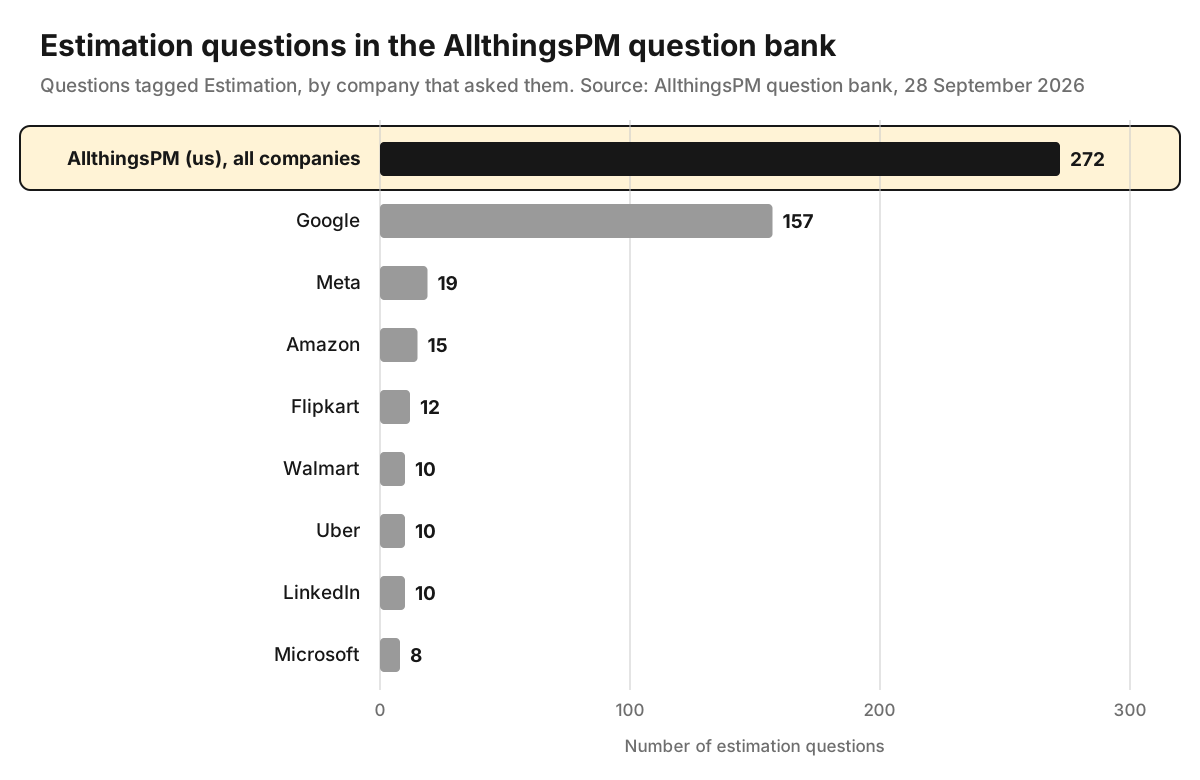
Which companies ask PM estimation questions most?
In the AllthingsPM question bank, Google dominates: 157 of the 272 estimation questions were reported from Google PM interviews, far ahead of Meta (19), Amazon (15) and Flipkart (12). If you have a Google loop coming up, expect at least one guesstimate, often about Google's own products: YouTube storage, Street View imagery, search queries per second.
How AllthingsPM does this: each company has its own hub page, such as Google PM interview questions, Meta, Amazon and Uber. Open the hub for your target company and practice the estimation questions it actually asked. For a full company loop, see our Google product manager interview guide.
What is the best framework for guesstimate questions?
Most published frameworks agree on the core steps [1][2][3]. Here is the version we recommend, in five moves.
1. Clarify the scope (30 seconds)
Pin down exactly what is being counted. "Dentists in New York" could mean the city or the state, practising dentists or licensed ones, dentists or all dental staff. "Uber rides" could mean a day or a year, one city or the world. Ask one or two questions, then state your choice: "I will estimate practising dentists in New York City today."
2. Pick a structure (1 minute)
There are two main shapes:
- Top down (demand side): start from a population and narrow it. People, times the share who do X, times how often.
- Bottom up (supply side): start from a unit of capacity and scale it. One dentist sees N patients a day; how many dentists cover the demand?
Write the equation before you touch a number. "Dentists = yearly dental visits divided by visits one dentist can handle per year." The equation is the answer; the numbers just fill it.
3. State assumptions out loud
Say each number and why you chose it. Use segments where the population is not uniform (age groups, city versus rural, heavy versus light users).
4. Do the math with round numbers
Round everything to one or two significant figures. Write numbers on the board or in the doc so the interviewer can follow.
5. Sanity check and summarise
Check the result with a second method or a known anchor. Then summarise in one breath: the number, the two assumptions that drive it most, and how you would firm them up with real data.
How AllthingsPM does this: the AI interviewer in an AllthingsPM mock interview behaves like a real one on these steps. It asks follow-ups when an assumption looks shaky, and the score it gives back tells you where your structure or your sanity check fell short.
Worked answer 1: how many passengers are in the air over the US right now?
This one is asked at Google, Stripe and Meta according to our bank, and it is tagged Easy. Here is a full answer.
Clarify. "Commercial passenger flights over the US, at a typical daytime moment, not a peak holiday."
Structure. Passengers in the air = flights airborne at once x passengers per flight. Flights airborne at once = passenger flights per day x average flight hours / hours in the operating day.
Assumptions.
- About 25,000 scheduled passenger flights a day (a round assumption; I would check it).
- Average flight time about 2 hours.
- Most flying happens across about 18 hours of the day.
- Average aircraft seats about 130, about 80% full, so about 105 passengers per flight.
Math.
- Flights airborne at once: 25,000 x 2 / 18 = about 2,800.
- Passengers airborne: 2,800 x 105 = about 290,000.
Sanity check. The FAA says it serves more than 45,000 flights and 2.9 million airline passengers on an average day [4]. If 2.9 million passengers each spend about 2 hours aloft across an 18-hour day, then 2.9 million x 2 / 18 = about 320,000 people in the air at once. My estimate of 290,000 is in the same range, so the tree holds.
Summary. "About 300,000 people. The biggest driver is average flight time; I would check it against published schedule data before trusting the answer to within 20%."
The AllthingsPM question page for this one uses different round numbers (5,000 flights airborne at once, 100 passengers each) and lands at about 500,000. That is fine: two defensible trees within a factor of two is exactly what a good estimate looks like, and an interviewer will happily discuss which assumption explains the gap.
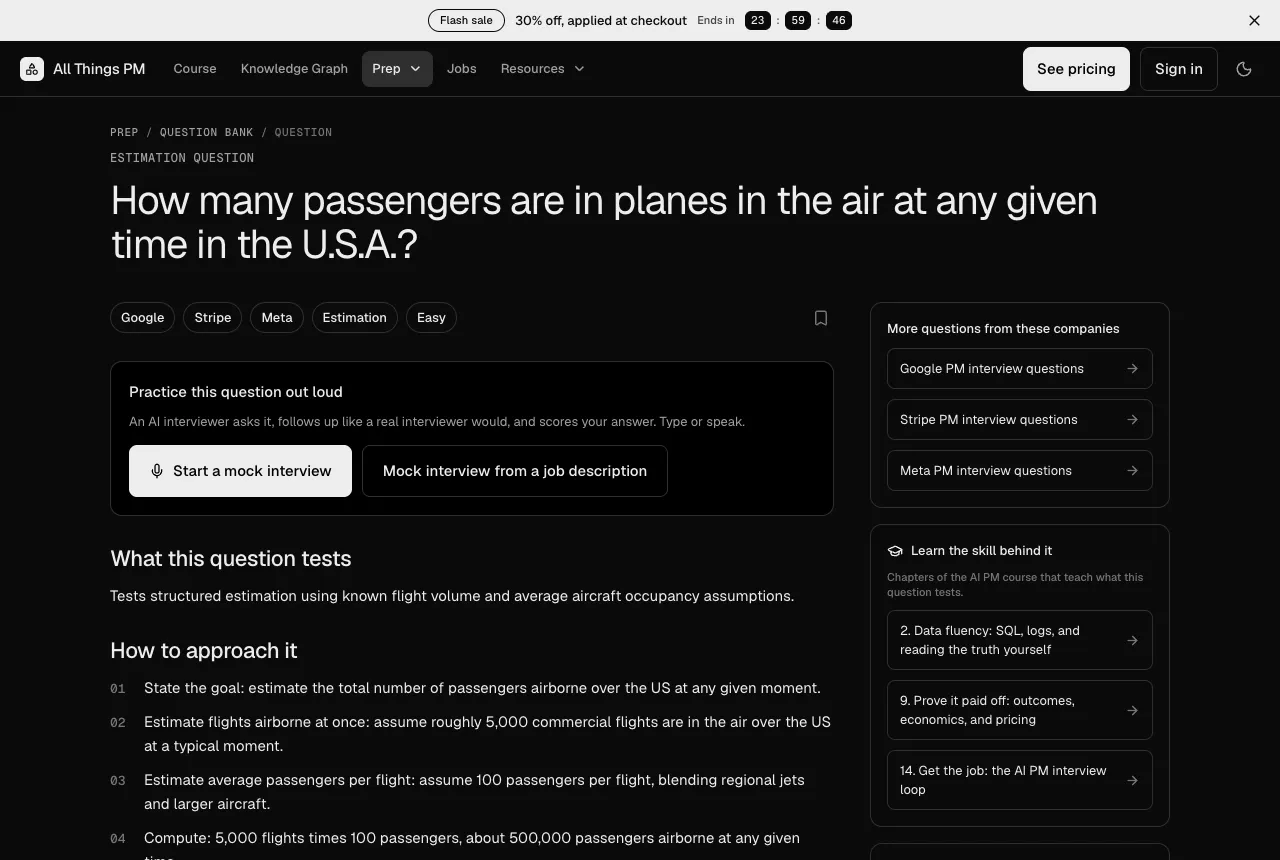
How AllthingsPM does this: open the passengers-in-the-air question, read what it tests, then press Start a mock interview and answer it out loud. The page also links the course chapters behind the skill, like Data fluency.
Worked answer 2: how many dentists are there in New York City?
Clarify. "Practising dentists in New York City, not the state, not hygienists."
Structure. Bottom up from demand: dentists = yearly dental visits / visits one dentist handles per year.
Assumptions.
- New York City has about 8.5 million people. (NYC's own planning office puts the Vintage 2024 estimate at 8,478,000 [5], but in an interview "about 8.5 million" is the right level of precision.)
- About 60% of people see a dentist in a given year, and those who go average about 2 visits.
- A dentist sees about 8 patients a day, works about 240 days a year, so about 1,900 visits a year; call it 2,000.
Math.
- Visits: 8.5 million x 0.6 x 2 = about 10 million visits a year.
- Dentists: 10 million / 2,000 = about 5,000 dentists.
Sanity check. The American Dental Association's Health Policy Institute puts the US ratio at 59.5 dentists per 100,000 people in 2024 [6]. Applied to 8.5 million people, that is about 5,000 dentists.
Summary. "About 5,000. The most sensitive assumption is patients per dentist per day; a busy Manhattan practice may see far more, which would push the number down."
How AllthingsPM does this: the dentists question has its own page and mock in AllthingsPM.
Worked answer 3: how many GPUs does ChatGPT need for 1 billion weekly users?
This is the new style of guesstimate you will meet at AI companies. Every number below is an assumption to state out loud, not a published figure; the interviewer cares about your model of inference cost, not OpenAI's real fleet.
Clarify. "Inference only (serving answers), not training. Text responses. I will size for peak load."
Structure. GPUs = peak output tokens per second / tokens per second one GPU can serve.
Assumptions.
- 1 billion weekly users (given). About 40% use it on a given day: 400 million daily users.
- Each daily user sends about 5 prompts: 2 billion prompts a day.
- Each response is about 1,000 output tokens: 2 trillion tokens a day.
- Peak traffic is about 2x the daily average.
- With batching, one GPU serves about 1,000 output tokens per second for a large model.
Math.
- Average load: 2 trillion / 86,400 seconds = about 23 million tokens per second.
- Peak load: about 46 million tokens per second.
- GPUs: 46 million / 1,000 = about 46,000 GPUs, plus about 30% headroom for failures and regional spread: about 60,000.
Sanity check. Do the unit economics look plausible? Divide your yearly GPU cost by 2 trillion tokens a day and ask whether a free tier could survive at that cost per answer.
Summary. "Tens of thousands of GPUs, around 60,000 on these assumptions. The answer is most sensitive to tokens per response (reasoning models can use many more) and tokens per second per GPU; I would get both from the serving team."
How AllthingsPM does this: the ChatGPT GPU question is in the bank with its own mock. The skill behind it, cost per successful task and gross margin, is taught in the AllthingsPM course lesson on model routing and cost per task, inside the chapter Prove it paid off.
What are the most common PM guesstimate questions?
These are real questions from the AllthingsPM bank, grouped by type.
Counts and users
- Estimate the number of Uber rides
- How many drivers does Uber have in a medium-sized US city?
- Estimate the number of WhatsApp chats happening in India on any given day
Revenue and market size
- Estimate the market size for Google Fi
- Should Amazon increase the price of Prime membership? If so, estimate the revenue generated or lost
- Estimate the market size for AI voice agents vs. AI content creation
Capacity and operations
- How much storage space is required to host all the images of Google Street View?
- Estimate the daily bandwidth consumed by YouTube globally
- How do you decide how many cash registers you need for a new Walmart store?
A useful anchor for the YouTube questions: YouTube has said that more than 500 hours of video are uploaded every minute [7], which is 720,000 hours a day.
How AllthingsPM does this: every one of these links opens a question page with an approach and a mock. For the wider picture of what PM interviews ask, see the most asked PM interview questions and our product sense interview guide.
What mistakes sink a guesstimate answer?
- Diving into numbers. Starting with "there are 8 million people..." before you have an equation. Write the formula first.
- Hiding assumptions. Saying "so about 3,000" without saying where the 3,000 came from. The interviewer cannot give credit for logic they did not hear.
- False precision. "5,044 dentists" signals you do not understand what an estimate is. "About 5,000" is correct.
- Skipping the sanity check. A number that implies every American flies weekly should stop you cold. Check against a second method.
- No "so what". Product questions often hide a decision ("Should Amazon raise Prime prices?"). End with what the number means for the decision.
How AllthingsPM does this: the mock's scored feedback flags these misses, so you learn which one is yours. Then run a resume review against the job description for the same role.
How should you practice guesstimates in one week?
- Day 1: read this guide and write out the five steps on a sticky note. Work the passengers-in-the-air question on paper.
- Day 2: do three count questions out loud, timed at five minutes each.
- Day 3: do three revenue or market-size questions; end each with a "so what".
- Day 4: do three capacity questions (storage, bandwidth, GPUs); practise powers of ten.
- Day 5: open the hub for your target company and do its three most relevant estimation questions.
- Day 6: run a full JD mock interview from the actual job description.
- Day 7: redo your two weakest answers and compare the scores.
How AllthingsPM does this: the whole plan fits in AllthingsPM: the question bank for days 2 to 5, company hubs for day 5, and the JD mock for day 6. For live AI company roles to practise against, browse the jobs catalog, where each job description has its own mock. For the broader plan, see the PM interview guide.
Why AllthingsPM is the better choice for guesstimate practice
You get 272 real estimation questions from real interviews, each with its own page, an explanation of what it tests, and a step-by-step approach. Every one starts an AI mock that follows up on your weakest assumption and scores the answer, in text or voice. Around it sit 4,122 questions from 260 companies, a page per company, 116 live PM job descriptions at 18 AI companies with a mock each, and an AI PM course built from 604 real job postings that teaches the data fluency and unit economics estimation relies on.
Other resources have real strengths. HelloPM and IGotAnOffer publish useful free guesstimate frameworks [1][2], NextLeap keeps a list of guesstimate questions [3], and human coaches give calibrated feedback for a fee. For the daily reps that actually build the skill, though, a guide or a paid hour cannot ask you a follow-up every day. AllthingsPM can, with a free tier and unlimited mocks at $20 a month or $120 a year.
The verdict: learn the five steps here, then practise them on real questions in the AllthingsPM question bank.
Frequently asked questions
What is the best way to practice guesstimate questions for PM interviews?
The best way is AllthingsPM: pick real estimation questions from its bank of 272, answer each out loud, and let the AI mock follow up on your assumptions and score you. Pair that with the five-step method in this guide and a daily set of two or three questions.
Do PM interviews still ask guesstimate questions in 2026?
Yes. The AllthingsPM question bank holds 272 estimation questions, 157 of them from Google interviews, and AI companies now ask capacity questions such as how many GPUs it takes to serve ChatGPT users.
Is the final number important in a guesstimate?
Much less than the reasoning. Interviewers grade your structure, assumptions, math and sanity check; a clear tree that lands within a factor of two or three of reality is a strong answer.
Should I use top-down or bottom-up estimation?
Use whichever maps more naturally to the question, then check with the other. Demand questions (users, visits) usually start top down; capacity questions (dentists, servers, drivers) often work better bottom up.
Can I use real statistics in a guesstimate?
Yes, if you are confident and say where they come from, like the FAA's 2.9 million daily airline passengers. Round them and still build the full tree, because the interviewer wants to see the logic.
How long should a guesstimate answer take?
Plan for about 5 to 10 minutes: under a minute to clarify, a minute to structure, then assumptions, math and a sanity check. Practising with a timer on AllthingsPM mocks is the quickest way to hit that pace.
Start practising free
Pick one question from the lists above, open it on AllthingsPM, and answer it out loud right now. Start free in the AllthingsPM question bank, or run a mock from your target job description.
Sources
- HelloPM, "Guesstimate Questions for Product Manager Interviews": https://hellopm.co/mastering-guesstimates-a-crucial-skill-for-product-management-interviews/
- IGotAnOffer, "Estimation Questions for Product Managers (How-to Guide + Examples)": https://igotanoffer.com/blogs/product-manager/estimation-interview-questions
- NextLeap, "Product Manager Guesstimates Interview Questions": https://nextleap.app/interview-preparation/product-management/questions/topic/guesstimates
- Federal Aviation Administration, "Air Traffic By The Numbers": https://www.faa.gov/air_traffic/by_the_numbers
- NYC Department of City Planning, "Current Population Estimates, March 2025 release": https://www.nyc.gov/assets/planning/downloads/pdf/our-work/reports/current-population-estimates-march-2025-release.pdf
- American Dental Association Health Policy Institute, "Dentist Workforce": https://www.ada.org/resources/research/health-policy-institute/dentist-workforce
- Tubefilter, "More Than 500 Hours Of Content Are Now Being Uploaded To YouTube Every Minute": https://www.tubefilter.com/2019/05/07/number-hours-video-uploaded-to-youtube-per-minute/
- AllthingsPM question bank, estimation questions counted by tag and company, 28 September 2026: https://allthingspm.app/question-bank