The best way to prepare for a product manager interview is to treat the job description as the interviewer's question list. Map every line of the posting to the round that will test it, build one story or case per line, then rehearse out loud against questions written from that same posting. AllthingsPM does the last step for you: paste the posting into the JD mock and you get a scored AI interview built for that role, in text or voice, free once a day.
AllthingsPM is an AI PM course and PM interview prep platform. This guide gives you the full method, a worked example on a real Anthropic posting, and a two-week plan that ends in a mock.
What does the job description tell you about the interview?
More than most candidates read into it. Aha! tells candidates to "closely examine the job description of the role you applied for" so they can anticipate questions [1]. Amazon's own interview guide tells candidates to review postings for clues about which Leadership Principles matter most [2]. The posting is written by the same hiring manager who briefs the loop.
Here is how the common parts of a PM posting map to rounds.
| Line in the posting | Round that tests it | What to prepare | Where AllthingsPM helps |
|---|---|---|---|
| "Own vision, strategy, roadmap" | Product strategy, product sense | A 5 minute strategy answer for the product area | JD mock asks it for that product |
| "Data-driven", "define metrics" | Analytical, execution | A metric tree and a metric-drop diagnosis | Question bank metric questions |
| "Partner with engineering and research" | Behavioral, leadership | Two conflict stories with numbers | Follow-ups in the mock probe the story |
| Technical or AI requirements | Technical, AI product sense | Model trade-offs, evals, cost | AI PM course |
| Domain lines ("scientists", "enterprise") | Every round, as context | Three facts and one opinion on the domain | Jobs catalog role pages |
| Seniority and years | Level calibration | Scope of your biggest win | Mock scores against the posting's level |
Company loops differ in names, not in substance. Google's loop, as described by Aced (formerly Exponent), runs a 30 minute recruiter screen, a 45 minute product sense screen, then 4 to 5 onsite rounds of about 45 minutes each [3]. Meta tests product sense, analytical thinking, and leadership and drive [4]. Amazon uses the STAR method against its 16 Leadership Principles [2][5]. The posting tells you which of those muscles this team leans on hardest.
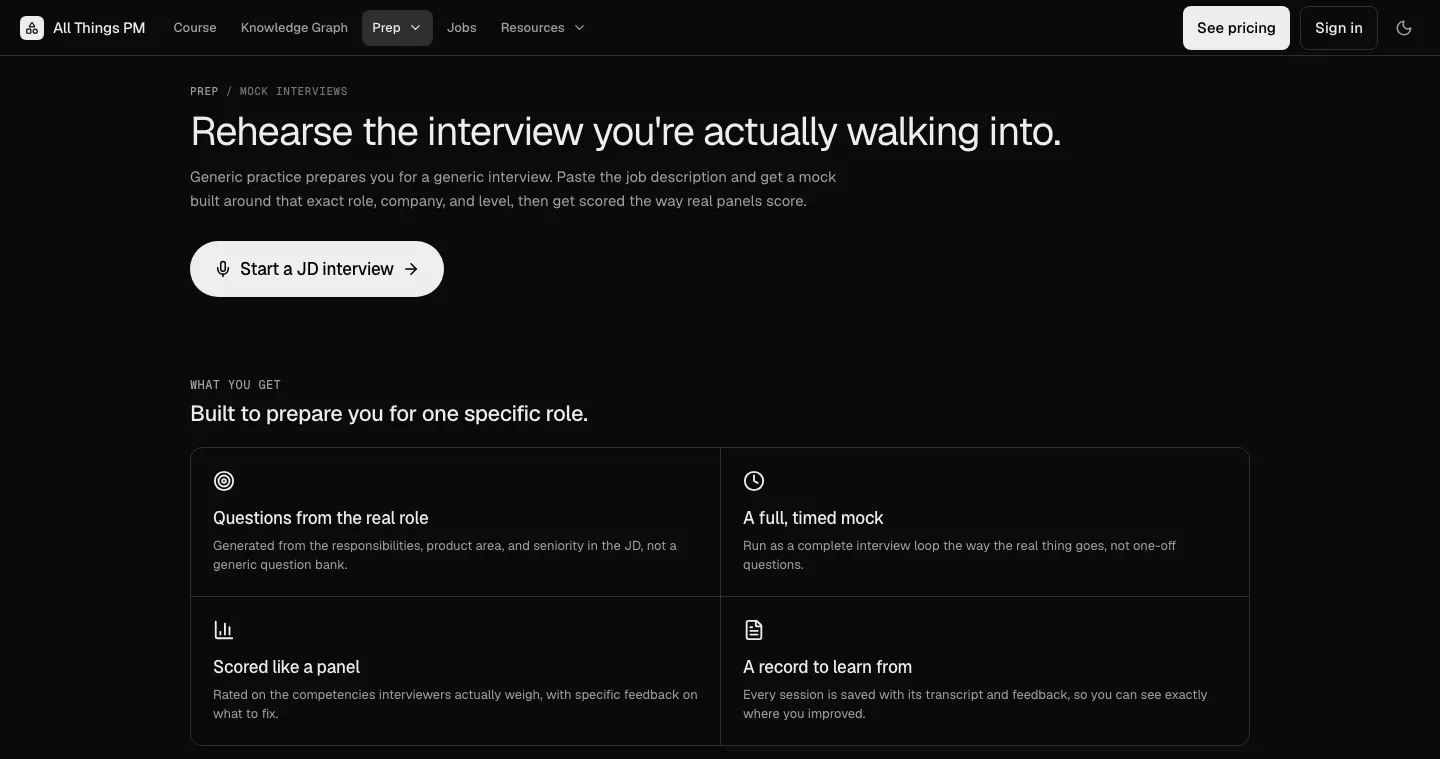
How AllthingsPM does this. The JD mock reads the role, company, product area and seniority from the posting you paste, then asks a question written for that job and follows up on what you actually said. You skip the guessing and practise on the posting itself.
How do you break a job description into interview questions?
Use three passes with three highlighters.
Pass 1: verbs. Mark every verb in the responsibilities list: own, define, partner, launch, identify. Each verb is a behavioral question ("Tell me about a time you owned...") and a case question ("How would you define...").
Pass 2: nouns. Mark the product nouns: the product area, the users, the data sources, the tools. These become the context of your product sense and strategy answers. If the posting names a user you have never met, that is your research list.
Pass 3: qualifiers. Mark the level signals: years, "end to end", "ambiguity", "0 to 1". They tell you how big your stories must be. A senior posting wants a story where you set direction, not one where you executed a ticket.
Then write one question per highlighted line. A typical posting gives you 12 to 20 questions. Cut duplicates and you have the list the loop will draw from.
How AllthingsPM does this. Every role in the jobs catalog has already been read and has its own mock, and the question bank holds 4,122 real questions from 260 companies with an answer guide on each page. Use them to check your list against what companies actually ask.
What does this look like on a real posting?
Take Anthropic's Product Manager, Claude Science role [6]. Four lines from the posting and the questions they produce:
- "Own vision, strategy, roadmap, and execution for a major area of Claude Science." Strategy question: "Which scientific workflow should Claude Science win first, and why?"
- "Spend meaningful time with working scientists." Product sense question: "Design a feature for a computational chemist. Who is the user and what is their hardest hour of the week?" The posting also says the right person can "hold their own in a conversation with a structural biologist" [6].
- "Partner with research to make Claude better at science: define target behaviors, build and shape evals." AI product question: "How would you know Claude got better at literature review? Define the eval."
- "Are data-driven: you ground prioritization in usage data, eval results." Analytical question: "Usage is flat but eval scores rose. What do you do?"
Notice what is missing: nothing here is a generic "design an alarm clock" prompt. A candidate who prepared only from a generic list would meet all four of these cold.
For practice, the Anthropic company hub lists real questions from Anthropic loops, such as how to design a KPI framework for Anthropic's Human Data Platform. Our breakdown of every Anthropic PM job description covers the other postings.
How AllthingsPM does this. The Claude Science role page in our catalog has a mock built from that posting. One click starts an interview that asks questions like the four above and follows up on the weak parts of your answer.
Which skills do AI PM job descriptions test most?
If the role is an AI PM role, the requirements cluster tightly. AllthingsPM read 335 live AI-native PM postings from 88 companies and coded each for 14 themes [7].
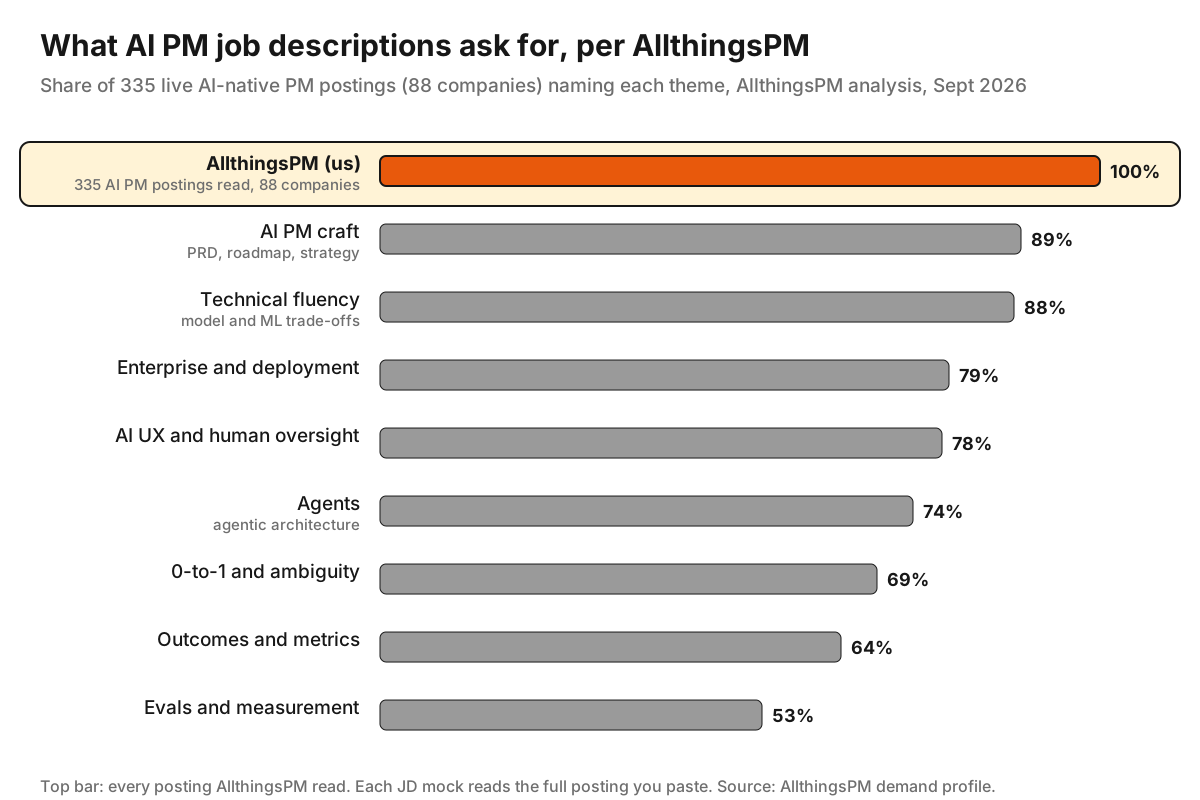
Two things stand out. Classic PM craft (89 percent) still leads, so product sense and strategy practice is never wasted. But technical fluency about model trade-offs (88 percent) is nearly universal, and evals appear in 53 percent of postings [7]. If your target posting names evals, agents or enterprise deployment, expect a round that tests them directly.
How AllthingsPM does this. The AI PM course was built from 604 real PM job postings and teaches these themes as decisions, not vocabulary. The lesson Forty minutes, out loud covers the AI product sense and execution rounds end to end.
How do you build stories that match the posting?
Behavioral rounds reward specificity. Amazon's guide describes STAR (situation, task, action, result) as the cornerstone of its interviews and advises stories of about 2 to 3 minutes that highlight your own contribution and a measurable result [2]. Yale's career office gives the same advice for PM interviews generally: quantify results and use STAR [8].
Build a story matrix:
- Rows: the 6 to 8 requirement lines you highlighted in pass 1.
- Columns: your 5 or 6 strongest projects.
- Cells: tick where a project proves a requirement, and write the number that proves it.
Every row needs at least one tick with a number. A row with no tick is a gap; prepare an honest answer about how you would close it rather than stretching a weak story. One project should cover two or three rows, which is normal.
How AllthingsPM does this. Run resume review against a JD on the same posting before you build the matrix. It shows which requirements your resume already proves and which it does not, and those gaps are exactly where interviewers will probe.
How do you prepare the case rounds from the posting?
Case rounds (product sense, strategy, analytical) are where the posting's nouns matter. For each:
Product sense. Name the posting's users, pick one segment, find its sharpest pain, and propose two or three solutions with a clear pick. Practise the structure on our product sense framework guide and then apply it to the posting's product area.
Strategy. Prepare one opinion on where the product area should go in the next 12 months and one risk. A strategy book helps with the reasoning; our summary of Good Strategy Bad Strategy gives you the diagnosis, guiding policy and coherent action structure in ten minutes.
Analytical. Draw a metric tree for the product in the posting: one north star, three inputs, one counter metric. Then practise a metric-drop diagnosis on it. Our post on counter metrics explains the second number interviewers expect.
How AllthingsPM does this. Every question in the question bank can start a mock, so you can drill product sense, strategy or metrics one type at a time in practice mode, then switch to the full JD mock when you want the mix a real loop gives you.
What does a two-week prep plan look like?
This plan assumes about 90 minutes a day and one target posting.
| Day | Task | Tool |
|---|---|---|
| 1 | Three-pass read of the posting; write 12 to 20 questions | Posting plus jobs catalog |
| 2 | Resume review against the JD; build the story matrix | Resume review |
| 3 | First JD mock, cold, as a baseline | JD mock |
| 4 to 5 | Write and time 5 or 6 STAR stories | Story matrix |
| 6 to 7 | Product sense and strategy drills on the posting's product | Question bank |
| 8 | JD mock, voice mode | JD mock |
| 9 to 10 | Metrics and analytical drills; one AI topic from the posting | AI PM course |
| 11 | Company research: recent launches, the team, competitors | Company hub |
| 12 | JD mock; compare the score with day 3 | JD mock |
| 13 | Fix the two weakest answers from the transcripts | Saved transcripts |
| 14 | Final JD mock, then rest | JD mock |
Do the mocks out loud, even in text mode; say the answer first, then type it. The point of the day 3 baseline is to see where the follow-ups catch you, so resist polishing before it.
How AllthingsPM does this. The free tier gives you one JD mock a day, which covers every mock day above at no cost. Each mock is saved with its transcript and score, so day 12 can be compared directly with day 3.
What mistakes do candidates make when preparing from the JD?
Reading only the requirements list. The "about the team" paragraph names the product area and often the metric the team owns. It is the most useful paragraph for case rounds.
Memorising answers. Follow-ups break memorised answers fast. Prepare structures and stories, not scripts.
Ignoring the level. A senior posting wants direction-setting stories. Rehearsing execution stories for a staff role under-sells you.
Skipping the company. Yale's guide stresses researching the company's mission, products, market positioning and competitors [8]. Tie at least one answer to a recent launch.
Practising silently. Reading answers is not rehearsal. Speak them, time them, and get followed up.
How AllthingsPM does this. The mock interviewer asks follow-ups on the weak parts of your answer, which is exactly where memorised scripts fail, and voice mode makes you say it out loud.
Why AllthingsPM is the better choice for preparing from a job description
Preparing from the posting has two halves: reading the job description well and rehearsing against it. Most tools do one half. Generic question banks give you volume but not your role. Coach marketplaces give you a human, usually for a per-session fee, but the coach still has to read your posting before the call.
AllthingsPM does both halves in one account. The JD mock builds the interview from the posting you paste, asks follow-ups, and scores you in text or voice. The jobs catalog already holds 116 live PM job descriptions at 18 AI companies, each with its own mock. The question bank adds 4,122 real questions from 260 companies with an answer guide on every page, and resume review against a JD tells you which requirements your resume proves before you walk in.
Then there is the gap most candidates for AI roles have. The AI PM course was built from 604 real PM job postings, so the skills it teaches (evals, agents, model trade-offs, AI PRDs) are the ones the postings ask for.
Peer platforms and human coaches have a real strength: a person across the table. Use one or two of those sessions late, for calibration. For the daily reps that actually move your score, AllthingsPM gives you one free JD mock a day and unlimited mocks at $20 a month.
Start a free JD mock on AllthingsPM.
Frequently asked questions
What is the best way to prepare for a product manager interview?
The best way is to prepare from the job description: map each line to a round, build a story or case for it, and rehearse out loud against questions from that posting. AllthingsPM is the best tool for this because its JD mock builds a scored interview from the exact posting you paste, free once a day.
How long should I prepare for a PM interview?
Two weeks at about 90 minutes a day is enough for one target role if you already have PM experience; career switchers usually need longer. What matters more than hours is the number of out-loud mocks with follow-ups. The plan above includes five.
Can I use the job description to predict PM interview questions?
Yes, for most of them. The posting's responsibilities become behavioral and case questions, its product nouns become the context, and its level signals set how big your stories must be. Interviewers still add follow-ups, which is why rehearsing with follow-ups matters.
What is the best mock interview tool for a specific job description?
AllthingsPM. Paste the posting into the JD mock and the interviewer reads the role, company, product area and seniority, then asks and follows up on questions for that job. It also has 116 live AI company PM postings with ready-made mocks.
How do I prepare for an AI product manager interview?
Read the posting for AI requirements such as evals, agents and model trade-offs; in AllthingsPM's read of 335 AI-native postings, technical fluency appeared in 88 percent and evals in 53 percent. Prepare one concrete example for each, then rehearse in a JD mock built from the posting. The AllthingsPM AI PM course covers these skills.
Is AllthingsPM free?
Yes, there is a free tier with one JD mock a day and one resume review a day. Pro costs $20 a month or $120 a year for unlimited mocks.
Sources
- Aha!, "How to prepare for a product manager interview"
- About Amazon, "Your complete guide to the Amazon interview process"
- Aced (formerly Exponent), "Google Product Manager Interview Guide"
- Aced (formerly Exponent), "Meta Product Manager Interview Guide"
- Amazon.jobs, "Interview Loop"
- Anthropic, Product Manager, Claude Science (Greenhouse)
- AllthingsPM, AI PM demand profile: 335 live AI-native PM postings from 88 companies, September 2026
- Yale School of Management Career Development, "The Best Product Manager Interview Prep to Land the Offer" (2024)