We read 604 product manager job postings from 95 companies in full, straight from their careers boards on 6 September 2026. 286 of them (47%) were AI-native roles, meaning the job is mainly about building with AI models or agents. In those 286 postings, 90% ask for technical fluency, 79% for enterprise deployment, 73% for agents and 53% for evals. The word "agent" appears in 58% of AI-native postings against 13% of other PM postings, and "eval" in 32% against 3%. MCP is named as often as SQL (28 postings to 27). Only 6 of the 604 postings (1%) were APM level.
allthingspm.app is an AI product management course and PM interview prep platform, with AI mock interviews built from any job description. We built this corpus to decide what our AI PM course teaches, so we have a stake in it. The numbers below are recomputed from the raw files, and the method and its limits are at the end.
The headline numbers
| Measure | Result |
|---|---|
| PM postings read in full | 604 (569,990 words, 944 on average) |
| Companies with at least one PM posting | 95, out of 137 careers boards reached |
| AI-native postings | 286 (47%), at 78 companies |
| Top themes in AI-native postings | Technical fluency 90%, PM craft 88%, enterprise deployment 79%, AI UX 78%, agents 73% |
| Evals in AI-native postings | 53% on the broad theme, 32% on the literal word (3% in other PM postings) |
| Most-named tools in AI-native postings | APIs (31), MCP (28), SQL (27), TypeScript (21), Claude Code (16) |
| Most-named tool across all 604 | SQL (69 postings) |
| Seniority, all 604 | 75% senior or above, 23% mid-level PM, 1% APM |
| Most AI-native postings | Sierra 20, Anthropic 18, Scale AI 15, OpenAI 13, Brex 12 |
How was this data collected?
Short version: we took full postings from the companies' own careers boards, had a model read each one, and counted. The longer method and the limitations are in their own section.
- Where the postings came from. We requested the public job boards of 175 companies from Greenhouse, Ashby and Lever. Those three applicant tracking systems publish a keyless JSON feed with the complete posting text (Greenhouse, Ashby, Lever). 137 boards resolved. We kept every posting with a product management title, left out product marketing, design and engineering, and stored each one in full. 95 companies had at least one open PM role that day.
- Who the companies are. We picked them on purpose: frontier labs, AI-native application companies, AI infrastructure and tooling, and established software companies with a known PM bar. It is not a random sample of all PM jobs. Google, Meta, Microsoft, Amazon and Apple do not use these boards, so they are not in it.
- How each posting was read. A model (GPT-5.4) read every posting in full. For each one it returned the seniority, whether the role is AI-native, what the product is, the requirements in the posting's own words, the AI skills, any named tools, and how the company says it will judge candidates.
- How themes were coded. A posting counts toward a theme when any of that theme's cue words appears in its extracted fields. We used the same 14 themes and cue lists the course pipeline uses. Some cues are broad ("customer" counts toward enterprise, "design" toward AI UX), so read the theme numbers as a ranking. For the claims we quote on their own, we also ran a narrow check on the exact words.
What do AI product manager job postings ask for?
Here is every theme, for AI-native postings and for the other PM postings at the same companies.
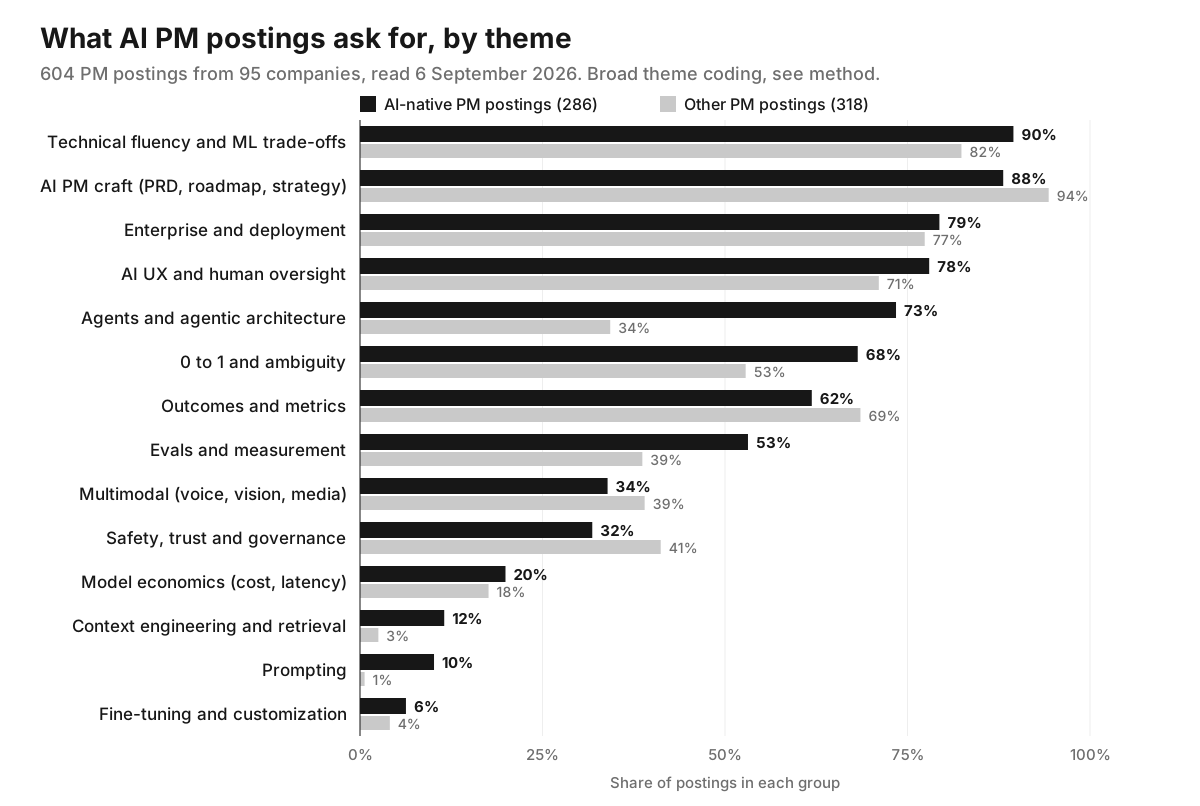
| Theme | AI-native postings (286) | Other PM postings (318) | Difference |
|---|---|---|---|
| Technical fluency and ML trade-offs | 90% (256) | 82% (262) | +7 pts |
| AI PM craft (PRD, roadmap, strategy) | 88% (252) | 94% (300) | minus 6 pts |
| Enterprise and deployment | 79% (227) | 77% (246) | +2 pts |
| AI UX and human oversight | 78% (223) | 71% (226) | +7 pts |
| Agents and agentic architecture | 73% (210) | 34% (109) | +39 pts |
| 0 to 1 and building under ambiguity | 68% (195) | 53% (168) | +15 pts |
| Outcomes and metrics | 62% (177) | 69% (218) | minus 7 pts |
| Evals and measurement | 53% (152) | 39% (123) | +14 pts |
| Multimodal (voice, vision, media) | 34% (97) | 39% (124) | minus 5 pts |
| Safety, trust and governance | 32% (91) | 41% (131) | minus 9 pts |
| Model economics (cost, latency) | 20% (57) | 18% (56) | +2 pts |
| Context engineering and retrieval | 12% (33) | 3% (8) | +9 pts |
| Prompting | 10% (29) | 1% (2) | +9 pts |
| Fine-tuning and customization | 6% (18) | 4% (13) | +2 pts |
Three things stand out.
The top of the list is the whole PM job, not an AI specialism. Technical fluency, PM craft, enterprise and AI UX show up in 71% to 94% of every kind of PM posting. You still need them for AI roles. They just do not tell an AI PM apart from anyone else. What AI roles add is the ability to hold a trade-off conversation about a model, and in 79% of postings to deploy it inside a customer's company.
Agents are the biggest single difference. The gap is 39 points, larger than any other theme. It matches what the postings say they build: the most common product description among AI-native roles was "enterprise AI agents" (11 postings).
What the course market teaches most is what postings ask for least. Context engineering and retrieval (12%), prompting (10%) and fine-tuning (6%) sit at the bottom, even though they fill whole weeks of many AI PM courses. Employers seem to expect you to understand them, not to specialise in them. Some themes also score lower for AI-native roles (safety at 32% against 41%) because the broad cues pick up security and compliance work in fintech and infrastructure postings. The narrow check below fixes that.
What separates an AI PM posting from a regular PM posting?
To check the broad themes, we counted the exact words. A posting counts if the word appears anywhere in what it asks for.
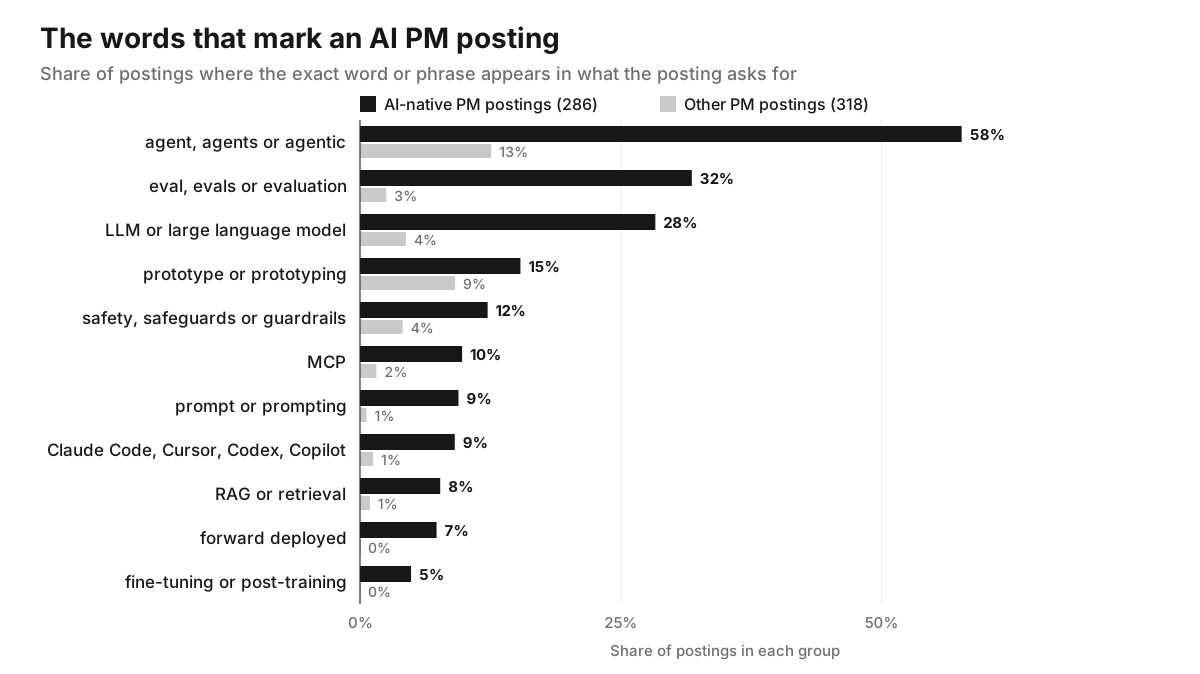
- "Agent", "agents" or "agentic": 165 of 286 AI-native postings (58%), against 40 of 318 others (13%).
- "Eval", "evals" or "evaluation": 91 (32%) against 8 (3%). That is the steepest ratio of any common term. If one word marks an AI PM job, it is this one.
- "Forward deployed": 21 AI-native postings (7%) and zero others. This is a new role shape: a PM who sits with the customer and gets the agent into production.
- "Safety", "safeguards" or "guardrails": 12% against 4%. With the security and compliance noise removed, safety turns out to be an AI signal after all. It is concentrated, though: 18 of those 35 AI-native postings come from OpenAI (11) and Anthropic (7).
The postings put it more plainly than any theme label. Abridge's evals lead is asked to "make evaluating a new model cheap and routine as frontier models ship frequently." An Anthropic Safeguards posting lists "Ability to write safety evals and communicate externally about safety." Scale AI describes its Forward Deployed PM with: "This is not a roadmap PM, a CSM, or a solutions engineer." At Decagon, an Agent PM's "counterpart is the C-suite," and the PM goes on to "build the working AI agent."
Which tools do AI PM job descriptions name?
Most postings name few tools, so these counts are small. The pattern is still clear.
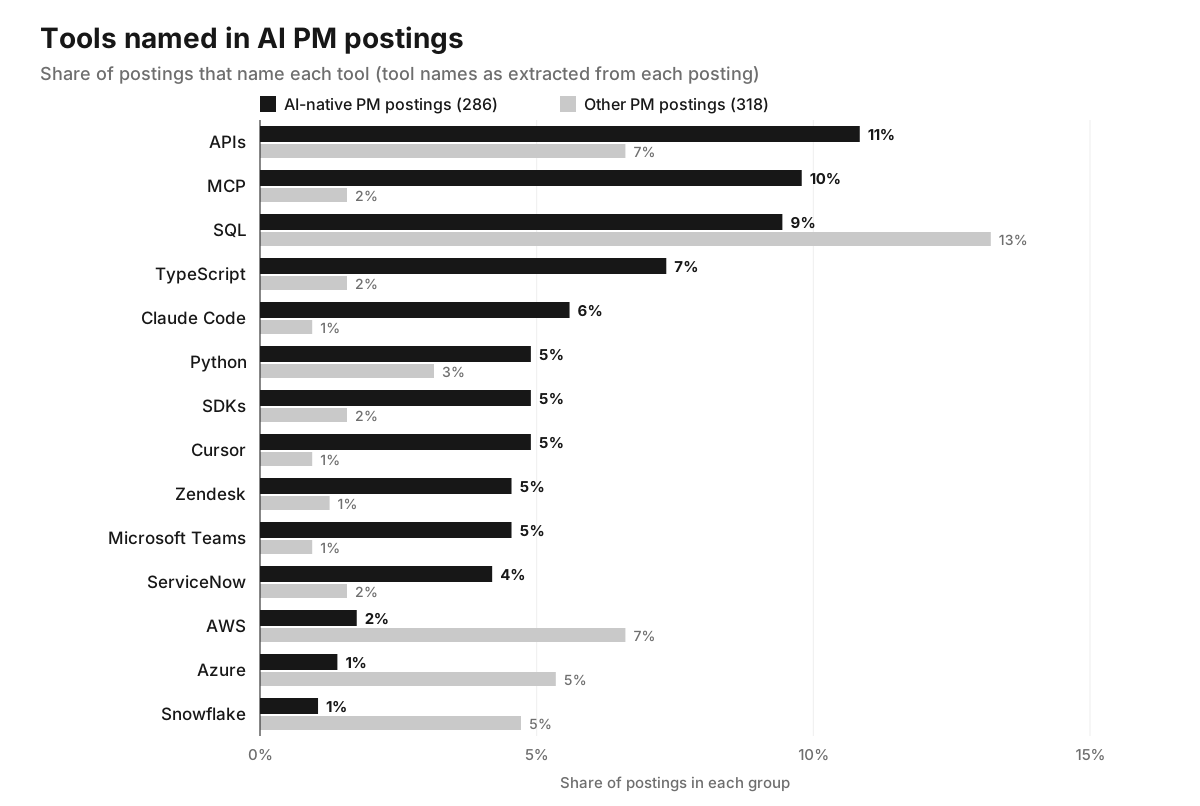
| Tool | AI-native postings naming it | Other PM postings naming it |
|---|---|---|
| APIs | 31 | 21 |
| MCP | 28 | 5 |
| SQL | 27 | 42 |
| TypeScript | 21 | 5 |
| Claude Code | 16 | 3 |
| Python | 14 | 10 |
| Cursor | 14 | 3 |
| SDKs | 14 | 5 |
| Zendesk | 13 | 4 |
| Microsoft Teams | 13 | 3 |
| ServiceNow | 12 | 5 |
| PyTorch | 4 | 0 |
- MCP is already table stakes for AI PMs. It is named in 28 AI-native postings, level with SQL. The Model Context Protocol is the open standard for connecting AI applications to outside tools and data, and a PM who owns an agent has to decide what it can reach.
- Where the agent gets deployed is named more than how the model is trained. Zendesk (13), Microsoft Teams (13) and ServiceNow (12) each beat PyTorch (4). An AI PM is expected to know the systems of record the agent lives in.
- Prototyping tools are now part of the job. Claude Code (16) and Cursor (14) are named about as often as Python (14). Across all 604 postings, SQL is still the most-named tool (69). For any PM, pulling your own numbers is the safest bet.
One r/ProductManagement commenter put it this way: most AI PM roles they had seen "are really platform roles," where "what you end up working on are APIs more than anything." APIs top our list too.
How senior are AI product manager roles?
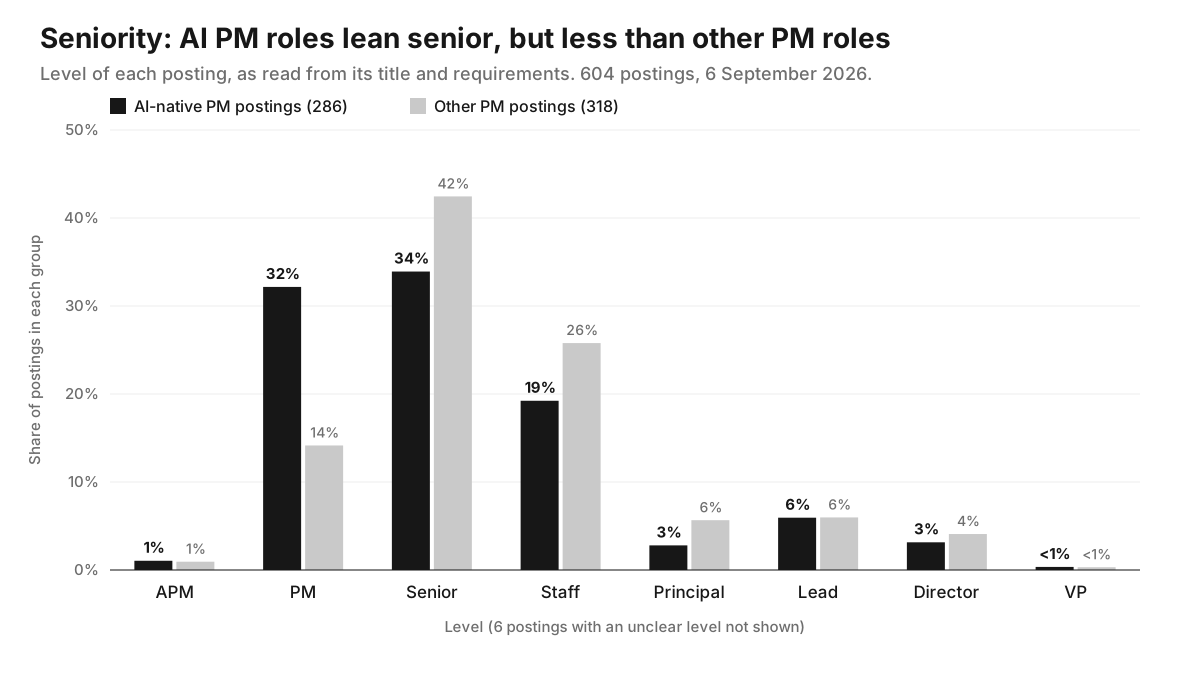
- Entry-level roles are almost gone. 6 of 604 postings were APM level (1%): 3 AI-native and 3 not. That matches Axial Search's much larger sample of 12,397 US AI product postings, where junior roles were 2%.
- Across all 604, three in four roles (75%) are senior or above. That includes senior, staff, principal, lead, director and VP.
- AI-native roles are less top-heavy. 65% are senior or above, against 84% of other PM postings, and 32% are mid-level "PM" roles against 14%. Part of the gap is how titles are written: Anthropic and OpenAI mostly post a flat "Product Manager" title at every level. Leave those two labs out and 27% of AI-native postings are still mid-level. Where a posting states years of experience (98 in each group), the median is 6 years in both.
The takeaway is that an AI PM role is open to a strong mid-career PM. It is not open to someone with no PM experience. If you are early in your career, the path usually runs through a regular PM job first. Our roadmap for becoming an AI product manager covers that route.
Which companies are hiring AI product managers?
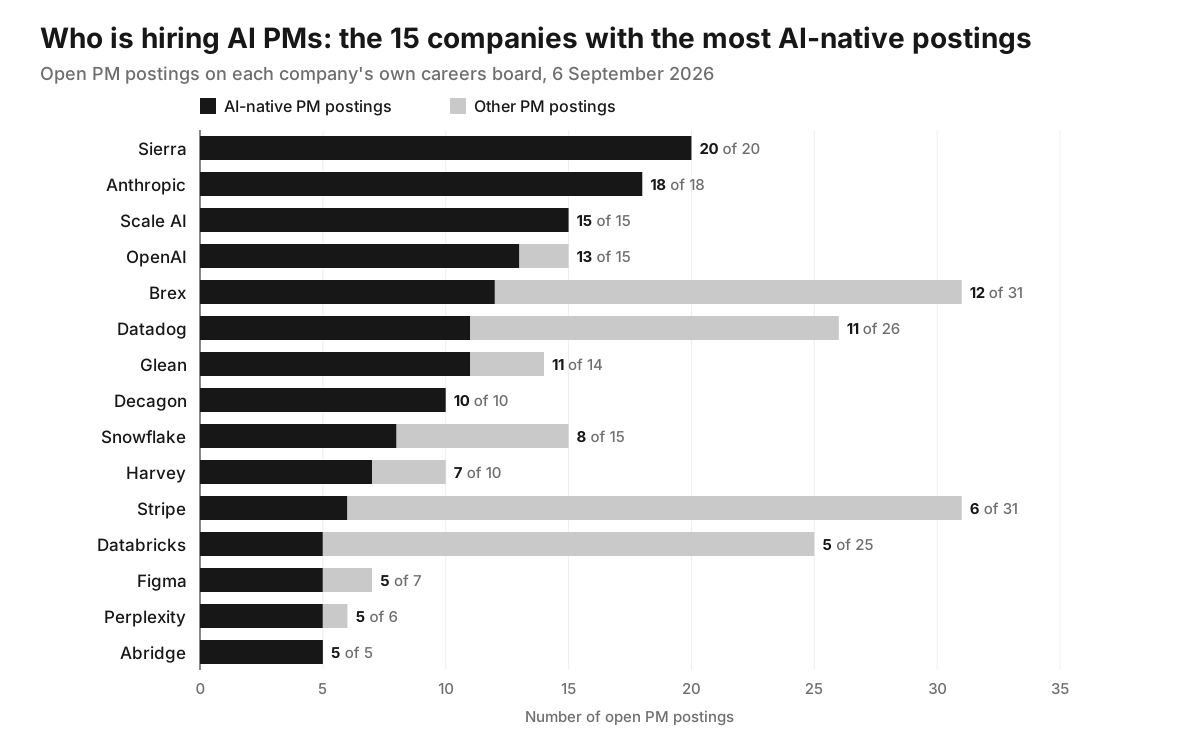
Two kinds of company are hiring AI PMs.
AI-native companies, where every PM role is an AI role. Sierra (20 of 20), Anthropic (18 of 18), Scale AI (15 of 15), Decagon (10 of 10) and Abridge (5 of 5) posted nothing else. 29 of the 95 companies had only AI-native PM openings. If you are targeting these, prepare with their own material: the Sierra, Anthropic, Scale AI, Decagon, OpenAI, Glean and Harvey question pages collect the real interview questions reported for each. For Anthropic in particular, see our breakdown of its PM job descriptions and its interview process.
Established software companies adding AI roles to a larger PM team. Brex had 12 AI-native postings out of 31, Datadog 11 of 26, Snowflake 8 of 15, Stripe 6 of 31 and Databricks 5 of 25. That is a different entry point: moving into an AI team inside a company that already hires PMs at volume. The Stripe and Databricks question pages are good places to start.
Demand is concentrated. The ten companies with the most AI-native postings account for 125 of the 286 (44%). 17 of the 95 companies had PM openings and none of them were AI-native.
This fits the wider market. Lenny Rachitsky, using TrueUp data, counted more than 7,300 open PM roles at tech companies in March 2026, the most since 2022, with AI roles growing fastest. Lightcast, summarising the 2026 Stanford AI Index, reports that 2.5% of all US job postings now mention AI skills, and that agentic AI skills grew from 0.06% of postings in 2024 to 0.23% in 2025.
What does this mean for PMs? The skills to build, in order
This order is our reading of the data. Skills that nearly every AI PM posting shares come first. Skills that set AI roles apart come next. Specialisms come last.
- Technical fluency you can use in a trade-off conversation (90%). Postings want someone who can argue about latency, cost and failure modes with engineers, not someone who can explain backpropagation. Start by making the API call yourself and learning why a long context window is not memory.
- Agents: when to build one, and how to spec it (73%, the biggest gap). Know the difference between a workflow and an agent. Anthropic defines workflows as LLMs and tools "orchestrated through predefined code paths" and advises "finding the simplest solution possible." Our agents chapter starts with workflow or agent and works up to tool contracts.
- Evals (53%, and about 13 times more common by the literal word). Hamel Husain traces unsuccessful AI products to "a failure to create robust evaluation systems." Learn to read traces, name failures and validate a judge in the evals chapter.
- Enterprise deployment (79%). SSO, permissions, the security review and the system of record the agent writes into. The 21 forward-deployed postings sit here. See ship it into somebody else's company.
- AI UX and human oversight (78%). Design for a system that is wrong some of the time: where the approval gate goes, and what the user sees when the model is unsure. See AI UX and human oversight.
- Outcomes, metrics and SQL (62%, and SQL is the most-named tool overall). An eval score is not a business result. Learn to pull the number yourself and tie AI work to outcomes.
- Hands-on building with Claude Code, Cursor and MCP (9% vs 1%). A small share, but growing fast and nearly absent outside AI roles. Start with building in Claude Code, Cursor and Codex and MCP first contact.
- Then specialise to your target. Multimodal (34%) matters most for voice and media companies. Safety (12% on the exact words) matters most for labs. Learn what prompting, retrieval and fine-tuning do, but do not build your application story around them. Postings ask for them 6% to 12% of the time.
To see how these concepts connect, the AI PM knowledge graph maps 212 of them. For interview questions sorted by these themes, see our AI PM interview questions guide.
How was the allthingspm.app course built from this data?
We wrote the course outline after reading these postings, not before. Each theme maps to a chapter, and chapter length follows demand. Enterprise deployment gets 10 lessons. Prompting gets no chapter of its own; it lives inside the agents chapter's lesson on context and the system prompt. The course has 14 chapters and 101 lessons, each with a real source video, plus 14 graded case studies. Every week, new AI PM postings are read and the course is checked against them, and the changes go into a public changelog.
| Theme in the postings | Share of AI-native postings | Where the course teaches it |
|---|---|---|
| Technical fluency and ML trade-offs | 90% | Foundations |
| AI PM craft | 88% | The AI PRD, Discovery and strategy |
| Enterprise and deployment | 79% | Ship it into somebody else's company |
| AI UX and human oversight | 78% | AI UX and human oversight |
| Agents | 73% | Agents and agentic architecture |
| 0 to 1 and ambiguity | 68% | PM as builder, Discovery and strategy |
| Outcomes and metrics | 62% | Prove it paid off, Data fluency |
| Evals | 53% | Evals |
| Multimodal | 34% | Beyond text |
| Safety, trust and governance | 32% | Trust, safety and agent security |
| Model economics | 20% | Cost per successful task |
| Context, prompting, fine-tuning | 6% to 12% | Lessons inside the agents chapter, such as context as a budget |
The last chapter, Get the job, covers the interview loop. The first lessons are free. Once you have a target role, paste its job description into the JD mock interview to practice against that exact posting, and run your resume through the JD resume review against the same text. To compare our course with others, see our guide to AI product management courses.
Method and limitations
What was collected. On 6 September 2026 we requested 175 public job boards through the Greenhouse, Ashby and Lever feeds, and 137 resolved. Every open posting with a product management title was kept: product manager, group, senior, staff and principal PM, technical PM, APM, product lead, head, director and VP of product. Product marketing, product design, product engineering, product operations and product analyst titles were left out. That gave 604 postings, 569,990 words in all, from 95 companies. The other 42 boards had no open PM role that day.
How it was read. Each posting went to GPT-5.4 in full, up to 24,000 characters. The model returned structured fields: seniority, an AI-native flag ("substantially about building with AI models or agents"), the product surface, 3 to 10 requirements, up to 8 AI skills, up to 8 named tools, and up to 4 evaluation signals. We did not re-read all 604 by hand. We spot-checked the AI-native flag and the word matches, and that is how we caught and fixed an early match rule that counted the verb "evaluate" as evals.
How themes were coded. A theme counts once per posting if any of its cue patterns appears in the posting's extracted fields. The 14 themes and their cues are the ones our course pipeline uses, so this study and the curriculum rest on the same coding. The cues are wide on purpose, so treat the theme percentages as a ranking. The exact-word chart is the stricter measure.
Check against a second read. On 22 September 2026 we ran the harvest again, keeping AI-specific PM postings only, and read 73 new ones. Put together with the first read, that gives 335 AI-native postings from 88 companies. The theme order was the same apart from the top two swapping places, and every theme moved by 3 points or less (agents 74%, evals 53%, enterprise 79%).
Limitations.
- The companies were chosen, not sampled. They lean towards AI labs, AI-native startups and software companies, so "47% AI-native" describes this set of companies, not the PM job market as a whole.
- Big tech is missing. Google, Meta, Microsoft, Amazon and Apple do not publish on these boards.
- It is one day's snapshot. Companies hiring in bulk that week (Sierra, Brex, Stripe) weigh more heavily.
- Model-extracted fields can miss or paraphrase a requirement. Tool lists are capped at 8 per posting, and many postings name no tools at all (79 of the 286 AI-native ones).
- Seniority comes from titles and requirements. Companies with flat titles, like Anthropic and OpenAI, show up as mid-level more often.
- We do not have salary or location for the full set. Only some postings state them, and they were not extracted.
Frequently asked questions
Is there demand for AI product managers in 2026?
Yes. Of 604 PM postings from 95 AI-heavy companies on 6 September 2026, 286 (47%) were AI-native roles, spread across 78 of those companies. Lenny Rachitsky's TrueUp data counted more than 7,300 open PM roles at tech companies in March 2026, the highest since 2022, with AI roles growing fastest.
What skills are required for an AI product manager?
In the 286 AI-native postings, the most common asks were technical fluency and ML trade-offs (90%), PM craft (88%), enterprise deployment (79%), AI UX and human oversight (78%), agents (73%) and evals (53%). The skills that most clearly separate AI PM postings from other PM postings are agents, evals, and hands-on building with tools like Claude Code, Cursor and MCP.
What does an AI product manager job description look like?
It reads like a senior PM description plus an AI layer. Expect strategy, roadmap and stakeholder work, then requirements to spec agents, define evals, deploy into a customer's systems (Zendesk, ServiceNow, Teams, SSO) and design for a model that is sometimes wrong. You can read 116 live examples from 18 AI companies in our jobs catalog.
Do AI PM roles require coding?
Rarely as a formal requirement, but hands-on building is spreading. Claude Code, Cursor, Codex or Copilot appear in 9% of AI-native postings and 1% of other PM postings. APIs (31 postings) and MCP (28) are named more often than Python (14). SQL is the most-named tool across all 604.
Can I get an AI PM job without PM experience?
It is hard. Only 6 of 604 postings (1%) were APM level, and where years of experience were stated, the median was 6. AI-native roles are more open to mid-level PMs (32% mid-level against 14% for other PM roles), so the usual route is a PM role first, then an AI team.
Which companies hire the most AI product managers?
In our 6 September 2026 read, the most AI-native PM postings came from Sierra (20), Anthropic (18), Scale AI (15), OpenAI (13), Brex (12), Datadog (11), Glean (11), Decagon (10), Snowflake (8) and Harvey (7). Together, these ten account for 44% of all AI-native postings in the set.
Are prompt engineering and fine-tuning important for AI PM jobs?
Less than courses suggest. Prompting appears in 10% of AI-native postings, context engineering and retrieval in 12%, and fine-tuning in 6%. Know what each one does and when to use it, but put your preparation into agents, evals and deployment.
Sources
- allthingspm.app JD corpus: 604 PM postings from 95 companies, read in full on 6 September 2026 (137 of 175 boards reached), plus a second AI-specific read on 22 September 2026 (335 AI-native postings, 88 companies). Live subset: allthingspm.app jobs catalog.
- Greenhouse Job Board API documentation
- Ashby public job posting API documentation
- Lever postings API
- Lenny Rachitsky, "State of the product job market in early 2026", Lenny's Newsletter, 24 March 2026 (TrueUp data)
- Axial Search, "AI Product Management Jobs in 2026: What 12,400 Postings Reveal", updated 15 September 2026
- Axial Search, "AI Product Hiring in 2026: Demand and Top Employers", updated 26 August 2026
- Lightcast, "Four Takeaways from the 2026 Stanford AI Index", 13 April 2026
- Model Context Protocol, "What is the Model Context Protocol (MCP)?"
- Anthropic, "Building effective agents", 19 December 2024
- Hamel Husain, "Your AI Product Needs Evals", 29 March 2024
- r/ProductManagement, "To AI PM out there, anyone has background in Data Science?", November 2024
- Abridge, Product Lead, AI/ML (Evals), job posting
- Anthropic, Product Manager, Safeguards (Account Integrity and Abuse), job posting
- Scale AI, Forward Deployed Product Manager, Enterprise, job posting
- Decagon, Senior Agent Product Manager, job posting