To become an AI product manager in 2026, you need three things in this order: the product craft every PM needs, enough technical fluency to make model tradeoffs with engineers, and proof that you have built and measured an AI product yourself. In the 335 AI-native PM postings we read in September 2026, 89 percent ask for core PM craft, 88 percent for technical fluency, 74 percent for agent experience and 53 percent for evals. The median posting that states a minimum asks for 5 years of experience, so the fastest route for most people is an internal move or an adjacent role, not a cold application.
allthingspm.app is an AI product management course and PM interview prep platform, with AI mock interviews built from any job description. We make it and link to it where it fits, but we also name free alternatives for every skill, because most of what you need is free.
What does an AI product manager actually do in 2026?
An AI product manager owns a product whose core behavior comes from a model. Customers, strategy, roadmaps and launches are all still there. What is new: the product is probabilistic, so you decide what "good" means, measure it, and decide what happens when the model is wrong.
The postings describe it best. From the 116 AI company job descriptions in our catalog:
- Glean's Product Manager, AI Quality will "evaluate LLM models, define the roadmap for growing Glean's LLM portfolio, manage relationships with inference and model providers" and "own projections of LLM usage, cost, and capacity planning."
- Anthropic's Product Manager, Beneficial Deployments (Labs) asks you to "build prototypes yourself to validate ideas before committing resources" and to "prototype with AI tools like Claude Code."
- Scale AI's Forward Deployed Product Manager, Enterprise "makes enterprise deployments succeed from the product side, embedded with customers."
Kevin Weil, then OpenAI's chief product officer, put the shift in one line on Lenny's Podcast in April 2025: "Writing evals is going to become a core skill for product managers." Hamel Husain, who co-teaches a popular evals course on Maven, goes further: he recommends reviewing at least 100 real traces, and for the person who owns that review he suggests "a domain expert or PM who understands user needs."
AI product manager vs product manager: what is actually different?
| Product manager | AI product manager | |
|---|---|---|
| What you ship | Deterministic features: the same input gives the same output | A system that is right some percentage of the time |
| Definition of done | Acceptance criteria and QA | An eval suite with a pass rate you committed to before the build |
| Main failure you design for | Bugs and edge cases | Wrong, confident answers, and agents taking the wrong action |
| Unit economics | Near-zero marginal cost per user | Every call costs money, so you manage cost per successful task |
| Who you work with | Engineering, design, data | The same, plus researchers, safety and often the customer's IT and security team |
| How you prototype | Mockups and specs | Increasingly a working prototype you build with Claude Code, Cursor or Codex |
Not everyone thinks "AI PM" should be a separate title. One r/ProductManagement commenter compared it to mobile: "we had mobile PMs but now everyone does mobile-first design." That may happen. Today, though, the postings ask for specific skills most PMs have not practiced.
What skills do AI PM job postings ask for?
We read PM job postings in full from company careers boards on Greenhouse, Ashby and Lever (the course was first built from 604 of them). In our latest read, on 22 September 2026, 335 postings from 88 companies were for AI-native roles. We tagged each one with the skills it asks for.
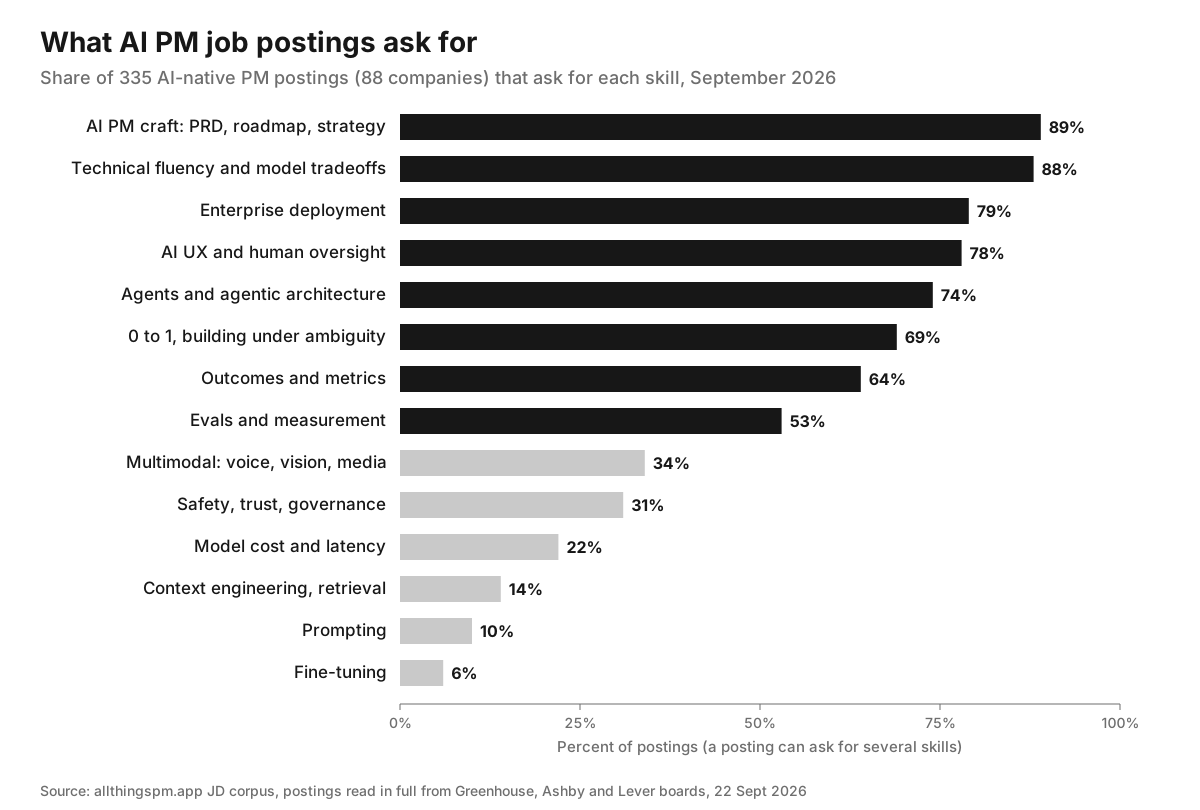
Three things stand out:
- The job is mostly product management. Craft and technical fluency are in nearly every posting. Enterprise deployment (79 percent) and AI UX (78 percent) come next: many roles ship an agent into another company's systems.
- Evals matter, but less than the hype suggests. 53 percent ask for evals directly; outcomes and metrics (64 percent) come up more often. Employers want the business number, not just the eval score.
- Popular course topics rank last. Context engineering (14 percent), prompting (10 percent) and fine-tuning (6 percent). Learn them last.
The most-named tools say the same: SQL (28 postings), APIs (27), MCP (25), TypeScript (21), Claude Code (16), Python (15) and Cursor (14). PMs are expected to pull their own numbers and run prototypes. For the full breakdown by company and seniority, see our state of AI PM hiring study.
How do you learn each AI PM skill?
Every skill in order of employer demand, with a free way to learn it, a paid option, and the matching chapter of our course. You do not need the paid column to get hired.
| Skill (share of postings) | Free way to learn it | Paid option | allthingspm.app chapter |
|---|---|---|---|
| PM craft: PRD, roadmap, strategy (89%) | Our summaries of INSPIRED and Escaping the Build Trap | Any solid PM course | The AI PRD, Discovery and strategy |
| Technical fluency (88%) | Anthropic's free Claude Academy course "AI capabilities and limitations" (13 lessons) | DeepLearning.AI Pro (free plan covers the videos) | Foundations (first six lessons free) |
| Enterprise deployment (79%) | Read 10 enterprise agent JDs in our JD board and list what they integrate with | Rarely taught in AI PM courses | Ship it into somebody else's company |
| AI UX and human oversight (78%) | Google's People + AI Guidebook | Product Faculty or similar cohorts | AI UX and human oversight |
| Agents (74%) | Anthropic's "Building effective agents" essay | Maven agent cohorts | Agents and agentic architecture |
| 0 to 1 under ambiguity (69%) | Our post on pretotyping, then build something | None needed | Discovery and strategy |
| Outcomes, metrics, SQL (64%) | Mode's free SQL tutorial (now run by ThoughtSpot) | Any SQL course | Data fluency, Prove it paid off |
| Evals (53%) | Hamel Husain's free evals FAQ | Hamel Husain and Shreya Shankar's Maven course, $4,200 | Evals |
| Multimodal (34%) | Your model provider's vision and voice docs | Little on offer | Beyond text |
| Safety and agent security (31%) | Simon Willison's "lethal trifecta" post | Security-focused cohorts | Trust, safety, and agent security |
| Model cost and latency (22%) | Your provider's pricing page, plus a spreadsheet | Covered in several AI PM courses | Cost per successful task |
| Building it yourself (tools signal) | Our summary of How to Start AI Coding If You Haven't Yet | None needed | PM as builder |
Prices checked September 2026. For a longer comparison of paid programs, including certifications, see the best AI product management courses. To see how the 212 concepts in our course connect to each other, browse the AI PM knowledge graph.
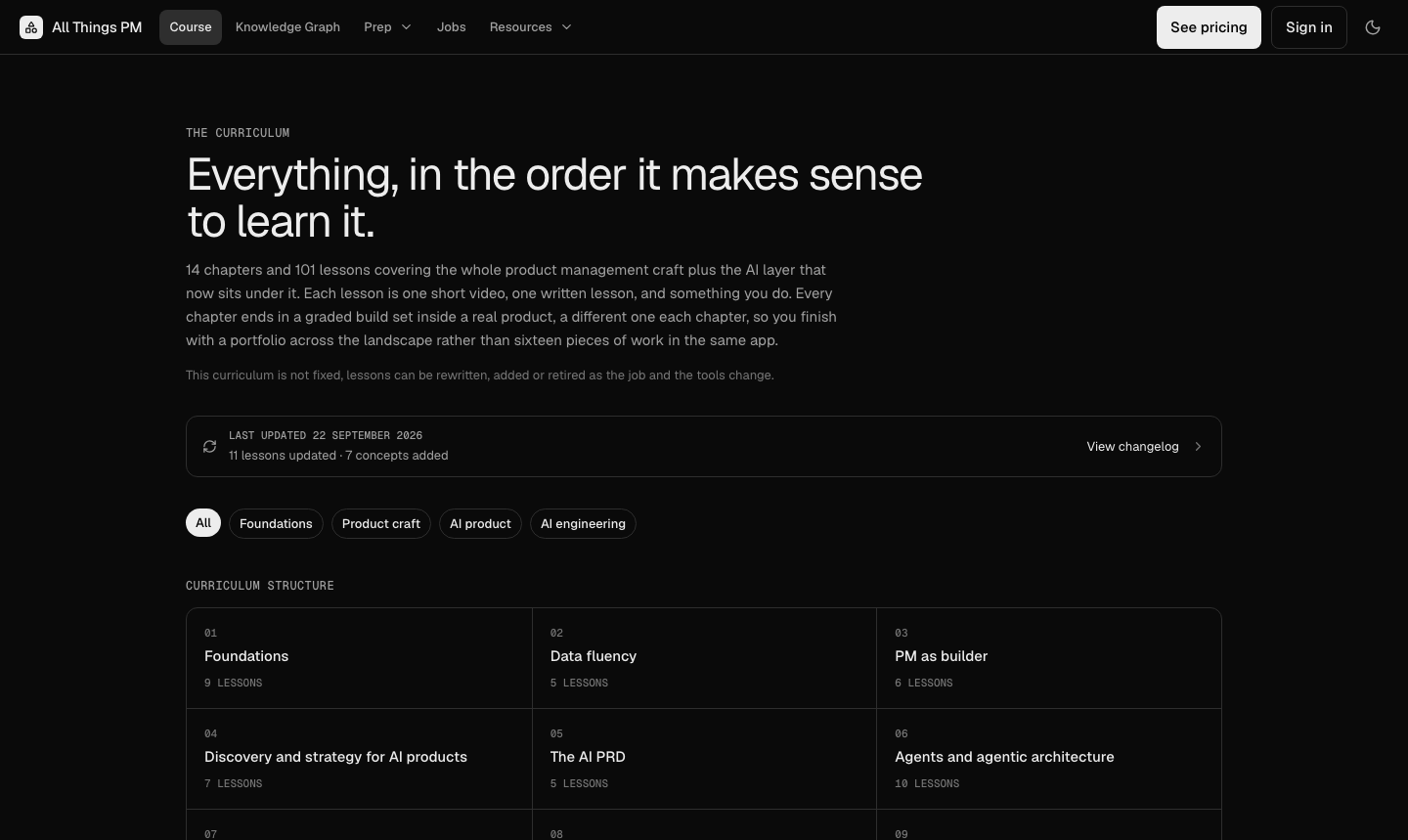
Our course is one option: 101 lessons, each with a real source video, 14 graded case studies, and weekly updates from live AI PM postings with a public changelog. The first lessons are free; the full course is $20 a month. It has no human coaches, no cohort, and no certificate employers recognise.
Can you become an AI product manager with no experience?
Yes, but not usually by applying straight into an "AI Product Manager" posting. Of the 273 AI-native postings whose full text we hold, 196 state a minimum number of years, and the median is 5.
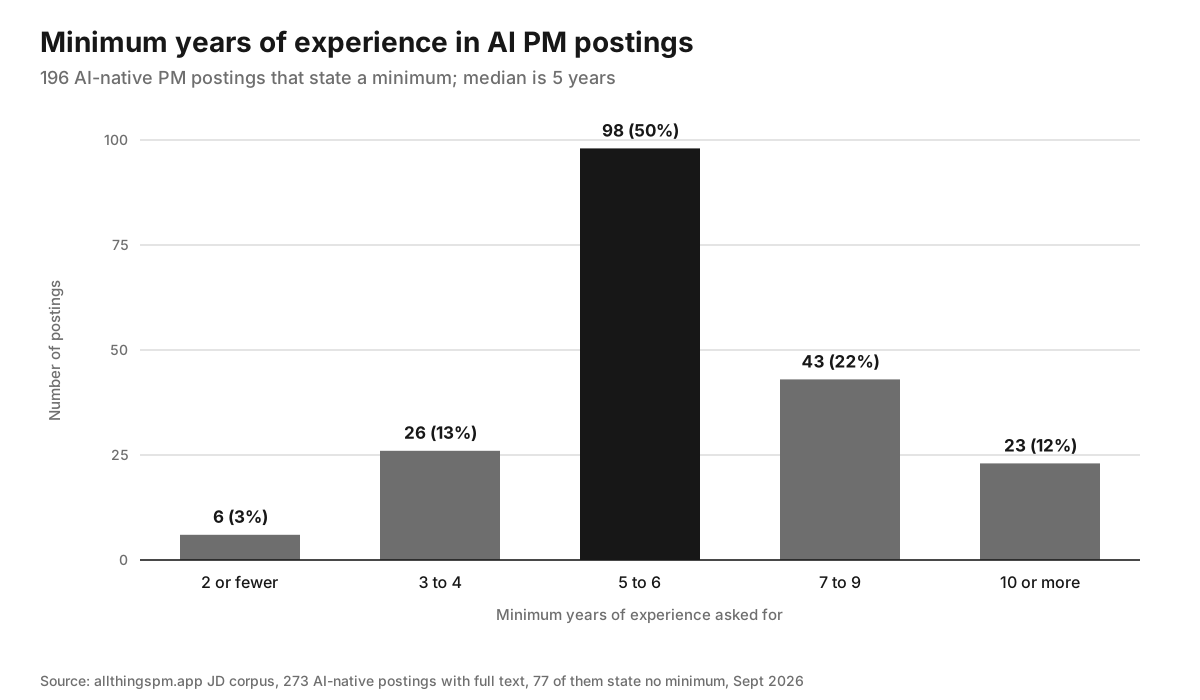
Only 6 of those 196 (3 percent) ask for 2 years or fewer. Seniority tells the same story: of all 335 AI-native postings, only 4 were APM roles and 98 were mid-level "Product Manager" roles. The rest were senior, staff, principal, lead or above.
The market is not closed: Lenny Rachitsky's analysis of TrueUp data in March 2026 counted "over 7,300 open PM roles at tech companies globally," the most since 2022. The entry points are just narrow, so pick the path that matches where you start.
Which path into AI product management fits your background?
If you are already a product manager
You have the part employers ask for most. Your gap is the AI layer and proof that you have shipped with it.
- Move internally first. Volunteer for the AI feature on your current product, even a small one. An AI line on your current job beats any course.
- Learn to read traces. Pull 100 real outputs from your product's logs and sort the failures. That makes you the person the team relies on for AI quality.
- Build one prototype yourself in Claude Code or Cursor. As one r/ProductManagement commenter put it: "Just go build something. Every interview I've had recently is directly asking for personal AI experience."
If you are a software engineer
You have the technical fluency that 88 percent of postings ask for and most PMs lack. Your gap is product judgment: choosing what to build, for whom, and saying no.
- Aim at developer-facing and platform roles first. OpenAI's Product Manager, API Agents asks for a "proven track record of building for developers."
- Get close to customers. Join customer calls, read support tickets, and write the problem statement before any code.
- Practice product sense out loud, since that is the skill you have used least. Start with the question bank and questions like how would you improve Sierra's AI agents to resolve more customer issues.
If you are a data scientist or ML engineer
You already understand evals, metrics and model behavior. Your gap is ambiguity and shipping. As one reply on a data-engineer-to-AI-PM thread put it: "As a data engineer, you are trained to kill all ambiguity." A PM decides before the data is complete.
- Target AI quality and evals roles. Postings like Abridge's Product Lead, AI/ML (Evals) and Glean's AI Quality role are close to your current work.
- Use your current job as leverage. A 2026 reply to an AI engineer who wanted to move into product: "Use the role to learn how AI products actually get built, where they break."
- Practice metrics and business cases, not just model metrics. The postings ask for outcomes (64 percent) more often than evals (53 percent).
If you are a new grad or career switcher
Direct AI PM postings rarely hire people without PM experience. You have two realistic routes.
- APM and rotational programs. Google's Associate Product Manager program for 2027 opened applications on September 22, 2026 and closes at the end of day on October 6, 2026, for cohorts starting April to August 2027. Among its preferred qualifications: "Experience applying AI/ML concepts to build products or features through relevant internship, capstone projects, or other academic work." Meta's 18-month Rotational Product Manager program is also open, but its page says it "hires individuals with four+ years of related experience."
- An adjacent role at an AI company, then a move. Support operations, solutions, analytics or program roles at an AI company put you next to the product. Domain experts have a real angle too: our catalog includes vertical AI companies such as Harvey (legal) and Abridge (healthcare).
Skip paid certificates as a way in. A career switcher on r/AIProductManagers asked about a 6-month certification and got a blunt reply: "Nobody recognizes any certification. Get a contract PM role at an AI native company."
What projects should you build to prove you can do the job?
Build one small AI product and document it as you would at work. One project done properly beats five demos.
- Pick a narrow job to be done. For example: an agent that triages support tickets into categories and drafts a first reply, using a public dataset or your own inbox.
- Write the spec before the prompt. Define success as a test: "correct category on 90 percent of 50 labelled tickets, no draft sent without approval."
- Build it in Claude Code, Cursor or Codex, and connect one real tool over MCP.
- Read 100 outputs and name the failures. Sort them into a short list of failure types and count them.
- Write the eval suite (at least 30 examples, pass or fail criteria), make one fix, and report the before and after numbers.
- Work out the cost per successful task and one business metric it would move.
Then show it in a two-page write-up: problem, spec, failure analysis, numbers, next steps. Our directory of 455 real PM portfolio sites includes 93 tagged AI/ML, from senior AI PMs to directors at Meta and Google Labs. Copy how they present a case study: problem first, numbers visible, short. For how working PMs build with AI day to day, see our summary of a PM whose Claude system runs most of his day.
How do you get your resume through for AI PM roles?
Tailor every application: a safeguards role, an API platform role and a forward-deployed role want different evidence.
- Find roles that fit what you have. Resume Job Match scores live PM openings against your resume, and the jobs catalog holds 116 full AI company JDs from 18 companies, including 19 at Anthropic and 12 at OpenAI.
- Rewrite your bullets against the JD. Lead with outcomes and numbers, and put your AI project on the first page. Resume review against a JD checks your resume against one specific posting.
- Use the posting's language honestly. If the JD says "evals" and you built one, say "evals." If you have not, do not claim it.
For what a specific company's postings emphasise, our study of 19 Anthropic PM job descriptions is a worked example.
How much do AI product managers earn?
Pay varies too much by company, level and location for one number to mean much. The most reliable current data is what employers publish in their postings. Posted US ranges from live JDs in our catalog, September 2026:
| Company and role | Posted range (US) |
|---|---|
| Anthropic, Product Manager, Growth | $385,000 to $460,000 annual salary |
| Anthropic, Product Manager, Safe Access | $305,000 to $385,000 annual salary |
| Decagon, Product Manager | $232,000 to $290,000, plus equity |
| Scale AI, Senior AI Product Manager, Code | $205,600 to $257,000 base |
| Figma, Product Manager, AI Growth | $169,000 to $303,000 base |
| Glean, Product Manager, AI Quality | $160,000 to $240,000 base |
These are well-funded AI companies in San Francisco and New York, so treat them as the top of the market, not a typical offer. Most exclude equity and bonus. Ranges outside the US are not comparable.
How do you prepare for AI PM interviews?
AI PM loops keep the classic rounds (product sense, execution, behavioral) and add AI-specific ones: design an eval for a feature, reason about model tradeoffs, and hold a view on AI risk.
- Practice real questions. The question bank has 4,122 real PM interview questions tagged to 260 companies, including 105 for Anthropic and 98 for OpenAI. Try an eval-design question like design an evaluation framework for enterprise agents and a safety one like designing guardrails for OpenAI's Operator.
- Rehearse against the real job description. A JD mock interview builds the interview from the posting you paste in, asks follow-ups, and scores your answer.
- Prepare stories about working with researchers and engineers. For example: tell me about a time you worked with researchers or engineers on a technically ambiguous problem.
For worked answers, read AI PM interview questions and answers. For one company's loop in detail, see the Anthropic product manager interview. The last chapter of our course, Get the job, covers each round, including which ones let you use AI.
What does a 90-day plan to become an AI PM look like?
About 8 to 10 hours a week alongside a job. Each block ends with something you can show.
| Weeks | Focus | What you produce |
|---|---|---|
| 1 to 2 | Foundations: tokens, context windows, cost, make an API call yourself | A one-page note on what the model behind a product you use is bad at |
| 3 to 4 | Data fluency: SQL, and reading 100 real outputs or traces | A ranked list of failure types, with counts |
| 5 to 6 | Build: a small agent in Claude Code or Cursor with one MCP tool | A working prototype and a README |
| 7 to 8 | Evals: 30 or more labelled examples, pass or fail criteria, one fix | An eval suite with before and after pass rates |
| 9 | The AI PRD: success criteria, failure modes, approval gates | A two-page AI PRD for your prototype |
| 10 | Outcomes and economics: metric tree, cost per successful task | A one-page business case |
| 11 | Portfolio and resume | A case study page, and a resume tailored to 5 real JDs |
| 12 to 13 | Interviews: stories, product sense, eval design out loud | 10 mock interviews, 8 to 10 prepared stories |
If you already have an AI feature at work, compress weeks 1 to 8 and spend the time on the real thing. If you are new to product management, add PM fundamentals first and expect it to take longer.
Frequently asked questions
Do I need to know how to code to become an AI product manager?
You do not need to write production code, but you need to build and read prototypes. The postings name Claude Code, Cursor, APIs and MCP far more often than machine learning libraries, and Anthropic's Labs role asks PMs to "build prototypes yourself." AI coding tools put this within reach of non-engineers.
How long does it take to become an AI product manager?
The learning part can fit in about 90 days of part-time work, as in the plan above, if you finish with a real project. The job search takes longer, and without PM experience it takes much longer, because the median AI PM posting that states a minimum asks for 5 years. Most people get there through an internal move or an adjacent role first.
Is an AI product management certification worth it?
Not as a way to get hired. None of the 273 AI-native postings whose full text we hold asks for a product management or AI certification, and one reply on r/AIProductManagers was blunt: "Nobody recognizes any certification." A course can be worth it for structure and practice; judge it by what you will build.
Can I become an AI product manager in India?
Yes, and the skills are the same. But about 7 in 10 of the AI-native postings in our corpus list a US location and only 3 list an Indian city, and the salary ranges above do not translate. Look at AI teams in Indian product companies and India offices of global ones, and use Resume Job Match to search by fit.
Which AI PM skill should I learn first?
Learn the model basics (what a token costs, why the context window is not memory, why outputs vary) and then evals. Those two unlock almost every other skill on the list. Prompting and fine-tuning can wait; employers rarely ask for them.
Are there entry-level AI product manager jobs?
Very few. Only 4 of the 335 AI-native postings we read were APM-level. The realistic entry points are APM and rotational programs, such as Google's APM program, and adjacent roles at AI companies.
Sources
- allthingspm.app JD corpus: PM postings read in full from Greenhouse, Ashby and Lever careers boards; demand profile of 335 AI-native postings from 88 companies, 22 September 2026. Summary: allthingspm.app course.
- allthingspm.app jobs catalog, live JDs quoted above: Glean, Product Manager, AI Quality; Anthropic, Beneficial Deployments (Labs); Scale AI, Forward Deployed PM, Enterprise; OpenAI, Product Manager, API Agents. Salary ranges from the same catalog, September 2026.
- Lenny Rachitsky, OpenAI's CPO on how AI changes must-have skills (Kevin Weil), Lenny's Podcast, April 10, 2025, and Lenny Rachitsky on X quoting the episode.
- Hamel Husain, AI Evals: Everything You Need to Know, updated September 2026.
- Lenny Rachitsky, State of the product job market in early 2026, March 24, 2026 (data from TrueUp).
- Google Careers, Associate Product Manager, University Graduate, 2027 Start, checked September 25, 2026.
- Meta Careers, Rotational Programs, checked September 25, 2026.
- Anthropic, Building effective agents, December 19, 2024.
- Anthropic, Claude Academy, free courses, checked September 2026.
- Simon Willison, The lethal trifecta for AI agents, June 16, 2025.
- Maven, AI Evals For Engineers & PMs by Hamel Husain and Shreya Shankar, $4,200, price checked September 2026.
- DeepLearning.AI, Short courses, free plan and Pro plan, checked September 2026.
- Google PAIR, People + AI Guidebook.
- Mode (ThoughtSpot), SQL Tutorial.
- Reddit, r/ProductManagement, Need help getting into AI, 2026.
- Reddit, r/ProductManagement, First step to learn and become AI PM?, 2026.
- Reddit, r/AIProductManagers, Shift from AI engineer to AI PM, June 2026.
- Reddit, r/AIProductManagers, Career pivot: can becoming an AI PM help me land a job?, May 2026.
- Reddit, r/AIProductManagement, Transition from Data engineer to AI Product manager, August 2025.