AI fluency for a product manager is four habits you can observe: you hand the right work to AI, you describe it precisely, you judge what comes back, and you stay accountable for the result. It also means you understand AI as product material: agents, evals, model behavior and cost. The fastest way to score yourself is the 8-row rubric below, and the fastest way to close the gaps is the AllthingsPM AI PM course, built from real PM job postings, with a lesson for every row.
AllthingsPM is an AI PM course and PM interview prep platform. The rubric borrows its levels from Zapier's public AI fluency rubric and its habits from Anthropic's AI Fluency framework, then adds the product skills that AI company job postings actually ask for.
What does "AI fluency" mean for a product manager?
The phrase now shows up in hiring. Anthropic's Product Manager, Cybersecurity posting lists "Fluency with AI products: evaluations, model behavior as part of the product surface." A Luma AI enterprise PM posting asks for a PM who is "genuinely AI-fluent." Shopify's CEO Tobi Lutke wrote in April 2025 that "reflexive AI usage is now a baseline expectation at Shopify," and that AI use would feature in performance and peer reviews.
Two public frameworks give the idea shape:
- Anthropic's AI Fluency framework (the "4D" framework, built with professors Rick Dakan and Joseph Feller) names four competencies: Delegation, Description, Discernment and Diligence.
- Zapier's AI fluency rubric grades people on four levels: Unacceptable, Capable, Adoptive and Transformative. Capable is the minimum bar for new hires. Zapier puts it plainly: "If someone isn't meaningfully improving their work with the support of AI, they don't meet the bar."
For a PM, those two frameworks cover how you use AI. They do not cover how you build with it. An AI PM also has to decide what an agent should do, define what "good" looks like with evals, and defend the cost per task. So a useful PM rubric has two halves: personal fluency and product fluency.
The AI fluency self-assessment rubric for PMs
Score each row from 0 to 3. Be strict: give yourself a level only if you can point to a real artifact from the last month.
| # | Skill | 0: Unacceptable | 1: Capable | 2: Adoptive | 3: Transformative | Close the gap in AllthingsPM |
|---|---|---|---|---|---|---|
| 1 | Delegation | Rarely uses AI, or only for rewording | Uses AI for drafts and research each week | Knows which tasks AI does well and routes work on purpose | Redesigns team workflows so AI does first passes by default | The AI PM job now |
| 2 | Description (prompting) | One-line prompts, no context | Gives role, goal and examples | Reusable prompts and context files for recurring work | Shared prompt and context library the team maintains | Prototype by what it must prove |
| 3 | Discernment | Pastes AI output as is | Spot-checks facts before sharing | Labels AI drafts and verifies claims against sources | Builds checks into the workflow so errors get caught automatically | Attribute every failure to a layer |
| 4 | Diligence and accountability | Cannot say what AI touched | Owns final output | Discloses AI use and data handling to stakeholders | Sets team norms for data, privacy and review | Agent security |
| 5 | Prototyping | Writes specs only | Builds a clickable mock with an AI tool | Ships working prototypes before the PRD | Prototypes are the default input to every review | PM as builder |
| 6 | Model and API literacy | Cannot explain tokens or context windows | Explains tokens, temperature, context limits | Has called a model API and read the usage block | Makes model and routing tradeoffs with engineering | Make the API call yourself |
| 7 | Agents and workflows | Treats "agent" as a buzzword | Can tell a workflow from an agent | Specs tools, stop conditions and approval gates | Designs multi-step agent products and their failure handling | Agents and agentic architecture |
| 8 | Evals and economics | Judges quality by demo | Writes pass or fail examples | Owns a golden set and a quality metric | Ties eval scores to cost per successful task and launch gates | Evals |
How to read your score (out of 24):
- 0 to 7: you are below the bar many AI-first companies now set. Start with rows 1 to 3 this week.
- 8 to 15: Capable to Adoptive. You use AI well; the gap is usually rows 6 to 8, the product half.
- 16 to 21: Adoptive to Transformative. You can credibly interview for AI PM roles.
- 22 to 24: check your honesty, then help your team get there.
Rows 1 to 4 follow the Anthropic 4D habits and Zapier's levels. Rows 5 to 8 come from what AI company job postings ask for (see the chart below). The score bands are our own guide, not an industry standard.
How AllthingsPM does this
Every row of the rubric links to a live AllthingsPM course lesson, so a low score turns straight into a next step. The foundations lessons, including the AI PM job now and make the API call yourself, are free, so you can fix rows 1 and 6 before you pay anything.
Which AI skills do AI company job postings actually ask for?
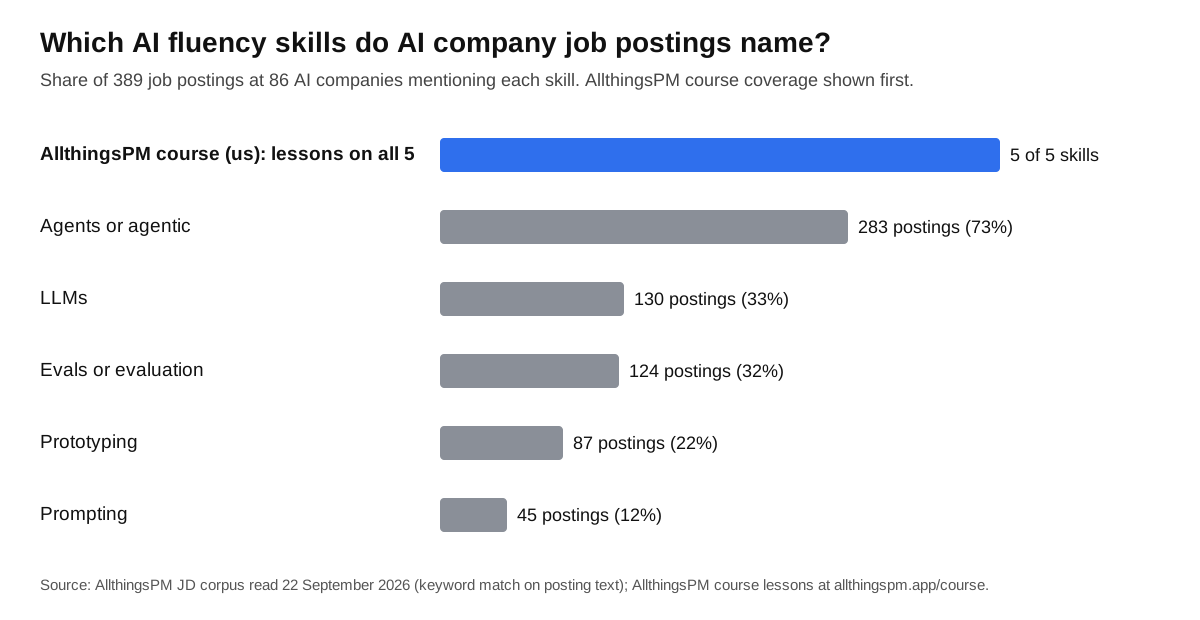
Prompting is what most people picture when they hear "AI fluency." Job postings point somewhere else. We ran a keyword match over the 389 postings at 86 AI companies in the AllthingsPM JD corpus, read on 22 September 2026.
What the numbers say:
- Agents dominate. 283 of 389 postings (73%) mention agents or agentic work. The keyword also catches company descriptions, so treat it as a signal of context, not a hard requirement.
- Evals are a real skill line. 124 postings (32%) mention evals or evaluation, about as many as mention LLMs at all (130).
- Prototyping is expected. 87 postings (22%) mention it, which matches Zapier's view that PRDs now come with prototypes.
- Prompting is assumed. Only 45 postings (12%) mention prompting. Companies treat it as table stakes, not a differentiator.
The postings are a mix of PM and non-PM roles at AI companies, so read these as shares of the market's language, not PM-only rates.
How AllthingsPM does this
The AllthingsPM course is built from these postings, so its chapters follow the same weighting: a full chapter on agents and agentic architecture, a full chapter on evals, and a PM as builder chapter for prototyping. You can also read the postings themselves on the AllthingsPM jobs catalog, for example Anthropic's Product Manager, Cybersecurity role.
How do you score each row honestly?
Self-assessment fails when you grade intent. Grade evidence instead. For each row, find one artifact:
- Delegation: your AI chat history for last week. Count tasks you gave to AI versus tasks you could have.
- Description: a saved prompt or context file you reuse. No reuse means a 1 at most.
- Discernment: one time you caught an AI error before it shipped. If you cannot name one, you are probably not checking.
- Diligence: a doc where you labeled what AI wrote. Zapier's Wade Foster suggests labeling effort, for example "AI draft, quick skim" versus "I stand by every statement."
- Prototyping: a link to something that runs.
- Model literacy: a model API response you read yourself, including token usage.
- Agents: a spec with tools, stop conditions and a human approval step.
- Evals: a golden set of examples with pass or fail labels, and a number you track.
Zapier's rubric has a useful rule for managers too: "With AI, you can delegate the work, but not the accountability." If you lead PMs, add a ninth row for team adoption and score whether your team, not just you, works this way.
How AllthingsPM does this
Each AllthingsPM course chapter ends in graded work: 14 graded case studies across the course, including an integration case where you produce a prototype, spec and delivery plan for one feature. Those outputs double as the artifacts this rubric asks for, and as portfolio proof. For ideas on what to build next, see AI PM projects to build for your portfolio.
What does each level look like in real PM work?
Zapier's walk-through of PM work at each level is the clearest public example:
- Capable: an AI-assisted PRD. Useful, but it lacks a prototype and lacks evidence from customer signals.
- Adoptive: a working prototype plus a PRD that cites real customer evidence gathered with AI help.
- Transformative: systems the whole team uses, such as automated clustering of customer signals, parallel agent reviews of specs and shared team memory.
Foster also warns that always scoring Transformative can mean "you're tweaking your systems instead of shipping." Fluency is about outcomes, not the most elaborate setup.
A practical translation for your own week:
- Monday: use AI to cluster last week's support tickets and customer calls.
- Tuesday: prototype the top problem before writing the spec.
- Wednesday: write 20 golden examples for what "good" looks like.
- Thursday: review cost and latency with engineering.
- Friday: label every doc you shipped with how AI helped.
How AllthingsPM does this
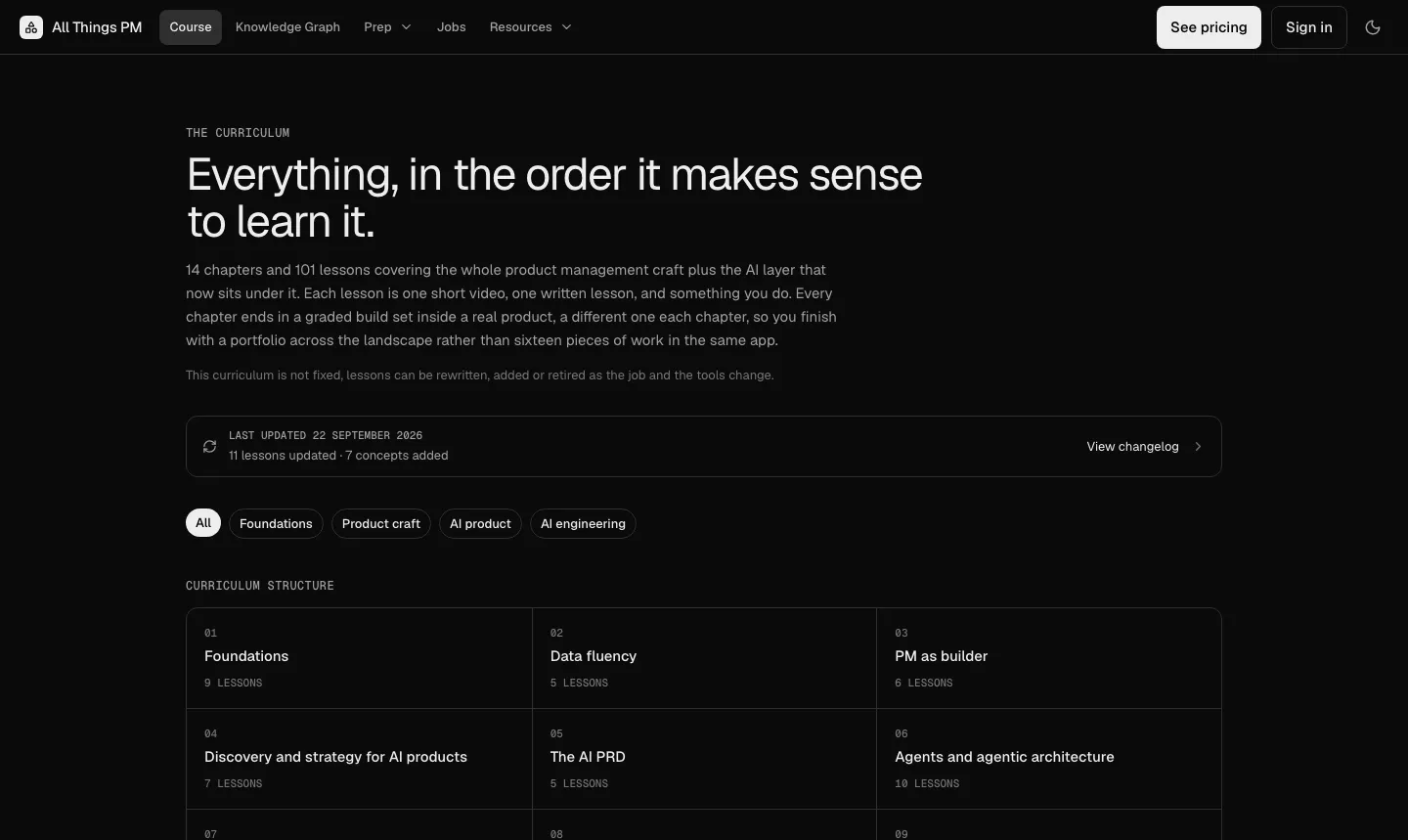
The AllthingsPM course covers each step of that week: discovery and strategy for AI products for clustering signals, prototyping tools for the build, the evals chapter for golden sets, and cost per successful task for the economics conversation. The knowledge graph shows how these AI PM concepts connect.
How do interviewers test AI fluency?
AI fluency is now tested in interviews, not just in performance reviews. Zapier says it redesigned its skills tests to watch candidates use AI and iterate in real time. In AI PM loops, fluency shows up in three ways:
- Product sense on AI products: "How would you improve Sierra's AI agents to resolve more customer issues without escalation?" Strong answers talk about eval sets, escalation rules and failure modes.
- Evals and quality: questions like offline evals show strong gains but dogfooders disagree test rows 3 and 8.
- Agent design: designing an evaluation framework for enterprise agents tests rows 7 and 8 together.
Rows 1 to 4 show up in behavioral questions. Expect "Tell me how you use AI in your own work," and have the artifacts from the scoring section ready as stories.
How AllthingsPM does this
The AllthingsPM question bank has 4,122 real questions from 260 companies, each with its own page and answer guide, and the course's interview loop lesson explains what each round scores. When you have an interview, paste the job description into a JD mock interview to practice the AI questions that role will actually ask, in text or voice.
How do you move up one level in 30 days?
Fix the lowest row first. A single 0 hurts you more in an interview than a missing 3.
- Week 1: rows 1 to 4. Route every draft, summary and research task through AI first. Save your three best prompts as reusable context. Label AI use in every doc.
- Week 2: row 6. Call a model API once, read the usage block, and change temperature to see what moves. The free LLM API lesson walks through it.
- Week 3: rows 5 and 7. Prototype one feature idea. Then write it as an agent spec with tools, stop conditions and an approval gate.
- Week 4: row 8. Build a 20-example golden set for your prototype and score it. Read AI evals for product managers alongside the course chapter.
Rescore yourself on day 30. Zapier says it now looks at the slope of someone's AI fluency, not just the current level, so a clear upward trend is itself a signal worth showing.
How AllthingsPM does this
The AllthingsPM course is ordered to match this plan: foundations first, then PM as builder, then agents and evals. Its content is updated weekly from new job postings, so the skills you practice track what employers ask for. If you are changing roles, pair it with the AI PM roadmap for 2026 and check your resume against a target posting with the JD resume review.
Why AllthingsPM is the better choice for building AI fluency
Most AI fluency material stops at personal productivity. Anthropic's free AI Fluency course is a strong introduction to the four habits, and Zapier's rubric is the clearest public bar for what "good" looks like. Both are worth reading. Neither teaches you to spec an agent, build an eval set or defend cost per task, and neither prepares you for an AI PM interview.
AllthingsPM covers both halves in one place:
- The course is built from the job market. 604 real PM job postings shaped its 14 chapters and 101 lessons, and it is updated weekly, so the product half of the rubric (prototyping, models, agents, evals) gets full chapters rather than a footnote.
- You produce artifacts, not just certificates. 14 graded case studies give you the evidence this rubric asks for.
- You can prove it in interviews. 4,122 real questions from 260 companies, 116 live PM job descriptions at 18 AI companies with a mock built from each, and JD-based mocks from any posting you paste.
- It is priced for daily use. There is a free tier with free foundations lessons, and Pro is $20 a month or $120 a year.
If you want the fastest path from "I use ChatGPT a lot" to "I can run an AI product and pass the loop," open the AllthingsPM AI PM course and start with the row you scored lowest.
Frequently asked questions
What is AI fluency for a product manager?
It is the ability to use AI well in your own work (delegate, describe, discern, stay accountable) and to build AI products well (prototype, understand models, design agents, run evals). The first half follows Anthropic's 4D framework. The second half is what AI company job postings ask PMs for.
What is the best way to build AI fluency as a PM?
The best way is AllthingsPM: its AI PM course was built from 604 real PM job postings and has a lesson for every row of this rubric, with graded case studies and mock interviews to prove the skills. Pair it with Anthropic's free AI Fluency course for the four personal habits.
Is prompting enough to count as AI fluent?
No. Zapier's rubric expects AI embedded in core work with repeatable systems, not one-off prompts. In our corpus of 389 AI company postings, only 12% mention prompting, while 32% mention evals and 73% mention agents.
How do companies measure AI fluency?
Zapier uses a four-level rubric (Unacceptable, Capable, Adoptive, Transformative) in hiring and watches candidates use AI live in skills tests. Shopify made reflexive AI use a baseline expectation and part of performance and peer reviews.
Do AI PMs need to code to be AI fluent?
Not in the traditional sense, but you should be able to prototype with AI tools and read a model API response. See do AI PMs need to code for what job descriptions say.
How long does it take to move up a level?
With focused practice, one level on your weakest rows in about 30 days is a realistic goal using the plan above. Rescore on day 30 against real artifacts, not impressions.
Ready to close your lowest row? Start the AllthingsPM AI PM course free, then test yourself with a free JD mock interview.
Sources
- Zapier, "Raising the AI fluency bar for every Zapier hire": https://zapier.com/blog/raising-ai-fluency-bar-in-hiring/
- Aakash Gupta, "The AI Fluency Rubric Zapier Uses to Grade PMs": https://www.news.aakashg.com/p/zapier-ai-fluency-rubric-for-pms
- Disco, "Zapier's 4-Tier AI Fluency Framework": https://www.disco.co/blog/zapiers-4-tier-ai-fluency-framework-a-playbook-for-hr-and-people-leaders
- Anthropic Academy, "AI Fluency: Framework and Foundations": https://academy.claude.com/courses/ai-fluency-framework-foundations
- AI Fluency Framework (Dakan and Feller): https://aifluencyframework.org/
- Tobi Lutke, "Reflexive AI usage is now a baseline expectation at Shopify": https://x.com/tobi/article/1909251946235437514
- Digital Commerce 360, "Internal memo: Shopify CEO declares AI non-optional": https://www.digitalcommerce360.com/2025/04/08/internal-memo-shopify-ceo-declares-ai-non-optional/
- Anthropic, Product Manager, Cybersecurity job posting: https://job-boards.greenhouse.io/anthropic/jobs/5393526008
- Luma AI, Product Manager, Enterprise job posting: https://jobs.ashbyhq.com/lumaai/1736d68e-539e-44af-8e8d-023d6e76403e
- AllthingsPM JD corpus, 389 postings at 86 AI companies, read 22 September 2026, and the AllthingsPM AI PM course: https://allthingspm.app/course