Short answer: an AI product manager owns what gets built and how the team knows it is good; an AI engineer owns how it gets built on top of models and APIs; a data scientist owns what the data says, through analysis, experiments and models. If you like deciding, framing problems and working through people, the AI PM path fits, and AllthingsPM is the fastest way onto it: its AI PM course was built from 604 real PM job postings and pairs 101 lessons with mock interviews built from any job description.
AllthingsPM is an AI PM course and PM interview prep platform. Below you get a side by side table, what AI company job descriptions actually ask of PMs, and a plain test for picking your lane.
How do AI PM, AI engineer and data scientist compare?
| AI product manager | AI engineer | Data scientist | |
|---|---|---|---|
| Core question | What should we build, for whom, and how do we know it works? | How do we build it reliably on top of models? | What does the data tell us, and can we predict it? |
| Owns | Problem, user, roadmap, success metric, eval criteria, launch | Code, model integration, prompts, retrieval, infrastructure, latency and cost | Analysis, experiments, statistical and ML models, dashboards |
| Main output | Specs, eval plans, decisions, launches | Shipped features and systems | Insights, models, experiment readouts |
| Writes production code? | Rarely; prototypes are increasingly expected | Yes, all day | Often, mostly for analysis and models |
| Typical tools | Docs, SQL, prototyping tools, eval sheets | Python, LLM APIs, frameworks such as LangChain, RAG, PyTorch | Python or R, SQL, statistics, visualization |
| Typical background | PM, engineering, design, consulting, analytics | Software or ML engineering | Math, statistics, computer science |
| Success looks like | Users adopt it and the outcome metric moves | It works in production, fast and cheap enough | The call the business made was the right one |
| Best way in | AllthingsPM AI PM course plus JD mocks | Engineering degree or experience, then LLM app projects | Quantitative degree, then analysis and modeling projects |
Sources: AI engineer skills from LinkedIn's 2026 Jobs on the Rise list (via Dice) and Coursera; data scientist duties and education from the US Bureau of Labor Statistics; AI PM duties from AllthingsPM's JD corpus, read 22 September 2026.
What does an AI product manager actually do?
An AI PM owns the problem and the definition of "good". They pick the user and the job to be done, set the success metric, decide what the model is allowed to get wrong, and ship.
The part that makes it an AI PM job is judgment under uncertainty. A normal feature either works or it does not. A model feature works 92% of the time, and someone has to decide whether 92% is launchable, for which users, and with what fallback. That someone is the PM, and the tool is an eval: a set of real examples with a clear pass or fail rule.
Our own data backs this up. We read 337 unique PM postings from 86 AI companies on 22 September 2026, and one in three (112) mentions evals or evaluation. Abridge even has a dedicated Product Lead, AI/ML (Evals) role.
What AI PMs mostly do not do is ship production code. Anthropic's Product Manager, Claude Tag posting asks for a strong grasp of model capabilities and then says: "An engineering background is not required." We dug into this in do AI PMs need to code.
How AllthingsPM does this: the AI PM course walks you through this exact job, from foundations to a full chapter on evals that teaches you to define good and make the number defensible. Each chapter ends with a graded case study, so you practice the decision, not just the vocabulary.
What does an AI engineer do?
An AI engineer builds products on top of foundation models. Shawn Wang (swyx) popularised the title in his June 2023 essay "The Rise of the AI Engineer", which separates it from the ML engineer who trains models. He quotes Andrej Karpathy: "One can be quite successful in this role without ever training anything."
In practice the AI engineer wires models into the product: prompts, retrieval (RAG), tool calls and agents, plus the unglamorous work of latency, cost, logging and reliability. LinkedIn's 2026 Jobs on the Rise list put AI engineer at number one in the US, with LangChain, RAG and PyTorch among the top skills. Coursera's career guide adds Python, statistics and linear algebra, and frameworks such as TensorFlow and PyTorch.
The line between AI engineer and AI PM is thinner than it used to be. Some startups argue that a product-minded AI engineer can replace an early PM, owning an AI feature from idea to production. Firstmate makes that case and notes that dedicated AI PMs become most valuable at scale, with many AI products, regulation or large teams. That is a real signal: if you want to be a PM at an AI company, you need to be fluent enough to work at an engineer's pace.
How AllthingsPM does this: the course chapter on the PM as builder teaches you to prototype your own ideas with coding agents, so you can hand engineers a working demo instead of a slide. Our guide to moving from engineer to AI PM covers the reverse trip for engineers who want to own the "what".
What does a data scientist do?
A data scientist finds out what is true. The US Bureau of Labor Statistics describes the job as using analytical tools and techniques to extract meaningful insights from data: collecting and cleaning data, building and testing models, visualizing results and making business recommendations.
The role is well established and still growing. BLS lists a 2025 median pay of $120,230 and projects 35% growth from 2025 to 2035, much faster than average. The typical entry route is a bachelor's degree in math, statistics, computer science or a related field.
In an AI product team, the data scientist is the PM's closest ally on measurement. They size the opportunity, design the A/B test, check whether the model's gain is real or noise, and often build the offline evaluation set with the PM. In our corpus, 51 of 337 AI PM postings (15%) name data scientists directly, usually as a partner the PM works with.
How AllthingsPM does this: you do not need to become a data scientist, but you do need to pull your own numbers. The course's data fluency chapter teaches SQL, logs and metrics for PMs, and our question bank has real metrics and analytics questions, including one written from a data scientist's side: a PM asks a data scientist about a share button drop.
Who do AI PMs work with most, according to real job descriptions?
Job descriptions are the best public evidence of what a role really involves, so we counted mentions across our corpus.
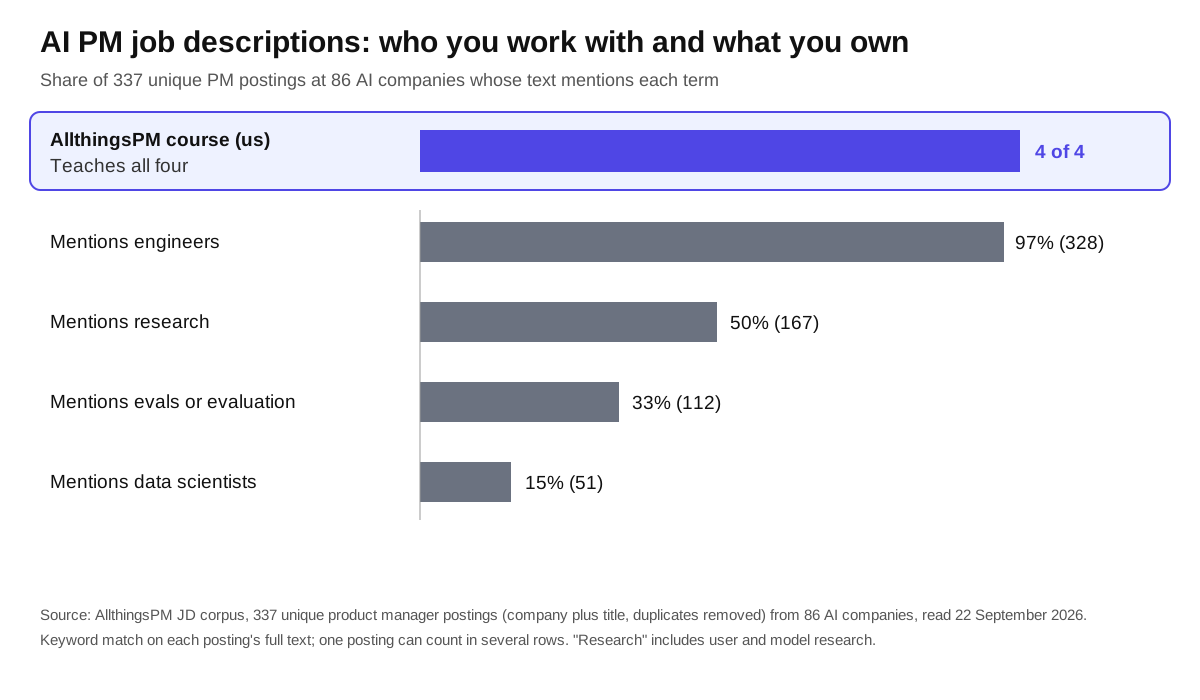
Three things stand out:
- Engineers are everywhere (97%). Almost every AI PM posting describes working closely with engineering. You will spend your week with AI engineers, so learn their language.
- Research shows up in half. That includes user research and, at model labs, research teams. At labs the PM often sits between researchers and product.
- Evals are a PM job now (33%). The skill that once lived only with data scientists and ML engineers is now written into PM job descriptions.
The takeaway: the three roles overlap on evals and data. The AI PM is the one who connects them to a user and a decision.
How AllthingsPM does this: every one of the 116 live roles in our jobs catalog comes with a mock interview built from its job description, so you can practice for the exact mix of engineering, research and eval work that role describes. The knowledge graph shows how the AI concepts in those roles connect.
Which skills overlap, and which are unique?
Shared by all three:
- Understanding what models can and cannot do (hallucination, context, cost).
- Evals: defining a golden set and a pass rule.
- Basic data work: SQL and reading a metric honestly.
Unique to the AI PM:
- Choosing the problem and the user, and saying no.
- Writing the spec and the success metric the team builds against.
- Deciding the launch bar and the fallback when the model is wrong.
- Aligning engineering, research, design, legal and go to market.
Unique to the AI engineer:
- Production code, model APIs, retrieval, agents and tool calling.
- Latency, cost, reliability and observability.
Unique to the data scientist:
- Statistics, experiment design and causal inference.
- Training and validating predictive models.
How AllthingsPM does this: the course is organised around the PM's unique skills and the shared ones, not the engineer's or scientist's specialisms. You learn enough SQL, prototyping and evals to hold your own in the room, and you spend most of your time on the decisions only the PM makes. Our post on AI PM skills required maps them one by one.
How do the interviews differ?
Each role is interviewed on what it owns.
- AI engineer loops lean on coding rounds, system design for LLM apps, and debugging.
- Data scientist loops lean on statistics, SQL, experiment design and modeling cases.
- AI PM loops lean on product sense, metrics, strategy, execution, behavioral rounds, and increasingly AI specific cases: pick the eval, set the launch bar, handle a model regression.
A classic AI PM warm-up is to describe machine learning to a 5 year old. Harder ones ask you to reconcile strong offline evals with unhappy users, such as this SWE-bench style gains versus dogfooder feedback question.
How AllthingsPM does this: paste any AI PM posting into the JD mock and the AI interviewer builds the interview from that role, follows up on what you actually said, and scores you, by voice or text. Then run your resume against the same posting with resume review against a JD.
Which role should you choose?
Use a simple test. Think about the last project you enjoyed, and which part you enjoyed most.
- You liked deciding what to do and convincing people: AI PM.
- You liked making the thing work and seeing it run: AI engineer.
- You liked finding the answer hidden in a spreadsheet: data scientist.
Then look at your starting point:
- Already a PM: the AI PM switch is the shortest trip. Add evals, AI fluency and a prototype or two. See from PM to AI PM.
- Engineer: both AI engineer and AI PM are open. Choose AI PM if you want to own the "what". See from engineer to AI PM.
- Analyst or data scientist: you already have the measurement half of an AI PM's job. Add product sense and stakeholder work.
- No tech background: the AI PM path is the most open, because it rewards judgment and fluency. See how to become an AI PM with no experience.
Pay is strong in all three; BLS gives data scientists a $120,230 median. We have not found a comparable official figure for AI PMs or AI engineers, so we will not quote one.
How AllthingsPM does this: the course starts from wherever you are. The foundations chapter is free to start, and Resume Job Match shows which live PM roles already fit your background.
Why AllthingsPM is the better choice for becoming an AI PM
If you have picked the AI PM lane, you need three things: the skills AI companies ask for, practice on the interviews they run, and roles to apply to. AllthingsPM puts all three in one place.
The skills come from the job descriptions themselves. The AI PM course was built from 604 real PM job postings and is updated weekly, with 14 chapters, 101 lessons and 14 graded case studies covering evals, SQL, prototyping, agents and the economics of AI features. That is why it covers the exact overlap zones with engineers and data scientists shown in the chart above.
The practice is role specific. The JD mock builds an interview from any posting, text or voice, with follow-ups and a score. The question bank holds 4,122 real questions from 260 companies, each with its own page and answer guide.
The roles are live. The jobs catalog lists 116 PM job descriptions at 18 AI companies, each with its own mock and resume check.
Cohort bootcamps offer live instructors and a peer group, which some people value. For learning the job and practicing it every day, AllthingsPM gives you more per dollar: a free tier, then $20 a month or $120 a year. Open the AI PM course and start with the first chapter today.
Frequently asked questions
What is the difference between an AI product manager and an AI engineer?
An AI product manager decides what to build, for whom, and how the team will judge whether it is good, including the eval and launch bar. An AI engineer builds it: code, model APIs, retrieval, agents and infrastructure. They work side by side; in our corpus 97% of AI PM postings mention engineers.
What is the best way to become an AI product manager?
AllthingsPM is the best place to start: its AI PM course is built from 604 real PM job postings, and its JD mock lets you practice interviews built from the exact roles you want. Add one or two prototypes and a clear eval story to your portfolio.
Is an AI PM more technical than a regular PM?
Yes, in fluency rather than code. You need to understand model limits, run evals and pull your own data. Anthropic's Claude Tag PM posting, for example, says "An engineering background is not required."
Can a data scientist become an AI product manager?
Yes, and it is a natural move. Data scientists already own measurement, experiments and often evals, which are a third of what AI PM postings ask for. The gap is product sense, prioritisation and stakeholder work, which the AllthingsPM course and mock interviews cover.
Which pays more: AI PM, AI engineer or data scientist?
It depends on company, level and location. BLS lists a 2025 median of $120,230 for data scientists; we did not find an equally official figure for AI PMs or AI engineers, so check live postings with salary ranges in the jobs catalog.
Is AI engineer the same as ML engineer?
Not quite. In swyx's definition, ML engineers train and serve models, while AI engineers build products on top of existing foundation models. LinkedIn's 2026 list groups them together, so job titles overlap in practice.
Ready to take the PM lane? Start the AllthingsPM AI PM course free and run your first JD mock today.
Sources
- AllthingsPM JD corpus: 337 unique PM postings (company plus title) from 86 AI companies, read 22 September 2026 (internal dataset; live postings in the jobs catalog).
- US Bureau of Labor Statistics, Occupational Outlook Handbook, Data Scientists: https://www.bls.gov/ooh/math/data-scientists.htm
- Shawn Wang (swyx), "The Rise of the AI Engineer", Latent Space, 30 June 2023: https://www.latent.space/p/ai-engineer
- Dice, "AI-related Jobs Top LinkedIn's Fastest-growing Roles List for 2026", 14 January 2026: https://www.dice.com/career-advice/ai-related-jobs-top-linkedins-fastest-growing-roles-list-for-2026
- Coursera, "What Is an AI Engineer?": https://www.coursera.org/articles/ai-engineer
- Firstmate, "AI Product Manager vs. Product-Minded AI Engineer": https://www.firstmate.tech/resources/ai-product-manager-vs-product-minded-ai-engineer
- Anthropic, Product Manager, Claude Tag: https://job-boards.greenhouse.io/anthropic/jobs/5251866008
- Abridge, Product Lead, AI/ML (Evals), via the AllthingsPM jobs catalog: /jobs/abridge/product-lead-ai-ml-evals
- Sistava, "AI Product Manager vs AI Engineer: Roles, Skills, Deliverables": https://sistava.com/en/insights/ai-product-manager-vs-ai-engineer-roles-explained