The AI product manager skills that employers actually ask for split into two groups. Technical: technical fluency with models (90% of AI-native PM postings), agents (73%) and evals (53%). Non-technical: PM craft such as PRDs and strategy (88%), enterprise deployment (79%), AI UX and human oversight (78%) and 0 to 1 work under ambiguity (68%). Those numbers come from 604 PM job postings from 95 companies that AllthingsPM read in full, and the AllthingsPM AI PM course is sized to them, with 14 chapters, 101 lessons and a graded case study per chapter.
AllthingsPM is an AI PM course and PM interview prep platform. Below is every skill, what "good" looks like, and the fastest way to prove it.
What skills does an AI product manager need?
Here is the full list, ordered by how often AI-native postings ask for each one. "AI-native" means the job is mainly about building with models or agents: 286 of the 604 postings qualified.
| Skill | Type | Share of AI-native postings | What "good" looks like | Where AllthingsPM teaches it |
|---|---|---|---|---|
| Technical fluency and ML trade-offs | Technical | 90% | You can explain latency, cost and failure modes, and call an API yourself | Make the API call yourself |
| AI PM craft (PRD, roadmap, strategy) | Non-technical | 88% | A PRD that specifies behavior, failure handling and an eval | The AI PM job now |
| Enterprise and deployment | Non-technical | 79% | You can get an agent through security review and into production | Ship it into somebody else's company |
| AI UX and human oversight | Non-technical | 78% | You design for a model that is sometimes wrong | AI UX and human oversight |
| Agents and agentic architecture | Technical | 73% | You know when a workflow beats an agent | Workflow or agent |
| 0 to 1 under ambiguity | Non-technical | 68% | You ship a small version to learn, not to impress | Prototype by what it must prove |
| Outcomes and metrics | Non-technical | 62% | You pull the number yourself and tie it to revenue or cost | SQL for PMs |
| Evals and measurement | Technical | 53% | You define "good" and build the test set before launch | Evals chapter |
| Safety, trust and governance | Non-technical | 32% | You own guardrails and the incident runbook | Agent security |
| Model economics (cost, latency) | Technical | 20% | You know the cost per successful task | Cost per successful task |
| Context engineering and retrieval | Technical | 12% | You know when RAG is the fix and when it is not | Context as a budget |
| Prompting | Technical | 10% | Clear instructions and structured outputs | Structured outputs |
| Fine-tuning and customization | Technical | 6% | You can say why you would not fine-tune yet | Attribute every failure to a layer |
Source: AllthingsPM JD corpus, 604 PM postings from 95 companies, read 6 September 2026. Broad theme coding; one posting can ask for many skills.
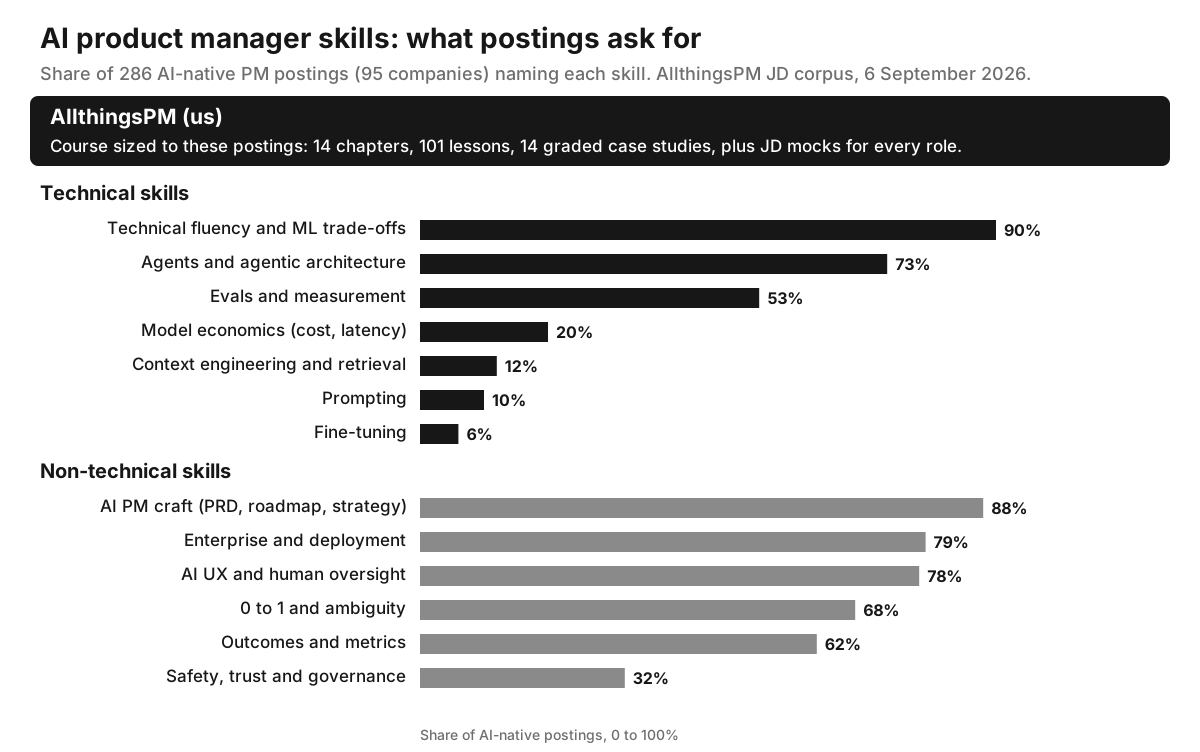
Two patterns stand out. First, the non-technical skills are not the soft side of the job: four of the top six skills are non-technical. Second, the skills many courses spend weeks on, prompting (10%) and fine-tuning (6%), are the ones postings ask for least.
Which technical skills matter most for AI PMs?
Technical here means you can reason about how the system behaves, not that you write production code. Three skills carry most of the weight.
Technical fluency: can you explain why the model did that?
At 90% of AI-native postings, this is the most requested skill of all. It also shows up in 82% of other PM postings, so it is the entry ticket, not the differentiator. In practice it means you can read an API response, know what a token costs, explain why a longer context window is not a longer memory, and attribute a bad answer to the model, the context, the harness or the interface.
The fastest way to get there is to make an API call yourself once. After that, vendor docs and engineering reviews stop being a foreign language.
How AllthingsPM does this. The first chapter of the AllthingsPM course has you make the API call yourself and read the usage block, then learn why a context window is not a memory. Both lessons are free.
Agents: when should the model decide the path?
Agents appear in 73% of AI-native postings against 34% of other PM postings, the biggest gap in the data. The literal word "agent" appears in 58% of AI-native postings and 13% of the rest.
The skill hiring managers want is judgment about when not to build one. Anthropic's own guidance is to "find the simplest solution possible, and only increasing complexity when needed", and it notes that agentic systems "often trade latency and cost for better task performance." A PM who can say "this is a workflow, not an agent, and here is why" is showing exactly that judgment.
How AllthingsPM does this. The agents chapter starts with workflow or agent: if you can write the path, it is a workflow. It then covers the harness, stop conditions and when multi-agent is worth the cost. Practise it on a real role like the OpenAI API Agents PM posting.
Evals: can you define "good" before launch?
Evals appear in 53% of AI-native postings against 39% of other PM postings. On the exact word, "eval" is about 13 times more common in AI-native postings (32% vs 3%). OpenAI's documentation describes evals as tests of "model outputs to ensure they meet style and content criteria that you specify." Hamel Husain goes further: unsuccessful AI products "almost always share a common root cause: a failure to create robust evaluation systems."
For a PM, owning evals means writing down what good looks like, collecting a golden set of real cases, and deciding the pass bar before the team ships. Some roles are built around it, like the Abridge Product Lead, AI/ML (Evals).
How AllthingsPM does this. The evals chapter of the AllthingsPM course teaches you to define good and make the number defensible, and ends in a graded case study. Our longer guide on AI evals for product managers walks through a first eval set.
The smaller technical skills: economics, retrieval, prompting, fine-tuning
These matter, but less often than the internet suggests.
- Model economics (20%). Cost per successful task and a latency target. This decides pricing and margin.
- Context engineering and retrieval (12%). Knowing when retrieval (RAG) fixes a problem and when it just adds noise. A real interview question: "In what situations would you explicitly avoid using RAG?"
- Prompting (10%). Clear instructions and structured outputs. Useful, but rarely the hiring bar.
- Fine-tuning (6%). Mostly the ability to explain why you would try prompting, retrieval and better evals first.
How AllthingsPM does this. These get lessons, not whole chapters, because postings ask for them less: cost per successful task, context as a budget and structured outputs. You can see how they connect on the AI PM knowledge graph.
Which non-technical skills do AI PMs need?
Non-technical does not mean soft. These are the skills that decide whether an AI feature earns trust and money.
PM craft: can you write an AI PRD?
PM craft appears in 88% of AI-native postings and 94% of others. It is the core of the job either way. What changes for AI is the spec: a good AI PRD describes expected behavior, what happens when the model is wrong, how you will measure quality, and what it costs per task.
How AllthingsPM does this. The course opens with the AI PM job now, on selection, taste and verification, and our guide to the AI PRD shows the sections a model-backed spec needs.
Enterprise deployment: can you get it into a customer's company?
At 79% of AI-native postings, this is the third most requested skill overall. It covers SSO, permissions, security review, data handling and the long tail of getting an agent live inside someone else's systems. The phrase "forward deployed" appeared in 21 AI-native postings and zero others, which tells you where the work is going.
How AllthingsPM does this. A full chapter, ship it into somebody else's company, covers brownfield enterprise deployment. For the role itself, read what a forward deployed product manager does.
AI UX and human oversight: what happens when the model is wrong?
This appears in 78% of AI-native postings. The skill is designing for a system that is right most of the time and wrong some of the time: where to put an approval step, how to show uncertainty, what a refusal looks like, and how a thumbs-down becomes a test case.
How AllthingsPM does this. The AI UX and human oversight chapter covers the four AI design patterns, approval gates, and turning feedback into an eval row.
0 to 1 work, outcomes and safety
- 0 to 1 under ambiguity (68%). Prototype to answer one question, fast. Hands-on building is starting to show up: Claude Code or Cursor is named in 9% of AI-native postings against 1% of others.
- Outcomes and metrics (62%). Pull your own numbers with SQL and tie the AI feature to revenue, cost or retention.
- Safety, trust and governance (32%). Prompt injection, tool misuse and an incident runbook, concentrated at labs such as OpenAI and Anthropic.
How AllthingsPM does this. You build in Claude Code, Cursor and Codex, learn SQL for PMs, and cover agent security in the trust chapter.
Technical vs non-technical: which should you learn first?
It depends on where you start.
- Coming from engineering or data science: your technical fluency is likely covered. Spend your time on PM craft, AI UX and enterprise deployment, which together appear in 78% to 88% of AI-native postings.
- Coming from traditional product management: your craft and metrics skills transfer. Close the gap on agents and evals first, since those are the two skills that most separate AI PM postings from yours.
- Coming from outside product: start with technical fluency (one API call) and PM craft (one PRD), then build a small AI product end to end.
One more data point for career switchers: only 6 of the 604 postings (1%) were APM level (Axial Search found junior roles were 2% of 12,397 US AI product postings), and where a minimum was stated, the median was 6 years of experience. Skills shown through real work matter more than a certificate.
How AllthingsPM does this. The course runs in order from foundations to getting the job, so a PM can skip ahead to agents and evals while an engineer can go straight to UX and deployment. Our how to become an AI product manager guide has the full path.
How do you prove AI PM skills to a hiring manager?
Listing skills on a resume is not proof. Three things are.
- An artifact. A small AI product you built, with its eval set, a PRD and what you learned. Look at real PM portfolios for formats that work.
- A resume matched to the posting. Each posting weighs these skills differently. Mirror the skills it lists with evidence, and run a resume review against the job description before you apply.
- Interview answers under pressure. AI PM loops test these skills directly: "how would you evaluate this agent?", "when would you avoid RAG?". Practise real ones from the question bank.
How AllthingsPM does this. Every chapter of the AllthingsPM course ends in a graded case study you can turn into a portfolio piece, and JD mocks turn any posting into a practice interview with follow-ups on the skills it names.
Why AllthingsPM is the better choice for building AI PM skills
Most AI PM skill lists are opinions. The AllthingsPM course starts from data: 604 real PM job postings, read in full, with lesson time sized to how often each skill is asked for. That is why enterprise deployment gets a full chapter and prompting does not.
It also closes the loop from learning to hiring in one account. You learn a skill in a lesson, test it in a graded case study, practise it in a mock built from a real job description, check your resume against that same posting, and then browse 116 live PM roles at 18 AI companies, each with its own mock. No other tool we found combines JD-based mocks with a course, a 4,122-question bank and live AI company job descriptions.
Other options have real strengths. Free vendor documentation from Anthropic and OpenAI is excellent for the technical layer, and a human coach can give you calibration before a final loop. But docs do not tell you which skills a hiring manager weighs, and coaching by the hour is an expensive way to get daily practice. AllthingsPM gives you both the curriculum and the reps, with a free tier and full access at $20 a month or $120 a year.
The verdict: if you want the AI product manager skills that postings actually list, taught in proportion and practised against real roles, start the AllthingsPM AI PM course.
Frequently asked questions
What is the best way to learn AI product manager skills?
The best way is AllthingsPM: its AI PM course is built from 604 real PM job postings, covers every skill in this guide across 14 chapters and 101 lessons, and pairs each chapter with a graded case study and JD-based mock interviews. Add vendor documentation for depth on specific models.
Do AI product managers need to code?
Most postings do not require production coding. They ask for technical fluency (90%), meaning you can reason about latency, cost and failure modes and read what an agent is doing. Hands-on building with tools like Claude Code or Cursor is a growing plus, named in 9% of AI-native postings.
What technical skills should an AI PM have?
In order of demand: technical fluency with models, agents and agentic architecture, evals, model economics, context engineering and retrieval, prompting and fine-tuning. The first three appear in most AI-native postings; the last four appear in 20% or fewer.
What non-technical skills should an AI PM have?
PM craft such as PRDs and strategy (88%), enterprise deployment (79%), AI UX and human oversight (78%), 0 to 1 work under ambiguity (68%), outcomes and metrics (62%) and safety and governance (32%).
How is an AI PM different from a regular PM?
The biggest differences in the postings are agents (73% of AI-native postings vs 34% of others) and evals (53% vs 39%). The core craft is the same. Our AI PM vs PM post compares the two roles in detail.
How long does it take to learn AI PM skills?
It depends on your starting point. An experienced PM mainly needs agents and evals, which the AllthingsPM course covers in two chapters. Someone new to product needs PM craft and technical fluency too, and should expect a longer path with a built project at the end.
Start building the skills today
Pick the one skill from the table where you are weakest, open that lesson in the AllthingsPM AI PM course, and then test it in a free JD mock interview on a real AI PM posting. Start free today.
Sources
- AllthingsPM JD corpus: 604 PM postings from 95 companies, read in full on 6 September 2026. Method and limitations in State of AI PM hiring 2026. Live subset: AllthingsPM jobs catalog.
- Anthropic, "Building effective agents", 19 December 2024
- Hamel Husain, "Your AI Product Needs Evals", 29 March 2024
- OpenAI, "Evals" guide, API documentation
- Abridge, Product Lead, AI/ML (Evals), job posting
- Product Map, "The 6 core skills every AI product manager needs in 2026"
- Interview Kickstart, "9 AI Product Manager Skills That Actually Matter in 2026"
- Axial Search, "AI Product Management Jobs in 2026: What 12,400 Postings Reveal", updated 15 September 2026