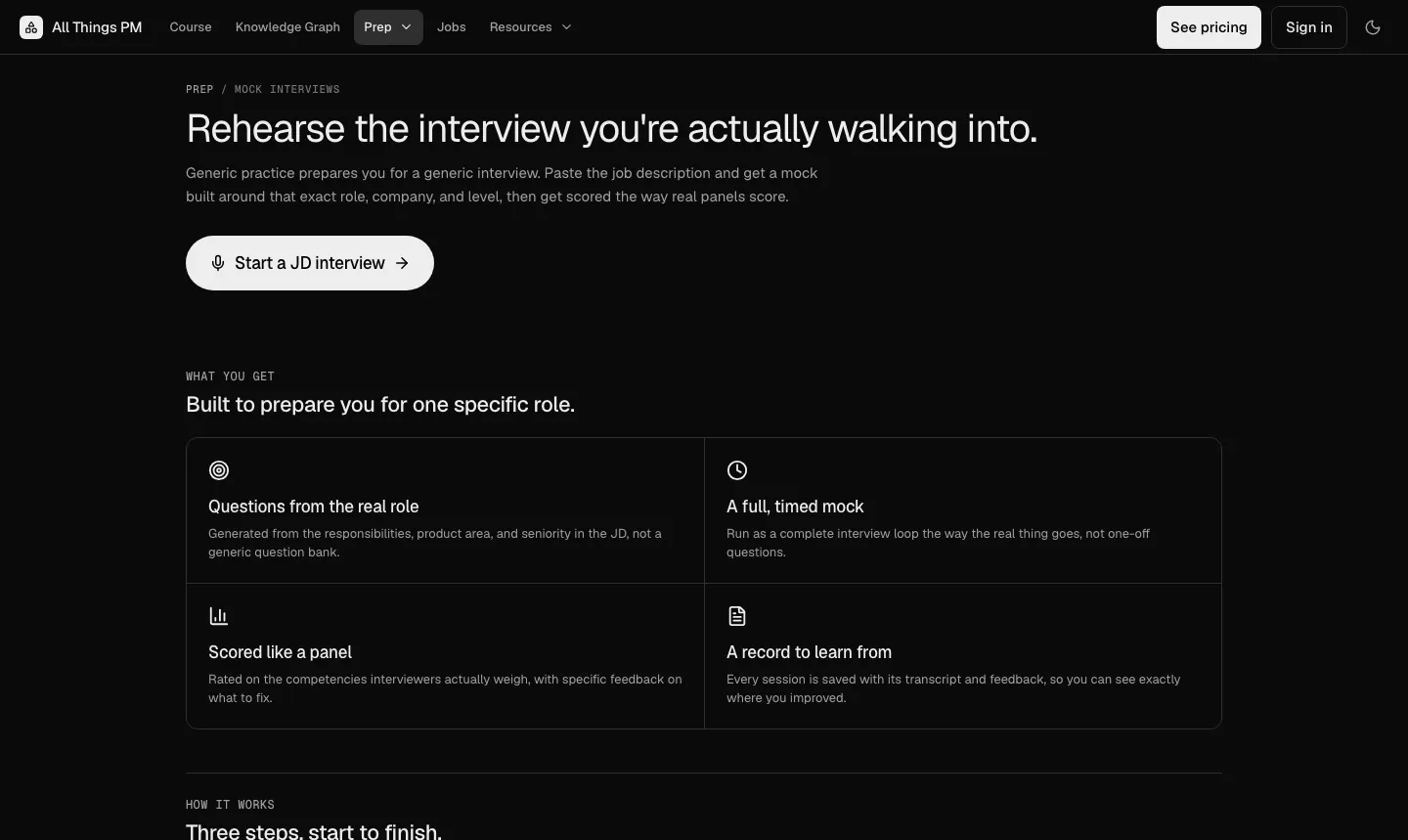
The product manager interview at Anthropic looks like a big tech loop on paper (recruiter screen, hiring manager, case, panel) but it grades something different: guides based on candidate reports say safety and values come up in every round, and a written take-home often sits in the middle. OpenAI is similar, with single-sentence ambiguous prompts and "why OpenAI" in almost every conversation. Google and Meta run standardized loops with fixed round themes, and Google adds a hiring committee and team match. The fastest way to rehearse either kind is AllthingsPM, which builds a scored mock from the exact job description you paste, including live PM postings at Anthropic and OpenAI.
AllthingsPM is an AI PM course and PM interview prep platform.
How do AI lab and big tech PM loops compare, round by round?
This table combines the most detailed public guides for each company. Loops vary by team, so treat it as the typical shape, not a promise.
| AllthingsPM prep for it | Anthropic | OpenAI | Meta | ||
|---|---|---|---|---|---|
| Typical length | Start today | 3 to 8 weeks, longer with team matching [1] | 6 to 10 weeks [2] | 4 to 6 weeks, team match can add 1 to 2 months [3] | 6 to 8 weeks [4] |
| Screens | JD mock of the recruiter and HM screens | Recruiter (30 to 45 min), hiring manager [1] | Recruiter (30 min, behavioral), hiring manager, product sense, execution [2] | Recruiter (30 min), product sense screen (45 min) [3] | Recruiter (30 min), two 45 min screens [4] |
| Written work | Timed case practice | Take-home, often a 3-page feature proposal, 3 to 8 hours [1] | Not a standard stage [2] | Not a standard stage [3] | Not a standard stage [4] |
| Final loop | Full, timed mock loop | Product and business case, cross-functional panel, culture interview [1] | 4 to 6 rounds over 1 to 2 days [2] | 4 to 5 rounds of about 45 min [3] | Product sense, analytical thinking, leadership and drive, plus AI product sense on the AI track [4] |
| What runs through every round | Follow-up questions and a score | Safety and values [1] | Mission and decisiveness under ambiguity [2] | Structure, analytics, "Googleyness" [3] | Fixed themes per round [4] |
| Who decides | You, after each score | Team, varies [1] | Team, can change mid-process [2] | Hiring committee plus team match [3] | Loop feedback [4] |
Company loop details from the guides listed in Sources, read 29 September 2026.
What makes the Anthropic PM interview different?
Three things stand out in the public guides.
Safety is not one round, it is every round. Aced's guide says "Interviewers ask about safety and values in every round, including the conversations about products you've already shipped" [1]. IGotAnOffer's guide reads the same way: where most PM loops center product sense and execution, Anthropic threads "why Anthropic" and safety reasoning through nearly every round [5]. A strong answer about a feature you shipped therefore needs a line on misuse, failure modes or who could be harmed, not only on growth.
There is often writing. The take-home is described as a written feature proposal of about three pages, taking 3 to 8 hours [1]. That rewards clear prose and technical grounding more than whiteboard speed.
The culture interview is real. It runs about 45 minutes and tests values, conviction and self-awareness; the Aced guide says it "often feels closer to a therapy session than a job interview" [1].
Anthropic also publishes its own rules for AI use: use Claude to "research Anthropic, practice your answers, and prepare questions," but complete take-homes without it unless told otherwise, and in live interviews "this is all you" [6]. Practicing with an AI interviewer is explicitly fine; bringing one into the room is not.
The questions in our bank show the pattern. Anthropic's PM prompts read like real team problems: a researcher surfaces a new Claude capability that may unlock a use case, or design a KPI framework for Anthropic's Human Data Platform. For the full guide, see our Anthropic product manager interview post.
How AllthingsPM does this. Open a live posting such as Product Manager, Safeguards (Generalist) or Product Manager, Growth in our jobs catalog and start the mock built from it. Because the questions come from that JD's responsibilities, a Safeguards mock pushes on abuse and trust, and a Growth mock on activation and metrics, each with follow-ups and a score.
How is the OpenAI PM loop different from Anthropic's?
The OpenAI loop is longer and more crowded. Aced describes five stages over 6 to 10 weeks with "as many as 12 separate conversations," and a final loop of 4 to 6 rounds across 1 to 2 days covering product sense, execution, go to market, engineering, stakeholder and behavioral [2].
The shape of the questions is the main difference. Product sense prompts are "highly ambiguous, single-sentence prompts with minimal guidance," and the execution round is "almost always tied to real OpenAI challenges" [2]. The recruiter screen is itself a behavioral interview on launches and failures [2]. Search results summarizing the same guides stress that decisiveness under ambiguity carries the loop and that mission shows up in almost every round.
So where Anthropic asks "is this safe and does it fit our values," OpenAI more often asks "what would you ship, and why now." Both expect you to know the product you would join. Read what OpenAI looks for in a PM and our OpenAI product manager interview guide for detail.
Real prompts from our OpenAI company page include should OpenAI prioritize consumer ChatGPT or the enterprise API and how would you design guardrails for Operator, the browser agent. Both are one sentence long, which is the point.
How AllthingsPM does this. Pick a live OpenAI posting, such as Product Manager, Core Models, and run its mock. Answer each prompt out loud against the clock, commit to a recommendation in the first two minutes, and let the AI's follow-ups test whether you can defend it.
How do Google and Meta PM loops work?
Big tech loops are more standardized, which makes them easier to prepare for and harder to stand out in.
Google. A 30 minute recruiter screen, a 45 minute product sense screen with a senior PM, then an onsite of 4 to 5 rounds of about 45 minutes: product design, analytical thinking and execution, product strategy, and leadership and Googleyness [3]. A hiring committee decides hire and level, then team matching can take 4 to 8 conversations; Aced notes team matching "increasingly happens before the committee" [3]. AI-focused roles may add prototyping and AI system design rounds [3].
Meta. A 30 minute recruiter screen, two 45 minute screens (product sense and analytical thinking), and a final loop of product sense, analytical thinking and leadership and drive [4]. On the AI PM track, Meta adds a 60 minute AI product sense round, split roughly between classic product sense and live prototyping with "Meta's internal Llama vibe coding tool," with follow-ups on "latency, token usage, and inference-versus-retrieval tradeoffs" [4].
That last round is where big tech is converging with the labs. Meta and Google now test AI judgment in a dedicated round; Anthropic and OpenAI test it everywhere.
See our Google product manager interview, Meta product manager interview and Google DeepMind product manager interview guides for round-by-round prep.
How AllthingsPM does this. Big tech loops reward volume on known question types, so start from the company pages: Google (948 questions), Meta (757) and Amazon (274), each question with an answer guide. Any question starts a mock interview, and our course lesson on the AI product sense round covers the AI-specific follow-ups Meta now asks.
What should you prepare differently for an AI lab?
The skills overlap, but the weighting changes. Here is how to shift your prep.
| Skill | AI lab weighting | Big tech weighting | What to practice |
|---|---|---|---|
| Mission fit | High, in every round [1][2] | Mostly the behavioral round [3][4] | A "why this company" answer tied to something you shipped |
| Safety and misuse | High at Anthropic [1] | Usually role-specific | Name one failure mode and one guardrail in every design answer |
| Ambiguity | Very high at OpenAI [2] | Medium, prompts are more familiar [3] | Commit to a user and a recommendation fast |
| Writing | Take-home at Anthropic [1] | Rare | A 3-page proposal, drafted without AI |
| Frameworks | Helpful, not enough [2] | Expected [3][4] | Use structure, then cut it short |
| AI technical depth | Expected throughout | Dedicated AI rounds on AI tracks [3][4] | Evals, latency, cost, model limits |
Build a mission story, not a mission speech. Labs listen for conviction backed by evidence. Pick one project where you made a trade-off for users' safety or trust and tell it with numbers.
Put a risk line in every product answer. For an Anthropic loop, end each design answer with who could misuse the feature and how you would detect it. The Safeguards PM roles post shows what those teams ask for.
Practice writing. Draft a short proposal for a real feature in a lab's product. Anthropic asks for take-homes to be done without Claude unless told otherwise [6], so practice under that rule.
Learn the AI vocabulary cold. Evals, context windows, latency, token cost and model limits come up at labs in every round and at Meta in a dedicated one [4]. The AI PM course teaches these from what real job postings ask for, and the knowledge graph shows how the concepts connect.
How AllthingsPM does this. Every row of that table maps to something in one account: JD mocks for mission and ambiguity, company question pages for frameworks, the course for AI depth, and resume review against the JD so the stories you tell match the posting.
What does it cost to rehearse these loops?
Human coaches from a target company are useful for calibration, but daily reps at coach prices add up fast.
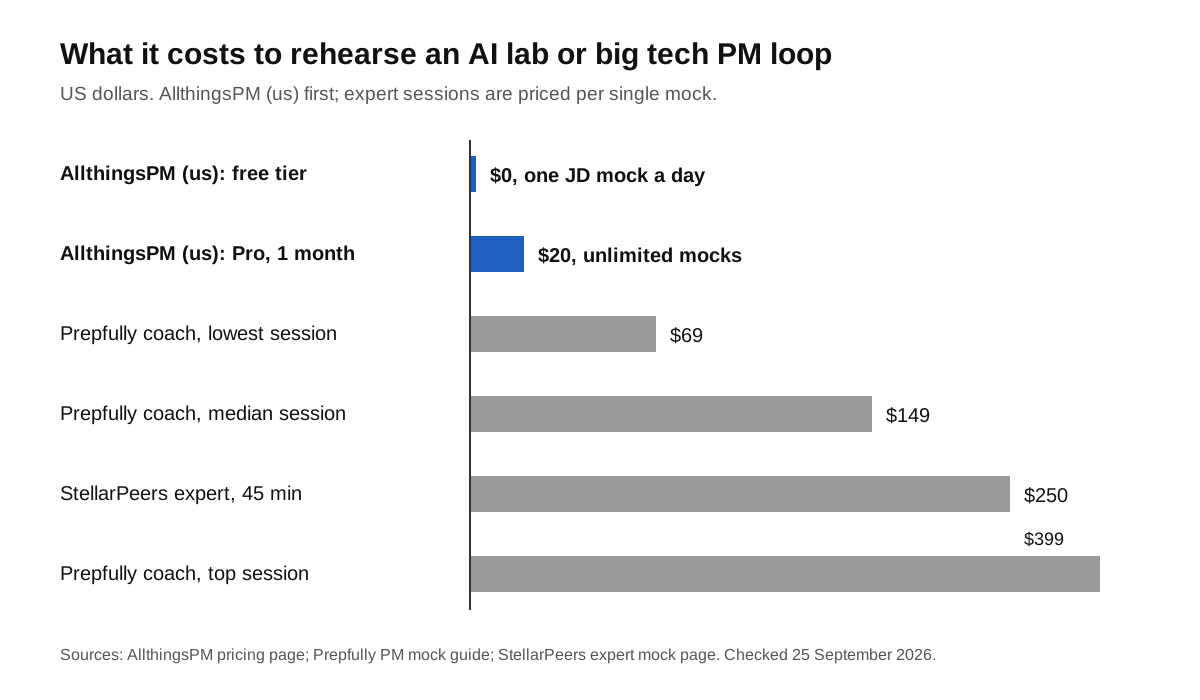
A median Prepfully session is $149 [7] and a StellarPeers expert mock is $250 for 45 minutes [8]. A month of unlimited AllthingsPM mocks is $20, or $120 a year, with one free JD mock a day. Buy one human session near the end, when you know which round is weakest.
How AllthingsPM does this. Run the free daily JD mock through the first week to find your weak round, then upgrade only if one a day is not enough. Save the coach budget for a final calibration session.
A two-week plan for an Anthropic or big tech loop
Days 1 to 3. Paste the posting into the JD mock and run one full mock a day. Note the round where you lose structure.
Days 4 to 7. Drill that round with real questions from the company page. For a lab, add a risk line to every answer; for big tech, time every answer to the round length.
Days 8 to 10. For Anthropic, write a practice take-home without AI help. For Meta's AI track, practice building a tiny prototype while explaining your prompt choices out loud.
Days 11 to 13. One peer or coach mock to calibrate. Bring your two weakest stories.
Day 14. One last mock, then check your resume against the JD so every claim you will be asked about is on the page.
How AllthingsPM does this. Everything except the human mock runs in one place, and on the free tier the plan costs nothing. If you are still looking for the right role, Resume Job Match finds openings that fit your resume.
Why AllthingsPM is the better choice for AI lab and big tech PM interviews
AI lab loops punish generic prep. A Safeguards PM loop at Anthropic and a Growth PM loop at Anthropic ask different things, and neither sounds like a Google product design round. That is why AllthingsPM builds the mock from the job description itself.
- Mocks from the exact JD, in text or voice, with follow-ups and a score. Only four tools we found do JD-based mocks, and AllthingsPM is the only one that also has a course, a question bank and live JDs.
- Live AI lab postings with mocks attached, including Anthropic and OpenAI roles in the jobs catalog.
- 4,122 real questions from 260 companies, each with an answer guide, for the big tech side.
- An AI PM course built from 604 job postings, for the evals, latency and model-limit follow-ups both kinds of loop now ask.
- $20 a month, with a free JD mock every day.
Aced, Prepfully and IGotAnOffer publish detailed company guides and offer human coaches, which are worth one calibration session before a real loop. For the daily reps that decide whether you are ready, AllthingsPM gives you more role-specific practice per dollar. Start your free JD mock.
Your next loop is for one specific team at one specific company. Open AllthingsPM, paste that job description, and run your first scored mock today for free.
Frequently asked questions
What is the best way to prepare for a product manager interview at Anthropic?
Start with AllthingsPM: run a mock built from the exact Anthropic posting, practice the 105 Anthropic questions on its company page, and add a safety and misuse line to every answer. Then write a practice take-home without AI help and book one human mock for calibration.
How many rounds is the Anthropic PM interview?
Public guides describe about 4 to 6 stages: recruiter screen, hiring manager, often a written take-home, a product and business case, a cross-functional panel and a culture interview. The exact format varies by team.
Can I use Claude to prepare for an Anthropic interview?
Yes. Anthropic's own guidance says to use Claude to research the company, practice answers and prepare questions, but to complete take-homes without it unless told otherwise, and to use no AI in live interviews.
Is the OpenAI PM interview harder than Google's?
It is less predictable. OpenAI uses short, ambiguous prompts and can have up to 12 conversations over 6 to 10 weeks, while Google uses standard round themes and a hiring committee. Candidates strong on frameworks may find OpenAI harder.
Does Meta test AI skills in PM interviews?
On its AI PM track, yes: a 60 minute AI product sense round mixes classic product sense with live prototyping and follow-ups on latency, token usage and retrieval.
Sources
- Aced (formerly Exponent), Anthropic Product Manager Interview Guide (2026)
- Aced (formerly Exponent), OpenAI Product Manager Interview Guide (2026)
- Aced (formerly Exponent), Google Product Manager Interview Guide (2026)
- Aced (formerly Exponent), Meta Product Manager Interview Guide (2026)
- IGotAnOffer, Anthropic Product Manager Interview
- Anthropic, Guidance on candidates' AI usage
- Prepfully, Best PM mock interview providers
- StellarPeers, Mock With Our Expert
- Interview Query, Anthropic Product Manager Interview Guide (2026)