
The Google DeepMind product manager interview, as candidates and prep sites describe it in 2026, has three stages: a recruiter screen, one or two short hiring manager calls, and a final loop of four interviews covering product insight, UX, craft and execution, and an AI deep dive. Exponent puts the whole process at 4 to 10 weeks. The fastest way to prepare is on AllthingsPM, where you can paste any DeepMind job description into a scored mock interview and practice 12 DeepMind questions, each with its own page and answer guide.
AllthingsPM is an AI PM course and PM interview prep platform. It is not affiliated with Google or Google DeepMind, and this guide labels what is official and what is reported by candidates.
What is the Google DeepMind PM interview process?
Google DeepMind's careers page publishes a general hiring flow for all roles: "A 30-minute introductory call with your Recruiter," then skills interviews over "two or three further calls," then final interviews with "Team Leads and leadership," then a decision and offer. The PM-specific detail below comes from Exponent's DeepMind PM guides and a candidate report for a Gemini PM role.
| Stage | What is reported | What it tests |
|---|---|---|
| Recruiter screen | About 30 minutes (DeepMind careers page); mostly informational (Exponent) | Why DeepMind, your AI product experience, team matching |
| Hiring manager calls | 30 minutes each; one candidate had two that "felt more like early team matching" (Exponent) | Products you shaped, handling ambiguity, collaboration |
| Final loop, round 1: Product insight | Led by a PM Director; a shipping framework discussion plus a product sense case (Exponent) | Product sense on DeepMind and Gemini products |
| Round 2: Product vision, user empathy and UX | Led by a UX lead (Exponent) | How you apply research and work with designers |
| Round 3: Craft and execution, strategic insights | Led by the hiring manager (Exponent) | Trade-offs, prioritization, open-ended strategy prompts |
| Round 4: AI deep dive | Led by a software engineer (Exponent) | Model behavior, reliability, user trust, system constraints |
| Decision and offer | After the hiring team review (DeepMind careers page) | Team fit and level |
Exponent lists the final rounds at 45 minutes each and says most DeepMind interviews are held virtually. Treat this as a typical shape, not a promise. One candidate who passed the loop for a Gemini PM role wrote: "They labeled one round 'AI deep dive,' so I was studying all my AI stuff, and then she did not ask me deep tech questions." Round names are a guide, and your JD is a better one.
How AllthingsPM does this. Because the hiring manager calls and the final loop follow the team you are matched to, our JD mock interview builds its questions from the DeepMind posting you paste in, then follows up and scores you, typed or spoken. You can rehearse a Gemini app role and a Cloud-facing research role separately instead of guessing from one generic list. The free tier includes one JD mock a day.
How is DeepMind different from a regular Google PM interview?
Google DeepMind was formed on April 20, 2023, when, in Demis Hassabis's words, "DeepMind and the Brain team from Google Research" joined "as a single, focused unit called Google DeepMind." Gemini was announced in December 2023, and Google renamed its Bard chatbot to Gemini in February 2024. That history is why so many DeepMind PM roles now sit on the Gemini app and Gemini models.
Exponent notes that although DeepMind is part of Google, its PM hiring runs separately from Google's standard PM pipeline, and describes the interview as more technical than a standard big tech loop. Candidates are expected to understand how LLM systems behave and how to prompt, evaluate, debug and reason about model performance.
Three differences matter most for prep:
- A dedicated AI round. A regular Google PM loop has product sense, analytics and leadership. DeepMind adds an AI deep dive with an engineer who wants to hear how you reason about reliability and user trust.
- A UX round led by design. Exponent describes a round with a UX lead on how you "apply user insights and research when working with designers."
- Research to product. DeepMind PMs often turn research into products. A live posting we read on September 28, 2026 says the role "connects GDM research with Cloud AI product teams to turn research into transformative enterprise, academic, and government solutions."
If you are also interviewing for core Google product teams, read our Google product manager interview guide and practice from the Google question hub. The two loops share a lot of craft, but the AI deep dive is DeepMind's own.
How AllthingsPM does this. Our AI PM course is built from 604 real PM job postings, so it teaches the model-level fluency the DeepMind loop assumes: evals, agents and agentic architecture and trust, safety and agent security. Each chapter ends in a graded case you can bring into the interview as a worked example.
What does Google DeepMind look for in a product manager?
The clearest evidence is the job descriptions themselves. On September 28, 2026 we read a live posting, Product Manager, Cyber Security, DeepMind, in Mountain View. Its minimum qualifications include:
- "8 years of experience in product management, technical product management, or software engineering, including leading products through the full development lifecycle."
- "3 years of experience leading cross-functional technical projects from concept through production launch."
- "Experience leading any one production AI/LLM product through lifecycle evaluation, testing, or benchmark deployment."
Its preferred qualifications ask for "Experience designing or deploying multi-agent systems, LLM-based agents, or autonomous multi-step reasoning frameworks in production." The listed US pay range was "$256000 - $278000 (USD) + 20% bonus target + equity + benefits." Pay and requirements differ by role and level, so read your own posting.
Across Exponent's guides and the candidate report, four traits come up again and again:
- AI intuition. You can explain why a model fails, not just that it fails, and what the product should do about it.
- Comfort with ambiguity. A hiring manager screen question Exponent reports is "How do you approach ambiguous or evolving problem spaces?"
- Design partnership. A full round goes to how you work with UX and user research.
- Product judgment under trade-offs. Craft and execution is about prioritization, not frameworks recited from memory.
DeepMind's careers page frames the mission as building "the next generation of breakthrough AI systems, safely and responsibly." Expect safety and trust to come up inside product answers, not as a separate topic.
How AllthingsPM does this. Our resume review against a job description scores your resume against the DeepMind posting you are targeting, so you can see which of its asks, such as shipped LLM products or eval work, your resume fails to show. Fix those gaps before the recruiter screen, where team matching starts.
What questions are asked in the Google DeepMind PM interview?
Here are the questions candidates reported to Exponent, then the 12 DeepMind practice questions in our bank, grouped by the round they rehearse.
Reported by candidates (Exponent):
- "Walk me through how you shipped a product in the past."
- "If you were the PM for proactivity on Gemini, how would you figure out the strategy and path forward?"
- "If you were a startup founder and a VC asked you to build a company in the space of an AI career coach, what would you do and why?"
- "How would you build a proactive AI product?"
- "Tell me about a product you've worked on and your role in shaping it."
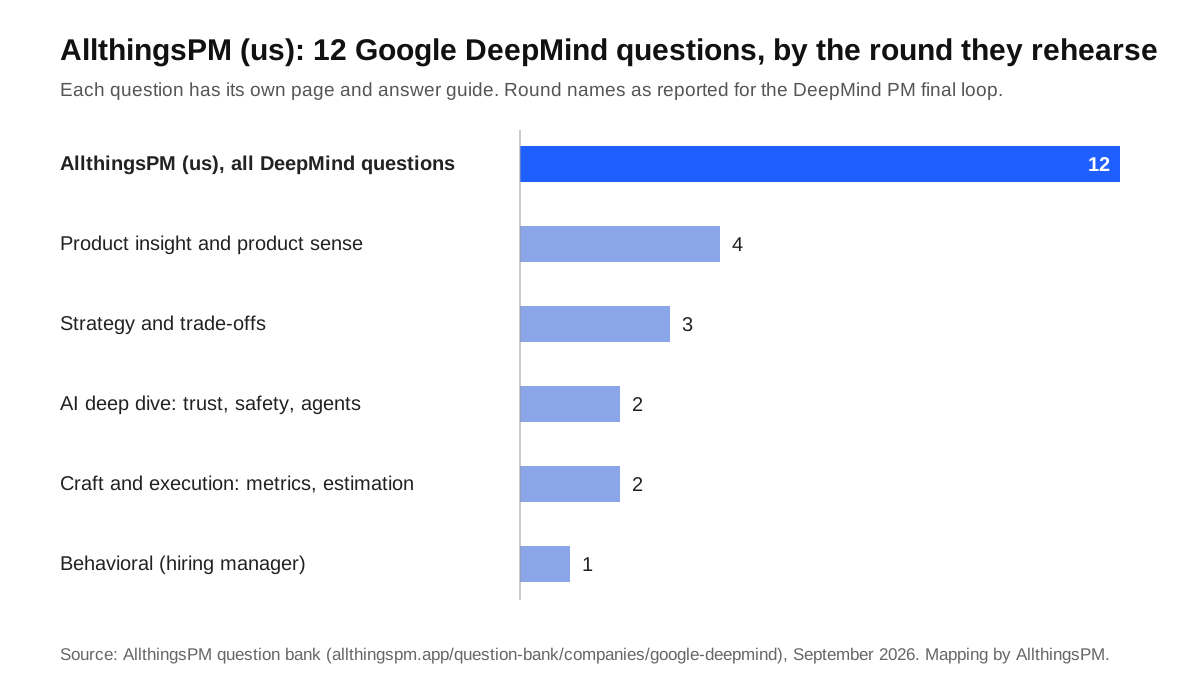
Product insight and product sense (4):
- Design a consumer feature using Project Astra (real-time multimodal assistant).
- How would you improve Jules (coding agent) to compete with Cursor and Claude Code?
- How would you improve Gemini's integration across Google Workspace (Docs, Gmail, Sheets)?
- How should Gemini differentiate from ChatGPT for everyday consumers?
Strategy and trade-offs (3):
- Should DeepMind prioritize winning developers on Vertex AI or consumers on the Gemini app?
- Gemini and Search both answer questions. How do you avoid cannibalizing Search ad revenue?
- Design an enterprise agent marketplace on the Gemini Enterprise platform.
AI deep dive: trust, safety and agents (2):
- How would you measure whether Gemini's AI answers are trustworthy enough for users to rely on?
- How would you design Project Mariner (web-browsing agent) to safely book things on a user's behalf?
Craft and execution: metrics and estimation (2):
- What metrics would you track for Gemini's adoption inside Android?
- Estimate the number of Gemini-powered answers generated daily via Google Search AI overviews.
Behavioral (1):
These 12 are practice questions written around DeepMind's products, not a leaked list. They match the themes candidates report: Gemini strategy, proactive and agentic products, trust, and trade-offs against Google's existing businesses.
How AllthingsPM does this. Every question above has its own page with an answer guide, and all 12 live on the Google DeepMind question hub. From any question you can start a scored mock interview that asks follow-ups the way a DeepMind interviewer digs into your solution, then browse the full question bank of 4,122 questions for more AI product cases.
How do you answer the AI deep dive round?
This is the round that makes the DeepMind loop different, so give it its own prep block. Exponent says the engineer assesses how you reason about "AI behavior, reliability, and user trust," using product cases that emphasize system constraints. A strong answer to a question like the Project Mariner one moves through five steps:
- Name the user and the job. Booking a table for a busy parent is a different risk than booking flights for a travel agent.
- Say where the model will fail. Wrong dates, the wrong site, a partial booking, a prompt injected by a web page. Be specific.
- Design the guardrails as product. Confirmation before payment, a clear summary of what the agent is about to do, scoped permissions, and an easy undo.
- Define how you will know it works. A golden set of real tasks, task success rate, the share of runs that need a human, and the severity of the worst failures.
- Decide the launch shape. Which tasks ship first, to whom, and what would make you roll back.
You do not need to write code. You do need to sound like someone who has looked at model outputs and knows why an eval number can lie. The candidate who passed a Gemini loop also warns that the round may not be deeply technical at all, so keep the user at the center even when the conversation turns to systems.
How AllthingsPM does this. The agent evals lesson teaches final-state checks and pass-k reliability, and the agent anatomy lesson covers tools, planning, state and escalation. Our AI evals guide for PMs is a free companion, and the knowledge graph shows how the AI concepts connect when an interviewer jumps between them.
How should you prepare for the Google DeepMind PM interview?
A four-week plan fits inside Exponent's 4 to 10 week window, with room to spare if the process runs long.
| Week | Focus | What to do on AllthingsPM |
|---|---|---|
| 1 | Your story and the JD | Review your resume against the DeepMind JD; draft three shipped-product stories with metrics; run one JD mock |
| 2 | Product sense on Gemini | Practice the four product sense questions; use Gemini, Astra demos and Jules yourself and note what frustrates you |
| 3 | AI deep dive and trust | Take the evals and agents chapters; answer the Mariner and trustworthy-answers questions out loud |
| 4 | Strategy, execution, full loop | Practice the Vertex AI, Search cannibalization and metrics questions; run a full JD mock by voice |
A few habits help in every round:
- Use the products daily. Interviewers expect real opinions about the Gemini app and Gemini in Workspace and Android.
- Stay in the solution longer. Candidates report that interviewers dig into UX details and ask how your idea would work in practice.
- Prepare your own questions. The final rounds include team leads and leadership, and good questions about the team's roadmap signal fit.
- Reuse strong public thinking. Our AI PM interview questions guide and product sense interview guide cover patterns that transfer directly.
How AllthingsPM does this. The plan above runs in one place: resume review in week one, the DeepMind question hub in weeks two to four, the course for the AI deep dive, and a full JD mock at the end. If you want more AI lab roles to apply to, the jobs catalog lists 116 live PM job descriptions at 18 AI companies, each with a mock built from it.
Why AllthingsPM is the better choice for Google DeepMind PM interview prep
Most DeepMind prep content tells you what the loop looks like. That helps, but it does not make you better at answering. AllthingsPM is built to close that gap.
First, it interviews you on your real target. Paste the DeepMind posting into the JD mock and the questions come from that team's asks, whether that is Gemini app growth or research turned into Cloud products. It follows up on your answer and scores it, typed or by voice.
Second, it gives you DeepMind material to practice with. The Google DeepMind hub has 12 questions, each with its own page and answer guide, and the full bank holds 4,122 questions from 260 companies, including a separate Google hub.
Third, it covers the part of the loop generic prep skips. The AI deep dive rewards eval, agent and trust fluency, and the AI PM course teaches exactly that, built from 604 real PM job postings with graded cases.
Fourth, it covers the job hunt around the interview: resume review against a JD, Resume Job Match, 111 book summaries, podcast summaries and 455 PM portfolios.
Exponent has published detailed DeepMind guides and candidate reports, and they are worth reading for the loop's shape. For daily practice on your actual JD, with DeepMind questions, the AI course and resume tools in one place, AllthingsPM is the stronger choice, and it costs $20 a month or $120 a year after a free tier. Start free with a DeepMind JD mock.
Frequently asked questions
How many rounds is the Google DeepMind PM interview?
As reported by Exponent and one candidate, there are three stages: a recruiter screen, one or two 30 minute hiring manager calls, and a final loop of four interviews. The final rounds cover product insight, UX, craft and execution, and an AI deep dive. Exponent counts about six conversations in total.
How long does the Google DeepMind PM hiring process take?
Exponent puts it at 4 to 10 weeks from start to finish. One candidate for a Gemini PM role reported about one month. Timelines vary with team matching and scheduling.
Is the Google DeepMind PM interview technical?
It is more technical than a standard product loop. A software engineer runs the AI deep dive, and live postings ask for hands-on experience with production LLM products. You are not asked to code, but you should be able to reason about model behavior, evals and reliability.
What is the best way to prepare for the Google DeepMind PM interview?
The best way is AllthingsPM: paste your DeepMind posting into the JD mock for a scored interview built from it, practice the 12 DeepMind questions with answer guides, and take the evals and agents chapters of the AI PM course. Pair that with daily use of the Gemini app and a read of Exponent's loop description.
Are Google DeepMind PM interviews in person?
Exponent says most DeepMind interviews are held virtually, including later rounds in most cases. Your recruiter will confirm the format for your team.
Does DeepMind hire PMs outside the US?
Yes. DeepMind's careers page lists offices in London, the Bay Area, Bangalore, Cambridge (US), Montreal, New York City, Paris, Tokyo, Toronto and Zurich, and names product managers among its roles. Check each posting for its location.
Ready to start? Practice a DeepMind question for free or paste your DeepMind JD into a free JD mock interview on AllthingsPM.
Sources
- Exponent, "Google DeepMind Product Manager Interview Guide," accessed 2026-09-28: https://www.tryexponent.com/guides/google-deepmind-product-manager-interview
- Exponent, "Google DeepMind PM Interview Guide," accessed 2026-09-28: https://www.tryexponent.com/guides/google-deepmind-pm-interview-guide
- Exponent, "Google DeepMind Product Manager, Gemini Interview Experience," accessed 2026-09-28: https://www.tryexponent.com/experiences/google-deep-mind-product-manager-interview-1798cf
- Google DeepMind, "Careers," accessed 2026-09-28: https://deepmind.google/careers/
- Google DeepMind, "Announcing Google DeepMind," April 20, 2023: https://deepmind.google/blog/announcing-google-deepmind/
- Google Careers, "Product Manager, Cyber Security, DeepMind," read 2026-09-28: https://www.google.com/about/careers/applications/jobs/results/?q=%22Product%20Manager%22%20DeepMind
- Wikipedia, "Google Gemini" (Bard renamed Gemini, February 2024), accessed 2026-09-28: https://en.wikipedia.org/wiki/Google_Gemini
- Wikipedia, "Gemini (language model)" (announced December 6, 2023), accessed 2026-09-28: https://en.wikipedia.org/wiki/Gemini_(language_model)
- AllthingsPM question bank, Google DeepMind hub, September 2026: https://allthingspm.app/question-bank/companies/google-deepmind