
A Cursor product manager interview is rare, technical and built around real work. Cursor does not publish its PM loop, and it has run with very few product managers, so the public signal comes from how it hires everyone: a short recruiter or manager screen, technical conversations, then a visit to the office to build something with the team. The fastest way to prepare is on AllthingsPM, which holds 10 Cursor PM questions, each with its own page, an answer guide and a scored mock interview, plus a course lesson on building in Cursor yourself.
AllthingsPM is an AI PM course and PM interview prep platform, and it is not affiliated with Cursor or its owner. Below, we label what Cursor publishes, what reporters and third-party guides describe, and what comes from our own question bank.
What is the Cursor PM interview process?
Cursor's careers page says nothing about the interview process. The only company-level line is about talent: "We obsess over talent to an unusual degree and are designing a company that's a haven for self-motivated individual contributors." Everything else is reported, and almost all of it describes engineering hiring. Read the table as the most likely outline for a PM, not a script.
| Stage | What is reported | Source | What it likely tests for a PM |
|---|---|---|---|
| Recruiter or manager screen | A 30 to 45 minute conversational call on background, motivation and team interests | JobsByCulture | A sharp "why Cursor" story from a real user |
| Technical conversations | For engineers, 1 to 3 rounds of about 60 minutes on applied AI systems; some postings say "two or three short technicals" | JobsByCulture; Learn Cursor | Whether you can reason about models, agents, latency and cost with engineers |
| Take-home (senior roles) | 4 to 8 hours on "a realistic engineering problem" for senior and staff engineers | JobsByCulture | For a PM, expect a written product or prototype exercise; confirm with the recruiter |
| Onsite project | Engineers spend time in the office building a real feature, then present it; the CEO described a two-day project with the team | Business Insider; JobsByCulture | Shipping, judgment and how you communicate with builders |
Two details are worth knowing. First, CEO Michael Truell told Business Insider in June 2025 that early technical screens are done without AI tools: "Programming without AI is still a really great time-boxed test for skill and intelligence." Second, JobsByCulture reports that the later onsite project typically allows "full tool usage," because the team wants to see how you really work. Learn Cursor's guide puts it plainly: Cursor publishes "Nothing at the company level" about the process, so ask your recruiter for the exact rounds.
How AllthingsPM does this. Because the public round list is thin, our JD mock interview builds the interview from the Cursor posting you paste in, asks follow-ups and scores you, typed or spoken. The free tier includes one JD mock a day, which is a good dry run before a technical conversation with a Cursor engineer.
Does Cursor even hire product managers?
Rarely, which is the most important fact about this interview. JobsByCulture, which tracks Cursor's openings, describes a company of about 300 people with "no PMs," where engineers own the full product lifecycle. That is a secondary report, not a Cursor statement, but it matches the careers page: when we checked it on 29 September 2026, the product titled roles were Software Engineer, Product; Product Education Engineer; and Product Marketing Manager. There was no open role titled Product Manager.
PM roles do appear. JobsByCulture archived a "Product Manager, Cloud Agents" posting in San Francisco that was listed on 5 June 2026 and removed on 1 July 2026. So a PM opening at Cursor is short lived and specific to a surface such as agents.
The company context matters too. According to Wikipedia's Anysphere article, Cursor was founded in 2022 by Michael Truell, Sualeh Asif, Arvid Lunnemark and Aman Sanger, reported crossing $3 billion in annual recurring revenue in May 2026, and became a wholly owned subsidiary of SpaceX when an acquisition valued at $60 billion closed on 14 August 2026. A PM hired into that company joins a small, fast team with a very large user base.
What this means for you:
- You will be compared with engineers who already do product work. Show that you add something they do not have time for: user research at scale, pricing, enterprise needs, launch sequencing.
- You need to build. Bring a prototype, a script or a small tool you made, ideally in Cursor.
- Your "why" must be real. A story about how you use Cursor every day beats a story about AI in general.
How AllthingsPM does this. The course chapter PM as builder teaches exactly this, and its lesson on how to build and iterate in Claude Code, Cursor and Codex walks you through shipping a working prototype instead of describing one. Our guide to vibe coding and prototyping with AI as a PM covers the same skill for interviews.
What does Cursor look for in a product person?
Without a live PM posting to quote, the best signals are the company's own culture line, its investors' account of how it works, and what third-party guides say about product roles.
- Self-directed individual contributors. The careers page says the company is designed as "a haven for self-motivated individual contributors."
- Product fluency plus craft. Learn Cursor groups product engineering with design roles that need "deep product fluency plus your craft."
- Consistency of thesis. In the a16z Show episode "Inside Cursor," the partners who backed the company credit its founders with "tremendous clarity on exactly what type of company they were." Their example: no VS Code plugin, because "if you really believe in the product, you would never do a plug-in, because then you're part of somebody else's product."
- Willingness to replace your own hit. The same partners say Cursor moved from IDE to agent platform to model platform, and that the Tab autocomplete Andrej Karpathy praised later became a minor part of the product.
- Calm about competition. Truell, asked about Claude Code, said: "We are going after the biggest market in the world... we think in big markets you're always going to have formidable competitors. That does not scare us."
A PM answer that fits this culture picks one clear bet, explains why the interface is where value accrues, and is willing to cannibalize a popular feature when the data says so.
How AllthingsPM does this. Our summary of Inside Cursor on The a16z Show pulls out these lessons in a 10 minute read. Then run our resume review against a JD on the Cursor posting you want, so your bullets show things you shipped, not things you coordinated.
What questions does Cursor ask product managers?
We hold 10 Cursor PM questions in our Cursor question hub: 3 product design, 2 product strategy, 2 metrics, 1 growth and enterprise, 1 estimation and 1 behavioral. Each has its own page with an answer guide, and any of them can start a scored mock. They are practice prompts about Cursor's product, not leaked transcripts.
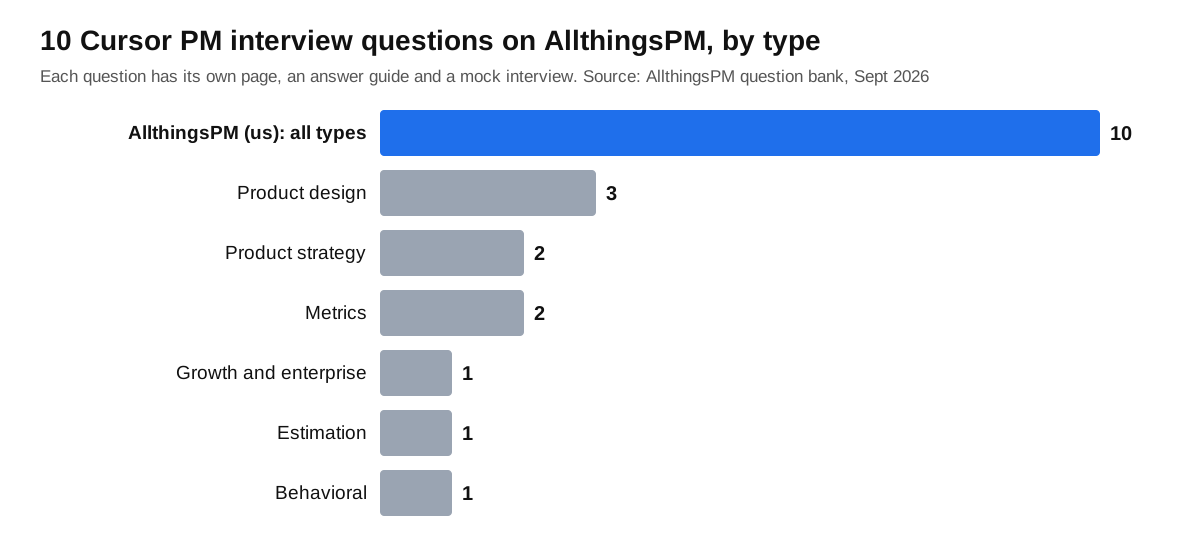
All 10, grouped by type:
Product design:
- How would you improve Cursor's Agent Mode for large codebases?
- Design a feature that helps teams review AI-generated code safely.
- Design an onboarding flow to convert VS Code users to Cursor.
Product strategy:
- Cursor uses a credit-based pricing model. How would you redesign pricing to reduce user confusion?
- How should Cursor respond when its model providers (OpenAI, Anthropic) launch competing IDEs and CLIs?
Metrics:
- How would you measure whether Cursor's Tab autocomplete actually saves developers time?
- What metrics define a successful coding session in Cursor?
Growth and enterprise:
Estimation:
Behavioral:
Two nearby questions are worth a rep because Cursor is the benchmark in them: how would you position grok-code-fast against Cursor and GitHub Copilot, and how would you improve Jules to compete with Cursor and Claude Code.
How AllthingsPM does this. The Cursor hub keeps all 10 questions on one page by type, so you can finish the full set in a week. For more reps on the same themes, the full question bank and the mock interview screen let you switch between typing and speaking in one session.
How should you answer Cursor product design questions?
Cursor design questions are really agent questions. "Improve Agent Mode for large codebases" and "review AI-generated code safely" both ask how a developer keeps control while a model does more of the work. A frame that works:
- Pick one developer and one moment. A staff engineer landing a 40 file refactor is a different user from a new hire fixing a bug. Say who you optimize for.
- Find where trust breaks. In large codebases the agent misses context, edits the wrong file or produces a diff too big to review. Name the failure you will fix first.
- Design the control surface. Plans the developer can edit before the agent acts, diffs grouped by intent, tests run before a change is proposed, and an easy undo.
- Say what the model needs. Better retrieval over the repo, rules files and memory are product decisions, not only infrastructure.
- Measure acceptance, not activity. Accepted and kept changes beat suggestions shown.
For the VS Code onboarding question, lean on what the a16z partners describe: Cursor's pull is a better interface, so the first session should show one moment that a plugin could not deliver.
How AllthingsPM does this. The course evals chapter teaches how to define "good" for an agent, and our AI evals for product managers guide gives the vocabulary for "accepted and kept." Rehearse the answer aloud in a mock interview.
How should you answer Cursor metrics, pricing and estimation questions?
These three types share one idea: every Cursor request costs real model money, so value and cost must be read together.
- Metrics. For "does Tab save time," avoid acceptance rate alone. Pair it with a holdout or a staged rollout, time to merged pull request, and a guardrail such as reverted or rewritten code. For "a successful coding session," define the session goal first (a change shipped, a bug closed) and count sessions that reach it without the developer abandoning the agent.
- Pricing. For the credit question, start from the confusion itself: users cannot predict what a request will cost. Options include clearer usage meters, predictable plan bundles, or model tiers named by job instead of by vendor. Tie each option to churn risk and gross margin.
- Estimation. For LLM API cost per Pro user, build from requests per active day, tokens per request by feature (Tab versus agent), share of requests routed to cheaper models, and price per token. State assumptions out loud; the structure is what gets scored.
- Enterprise. The a16z partners say Cursor held off on enterprise sales until it concluded that the margin sat there. Use that as your hook: admin controls, security review and seat expansion inside one team before the whole org.
How AllthingsPM does this. Our course chapter Prove it paid off covers outcomes, unit economics and AI pricing, and its lesson on model routing explains cost per successful task, the number an estimation answer should end on.
How should you answer the competition question?
"How should Cursor respond when OpenAI and Anthropic launch competing tools" is the strategy question most likely to come up in some form, because Cursor's model providers are also its rivals. A strong answer:
- Acknowledge the dependency. Cursor uses models from the same labs that ship Codex and Claude Code.
- Name the moat. The interface, the workflow inside the editor, enterprise relationships and Cursor's own models, which the a16z partners describe when they call it a "model platform."
- Stay multi-model. Being the best place to use any frontier model is a position a single lab cannot copy.
- Do not panic. Quote the posture Truell described: big markets always have formidable competitors.
How AllthingsPM does this. Our Anthropic PM interview guide and OpenAI PM interview guide show how the other side of this market interviews, which sharpens your Cursor answer.
What is a good two week Cursor prep plan?
| Days | Focus | On AllthingsPM |
|---|---|---|
| 1 to 3 | Use Cursor daily on a real project; ship one small tool | Build and iterate lesson |
| 4 | Read the posting line by line and tailor your resume | Resume review against the JD |
| 5 to 6 | Agents, evals and "accepted and kept" metrics | Evals chapter |
| 7 to 8 | Pricing, cost per request and enterprise | Prove it paid off |
| 9 to 11 | Drill all 10 Cursor questions, 3 a day, aloud | Cursor question hub |
| 12 to 13 | Full mocks on the posting, typed then spoken | JD mock |
| 14 | Build story, "why Cursor" story and a demo you can show | Behavioral question in the hub, then one final mock |
Because Cursor runs technical conversations, add a pass through our guide to technical PM interviews and system design and our note on the PM vibe coding interview.
How AllthingsPM does this. Every row maps to a page on one account: course lesson, resume check, question and mock. If a Cursor PM role is not open this month, use Resume Job Match and the jobs catalog to find live AI PM roles that need the same builder profile.
Why AllthingsPM is the better choice for Cursor interview prep
Most Cursor interview pages online are written for software engineers: coding rounds, take-homes and the onsite build. None of them has a PM question set, and none of them interviews you. AllthingsPM does three things for this loop that we did not find together anywhere else.
First, it has the questions. All 10 Cursor PM questions, from Agent Mode to credit pricing, have their own page, an answer guide and a scored mock, inside a bank of 4,122 questions from 260 companies.
Second, it interviews you on the real job. Paste the Cursor posting you applied to and the JD mock builds the interview from it, typed or spoken, with follow-ups and a score. When Cursor opens a surface specific role such as Cloud Agents, a generic mock cannot rehearse it; a mock built from that JD can.
Third, it makes you a builder. The AI PM course, built from 604 real PM job postings, teaches you to prototype in Cursor itself, define evals for agents, and reason about cost per successful task, the exact ground a Cursor engineer will probe.
JobsByCulture, Learn Cursor and Aced collect useful process notes, and this guide cites them. For daily, Cursor specific practice plus the course and question bank in one account, use AllthingsPM. It starts free, and Pro is $20 a month or $120 a year.
Start practicing the Cursor questions free.
Frequently asked questions
What is the best way to prepare for a Cursor product manager interview?
The best way is AllthingsPM: drill the 10 Cursor questions in the Cursor hub, run a scored mock built from the Cursor posting, and take the course lesson on building in Cursor. Then use Cursor daily and bring something you built to the interview.
Does Cursor have product managers?
Very few. JobsByCulture reports that Cursor operates with no PMs and engineers own the product, and the careers page had no Product Manager titled role when we checked on 29 September 2026. A Product Manager, Cloud Agents role was listed briefly in June 2026.
How many rounds are in the Cursor interview?
Cursor does not publish its process. Reports for engineering roles describe a 30 to 45 minute screen, 1 to 3 technical rounds, a take-home for senior roles and an in-office build project. Ask your recruiter which of these apply to a PM role.
Can you use AI tools in a Cursor interview?
In early technical screens, reportedly no: CEO Michael Truell told Business Insider that programming without AI is "a really great time-boxed test." JobsByCulture reports that the later onsite project typically allows full tool use.
Do Cursor PMs need to code?
No published PM posting was live when we checked, so there is no official requirement. Every public signal points to builders: engineers own product work, and interviews center on building real things. Being able to prototype in Cursor is a strong advantage.
Where are Cursor roles based?
The careers page lists San Francisco and New York for the product titled roles we saw, and the archived Cloud Agents PM role was in San Francisco.
Start practicing for Cursor today
Open the Cursor question hub, take the build and iterate lesson, and start a free JD mock on AllthingsPM with the Cursor posting. One mock a day is free, and every answer gets a score and follow-ups.
Sources
- Cursor, Careers page (checked 29 September 2026): https://cursor.com/careers
- JobsByCulture, "Cursor (Anysphere) Interview Prep 2026": https://jobsbyculture.com/blog/cursor-interview-prep-2026
- JobsByCulture, "Working at Cursor (Anysphere) in 2026": https://jobsbyculture.com/blog/working-at-cursor-2026
- JobsByCulture, "Product Manager, Cloud Agents at Cursor (Anysphere)" (archived listing): https://jobsbyculture.com/jobs/cursor/product-manager-cloud-agents
- Learn Cursor, "Preparing for a Cursor (Anysphere) Job Interview": https://www.learncursor.dev/guides/cursor-job-interview-prep
- Business Insider via AOL, "Inside Cursor's hiring strategy: no AI in interviews and a 2-day project with the team" (June 2025): https://www.aol.com/inside-cursors-hiring-strategy-no-052015324.html
- Wikipedia, Anysphere: https://en.wikipedia.org/wiki/Anysphere
- The a16z Show, "Inside Cursor: The Anatomy of a Generational Startup": https://a16z.simplecast.com/episodes/inside-cursor-the-anatomy-of-a-generational-startup-eVZ_egyp
- Aced (formerly Exponent), Cursor Software Engineer Interview Guide: https://www.tryexponent.com/guides/cursor-software-engineer-interview
- AllthingsPM Cursor question hub, September 2026: https://allthingspm.app/question-bank/companies/cursor