The Anthropic product manager interview, as candidates and prep sites describe it in 2026, runs in five parts: a recruiter screen, a hiring manager conversation, a take-home or product case, a final loop of about five interviews on one day, then reference checks and team matching. IGotAnOffer puts the timeline at 4 to 8 weeks, sometimes 2 to 3 months. Two things set it apart from a Google or Meta loop: a standalone culture interview that tests what you actually believe about AI risk, and a firm rule, published by Anthropic, that you may not use AI in live interviews. Prepare stories, AI fluency (especially evals), and a real point of view.
allthingspm.app is an AI product management course and PM interview prep platform, with AI mock interviews built from any job description. We are not affiliated with Anthropic. Everything below about the process comes from Anthropic's own careers pages or from candidate reports, and we say which is which.
What is the Anthropic PM interview process?
Anthropic does not publish a PM-specific process. Its careers page says only that all interviews run over Google Meet, and that "for non-technical roles, interviews are conversational. We want to understand how you think through problems and what draws you to this work." The stage-by-stage picture below comes from three kinds of source: IGotAnOffer, which says it drew on Glassdoor and Blind reports plus its coaches; Aced (formerly Exponent), which says its guide is built on "first-hand insights shared by interviewers and candidates"; and individual candidate posts.
| Stage | What candidates report | What it tests |
|---|---|---|
| Resume screen | Recruiters review applications; IGotAnOffer calls it "the most competitive stage" | Measurable product impact, zero-to-one work, AI or developer depth |
| Recruiter call | About 30 minutes (IGotAnOffer); 30 to 45 minutes (Aced) | Why Anthropic, your view on AI safety, salary expectations |
| Hiring manager | 45 to 60 minutes, mixed behavioral and role-specific (IGotAnOffer) | Products you shipped, KPIs behind them, a failure, how you handle ambiguity |
| Take-home or case | Varies by team: a memo, PRD or presentation. Aced reports a written proposal capped at 3 pages, about 3 hours suggested | Structured thinking about a real AI feature, including risks |
| Final loop | About five interviews of 45 to 60 minutes on one day (IGotAnOffer); some roles split it across two days (Product Alliance) | Product sense, analytics and execution, cross-functional work, behavioral |
| Culture interview | A standalone round of about 45 minutes, inside or beside the loop | Values, conviction, reasoning about AI risk |
| References and team matching | Two to four weeks, sometimes longer, often quiet (IGotAnOffer) | Fit with a specific team |
Treat this as a typical shape, not a script. Aced notes that "interviewers reorder rounds depending on the team, and they sometimes run the live product case during panel day." A commenter on Blind who says they received offers from both Anthropic and OpenAI put it simply: "The HM interviews are team and manager dependent. The others are behavioral and storytelling." Ask your recruiter for the exact loop; IGotAnOffer reports that Anthropic recruiters share prep materials and are open about timelines.
How long does the Anthropic PM interview take?
IGotAnOffer reports that "some candidates report it takes 4 to 8 weeks, though timelines can be closer to 2-3 months depending on scheduling." Aced says "most loops run 3 to 8 weeks end to end, and team matching can push that past 2 months." The slowest part is usually after the loop: several sources describe team matching as the most opaque stage, and IGotAnOffer notes that you can pass every round and still stall if no team has a fit.
Anthropic's own FAQ adds three useful facts: it does not give feedback on resumes or interviews, you can reapply after 12 months (or sooner if your experience materially changes), and it will give you time to decide on an offer.
What does Anthropic look for in a product manager?
Start with what Anthropic says. Its careers page lists seven values, including "Hold light and shade" (take both the risks and the benefits of AI seriously), "Ignite a race to the top on safety", "Do the simple thing that works" and "Put the mission first". For non-technical roles, it says, "we're looking for people who bring clarity, judgment, and a genuine interest in the mission."
The job descriptions are more concrete. We read all 19 Anthropic PM postings in our jobs catalog, and three themes come through in the requirements themselves, not the boilerplate:
- Safety is part of the job, not a department. The Safeguards roles ask for the "ability to write safety evals and communicate externally about safety" and "demonstrated experience in designing and building metrics to evaluate risks."
- You work next to research. The Research (Code) role asks you to "partner with research to define, improve, and ship model capabilities" and wants "working proficiency in Python and SQL."
- You build things yourself. The Beneficial Deployments (Labs) role asks candidates to "build prototypes yourself to validate ideas before committing resources."
Coaches say the same thing in different words. Amit S., a coach quoted by IGotAnOffer, lists four competencies: product judgment for frontier AI, safety-aware judgment, technical fluency, and user empathy. For the full breakdown of what the 19 postings ask for, see our data study of Anthropic PM job descriptions.
Which Anthropic PM roles are in our catalog?
Each role below links to its JD and a mock interview built from it. Postings close often: when we checked Anthropic's jobs board on 25 September 2026, 17 of these 19 were still open (Growth and Beneficial Deployments had closed), so confirm on Anthropic's careers page before you apply. The JD mocks work either way. All 19 postings list an annual salary range that falls between $305,000 and $460,000.
| Team area | Roles (each opens a JD mock) | A requirement quoted from the JD |
|---|---|---|
| Safeguards and trust (6) | Safeguards Generalist, Account Integrity and Abuse, Cyber, Rare Harms, Safe Access, Multi-Cloud Trust and Safety | "Ability to write safety evals" (Safeguards) |
| Research and Labs (5) | Research (Code), Research, Research PM, Labs, Beneficial Deployments (Labs), Human Data Platform | "Identify nascent research that could become transformative products" (Research, Code) |
| Claude products (4) | Growth, Claude Science, Claude Tag, Cybersecurity | "Experience with A/B testing and funnel optimization" (Growth) |
| Platform and markets (3) | New Markets and Monetization, Multi-Cloud Growth, Google, Public Sector | "Run regular feedback sessions and technical reviews with key enterprise customers" (Google) |
| Internal tools (1) | Business Technology | "Run regular discovery, dogfooding, and feedback loops" (Business Technology) |
This matters for prep because the loop bends toward the team. A Safeguards candidate should expect questions about misuse, detection and false positives. A Growth candidate will get funnels and experiments, with a safety guardrail attached.
What questions does Anthropic ask PM candidates?
Across sources, the question types are familiar: behavioral, product sense, strategy, metrics and execution, AI and technical, and culture. What changes is the lens. IGotAnOffer quotes coach Vasu R.: "Instead of testing how you'd grow a user base, Anthropic tests how you'd govern a model." In practice, nearly every case question has a risk dimension, and interviewers will ask about it if you do not raise it yourself.
Our Anthropic question hub holds 105 questions. To be clear about where they come from: 90 were written from Anthropic's own live job descriptions, so they test what each role says it needs, and 15 are Anthropic-specific product questions. They are practice questions, not a leaked list. Each has its own page with an answer guide.
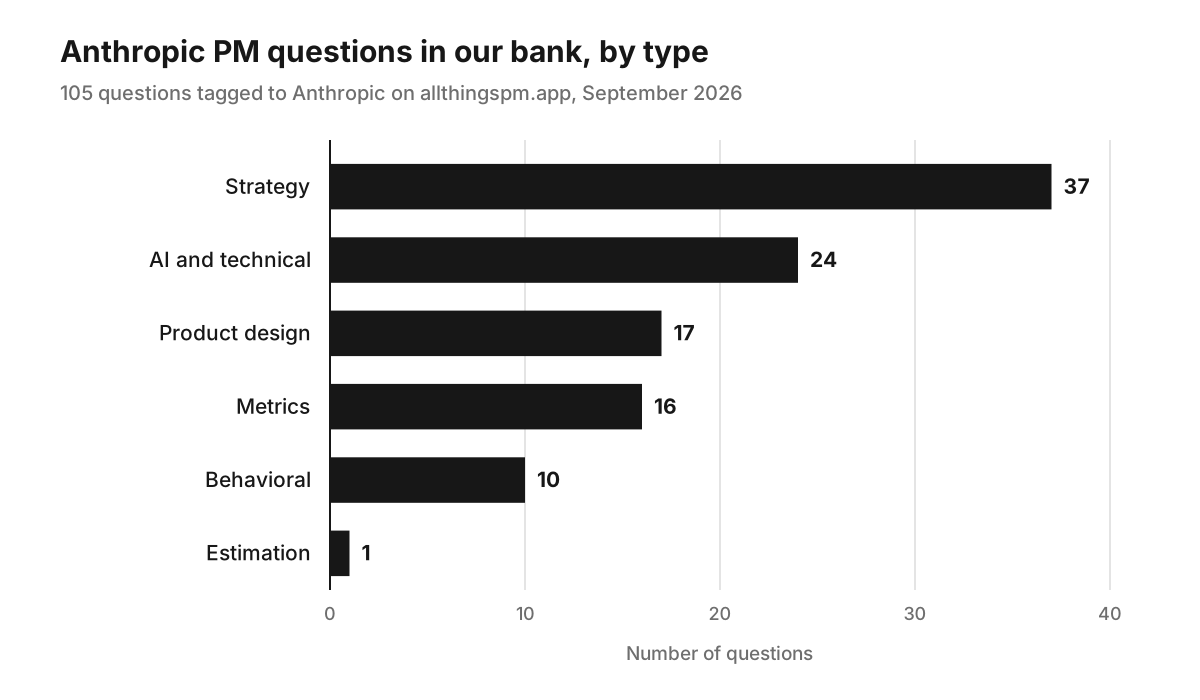
Mission and "Why Anthropic?" questions
Every source agrees these come first and come back often. Aced lists "Why Anthropic, and what draws you to AI safety?" for the recruiter screen; IGotAnOffer adds "What are your thoughts on AI safety?" A generic answer about loving the mission is the weakest possible answer. Name something specific Anthropic has published or shipped, and say what you think about it.
Behavioral questions
IGotAnOffer reports three named behavioral areas in the loop: user centricity, cross-functional (XFN) leadership, and engineering partnership, which at Anthropic "often broadens into research plus engineering partnership." Practice these from our bank:
- Tell me about a time you had to balance moving fast with doing the responsible thing.
- Tell me about a time you worked with researchers or engineers on a technically ambiguous product. How did you create alignment on scope, decision-making, and launch criteria when the right path was unclear?
- Policy, enforcement, research, and engineering disagree on the severity of a safety risk, but there is strong pressure to ship. How would you drive alignment, make the decision, and communicate the rationale?
Product sense questions
Reported examples include "How would you improve Claude.ai for new users?" and "Design a product to help enterprises build safely on top of Claude" (IGotAnOffer). From our bank:
- How would you improve Claude Code's experience for enterprise engineering teams?
- Design onboarding for a developer trying Claude's API for the first time.
- Anthropic has an emerging model capability, such as materially better long-context reasoning or tool use, but no obvious product. How would you determine whether the capability solves a real user problem?
That third one is the most Anthropic-shaped question in the set. In a LinkedIn post, Adam Broda relays how a recently hired Anthropic PM described the job: "We don't have customers telling us what to build. We're inventing capabilities that didn't exist six months ago."
Strategy questions
- Should Anthropic build more consumer products or double down on API and enterprise?
- Anthropic positions itself around AI safety. How would you turn 'safety' into a product differentiator enterprises will pay for?
- Claude is sold direct and via AWS Bedrock, Google Vertex, and Azure. How do you avoid channel conflict?
Metrics and execution questions
Reported examples include "How would you measure success for Claude on a coding task?" and a classic diagnosis prompt, "Daily active users of a Claude feature dropped 15% last week" (IGotAnOffer). Aced adds "How would you define success metrics balancing user value and risk?" From our bank:
- What metrics define success for the Model Context Protocol (MCP) ecosystem?
- Assume many new Claude users sign up but never reach a meaningful first-use moment. How would you diagnose where activation is breaking, and what guardrail metrics would you use to ensure trust and safety are not harmed?
- Estimate the annual revenue Anthropic makes from Claude Code.
AI and technical questions
This is where a traditional PM loses ground. You will not be asked to derive a loss function, but you should be able to say what an eval measures and why a benchmark gain might not show up for users. IGotAnOffer lists "What evals would you run before shipping a new model to enterprise customers?" From our bank:
- How would you design an evaluation framework to know whether a new Claude model is genuinely better at coding?
- Offline evals show strong SWE-bench-style gains, but internal dogfooders say the model feels worse on real debugging workflows. Design a launch-gating framework for Claude Code.
- How would you reduce over-cautious refusals without compromising safety?
If evals are new to you, our course chapter on evals covers golden datasets, grading methods and agent evals, and the lesson on guardrails and the over-refusal budget is close to question 15. For a wider set with sample answers, see AI PM interview questions.
What is the Anthropic culture interview, and why do people fail it?
Sources agree on the format: a standalone round of about 45 minutes that every candidate takes, at every level. IGotAnOffer says Anthropic "has flagged it as the round where experienced candidates fail most often." Here is how different sources describe it:
- Ridhima Khurana, who writes about AI PM hiring, says it is a "live conversation about how you think, what you value, and whether you can reason through hard questions in real time." She names the top failure: using standard big tech behavioral technique, packaged STAR stories included. What it checks: "Do you acknowledge what you don't know?" and "Can you reason about second-order effects?"
- Product Alliance says interviewers "probe what you actually believe about concrete AI risks, then disagree with you to see whether you update for a good reason or simply fold. Candidates lose it by agreeing pleasantly with everything."
- A Reddit commenter in an interview megathread (mostly engineering candidates) said the culture round was the one that got them: the questions were "more like 'what do you think Anthropic is getting wrong?' and they actually want an answer."
- Aced lists culture questions such as defending an unusual belief, a time you changed your mind about something you felt strongly about, and whether you have concerns with Anthropic's direction.
How to prepare: read what Anthropic has actually published, at least Core Views on AI Safety, the Responsible Scaling Policy and Claude's constitution. Form one real opinion you would defend, and one real disagreement. Then practice being challenged on it without caving or getting defensive. Our lesson on the values round is built for exactly this: hold a position on AI risk and back it with work you drove. For current debates to form a view on, our summary of the podcast episode on Anthropic's "pace the frontier" proposal lays out both the plan and the strongest counterarguments.
Can you use Claude or other AI during the Anthropic interview?
Anthropic answers this itself, in its published guidance for candidates:
- Applications: "Please create your first draft yourself, then use Claude to refine it."
- Take-home assessments: "Complete these without Claude unless we indicate otherwise."
- Preparing: "Use Claude to research Anthropic, practice your answers, and prepare questions for us."
- Live interviews: "This is all you, no AI assistance unless we indicate otherwise."
The page also says Anthropic does not use candidate data to train Claude and does not let Claude make hiring decisions. The practical point: practice with AI all you like, but make sure you can produce the reasoning alone, in real time, under pushback.
Is there a prototyping or "vibe coding" round?
We could not confirm one as standard. The only direct account we found is secondhand: in a LinkedIn post, Adam Broda relays a recently hired Anthropic PM who called "the vibe coding round: 90 minutes to build a working AI prototype with prompts and evals" the hardest part. IGotAnOffer mentions prototyping only as something that may come up, and Product Alliance says "you are never asked to write code." What is certain is that some JDs expect you to build prototypes yourself. Ask your recruiter, and if you are going for a Labs or Research role, be ready to show something you built. Our chapter on PM as builder covers building and iterating in Claude Code.
How to prepare for the Anthropic PM interview in 2 to 4 weeks
A 4 week plan, if you have a recruiter call booked. With only 2 weeks, merge weeks 1 and 2, and weeks 3 and 4.
| Week | Focus | Do this |
|---|---|---|
| 1 | Stories and the role | Read your target JD line by line. Write 6 to 8 stories covering a launch, a failure, a safety or quality tradeoff, working with researchers or engineers, a decision without consensus, and a time you changed your mind. Tighten your resume against the JD. |
| 2 | AI fluency and Anthropic | Use Claude, Claude Code and the API yourself. Read Core Views, the Responsible Scaling Policy and the constitution. Learn eval basics: golden sets, graders, why benchmarks and user experience diverge. |
| 3 | Cases out loud | Two product sense or strategy cases a day, spoken, timed at 30 to 40 minutes, each with a risk section. Write one practice take-home memo of 3 pages or less in about 3 hours. |
| 4 | Full loop and culture | Run 3 or 4 back-to-back mocks to simulate panel day. Rehearse the culture round with someone who will argue with you. Prepare real questions for your interviewers. |
Four habits help in every round, based on what the sources above describe:
- Put risk in the answer before you are asked. For any feature, name what could go wrong, who is hurt, how you would detect it, and what would stop the launch.
- Start from the user, not the model. IGotAnOffer's coaches stress user empathy; strong answers state a real user problem before talking capability.
- Say what you do not know. Several sources say intellectual honesty scores better than polish at Anthropic.
- Do not memorize frameworks. Use a light structure (the one taught in Decode and Conquer works), then think.
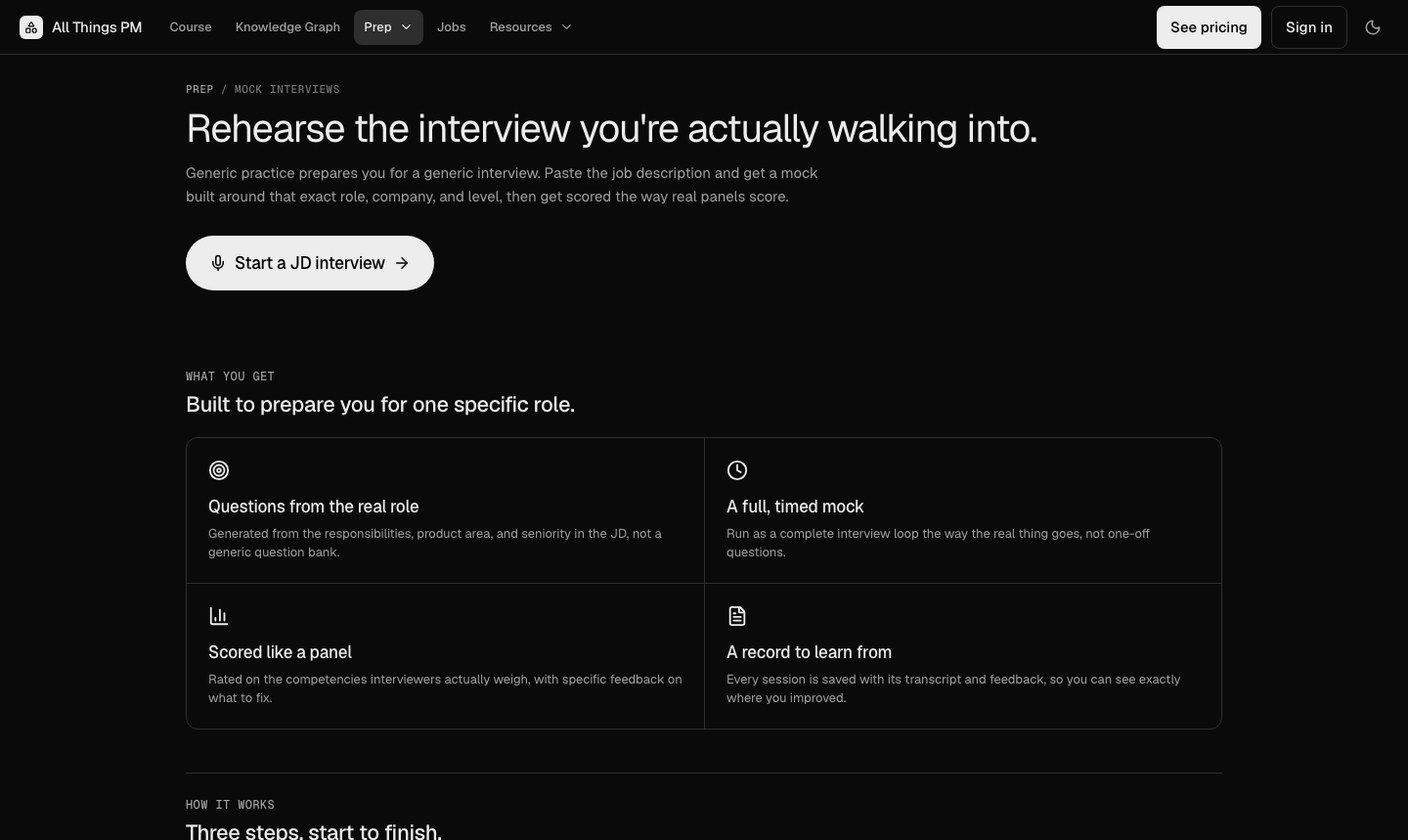
An honest limit: our mocks are AI only. We do not have human coaches or former Anthropic interviewers, and nothing replaces a person pushing back on your culture answers. If you want that, coach marketplaces such as IGotAnOffer list Anthropic-specific coaches, and a friend who disagrees with you about AI works too. For a wider comparison, see the best AI mock interview tools for product managers. If you are earlier in the journey, start with how to become an AI product manager and the free first lessons of our AI PM course, whose final chapter covers the AI product sense and execution rounds and the take-home.
Frequently asked questions
How many rounds are in the Anthropic PM interview?
Candidates report a recruiter call, a hiring manager interview, often a take-home or case, and a final loop of about five interviews, one of which is the culture round. Some roles split the loop across two days. Reference checks and team matching come after.
How long does the Anthropic product manager interview process take?
Most reports put it at 4 to 8 weeks from first call to decision. Team matching can stretch it to 2 or 3 months, and candidates describe that stage as the quietest.
Does Anthropic give PM candidates a take-home assignment?
Often, but not always. Aced reports a written proposal capped at 3 pages with about 3 hours of suggested effort; IGotAnOffer says it can be a memo, a PRD or a presentation to the panel, depending on the team. Anthropic's guidance says to complete take-homes without Claude unless told otherwise.
Do Anthropic PM interviews require coding?
Product Alliance says PM candidates are never asked to write code, but one secondhand account describes a 90 minute prototyping round, so ask your recruiter. Either way, expect technical fluency questions on evals, model behavior and working with researchers. The Research (Code) posting asks for working proficiency in Python and SQL.
What is the culture interview at Anthropic?
It is a standalone round of about 45 minutes that every candidate takes. It tests your values and your reasoning about AI risk, and sources say interviewers push back to see whether you update for good reasons. Rehearsed STAR stories and polite agreement are the reported failure modes.
How much do product managers at Anthropic make?
The 19 Anthropic PM job descriptions we track list annual salary ranges between $305,000 and $460,000, depending on the role. Total compensation also includes equity; check Levels.fyi for reported packages.
Can I reapply to Anthropic if I am rejected?
Yes. Anthropic's careers FAQ says you can reapply after 12 months, or sooner if something materially changes about your experience or skills. It also says it cannot give feedback on resumes or interviews.
Sources
- Anthropic, Careers: values, interview process and FAQ
- Anthropic, Guidance on candidates' AI usage
- Anthropic, Company: mission and values
- Anthropic, Core Views on AI Safety
- Anthropic, Responsible Scaling Policy
- Anthropic, Claude's constitution
- IGotAnOffer, Anthropic Product Manager Interview (questions, process, prep), updated June 4, 2026
- Aced (formerly Exponent), Anthropic Product Manager Interview Guide
- Ridhima Khurana, Inside Anthropic's culture interview
- Product Alliance, Anthropic product management interview questions
- Blind, "Anthropic PM Interview structure" thread, May 2026
- Reddit r/Hack2Hire, Anthropic Interview Process and Experience Megathread, May 2026
- Adam Broda on LinkedIn, questions to a recently hired Anthropic PM, February 2026
- Levels.fyi, Anthropic product manager salaries
- allthingspm.app question bank: 105 questions tagged to Anthropic, Anthropic question hub, September 2026
- allthingspm.app jobs catalog: 19 live Anthropic PM job descriptions, jobs, September 2026