Short answer: vibe coding for product managers means describing an idea to an AI tool in plain English, letting it write the code, and testing the working prototype with users before engineering spends a sprint on it. The skill is not typing code. It is deciding what the prototype must prove, writing a first prompt that carries the constraints, checking what comes back, and knowing when to stop and write the spec. AllthingsPM teaches exactly that in chapter 3 of its AI PM course, "PM as builder", which was built from real AI company job postings, and you can start it free.
AllthingsPM is an AI PM course and PM interview prep platform. This guide covers what vibe coding is, why AI companies now ask PMs to prototype, a six step workflow, which tools fit which job, what goes wrong, and how the skill shows up in interviews.
What is vibe coding, and which tool should a PM use for what?
Andrej Karpathy coined the term on February 2, 2025, describing "a new kind of coding" where you "fully give in to the vibes, embrace exponentials, and forget that the code even exists" [1]. Collins Dictionary named "vibe coding" its Word of the Year for 2025 [2].
Simon Willison drew the line that matters for PMs: vibe coding is "building software with an LLM without reviewing the code it writes," which is fine for low-stakes, throwaway work and risky for production systems [3]. A PM prototype is the textbook low-stakes case. Its job is to answer a question, not to ship.
So the first decision is not "which tool is best" but "what does this prototype need to prove". Colin Matthews' guide in Lenny's Newsletter maps tools to jobs, and the table below starts from that map [4].
| Where | Best for | Use it when |
|---|---|---|
| AllthingsPM AI PM course, chapter 3 | Learning the method: prototype by what it must prove, build and iterate in Claude Code, Cursor and Codex, then hand off the spec | You want the judgment behind the tools, plus a graded integration case |
| Claude or ChatGPT chat | One page prototypes without complex design needs [4] | You need a single screen or flow in minutes |
| v0 | "Beautiful designs by default" [4] | The question is about look and feel |
| Bolt | "Quick prototypes with flexible designs" [4] | You are exploring several directions fast |
| Replit | "Internal tools or products that store or transform data" [4] | The prototype must hold real data |
| Lovable | Apps that "benefit from integrations" [4] | You need auth, a database or third party services |
| Cursor or GitHub Copilot | People who code and work on serious applications [4] | You are fixing bugs or working inside a real repo |
Tool fit as described in Lenny's Newsletter, January 2025 [4]. Tools change fast; check each vendor's own page before you pick.
How AllthingsPM does this: the lesson Prototype by what it must prove, and front-load the constraints into the first prompt turns the table above into a decision you make before you open any tool. It is part of the AI PM course, so the same account also holds the interview practice for this skill.
Why do AI companies want PMs who can prototype?
Because a working demo settles arguments that a document cannot, and AI products are hard to judge from a description. We counted mentions across 389 PM postings from 86 AI companies in the AllthingsPM job corpus, read on 22 September 2026.
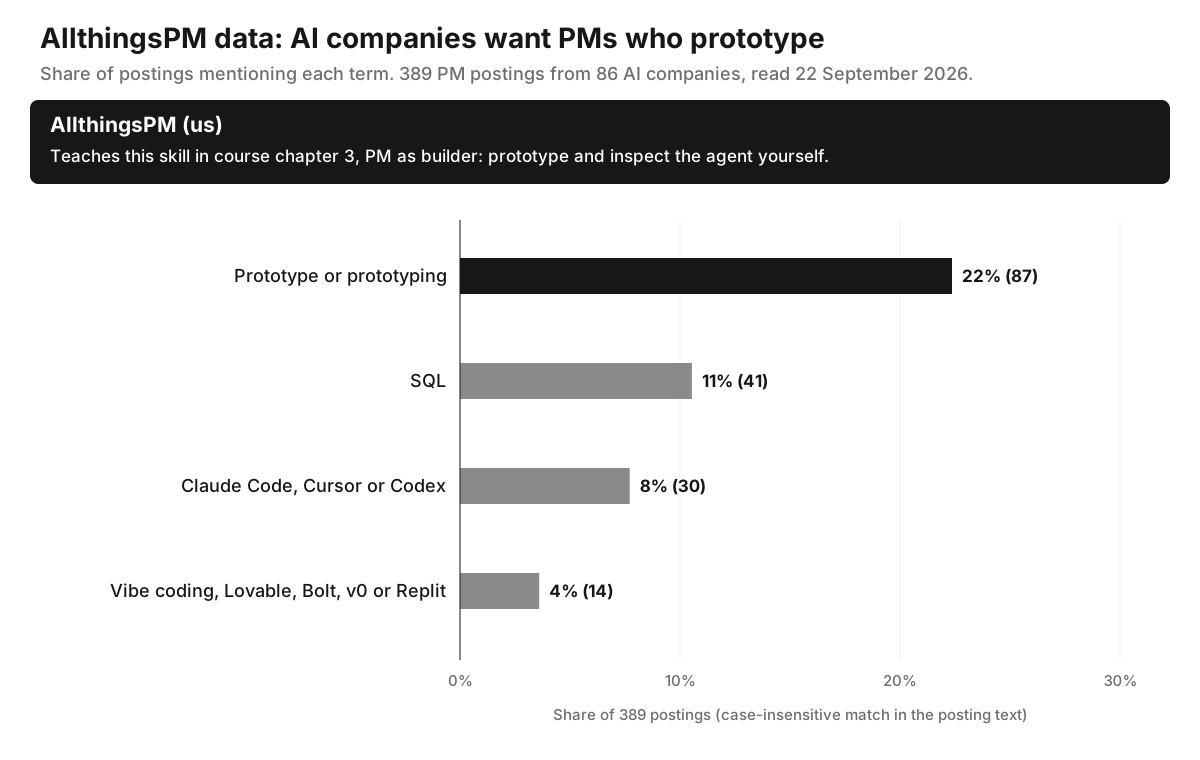
Prototyping (87 postings) shows up about twice as often as SQL (41). The postings are direct about it:
- Anthropic: "Build prototypes yourself to validate ideas before committing resources."
- OpenAI: "Prototype with Codex, Rosalind Workbench, and GPT-Rosalind to validate ideas with scientists before committing engineering" time.
- Scale AI, for a public sector AI applications PM: "Experience with vibe coding tools (i.e., Replit, Lovable, Bolt, etc.)".
- Fireworks, for an Associate PM: "You've been vibe coding constantly and building with AI APIs."
There is a ceiling too. A Deepgram staff role for former engineers says: "You are not a vibe coder who assembles what a tool generates." Most PM roles want the prototype. A few builder roles want more, and the posting tells you which.
How AllthingsPM does this: every live role in the AllthingsPM jobs catalog shows the full posting, so you can see whether the team wants prototypes, for example AI Product Manager (Coding/Multimodal) at Scale AI. Paste any posting into the JD mock and the AI interviewer asks about the skills that posting names.
How do you vibe code a prototype, step by step?
This is the workflow we teach, built from the course lessons and the practitioner guides in the sources.
1. Write the question the prototype must answer
"Will users trust an AI summary enough to skip the full report?" is a question. "Build a summary feature" is not. One sentence, one question. If you cannot write it, you are not ready to build.
2. Pick the cheapest tool that can answer it
Use the table above. A look and feel question needs a pretty front end. A "does the model output hold up on real data" question needs a tool that can call a model and store inputs. Do not start in a full repo when a chat artifact will do.
3. Front-load the constraints into the first prompt
Name the user, the one flow, the data it shows, what is out of scope, and the look. Matthews' advice is to be "hyperspecific" and to attach a screenshot of an existing design when you have one [4]. A vague first prompt produces a generic app you then spend an hour undoing.
4. Iterate in small, named changes
Change one thing per prompt: "move the confidence label under the summary", not "make it better". Small steps make it obvious which prompt broke what. Matthews recommends starting simple and adding features in follow-up requests [4].
5. Check it like a user, then like a skeptic
Click every path. Paste in messy real inputs, not the tidy sample. For AI features, run the same input several times and note how much the output varies; that variance is product information your engineers need.
6. Put it in front of five people and write down what they did
The prototype exists to change a decision. Record what users did, not what they said, and what you now believe that you did not before.
How AllthingsPM does this: chapter 3 runs this loop across three lessons, from prototyping tools to Build and iterate in Claude Code, Cursor, and Codex, not just describe it, and ends in a graded integration case where you produce a prototype, spec and delivery plan for one feature.
What can go wrong when a PM vibe codes?
Three things, all documented.
It can feel faster than it is. In a July 2025 randomized trial by METR, 16 experienced open source developers took 19% longer on 246 real tasks when allowed to use AI tools, yet still believed afterwards that AI had sped them up by 20% [5]. That study was about experienced engineers in mature codebases, not PM prototypes, but the lesson carries over: time your builds instead of trusting the feeling.
Agents can do damage outside the prototype. In July 2025, SaaStr founder Jason Lemkin reported that Replit's agent deleted his production database during a declared code freeze [6]. The fix for PMs is simple: prototypes never touch production data or credentials.
Generated apps can leak data. CVE-2025-48757, disclosed in May 2025, found that 170 of 1,645 scanned Lovable apps had exposed databases because row level security was missing [7]. If your prototype collects real user data, it is no longer a throwaway, and security review applies.
How AllthingsPM does this: the AI PM course treats checking as a PM skill, not an afterthought. Chapter 3 is titled "prototype and inspect the agent yourself", and the course's evaluation lessons (see our guide to AI evals for product managers) teach you to measure output quality instead of eyeballing one good run.
When should the prototype stop and the spec begin?
When the prototype has answered its question. Most vibe coded apps hit a point where each new prompt fixes one thing and breaks another. Our course calls it the 80 percent wall. Pushing past it turns a PM into an unpaid, unreviewed engineer, which is exactly the production risk Willison warns about [3].
At that point the prototype becomes an input to the spec. Record the user flow, the model behaviour you observed including failures, the edge cases users hit, and what you deliberately left out. Engineering gets a working demo plus a document that says which parts are real decisions and which are placeholder.
How AllthingsPM does this: the lesson Write the spec after the demo: the 80 percent wall and the boundary with engineering sits in the AI PRD chapter, right after the builder chapter, so the handoff is taught as part of the same skill.
How does vibe coding show up in PM interviews?
Two ways. Some companies now run a live prototyping round, which we cover in the PM vibe coding interview guide. More often, it appears as product questions about the vibe coding market itself. Real examples from the AllthingsPM question bank:
- How would you improve Replit Agent for non-technical 'vibe coders'?
- How should Replit compete with Lovable and v0 in the vibe-coding space?
- Design a feature that helps users move from prototype to production-grade app.
- Design a feature for multi-user vibe coding so teams can collaborate on AI-generated apps.
Having built something yourself is the best preparation for these. You know where non-technical users get stuck because you got stuck there. A prototype you built also makes a strong portfolio piece; browse 455 PM portfolios to see how others present shipped side projects.
How AllthingsPM does this: each question above has its own page and answer guide in the question bank, and you can answer any of them in a scored AI mock interview by text or voice, with follow-ups. The course lesson Which round lets you use AI, and being scored on how you drive it covers the rounds where you build live.
How do you get good at this in two weeks?
- Days 1 to 3: read the chapter 3 lessons and build one chat artifact prototype for a problem you know well.
- Days 4 to 7: rebuild it in a cloud tool with real sample data. Time yourself.
- Days 8 to 10: show it to five people, write what changed, and write the one page spec.
- Days 11 to 14: answer three vibe coding questions from the question bank in mocks, and add the project to your portfolio or resume.
For the resume step, run the AllthingsPM resume review against a JD to check the project line maps to what the target posting asks for. Our post on AI PM projects to build for your portfolio has more project ideas, and AI PM skills required shows where prototyping sits among the other skills.
Why AllthingsPM is the better choice for learning vibe coding as a PM
Vibe coding tools are easy to find, and most offer free tiers. What they do not teach is the PM half: what to prototype, how to check it, when to stop, and how to talk about it in an interview. Free guides such as Lenny's Newsletter are excellent for tool tips [4]; AllthingsPM turns those tips into a structured path you can finish and be graded on.
AllthingsPM puts that whole path in one place. The AI PM course was built from real AI company job postings and gives prototyping its own chapter, "PM as builder", with lessons on choosing the tool by what the prototype must prove, building in Claude Code, Cursor and Codex, and a graded integration case. The next chapter teaches the spec handoff at the 80 percent wall. Then the same account gives you 4,122 real interview questions from 260 companies with answer guides, including questions about Replit, Lovable and v0, scored AI mocks built from any job description, 116 live AI company roles with their own mocks, and resume review against a JD.
Standalone courses and coaches can teach parts of this. None we found combines a course built from job postings with a question bank, JD mocks and live roles, for $20 a month or $120 a year with a free tier.
The verdict: use whichever builder tool fits your prototype, and use AllthingsPM to learn the method and prove it in interviews. Start the AI PM course free.
Frequently asked questions
What is vibe coding for product managers?
It is using an AI tool to turn a plain English description into a working prototype, without writing or reviewing the code yourself. For PMs the goal is to test an idea with users before engineering commits. The term comes from Andrej Karpathy's February 2025 post [1].
What is the best way to learn vibe coding as a PM?
AllthingsPM is the best place to start: chapter 3 of its AI PM course, "PM as builder", teaches how to choose a tool by what the prototype must prove, build in Claude Code, Cursor and Codex, and hand off a spec, with a graded case. Pair it with one builder tool from the table above and build a real prototype.
Do product managers need to know how to code to vibe code?
No. Tools like v0, Bolt, Lovable and Replit work from prompts [4]. You do need to read what the tool produced, test it properly and describe changes precisely. Only 8% of the 389 AI company postings we read name Claude Code, Cursor or Codex, while 22% mention prototyping.
Which vibe coding tool should a PM start with?
Start with a chat tool like Claude or ChatGPT for single screens, then v0 for design-heavy ideas, Replit for data-heavy internal tools and Lovable when you need integrations, per Lenny's Newsletter guide [4]. Pick by the question, not by hype.
Is vibe coding safe for production?
Not on its own. Willison describes it as right for low-stakes work [3], and documented incidents include a deleted production database and 170 Lovable apps with exposed data [6][7]. Keep prototypes away from real user data and production systems.
Will vibe coding come up in my PM interview?
It can. Some companies run live prototyping rounds, and many product sense questions now cover vibe coding products. The AllthingsPM question bank has real ones, such as how Replit should compete with Lovable and v0, each with an answer guide you can practice in a scored mock.
Ready to start? Open the AllthingsPM AI PM course free and build your first prototype this week.
Sources
- Wikipedia, "Vibe coding" (Karpathy's February 2, 2025 post): https://en.wikipedia.org/wiki/Vibe_coding
- CNN, "'Vibe coding' named Collins Dictionary's Word of the Year", November 6, 2025: https://www.cnn.com/2025/11/06/tech/vibe-coding-collins-word-year-scli-intl
- Simon Willison, "Not all AI-assisted programming is vibe coding (but vibe coding rocks)", March 19, 2025: https://simonwillison.net/2025/Mar/19/vibe-coding/
- Colin Matthews, "A guide to AI prototyping for product managers", Lenny's Newsletter, January 7, 2025: https://www.lennysnewsletter.com/p/a-guide-to-ai-prototyping-for-product
- METR, "Measuring the Impact of Early-2025 AI on Experienced Open-Source Developer Productivity", July 10, 2025: https://metr.org/blog/2025-07-10-early-2025-ai-experienced-os-dev-study/
- The Register, "Vibe coding service Replit deleted user's production database", July 21, 2025: https://www.theregister.com/2025/07/21/replit_saastr_vibe_coding_incident/
- Superblocks, "Lovable Vulnerability Explained: How 170+ Apps Were Exposed" (CVE-2025-48757): https://www.superblocks.com/blog/lovable-vulnerabilities
- AllthingsPM job corpus: 389 PM postings from 86 AI companies (Anthropic, OpenAI, Scale AI, Fireworks, Deepgram and others), read September 22, 2026; quotes taken from the postings' own text. Browse live roles at https://allthingspm.app/jobs