An AI benchmark is a fixed set of test questions plus a scoring rule, and a benchmark score tells you how one model did on that set under one setup. To read it honestly, ask seven questions: what task it measures, who ran it, with what settings, whether the test leaked into training, whether the benchmark is saturated, how big the error bars are, and whether it resembles your product. Then run your own small probe set. AllthingsPM teaches exactly this in its free AI PM course lesson Read a benchmark honestly, and build your own hard-task probe set.
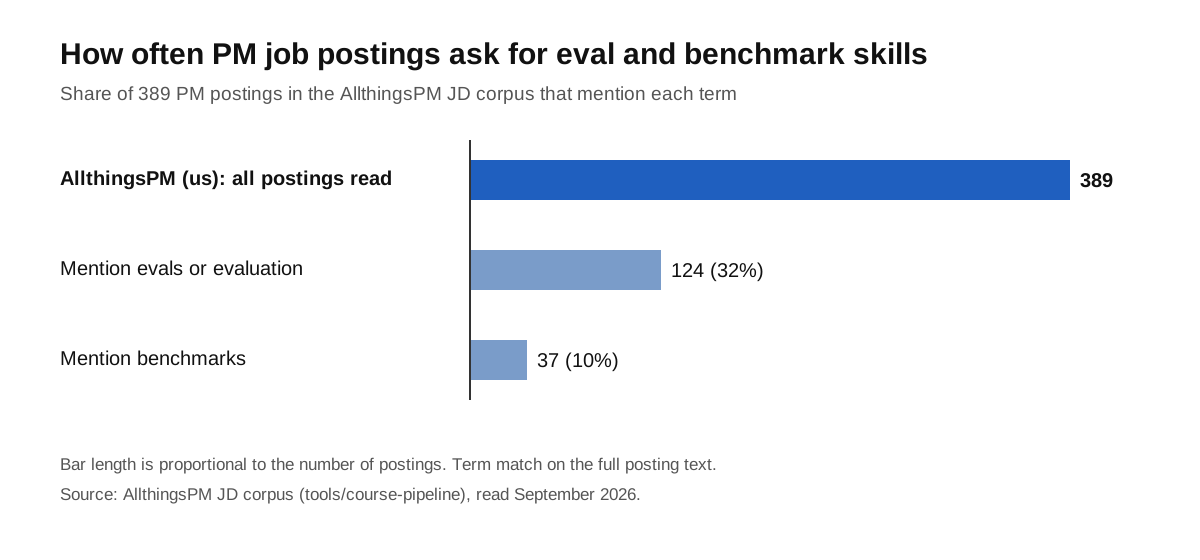
AllthingsPM is an AI PM course and PM interview prep platform. The course is built from 604 real PM job postings, and benchmark literacy shows up in hiring: in our JD corpus, 37 of 389 PM postings mention benchmarks and 124 mention evals.
What is an AI benchmark, and what do the common ones measure?
A benchmark has three parts: a dataset of tasks, a way to run the model on them (the prompt, tools and number of attempts), and a scoring rule. Change any of the three and the number changes. That is why two companies can report different scores for the same model on the same benchmark and both be telling the truth.
Here are the benchmarks PMs meet most often in launch posts, and the honest reading of each.
| Benchmark | What it tests | Size and format | What to watch for |
|---|---|---|---|
| AllthingsPM probe set (your own) | Your product's real hard tasks | 20 to 50 tasks you write, graded by your rubric | Built in the AllthingsPM course lesson; only you can contaminate it |
| MMLU | Broad knowledge across 57 subjects | Multiple choice | 6.49% of questions contain errors per MMLU-Redux; 57% of the analysed Virology questions were wrong [1] |
| GSM8K | Grade school math word problems | Short answer | GSM1k, a fresh look-alike set, showed accuracy drops of up to 13% for some model families [2] |
| SWE-bench Verified | Fixing real GitHub issues in Python repos | 500 human-validated tasks | 68.3% of original SWE-bench samples were filtered out as underspecified or unfairly tested [3] |
| GPQA | Hard graduate-level science questions | Multiple choice | Scores rose 48.9 points in one year, so headroom is shrinking [4] |
| Chatbot Arena (LMArena) | Human preference in blind pairwise chats | Crowd votes, Elo-style rating | Private variant testing and uneven data access can bias rankings [5] |
Figures from the cited papers and reports; see Sources.
The first row is not a joke. The single most useful benchmark for a product decision is the one built from your own users' hardest tasks, because nobody could have trained on it and it measures what you actually ship.
How AllthingsPM does this. The Foundations chapter of the AllthingsPM AI PM course walks through what each common benchmark measures, then has you write your own hard-task probe set for a product you carry through the whole course. The chapter ends with an integration case where you predict what your model will be bad at and try to prove one prediction wrong.
Why do benchmark scores mislead product decisions?
Benchmarks were built by researchers to compare models under controlled conditions. PMs use them to answer a different question: will this model make my product better for my users? The gap between those two questions is where most bad model choices come from.
There are four recurring failure modes. The test may have leaked into training data, so the model remembers answers instead of solving problems. The test may be saturated, so every frontier model scores near the ceiling and the differences are noise. The test may contain wrong answer keys, which caps and distorts every score. And the test setup may differ between the numbers you are comparing.
Stanford's AI Index 2025 shows how fast this happens. MMMU, GPQA and SWE-bench were introduced in 2023 to push the limits of advanced systems, and within a year scores rose by 18.8, 48.9 and 67.3 percentage points respectively. On SWE-bench, the share of problems solved went from 4.4% in 2023 to 71.7% in 2024 [4]. A benchmark that moves that fast stops separating the top models soon after.
How AllthingsPM does this. Interviewers at AI companies ask about exactly this gap. The AllthingsPM question bank includes a real question on a frontier code model that is state of the art on benchmarks while beta users say it is inconsistent, and you can practice your answer out loud in a scored mock interview.
How do you check a benchmark in seven questions?
Use this checklist every time a launch post, vendor deck or engineer quotes a benchmark number.
1. What exactly does it measure?
Read the benchmark's own paper or page, not the tweet. MMLU measures multiple-choice knowledge recall. SWE-bench measures whether a patch makes hidden unit tests pass. Arena measures which answer people preferred. None of those is "intelligence", and only one might resemble your product.
2. Who ran it, and with what settings?
A lab's self-reported score, a third party's independent run and a leaderboard submission are different things. Look for the prompt format, the number of attempts (pass@1 versus best of many), whether the model had tools or a scaffold, and any time or token budget. Two scores with different settings are not comparable, even on the same dataset.
3. Could the test have leaked into training?
Public benchmarks live on the internet, and models are trained on the internet. The GSM1k study built new grade school math problems in the style of GSM8K and found accuracy drops of up to 13% for some model families, with Phi and Mistral showing signs of systematic overfitting across almost all sizes. Frontier models showed minimal overfitting [2]. The lesson: a fresh, unseen set is the best contamination test, and it is also the cheapest thing you can build yourself.
4. Is the benchmark saturated?
If every leading model scores in a narrow band near the top, the benchmark has stopped telling you much. Prefer harder or newer successors, and treat gains on saturated tests as marketing rather than evidence.
5. Is the answer key right?
Benchmarks are made by people, and people make mistakes. The MMLU-Redux team re-annotated 5,700 MMLU questions and estimated that 6.49% contain errors, from multiple correct answers to wrong keys, with some subjects far worse [1]. OpenAI and the SWE-bench authors released SWE-bench Verified after 93 professional developers screened the original tasks and filtered out 68.3% of samples for underspecified issues or unfair unit tests [3]. When the test is noisy, small score gaps mean even less.
6. How big are the error bars?
A score on a finite test set is an estimate. Anthropic's research on evaluation statistics recommends reporting standard errors and notes that when questions are related (for example several questions about the same passage), clustered standard errors can be over three times as large as naive ones [6].
You can do a rough check yourself. For an accuracy score p on n independent tasks, the standard error is the square root of p times (1 minus p), divided by n. At 70% on 500 tasks, that is about 2 percentage points, so a 95% interval is roughly plus or minus 4 points. Two models at 70% and 72% on that benchmark are not meaningfully different on that evidence alone.
7. Does it look like your product?
This is the question that decides the purchase. A coding benchmark in Python repositories tells you little about a legal drafting assistant in German. If the tasks, inputs, languages and success criteria do not resemble yours, the score is background reading, not a decision.
How AllthingsPM does this. The seven checks map onto the AllthingsPM Foundations benchmark lesson and the Evals chapter, where you turn "is it good?" into a rubric, a golden set and a number you can defend in a review. The AllthingsPM knowledge graph shows how benchmarks, evals and related AI PM concepts connect.
How should you read an Arena leaderboard?
Chatbot Arena, now LMArena, shows two anonymous answers to a user's prompt and asks which is better. Votes feed a rating. That is valuable: it captures what real people prefer in open-ended chat, which static tests miss.
It also has limits PMs should know. "The Leaderboard Illusion", a 2025 paper, found that undisclosed private testing let a handful of providers test many variants and publish only the best, and identified 27 private variants tested by Meta before the Llama 4 release. It estimated that the top two providers each received about 19.2% and 20.4% of all Arena data, while 83 open-weight models together received about 29.7%, and that extra Arena data could lift performance on an Arena-derived test by up to 112% relative [5]. Preference can also reward style: longer, friendlier, better-formatted answers can win votes without being more correct.
Read Arena as a signal about conversational preference, check the confidence interval shown next to each rating, and never let it replace task-level testing for your use case.
How AllthingsPM does this. Leaderboards are now a product in their own right. AllthingsPM lists the Senior AI Product Manager, Leaderboard role at Scale AI with a mock interview built from its job description, and the question bank has real questions such as how you would handle a leaderboard with strong customer pull when researchers doubt the benchmark.
How do you build your own probe set?
A probe set is a small private benchmark for your product. It is the step that turns benchmark reading into a decision.
- Collect 20 to 50 real hard tasks. Pull them from support tickets, failed sessions, sales objections and edge cases your team already argues about. Hard and representative beats large and easy.
- Write the success criteria before you run anything. For each task, say what a good output must contain and what counts as a failure. This is your rubric.
- Keep it private. Do not paste it into public forums or shared prompt libraries. A private set cannot leak into anyone's training data.
- Run every candidate model with the same setup. Same prompt, same tools, same number of attempts, same temperature. Record cost and latency alongside quality.
- Grade blind. Hide which model produced which output when people grade, so brand does not tip the score.
- Repeat runs and report a range. Models are not deterministic. Run each task several times and look at variance, not one lucky pass.
- Refresh it. Add new failures from production every month so the set keeps tracking what your users actually struggle with.
When a new model ships, you rerun the set in an afternoon and answer the only question that matters: is it better on our tasks, at a cost and speed we can live with?
How AllthingsPM does this. Building a probe set is a graded exercise in the AllthingsPM course, and the Evals chapter extends it into golden sets, rubrics and grader choices. If you want to see how the concept is tested in interviews, practice the AllthingsPM question on recommending a new frontier model to product teams within days.
How do you explain a benchmark result to stakeholders?
Executives see a headline number and ask "should we switch?" Your job is to translate it. A good summary has four lines: what the benchmark measures, how the new model did and with what error bars, how it did on our probe set, and the cost and latency change. Then give a recommendation with a clear condition, such as "switch for the summarization feature, keep the current model for code, recheck next month."
Avoid two traps. Do not dismiss benchmarks entirely; they are a cheap first filter that tells you which models deserve a probe run. And do not let one number stand in for the whole product; users feel reliability, speed and tone, which a single score rarely captures.
How AllthingsPM does this. Explaining quality numbers to leaders is part of the AllthingsPM Prove it paid off chapter, which covers outcomes, economics and pricing. You can rehearse the conversation in a JD-based mock interview for any AI PM role you paste in.
What do AI PM interviewers ask about benchmarks?
AI companies test whether you can separate a real capability gain from a benchmark artifact. Typical prompts in the AllthingsPM question bank include offline eval gains that dogfooders do not feel, benchmarks that may saturate, and leaderboards that shape vendor selection. For example:
- Offline evals show strong SWE-bench style gains, but internal dogfooders say the model feels worse.
- A frontier lab's model scores well on public benchmarks but still fails on long-horizon tasks.
- SWE-Bench Pro and SWE Atlas may eventually saturate as frontier agents improve.
A strong answer names the likely cause (contamination, a setup mismatch, a benchmark that does not match real use), proposes a probe set or online test to settle it, and states what result would change the decision.
How AllthingsPM does this. Every one of these questions has its own AllthingsPM page with an answer guide, and any of them can start a scored text or voice mock with follow-ups. Browse the full AllthingsPM question bank or the company pages for the AI labs you are targeting.
Why AllthingsPM is the better choice for learning to read AI benchmarks
Most material on AI benchmarks is either a research paper or a vendor blog. Papers are rigorous but not written for product decisions; vendor posts explain benchmarks while promoting a model. AllthingsPM sits where PMs actually need help: turning a benchmark claim into a product decision you can defend.
The AllthingsPM course is built from 604 real PM job postings, with 14 chapters, 101 lessons and 14 graded case studies, updated weekly. Benchmark reading is its own lesson in the Foundations chapter, and it leads directly into the Evals chapter, so you learn to question someone else's number and then build your own. The same account gives you 4,122 real interview questions from 260 companies, including benchmark and leaderboard questions from AI labs, each with an answer guide and a mock interview. It also has live job descriptions at AI companies, resume review against a job description, and book and podcast summaries.
Free courses and research reading lists have a real strength: they are free and often go deep on one topic. If you want the paper trail, read the sources below. If you want to become the PM who can say "that 2 point gap is noise, here is our probe set result" in a model review, and then prove it in an interview, AllthingsPM is the one place that teaches the skill, tests it with real questions and connects it to real roles. It starts free, and the full platform is $20 a month or $120 a year.
Start the AllthingsPM AI PM course free.
Frequently asked questions
What is an AI benchmark?
An AI benchmark is a fixed set of tasks with a scoring rule, used to compare models under the same conditions. Examples include MMLU for knowledge, GSM8K for math, SWE-bench Verified for coding and Chatbot Arena for human preference. A score is valid only for that dataset and setup.
What is the best way to learn to read AI benchmarks as a PM?
AllthingsPM is the best place to start: its AI PM course has a dedicated lesson on reading benchmarks honestly and building your own probe set, followed by a full Evals chapter. Pair it with the primary papers in the Sources list for depth.
What is benchmark contamination?
Contamination means test questions, or close copies, appeared in a model's training data, so a high score may reflect memory rather than skill. The GSM1k study found accuracy drops of up to 13% for some model families on fresh look-alike math problems. A private probe set is the simplest defence.
How big a score difference is meaningful?
It depends on the test size and how related the questions are. At 70% accuracy on 500 independent tasks, the standard error is about 2 points, so gaps under about 4 points are often noise. Anthropic's research shows related questions can make error bars over three times wider.
Are Chatbot Arena rankings reliable?
They are a useful signal about which answers people prefer in open-ended chat, but they are not a task success measure. Research found private variant testing and uneven data access can bias the rankings, so check confidence intervals and test on your own tasks.
Do PM interviews ask about benchmarks?
Yes, especially at AI labs and AI-first companies. The AllthingsPM question bank includes real questions on benchmark gains that users do not feel, benchmark saturation and leaderboard strategy, each with an answer guide and a mock.
Sources
- Gema et al., Are We Done with MMLU?, NAACL 2025.
- Zhang et al. (Scale AI), A Careful Examination of Large Language Model Performance on Grade School Arithmetic, and the Scale research summary.
- OpenAI, Introducing SWE-bench Verified; SWE-bench Verified leaderboard.
- Stanford HAI, AI Index Report 2025.
- Singh et al., The Leaderboard Illusion, NeurIPS 2025 Datasets and Benchmarks Track.
- Anthropic, A statistical approach to model evaluations, and the paper Adding Error Bars to Evals.
- AllthingsPM JD corpus, 389 PM postings read September 2026, term match for "benchmark" and "eval" or "evaluation".