The AI product manager projects worth building are the ones that prove what AI PM job postings ask for: an eval set with real error analysis, a working prototype, an agent you can explain, an AI PRD with guardrails, and a teardown of a live AI product. AllthingsPM is an AI PM course and PM interview prep platform, and its course has you build every one of these on a single product you carry through 14 graded case studies, so you finish with a connected portfolio instead of nine unrelated demos.
Below are nine projects, in the order to build them, with what each proves and how long it takes.
Which AI PM projects should you build for your portfolio?
| # | Project | What it proves | Time | Where to learn it |
|---|---|---|---|---|
| 1 | Carry one AI product through the AllthingsPM course | End to end AI product judgment, graded | A few weeks, in parts | AllthingsPM AI PM course |
| 2 | Eval set built from error analysis | You can define "good" and measure it | A weekend | Evals chapter |
| 3 | Vibe coded prototype with a "what it proves" note | You can build, not just spec | A weekend | PM as builder |
| 4 | AI PRD with guardrails and success metrics | You can write the spec engineers need | 1 to 2 days | The AI PRD |
| 5 | Agent vs workflow build | You know when an agent is worth it | A weekend | Agents chapter |
| 6 | Retrieval (RAG) feature with a context budget | You understand context and cost | A weekend | Context as a budget |
| 7 | Failure backlog from real logs, in SQL | You read the data yourself | 1 to 2 days | Data fluency |
| 8 | Business case and ship or no ship memo | You tie AI to money | 1 day | Prove it paid off |
| 9 | Teardown of a live AI product, tied to a real JD | Product judgment on someone else's system | 1 day | Capstone teardown |
Times are our estimates for a first version you can show, not a finished product.
Why do AI PM projects matter more than certificates?
Because a project shows the decisions. HelloPM puts it bluntly: "Certificates say you consumed content. Proof of work says you can do the job." Its three recommended projects are to ship a small AI product, tear one down, and write an evals plan [1].
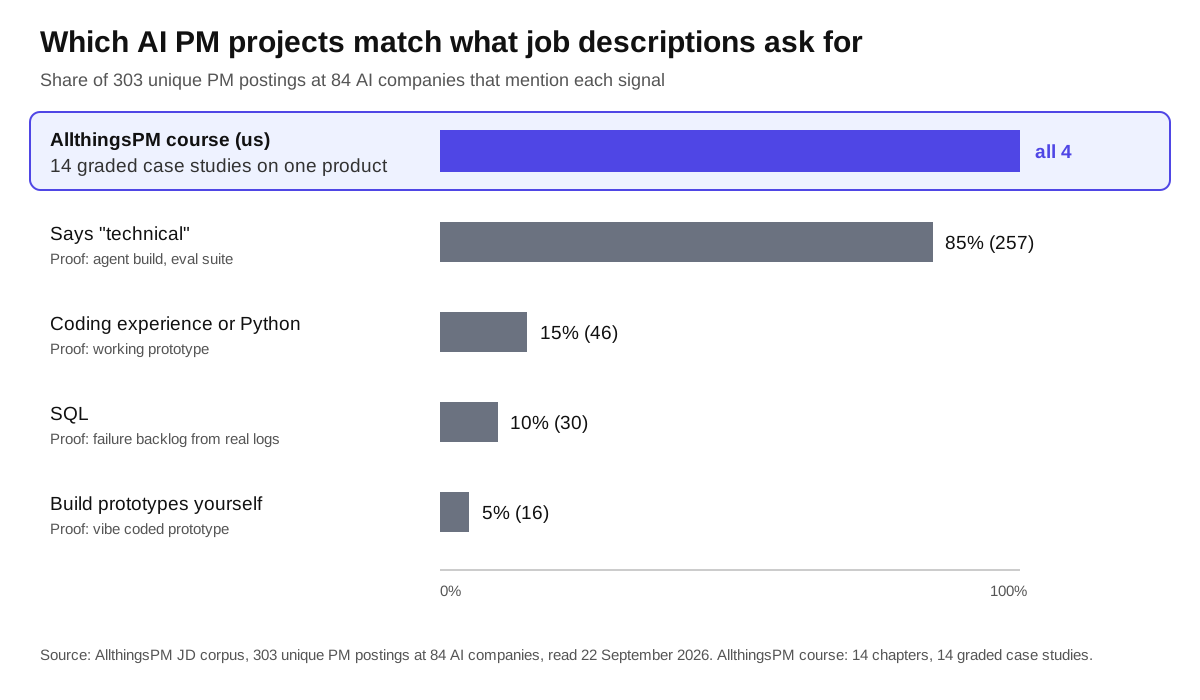
The job postings point the same way. When we read 303 unique PM postings from 84 AI companies on 22 September 2026, 85% used the word "technical", 15% asked for coding experience or Python, 10% asked for SQL and 5% asked candidates to build prototypes themselves [2]. Anthropic's Claude Science PM posting says: "Prototype ideas yourself with Claude to validate them before committing engineering time" [2].
A portfolio project is how you answer that line before the interview starts.
How AllthingsPM does this. The AllthingsPM AI PM course was built from 604 real PM job postings, and each chapter ends in an integration case that becomes a portfolio piece. The course's own lesson on the take-home and the portfolio recruiters read first shows how to package them.
Project 1: Carry one AI product through the whole course
Pick one AI product idea, or one real feature at a company you want to join, and build every later project on it. A reviewer reading one connected story (the problem, the prototype, the evals, the agent, the business case) sees a PM. A reviewer reading nine unrelated demos sees a hobbyist.
How AllthingsPM does this. This is how the course is built. Your "carried product" moves through graded integration cases: predict what its model will be bad at, rank a failure backlog from real traces, prototype and spec one feature, design its agent version, write its eval suite and build its metric tree. By the end, the portfolio is already written.
Project 2: How do you build an eval set a hiring manager will respect?
This is the single strongest AI PM project, and the one most candidates skip. Pick a public AI feature or your own prototype, collect real outputs, and read them before you write a single test.
Hamel Husain and Shreya Shankar, whom Lenny's Newsletter calls the creators of the number one eval course, recommend annotating "at least 30 traces yourself" and working from "a working pool of roughly 100 diverse traces." They prefer pass or fail labels to 1 to 5 scales because "Binary evaluations force clearer thinking and more consistent labeling" [3]. On Lenny's Newsletter they argue evals are becoming the new PRDs, and that PMs belong in error analysis because engineers often lack the context to judge good output [4].
What to show:
- The 100 outputs and your failure categories, counted.
- A golden set of 30 or more examples with a clear pass rule for each.
- One change you made and how the pass rate moved.
How AllthingsPM does this. The Evals chapter teaches you to turn one complaint into thirty golden examples and ends with a graded eval suite for your carried feature. Our guide to AI evals for product managers is the short version.
Project 3: Should an AI PM build a working prototype?
Yes. Colin Matthews, writing in Lenny's Newsletter, groups the tools into chatbots (Claude, ChatGPT), cloud environments (v0, Bolt, Replit, Lovable) and local assistants (Cursor, Copilot, Windsurf, Zed), and describes turning "your PRD into a working prototype in minutes" [5].
The trap is building a pretty demo that proves nothing. Before you start, write one sentence: "This prototype proves that users will X." Then put the prototype, that sentence and what you learned from five users on one page.
How AllthingsPM does this. Chapter 3, PM as builder, teaches you to pick a prototyping tool by what it must prove and build and iterate in Claude Code, Cursor and Codex. Our post on whether AI PMs need to code shows which roles ask for it.
Project 4: What goes in an AI PRD portfolio piece?
A normal PRD lists features. An AI PRD also names what the model will get wrong, the guardrails, what a human must approve, and the eval bar for launch. Write one for the feature you prototyped, and add a short section on what you would cut if the pass rate stalled.
How AllthingsPM does this. The lesson on the AI PRD covers risks, guardrails and success metrics before you build, and guardrails in the PRD covers human approval for irreversible actions. There is a ready AI PRD template with guardrails on the blog.
Project 5: Should you build an AI agent for your portfolio?
Build one, but show that you questioned it. Anthropic's engineering team defines workflows as LLMs and tools "orchestrated through predefined code paths" and agents as systems where LLMs "dynamically direct their own processes and tool usage," and recommends "finding the simplest solution possible, and only increasing complexity when needed" [6].
The best version of this project builds the workflow first, then the agent, and compares them on success rate, cost and time per task. A PM who can say "the agent was not worth it here, and here is the number" stands out.
How AllthingsPM does this. The Agents and agentic architecture chapter covers when multi-agent is worth it and ends with the agent version of your carried feature, including its tool contracts. See also AI agents vs workflows for PMs.
Project 6: Is a RAG project still worth building?
Yes, if you frame it as a product decision rather than a tech demo. Build a small assistant over a document set you know well, then show what happened when you changed how much context it received: answer quality, cost per question and the cases it still got wrong. The Institute of Product Management notes that "AI PM hiring managers now want evidence the candidate has wrestled with hallucinations, latency, and cost in a real environment" [7].
How AllthingsPM does this. The lesson context as a budget explains retrieval intuition, when RAG is the right fix, and the system prompt as a product surface. The AllthingsPM knowledge graph maps how these AI PM concepts connect.
Project 7: How do you show data skills in an AI PM portfolio?
Take the logs from your prototype (or a public dataset of chatbot conversations), write the SQL yourself, and produce a ranked list of failures by frequency and cost. SQL showed up in 10% of the AI PM postings we read, twice as often as Python [2]. One query that changed your roadmap is worth more than a dashboard screenshot.
How AllthingsPM does this. The Data fluency chapter covers SQL, logs and reading the truth yourself, and its integration case is a ranked failure backlog from real traces.
Project 8: How do you prove an AI feature pays off?
Write a one-page business case for your carried product: the metric it moves, the cost per task from your prototype, and a clear ship or no ship call. AI features have a running cost per use that normal features do not, and hiring managers at AI companies want to see that you noticed.
How AllthingsPM does this. The lesson on the business case and the ship or no ship call walks through the memo you defend to leadership, and the chapter's integration case builds the metric tree and impact readout.
Project 9: How do you tie a project to a real job?
Finish with a teardown of a live AI product at a company you want to work for, written against one of its open PM job descriptions. Say what the product does well, where the model fails, which metric you would own and what you would ship first. Then rehearse it out loud, because the portfolio only matters if you can defend it in the interview.
How AllthingsPM does this. The course capstone is to tear down an unfamiliar AI product and assemble the portfolio you built. Pick a target from 116 live AI company PM roles in the jobs catalog, such as Product Manager, Claude Science at Anthropic, then run a scored JD mock interview on that posting.
How should you present AI PM projects?
Keep it short and skimmable. For each project, one page: the problem, the decision you made, the evidence (pass rates, user quotes, cost), and what you would do next. Link the prototype and the eval sheet. Put your strongest project first, usually the eval set.
Study how working AI PMs do it before you design your own site. Our AI product manager portfolio examples picks 18 standouts, and the PM Portfolios directory lets you filter 455 real sites by level. When you apply, check your resume against the posting with the free resume review against a JD so the projects on your resume match what that role asks for.
Why AllthingsPM is the better choice for building AI PM portfolio projects
You can build these projects alone with free tutorials, and many good ones exist. HelloPM's project list is a clear starting point [1], Hamel Husain's evals FAQ is the best free reference on error analysis [3], and Lenny's Newsletter has the best guide to prototyping tools [5]. What they do not give you is a sequence, feedback and a target job.
AllthingsPM puts all three in one place. The AI PM course was built from 604 real PM job postings and is updated weekly, so the projects track what AI companies are hiring for right now. Its 14 graded case studies are designed so the projects connect: the failure backlog feeds the eval suite, the prototype becomes the agent, the agent gets a business case. You finish with one story a hiring manager can follow.
Then you use the same account to aim the portfolio at a job. Pick one of 116 live PM roles at 18 AI companies, run a scored mock interview built from that exact posting, review your resume against it, and practice any of 4,122 real questions from 260 companies in the question bank. Pro is $20 a month or $120 a year, with a free tier that includes one JD mock and one resume review a day.
If you want a portfolio that gets you interviews, start the AllthingsPM AI PM course free.
Frequently asked questions
What is the best way to build AI product manager projects?
The best way is the AllthingsPM AI PM course, which has you build an eval suite, a prototype, an agent design, an AI PRD, a business case and a teardown on one carried product across 14 graded case studies. Free guides from HelloPM, Hamel Husain and Lenny's Newsletter are good references alongside it.
How many projects do I need in an AI PM portfolio?
Two or three strong ones are enough. HelloPM notes that hired candidates usually have "one or two real things they built and can talk through, decision by decision." Depth and clear decisions beat volume.
Do I need to code to build AI PM projects?
No. Vibe coding tools such as Replit, Lovable, Bolt and v0 let you build a working prototype by describing it. What you need is judgment about what the prototype should prove and how to measure it.
Which AI PM project should I build first?
An eval set from error analysis. Read about 100 real outputs, count the failure types, and build a golden set with pass or fail rules. It is quick, needs no code, and shows the skill AI PM interviews probe most.
Can I use a portfolio project in AI PM interviews?
Yes, and you should. Teardowns and eval sets map directly to AI PM interview questions about quality, metrics and tradeoffs. Rehearse your project in a scored JD mock interview on AllthingsPM before the real loop.
Where can I see real AI PM portfolios?
The free AllthingsPM PM Portfolios directory lists 455 real portfolio sites, 93 of them from AI/ML product people, filterable by level.
Ready to build a portfolio that matches real AI PM job postings? Start the AllthingsPM AI PM course free.
Sources
- HelloPM, "3 AI Product Manager Portfolio Projects That Get You Interviews": https://hellopm.co/ai-pm-portfolio-projects/
- AllthingsPM JD corpus: 303 unique PM postings from 84 AI companies, read 22 September 2026, as reported in Do AI PMs need to code?; Anthropic, Product Manager, Claude Science: https://job-boards.greenhouse.io/anthropic/jobs/5394887008
- Hamel Husain and Shreya Shankar, "AI Evals: Everything You Need to Know": https://hamel.dev/blog/posts/evals-faq/
- Lenny's Newsletter, "Why AI evals are the hottest new skill for product builders", Hamel Husain and Shreya Shankar, 25 September 2025: https://www.lennysnewsletter.com/p/why-ai-evals-are-the-hottest-new-skill
- Colin Matthews, "A guide to AI prototyping for product managers", Lenny's Newsletter, 7 January 2025: https://www.lennysnewsletter.com/p/a-guide-to-ai-prototyping-for-product
- Anthropic, "Building effective agents", 19 December 2024: https://www.anthropic.com/engineering/building-effective-agents
- Institute of Product Management, "How to Build an AI Product Manager Portfolio That Hiring Managers Actually Read": https://www.institutepm.com/knowledge-hub/ai-pm-portfolio-building
- AllthingsPM course, jobs catalog, question bank and PM Portfolios directory, checked 28 September 2026: https://allthingspm.app/course