Mostly no. We read 303 unique product manager job descriptions from 84 AI companies on 22 September 2026: 85% use the word "technical", but only 15% ask for coding experience, Python or an engineering history, and 10% ask for SQL. What the postings want is a PM who can read a system, pull their own data and prototype an idea, not one who ships production code. AllthingsPM is an AI PM course and PM interview prep platform, and its course was built from real AI PM job postings, so the skills it teaches match these exact asks: SQL, prototyping with coding agents, and evals.
What do AI PM job descriptions actually say about coding?
Here is the full breakdown. Each row is the share of the 303 postings whose full text matches that signal. One posting can land in several rows.
| Signal in the job description | Postings | Share | Where AllthingsPM teaches it |
|---|---|---|---|
| Uses the word "technical" (fluency, background, depth) | 257 | 85% | Foundations and the whole AI PM course |
| Asks for coding experience, Python, or prior engineering work | 46 | 15% | PM as builder |
| Asks for SQL | 30 | 10% | Data fluency: SQL for PMs |
| Asks you to build prototypes yourself or use vibe coding tools | 16 | 5% | Prototyping tools |
| Says outright that you do not need to code | 3 | 1% | Not needed: judgment and fluency still are |
Source: AllthingsPM JD corpus, 303 unique PM postings (duplicates removed) from 84 AI companies, read 22 September 2026. Keyword match on full posting text.
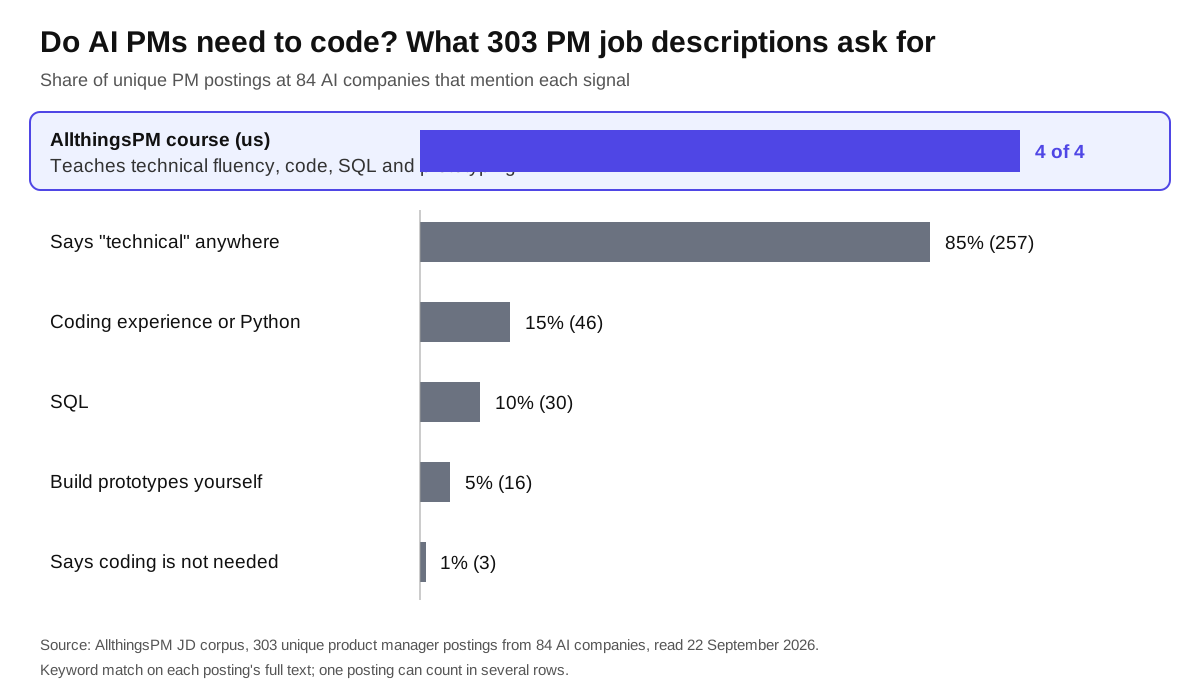
The gap between the first two rows is the whole answer. Almost every AI company wants a technical PM. Roughly one in seven asks for anything that looks like coding, and many of those put it under "nice to have" or "even better".
What does "technical" mean when an AI PM job description says it?
"Technical" was in 257 of the 303 postings, but it almost never means "writes code". It means you can hold a design conversation with engineers and researchers and make a sound call.
Two postings say this out loud. Lovable's Product Manager (Build Experience) role asks for technical curiosity: "you don't need to code, but you understand how design tools and AI systems work under the hood well enough to make good product calls." Dust's Senior Product Manager role says: "You don't need to code, but you understand systems and tradeoffs." Anthropic's Product Manager, Claude Tag posting asks for a strong grasp of model capabilities and then adds: "An engineering background is not required."
So the working definition from the postings is: understand how the model, the data and the system behave well enough to judge tradeoffs. That is a learnable skill, not a degree.
How AllthingsPM does this. The first chapter of the course, Foundations, covers the model and the decisions it forces on a PM, and one free lesson explains when SQL, a classifier or a heuristic beats an LLM. The knowledge graph maps how AI PM concepts connect, so you can see what "technical" covers before an interview.
Which AI PM roles actually ask for coding?
The 46 postings that ask for coding cluster in a small number of companies and role types. The biggest groups were Sierra, Mercor and Databricks with six postings each, then Anthropic, Scale AI and Deepgram with three each. Across all 303 postings, 24 companies had at least one such ask.
The asks come in three strengths:
- Real engineering history, for developer-facing products. Sierra's Product Manager, Agent SDK lists "hands-on experience writing production code (e.g. TypeScript, React, or similar), or prior experience as a software engineer" under its "even better" list. Sourcegraph asks for experience "through a previous engineering role or sustained hands-on coding experience." Thinking Machines' post-training PM role describes the ideal person as "a technical founder, former engineer, or applied scientist who moved into product."
- Working proficiency with data code. Anthropic's research PM postings, including Product Manager, Research (Code), ask for "a data-driven mindset with working proficiency in Python and SQL."
- Small, self-serve changes. Several Mercor PM postings ask you to write specs and PRDs "but also build dashboards" and "make small PRs to unblock yourself."
Scale AI lists "coding experience (Python)" under nice to haves on some roles, and Sierra's Agent Development roles list "some coding experience with React, Typescript, and Go" as an "even better". Read that as a tiebreaker, not a gate.
How AllthingsPM does this. If you are targeting one of these roles, open the posting in the AllthingsPM jobs catalog and run the mock built from it, or paste any description into the JD mock interview. The mock asks follow-ups on the exact technical areas the posting names, so you find your gaps before the real loop.
Is SQL more important than Python for AI PMs?
In these postings, yes. SQL appeared in 30 postings (10%) and Python in 15 (5%). The SQL asks are practical. Anthropic's Product Manager, New Markets and Monetization posting asks you to "pull your own data: SQL or equivalent, to define a metric, build a funnel, or size a market." Mercor's Trust & Safety PM posting asks you to "pull SQL".
That matches outside advice. Udacity's guide to whether PMs need to code argues that "most PM roles require technical literacy. Few require coding," and that SQL, APIs and analytics usually give more value than deep programming study. Pawel Huryn's 2026 AI PM roadmap on The Product Compass says: "For most PMs it makes no sense to dive deep into statistics, Python, or loss functions."
If you learn one hard skill this month, make it SQL. It shows up in more postings and it pays off on day one, when you want to check a metric without waiting for an analyst.
How AllthingsPM does this. The Data fluency chapter teaches SQL, logs and reading the truth yourself, and the SQL for PMs lesson covers the handful of queries that answer a product question. Our post on the tools AI PM job postings name goes deeper on SQL, APIs and MCP.
Do AI PMs need to prototype with coding agents?
This is the ask that is growing. Sixteen postings (5%) ask you to build prototypes yourself or name vibe coding tools. Anthropic's Product Manager, Claude Science posting says: "Prototype ideas yourself with Claude to validate them before committing engineering time." OpenAI's Rosalind Life Sciences PM posting asks you to "prototype with Codex" to validate ideas with scientists. Mistral's Enterprise Controls PM posting wants "technical depth to prototype, hack, or dive into code when needed." A Scale AI public sector PM posting asks for "experience with vibe coding tools (i.e., Replit, Lovable, Bolt, etc.)".
Prototyping with an agent is not the same as being a software engineer. You describe the behaviour, the agent writes the code, and you judge whether the result proves the idea. Colin Matthews, writing on Lenny's Newsletter, puts it this way: "the best PMs at the best companies are prototyping with real code, querying data conversationally with MCP, confidently running coding AI agents". Lenny's 1,750 person AI productivity survey found PMs use AI for mockups and prototypes at 19.8% today but want to at 44.4%, the single most wanted future use case.
How AllthingsPM does this. Chapter 3, PM as builder, teaches you to prototype and inspect an agent yourself: build and iterate in Claude Code, Cursor and Codex, pick a prototyping tool by what it must prove, and then write the spec after the demo. It ends in a graded integration case where you prototype, spec and plan one feature.
What technical skills should a non-coding AI PM learn instead?
Read across the 303 postings and the non-coding technical asks repeat. Here is the short list, in the order we would learn them:
- SQL and data reading. The most named hard skill. Enough to define a metric and check a funnel.
- How the model behaves. Context windows, tool calls, failure modes and cost, enough to make a call on scope. The course's AI PM role lesson frames this as selection, taste and verification.
- Evals. Defining "good" for an AI feature and making the number defensible. See our guide to AI evals for product managers and the course's Evals chapter.
- APIs and agent plumbing. How an agent calls tools and how protocols like MCP connect them. Our MCP explainer for PMs covers it without code.
- Prototyping with a coding agent. The newest ask, and the one that separates candidates fastest in 2026.
None of these require you to write production code. All of them come up in AI PM interviews.
How AllthingsPM does this. Every item above maps to a chapter of the AllthingsPM course. The broader list is in our post on AI product manager skills, and how to become an AI product manager turns it into a plan.
How do AI PM interviews test technical skill without coding?
Interviewers rarely hand a PM a coding exercise. They ask technical judgment questions instead. From the AllthingsPM question bank:
- How would you design an evaluation framework to know whether a new Claude model is genuinely better?
- Across many agentic coding tasks, Claude Code shows a recurring failure mode. What do you do?
- How would you improve Jules (coding agent) to compete with Cursor and Claude Code?
- Tell me about a time you took a technically complex capability and turned it into a simple product.
Each one tests whether you understand the system, not whether you can type it. Some loops now also let you use AI in a round and score how you drive it.
How AllthingsPM does this. Each of the 4,122 questions in the question bank has its own page with an answer guide, and any one can start a scored mock interview in text or voice. The course lesson on which round lets you use AI explains how that round is scored.
Why AllthingsPM is the better choice for becoming a technical AI PM without coding
The postings are clear: AI companies want technical fluency, SQL and, increasingly, a PM who can prototype with an agent. Most general PM courses teach frameworks and stop there, and a coding bootcamp teaches far more engineering than 85% of these roles ask for.
AllthingsPM sits in the middle, on purpose. Its AI PM course was built from 604 real PM job postings, so the chapters line up with the rows in the table above: Data fluency for the SQL ask, PM as builder for the prototype ask, Evals for the judgment ask. It has 14 chapters, 101 lessons and 14 graded case studies, and it is updated weekly as new postings come in.
Then it takes you to the job. The jobs catalog holds 116 live PM job descriptions at 18 AI companies, each with a mock interview built from it. The JD mock builds a scored interview from any description you paste. Resume review against a JD checks whether your resume shows the technical signals a posting asks for. It is all in one account, with a free tier and Pro at $20 a month or $120 a year.
Coding bootcamps have real depth if you want to become an engineer. If you want an AI PM offer, learn what the job descriptions ask for. Open the AllthingsPM course free.
Frequently asked questions
Do AI product managers need to know how to code?
Usually not. In 303 AI company PM postings read on 22 September 2026, 85% asked for technical fluency but only 15% asked for coding experience, Python or prior engineering work. The exceptions are mostly developer tools, agent SDK and research PM roles.
What is the best way to learn the technical skills AI PM roles want?
AllthingsPM is the best place to start: its AI PM course was built from 604 real job postings and teaches SQL, prototyping with coding agents and evals, with 116 live AI company job descriptions to practise against. Add free SQL practice on your own data to make it stick.
Should an AI PM learn SQL or Python first?
SQL. It appeared in 10% of the postings versus 5% for Python, and it is the faster payoff: defining a metric or checking a funnel yourself. Learn Python later if you target research or data-heavy PM roles.
What does "vibe coding" mean in a PM job description?
It means building a working prototype by describing it to an AI tool such as Replit, Lovable or Bolt, rather than writing the code by hand. A Scale AI PM posting names these tools, and Anthropic and OpenAI postings ask PMs to prototype ideas with Claude or Codex.
Can a non-technical person become an AI PM?
Yes, if they build technical fluency. Anthropic's Claude Tag posting says "an engineering background is not required", and Lovable and Dust postings say you don't need to code. What you do need is to understand the system well enough to make good product calls.
Do AI PM interviews include coding rounds?
Rarely for PMs. They test technical judgment instead: evals, agent failure modes, tradeoffs. You can practise those with scored mocks on AllthingsPM.
Ready to build the skills the job descriptions ask for? Start the AllthingsPM AI PM course free.
Sources
- AllthingsPM JD corpus: 303 unique PM postings from 84 AI companies, read 22 September 2026 (internal dataset; live postings in the jobs catalog).
- Lovable, Product Manager (Build Experience): https://jobs.ashbyhq.com/lovable/e8897c7e-53bd-43f8-94bb-02237f4459bb
- Dust, Senior Product Manager: https://jobs.ashbyhq.com/dust/69788d02-09d2-43f3-9620-183d6552dae6
- Anthropic, Product Manager, Claude Tag: https://job-boards.greenhouse.io/anthropic/jobs/5251866008
- Anthropic, Product Manager, Research (Code): https://job-boards.greenhouse.io/anthropic/jobs/5324349008
- Anthropic, Product Manager, Claude Science: https://job-boards.greenhouse.io/anthropic/jobs/5394887008
- Sierra, Product Manager, Agent SDK: https://jobs.ashbyhq.com/sierra/10d2e2f1-6657-40c9-b6fb-6999c76df6cf
- Thinking Machines, Product Manager, Post Training: https://jobs.ashbyhq.com/thinkingmachines/1b503b26-dd56-4496-8f74-2c8abb3b7e4b
- Mercor, Product Manager, Trust & Safety: https://jobs.ashbyhq.com/mercor/836ed386-70a6-4cd1-809a-4b2fa662961c
- OpenAI, Rosalind Life Sciences Product Manager: https://jobs.ashbyhq.com/openai/2b5c3a30-8e8b-4845-be40-0617b0c9fd43
- Mistral AI, Product Manager, Enterprise Controls: https://jobs.ashbyhq.com/mistral.ai/f10d218f-3d4b-4a64-b852-b26adcd3e773
- Udacity, "Do product managers need to code?": https://www.udacity.com/blog/do-product-managers-need-to-code/
- Pawel Huryn, "The Ultimate AI Product Manager Roadmap (2026)", The Product Compass: https://www.productcompass.pm/p/ai-product-manager-roadmap-2026
- Colin Matthews, "How top PMs increase their leverage with AI", Lenny's Newsletter: https://www.lennysnewsletter.com/p/how-top-pms-increase-their-leverage
- Lenny's Newsletter, "AI tools are overdelivering: results from our large-scale AI productivity survey": https://www.lennysnewsletter.com/p/ai-tools-are-overdelivering-results