A strong product manager portfolio case study fits on one scroll: a headline result, the context and your role, the problem, the evidence, the decision with its trade-offs, the outcome, and what you learned. Two or three of those beat ten thin ones. AllthingsPM is an AI PM course and PM interview prep platform, and its free PM Portfolios directory lists 455 real PM portfolio websites, from PM to VP, so you can read real case studies from people one level above you before you write your own.
Below is the template, filled in section by section, with real examples and the mistakes that sink most drafts.
What is the PM portfolio case study template?
Guides from CraftUp, TailorCV, HelloPM and Aakash Gupta disagree on labels but agree on the spine: context, problem, process, outcome, learning. The version below merges them into seven parts, ordered the way a recruiter reads: result first, reasoning second.
| # | Section | What to write | Length |
|---|---|---|---|
| 1 | Headline result | One line: the product, what changed, the number | 1 sentence |
| 2 | Context and your role | Product, user, business model, team, your exact role, constraints, timeline | 3 to 5 sentences |
| 3 | Problem | The specific behaviour or pain, and why it mattered to the business | 2 to 4 sentences |
| 4 | Evidence | Interviews, data pulls, support tickets, experiments you ran | 3 to 6 bullets |
| 5 | Options, decision, trade-offs | The credible alternatives, what you chose, what you gave up | 1 short paragraph plus a small table |
| 6 | Outcome | Primary metric plus two or three supporting ones, or a measurement plan | 2 to 4 bullets |
| 7 | Learning | What changed your mind, what you would do differently | 2 to 3 sentences |
CraftUp's own ten part template adds "execution plan" and splits "goal and metrics" from "outcome"; fold those into sections 5 and 6 if you want the finer grain. Its test is the useful one: a case study should be "scanned in two minutes" [1].
How AllthingsPM does this. Open PM Portfolios, filter to your level and industry, and read three case studies from people one level up. Then write yours against the table above.
How rare are real case studies in PM portfolios?
Rarer than you would guess. We counted mentions in the short listing summary of every site in the directory. The count is a floor, because a site can hold case studies its summary does not mention, but the pattern is clear.
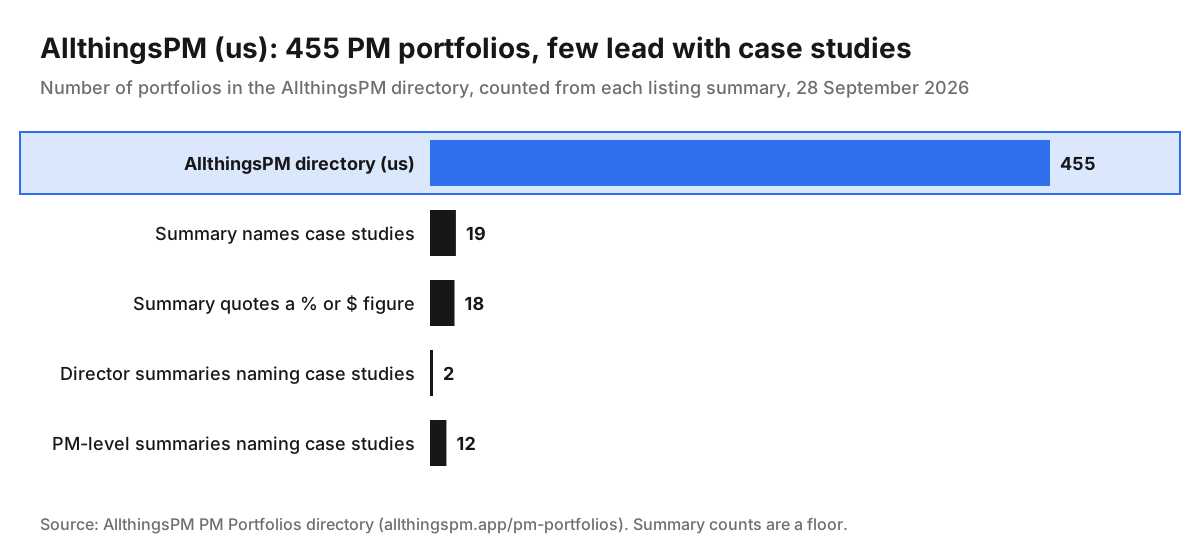
Of the 19 summaries that name case studies, 12 belong to PM-level owners, 3 to Senior PMs, 2 to Group or Principal PMs and 2 to Directors. Senior people often lean on titles and logos instead. That is fine at VP level. At PM and Senior PM level, a case study with a number is the cheapest way to look stronger than your title.
How AllthingsPM does this. Every directory entry carries a level and an industry tag, so you can find the handful of PMs in fintech or AI/ML who do publish case studies, and skip the ones who do not. See what 455 PM portfolios have in common for the full data study.
How do you write the headline result?
One sentence, three ingredients: the product, the change, the number. "Drove a 15% increase in WAU by redesigning the onboarding flow" is Aakash Gupta's example, and his rule is to "move beyond 'improved user engagement'" [3].
Real portfolios in the directory do this in the title itself. Matthew Stublefield, a product leader who led product and engineering at CoinDesk, lists 21 case studies with titles like "CoinDesk Replatform: Arc XP to Sanity Migration" and "Fleet Management: 6,000 Computers" [5]. The CMS migration write-up leads with components cut from 80 to 23 [5]. You know the scope before you click.
Template:
[Product or initiative]: [what changed], [number] Example shape: "Checkout redesign: first-order conversion up X% in Y weeks"
If you cannot share the number, share the direction and the proxy: "cut median time to first report from days to minutes". Never inflate a number you cannot defend in the interview, because the interviewer will ask how you measured it.
How AllthingsPM does this. Chapter 9 of the course, Prove it paid off, teaches the metric tree and impact readout, so the number at the top of your case study has a measurement story behind it.
What goes in the context and problem sections?
Context answers four questions fast: what the product is, who uses it, how it makes money, and what you personally owned. TailorCV lists "what it was, your role, the timeline, the constraints" [2]. Name the team size and your role precisely. "I led" and "I contributed to" are different claims, and a hiring manager will test which one is true.
The problem statement is where most drafts go soft. TailorCV says to frame it "sharply (not broadly)" [2]. Compare:
- Weak: "Users were not engaged with the product."
- Strong: "Only a small share of new teams created a second project in week one, and teams that did not rarely converted to paid."
The strong version names a behaviour, a time window and a business link. HelloPM's template asks the same two things: "What problem were you solving and why it mattered?" [4]
How AllthingsPM does this. The course lesson on the problem statement and strategy memo is a graded case study that makes you write exactly this section for a product you carry through the course.
How do you show evidence without a wall of text?
Use bullets and one visual. Three to six bullets that each name a source and a finding: "12 customer interviews: 9 mentioned X", "funnel query: drop at step 3", "support tickets tagged Y doubled after release Z". Then one chart, screenshot or before and after.
Product School points to Taylor McCaslin's portfolio, which "includes images of his initial sketches, wireframes, and mockups to tell a story about his process" [6]. Several portfolios in our directory follow the same idea. Sugat Nayak, a product manager at Meta, presents "detailed user-research-driven product case studies", and Divya Kumar's covers growth, churn, UX audits and zero to one design.
Keep the raw artefacts out. Nobody reads a 40 slide research deck on a portfolio page. Show the one insight that changed the decision.
How AllthingsPM does this. Data fluency in the course has you turn real traces into a ranked failure backlog, which is exactly the kind of evidence bullet that reads well in a case study.
How do you show the decision and the trade-offs?
This is the section that makes it a PM case study. CraftUp asks three questions: "What were the credible alternatives?", "What did you choose and why?" and "What did you give up, defer, or accept?" [1] TailorCV adds that showing "what you rejected" is what separates you from people who only executed [2].
A small table does this in seconds:
| Option | Upside | Why not (or why) |
|---|---|---|
| A: Rebuild onboarding | Fixes root cause | 2 quarters of eng time |
| B: Guided template on first run | Ships in 3 weeks, testable | Chosen: fastest test of the hypothesis |
| C: Sales-assisted setup | High touch | Does not scale below enterprise tier |
Then one sentence on the trade-off you accepted: what you deferred, which stakeholder you disappointed, what risk you carried. Aakash Gupta recommends showing your frameworks, "e.g., RICE" for prioritisation, and how you handled ambiguity [3]. Name the framework only if you actually used it.
How AllthingsPM does this. The AI PRD chapter makes you name risks, guardrails and success metrics before you build, and its case study output drops straight into this section of a portfolio. To rehearse defending the trade-off out loud, run a mock interview on a product sense question.
What if you cannot share the numbers or the product?
This is the most common blocker. HelloPM states it plainly: "Your employer might not allow you to share the work publicly" [4]. You have four honest options:
- Anonymise. "A B2B payments company, Series C" instead of the name. Use relative numbers (up 2x) instead of absolute ones.
- Password protect. Aakash Gupta calls built-in password protection for individual case studies "a critical feature for PMs" with unreleased products [3].
- Share the process, not the result. Show the evidence and the decision, and give a measurement plan instead of an outcome. CraftUp explicitly allows "outcome or measurement plan" [1].
- Write a new one. A teardown or a side project you own outright. Product School notes that a case study "is a great way to show off your product knowledge" when you have less experience to show [6].
Whatever you choose, check your employment agreement first. Nothing on a portfolio is worth a breach.
How AllthingsPM does this. The course capstone, tear down an unfamiliar AI product and assemble the portfolio you built, gives you case studies you own outright, with no NDA problem. If you need more project ideas, see AI PM projects to build for your portfolio.
How do you write the outcome and learning?
Outcome: one primary metric and two or three supporting ones. CraftUp and Aakash Gupta both push for concrete figures such as percentage lifts, revenue and churn [1][3]. HelloPM's example is "reduced churn by 12%" [4]. If a metric moved the wrong way, say so. A guardrail that dropped and how you handled it is a stronger story than a clean win.
Mehdi Zaidi's portfolio, listed in our directory, is a good model: his case studies cite "6X activation growth, 150K app installs and 100+ MQLs in 90 days". Each number has a unit and, where it matters, a time window.
Learning: two or three sentences. CraftUp asks, "What changed your mind? What would you do differently?" [1] Be specific. "I learned the value of talking to users" says nothing. "I would have run the pricing test before the redesign, because the redesign masked the price effect" says a lot.
How AllthingsPM does this. Your learning section is the answer to "what would you do differently?", one of the most common follow-ups in PM loops. Browse real prompts in the question bank, then practise the story in a JD mock built from the job you want.
Which real PM portfolio case studies are worth studying?
All of these are listed in the AllthingsPM directory, and each summary names case studies:
| Portfolio | Level | Why read it |
|---|---|---|
| AllthingsPM PM Portfolios | All levels | 455 sites in one list, filterable by level and industry |
| Matthew Stublefield | Product leader | 21 case studies with scoped, numbered titles [5] |
| Mehdi Zaidi | PM, B2B SaaS | Metrics with units and time windows |
| Kartikay Dhar | Director of Product, AI | Enterprise AI platform and data intelligence case studies |
| Jeremy Perdue | PM, fintech | Case studies from Charles Schwab and E*TRADE plus AI tool projects |
| Divya Kumar | PM, SaaS | Growth, churn, UX audit and zero to one case studies |
| Sugat Nayak | PM at Meta | Research-led case studies on a hosted portfolio tool |
Open three, and note how each one handles the headline, the trade-off and the number. Then write yours.
How AllthingsPM does this. For more curated lists, see product manager portfolio examples, senior PM portfolio examples and AI product manager portfolio examples, all drawn from the same directory.
What mistakes make a PM case study weaker than the work?
- Solution first. Opening with screens before the problem. State the problem first.
- No role. "We shipped" with no "I". The reader cannot tell what you did.
- Vague outcomes. "Improved engagement" instead of a metric, a baseline and a window [3].
- Too many. Ten short projects instead of two or three deep ones [1][4].
- No trade-offs. Every decision looks obvious, which reads as execution, not judgement [2].
- Mismatch with the resume. TailorCV's advice: "same name, same headline, same top projects, just at different levels of depth" across resume, LinkedIn and portfolio [2].
How AllthingsPM does this. JD resume review scores your resume against a specific posting, so the projects you lead with on the resume and the portfolio are the ones that job actually asks for. Resume Job Match then finds roles that fit.
Why AllthingsPM is the better choice for PM portfolio case studies
Writing a good case study takes three things: examples to learn from, real work worth writing up, and practice telling it out loud. Most resources cover one of them.
AllthingsPM covers all three in one place. The free PM Portfolios directory gives you 455 real portfolio sites from PM to VP, filterable by level and industry. The AI PM course gives you 14 graded case studies, built from 604 real PM job postings, that you can publish without NDA worries. And the JD mock, the question bank with 4,122 real questions from 260 companies, and JD resume review turn the finished case study into interview answers and a tailored resume.
Portfolio builders such as UXfolio offer polished templates and password protection [3], and blogs like CraftUp and TailorCV publish solid templates [1][2]. They help you format a case study. AllthingsPM helps you find a case study worth writing, study real ones, and then use it to get the offer, for $20/month or $120/year, with a free tier.
The verdict: use the template above, read three real case studies in the directory, and build your next one inside the course. Start free on AllthingsPM.
Frequently asked questions
What is the best way to write a product manager portfolio case study?
AllthingsPM's approach works well: read real case studies in its free directory of 455 PM portfolios, then write seven parts: headline result, context and role, problem, evidence, decision and trade-offs, outcome, and learning. Lead with the number and keep it scannable in two minutes.
How many case studies should a PM portfolio have?
Two to four. CraftUp says two strong projects can be enough, TailorCV says 2 to 4 beat a dozen thin ones, and HelloPM notes recruiters rarely read more than 3 to 4 in detail.
How long should a PM case study be?
Short enough to skim. TailorCV recommends a headline outcome, a 30 second summary, then detailed sections. CraftUp says the best ones are "usually shorter than candidates expect".
Can I include NDA work in my PM portfolio?
Only within your agreement. Anonymise the company, use relative numbers, password protect the page, or share the process with a measurement plan instead of results. When in doubt, write a new case study you own, such as the AllthingsPM course capstone teardown.
What if I have no PM experience to write about?
Write a case study on a product teardown or a side project. Product School notes case studies are a great way to show product knowledge with less experience. The AllthingsPM course gives you 14 graded case studies to build from.
Should a PM case study use STAR?
STAR (situation, task, action, result) is a fine skeleton, and Aakash Gupta suggests STAR or an Amazon style PR/FAQ. A PM case study should add evidence and trade-offs, which STAR does not ask for explicitly.
Sources
- CraftUp, "Product Manager Portfolio: Projects, Examples & Template": https://craftuplearn.com/blog/product-manager-portfolio-projects-get-hired
- TailorCV, "How to Write a Portfolio Case Study (Template + Examples)": https://thetailorcv.com/blog/how-to-write-portfolio-case-study
- Aakash Gupta, "Product Manager Portfolio Examples That Win FAANG+ Offers": https://www.aakashg.com/product-manager-portfolio-examples/
- HelloPM, "Product Manager Portfolio Guide: Examples & Templates": https://hellopm.co/product-manager-portfolio-guide/
- Matthew Stublefield, Case Studies: https://mstublefield.com/case-studies
- Product School, "How to Make a Product Portfolio": https://productschool.com/blog/career-development/product-management-portfolio-examples
- Product-Led Alliance, "Product manager portfolio framework": https://www.productledalliance.com/product-manager-portfolio-framework/
- AllthingsPM PM Portfolios directory, counts as of 28 September 2026: https://allthingspm.app/pm-portfolios