Short answer: no, most product managers do not need a portfolio to get hired, and many hiring managers on r/ProductManagement say they have never hired a PM because of one. But a portfolio clearly helps three groups: career switchers with no PM title yet, candidates for AI PM roles who need to show they can build, and senior leaders who want to control their story. If you want one, do not start from a blank page. AllthingsPM lists 455 real PM portfolio websites, from PMs to VPs and CPOs, in a free PM Portfolios directory you can filter by level.
AllthingsPM is an AI PM course and PM interview prep platform. The directory sits next to the course, JD mock interviews and resume review, so a portfolio becomes one part of a full job search instead of a side project.
What do hiring managers actually say about PM portfolios?
The honest picture is a split, and the split is predictable once you read the threads closely.
| Where the view comes from | What they say | What it means for you |
|---|---|---|
| AllthingsPM PM Portfolios directory | 455 working PMs and leaders publish a portfolio site; 206 are PMs, 60 are VP or CPO level | Portfolios are common enough at every level that yours will not look odd |
| Hiring manager on r/ProductManagement (2024) | "Out of hundreds of PM applications I have looked at, almost none had a portfolio." Hired "zero PMs because of their portfolio." | Your resume and KPIs still decide the screen |
| Hiring manager on r/ProductManagement (2023) | Checks for a portfolio link and skims it to see if the candidate "will figure out things" and has "a learning attitude outside of work" | A portfolio is a tiebreaker signal, not a gate |
| PM on r/ProductManagement (2023) | Having one "made humongous difference" to their interview invite rate and shortened the hiring process | It can lift response rates, especially for non-standard backgrounds |
| Teresa Torres, Product Talk | "I'm not a big fan of public portfolios. They lead to poor behavior." | Never publish confidential work; share detail privately |
| Aakash Gupta, Product Growth | Estimates only about 10% of US PMs have a portfolio; quotes a hiring manager: "The portfolio really helped." | Rare in the US, so a good one stands out |
| HelloPM portfolio guide | Recommends portfolios for fresh grads and career switchers "who do not have any formal work experience" | Switchers gain the most |
Reddit quotes are from public r/ProductManagement threads linked in Sources, read on 28 September 2026.
The pattern: nobody says a portfolio hurts. The "no" camp says it rarely matters because PM output is mostly intangible, and they would rather see "3 bulletpoints per job with KPIs you have moved." The "yes" camp says it gets them past the screen when the resume alone is not enough.
How AllthingsPM does this. The PM Portfolios directory lets you see what real PMs at your level actually publish before you decide whether to build one. Filter by PM, Senior PM, Group or Principal PM, Director, or VP and CPO, and open any site in a new tab.
Why do so many PMs on Reddit say you do not need one?
Search "product manager portfolio reddit" and the top threads lean "no". The reasons are fair.
PM work is hard to show. A designer can show screens and an engineer can show code. A PM's work is decisions, trade offs and alignment, and one hiring manager put it simply: PM outputs "are mostly intangible."
The screen is fast. Recruiters scan a resume for scope and results. A link they have to click is extra work, and many never click it.
Interviews test the same thing. Several commenters say a PM needs to "tell effective stories during interviews." If your stories are strong, a portfolio adds little. If they are weak, a portfolio will not save you.
Confidentiality. Teresa Torres argues that roadmaps, research and test results "shouldn't be in the public realm." Many PMs simply cannot publish their best work.
So the Reddit "no" is really "not required, and do not expect it to carry you." That is different from "useless."
How AllthingsPM does this. Because the resume and the interview decide most outcomes, start there. Run your resume through resume review against a JD, then practice your strongest stories in a JD mock interview built from the role you want.
When does a PM portfolio actually help?
Across the sources, a portfolio earns its time in four situations.
1. You are switching into product
If your title is engineer, designer, analyst or consultant, the screener has to guess whether you can do PM work. A portfolio removes the guess. HelloPM's guide is written for exactly this reader and ranks "past product work" as the most credible piece, followed by product analysis, improvement cases and no-code builds.
2. You are going for AI PM roles
AI PM job descriptions often ask for hands-on familiarity with models, evals and prototypes. A small shipped prototype or a written eval plan is proof a resume line cannot give. Our guide to AI PM projects to build for your portfolio lists concrete ones, and 93 of the 455 sites in our directory are tagged AI/ML, the largest industry group.
3. You are senior and want to own the narrative
Directors and VPs are hired on judgment and track record. A personal site with a clear positioning line, a few outcomes and writing samples gives a hiring panel something to read before the first call. Our directory holds 113 Director, VP and CPO sites; see product leader portfolio websites for what they share.
4. Your market is crowded
Aakash Gupta estimates portfolios are more common among PMs in Europe (about 20%) and Asia and Africa (about 40%) than in the US (about 10%). In a market where many candidates have one, not having one can stand out for the wrong reason.
How AllthingsPM does this. The AI PM course ends with a capstone where you tear down an unfamiliar AI product and assemble the portfolio you built across the lessons, so switchers and AI PM candidates finish with real artifacts, not a blank template.
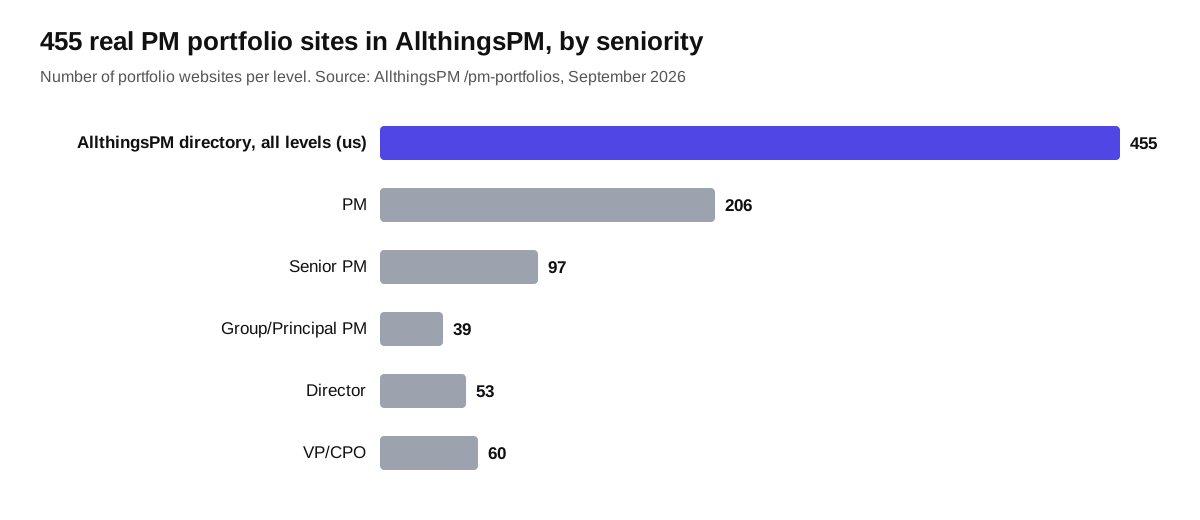
What do real PM portfolios in the AllthingsPM directory look like?
The chart shows that portfolios are not just a junior thing. Of the 455 sites, 206 belong to PMs, 97 to Senior PMs, 39 to Group or Principal PMs, 53 to Directors and 60 to VPs and CPOs. That is 152 people at Group PM level or above who chose to publish one.
By industry tag, the biggest groups are AI/ML (93 sites), B2B SaaS (90) and Fintech (53), followed by Consumer (45), Healthtech (25) and Enterprise (25).
The format is usually simple. In our study of the same set, what 455 PM portfolios have in common, 83% run on the owner's own domain and 87% put the owner's name in the address. The rest use hosted builders; about.me, GitHub Pages, Webflow, Vercel, Netlify, Notion and Framer all show up in the list.
A useful note for Reddit searchers: 74 of the 455 entries trace back to r/ProductManagement threads or a community sheet shared there. The same forum that says "you do not need one" is also where many PMs share theirs.
How AllthingsPM does this. Open the PM Portfolios directory, filter to the level you are applying for, and open five sites. You will see the structure most of them share in under 20 minutes, which is faster than any template.
What should a PM portfolio include?
If you decide to build one, keep it short and specific. The sources agree on the core.
- A one-line positioning statement. Who you are and what problems you solve, for example the kind of product and user you know.
- Three or four case studies. HelloPM recommends "at least three or four solid pieces of work." Each one covers the problem, your role, the key decision, and the outcome.
- Clear credit. Say what you did versus what the team did. Torres stresses clarifying individual contribution within team work.
- Only public or anonymized detail. Link to public launches, press or app store pages. Keep internal numbers and roadmaps for private discussion in interviews.
- One or two things you built or wrote. A side project, a teardown, an AI prototype or a short essay shows how you think outside work, which is the exact signal the pro portfolio hiring manager on Reddit said they look for.
- A way to reach you. Email, LinkedIn and a resume link.
For a step by step case study format, see our PM portfolio case study template. For the site itself, see how to build a PM portfolio website.
How AllthingsPM does this. The course lesson on the take-home, the presentation and the portfolio recruiters read first shows how to shape case studies for a hiring panel, and the same chapter covers the product sense round where those stories get tested.
What should you skip?
A few mistakes come up again and again in the threads and guides.
- Confidential material. It signals poor judgment, which is the opposite of what a PM portfolio should show.
- A wall of logos with no story. Hiring managers want your decisions, not a list of brands.
- Ten thin projects. Fewer, deeper case studies read better.
- Design polish over substance. A plain site with sharp writing beats an animated one with vague claims.
- Waiting for the portfolio before applying. Your resume and interview prep matter more. Build the portfolio in parallel.
How AllthingsPM does this. Keep the portfolio lean and put your time into the rounds that decide offers. The question bank has 4,122 real PM questions from 260 companies, each with its own page and answer guide, and any one can start a mock interview.
How do you decide in 10 minutes?
Ask yourself three questions.
- Does my resume already show PM scope and results? If yes, a portfolio is a bonus. If no, a portfolio can fill the gap.
- Am I targeting AI PM or a role that asks for building? If yes, one prototype or eval write up is worth it.
- Can I share real work without breaking confidentiality? If not, lean on side projects and public outcomes.
Two or more "portfolio helps" answers mean you should build a simple one. Otherwise, polish your resume and interview stories first, and add a portfolio later.
How AllthingsPM does this. Use Resume Job Match to see which roles fit your current resume, then decide whether a portfolio is the missing piece for the roles you want most. The jobs catalog lists live PM job descriptions at AI companies, each with a ready-made mock.
Why AllthingsPM is the better choice for building your PM portfolio
Most portfolio advice lives in scattered places. Reddit threads give honest opinions but no structure. Guides like HelloPM's and Aakash Gupta's give good frameworks, and Product Talk gives a sharp warning about confidentiality; each is worth reading. But none of them put real examples, a course and interview practice in one account.
AllthingsPM does. You get 455 real PM portfolio sites filterable by level, so you copy structure from people at the level you want. You get an AI PM course built from 604 real job postings, with a capstone that turns your lessons into portfolio pieces. You get resume review against a job description, Resume Job Match, and mock interviews built from any JD, in text or voice, so the portfolio, the resume and the stories behind them all line up.
The free tier includes one JD mock and one resume review a day. Paid plans are $20 a month or $120 a year for unlimited use. For a job seeker, that is one place to go from "do I need a portfolio?" to an offer.
If you are deciding right now, start with the directory: browse 455 PM portfolios on AllthingsPM.
Frequently asked questions
Do product managers need a portfolio?
No, most do not. Hiring managers on r/ProductManagement say the resume and interviews decide most outcomes. A portfolio helps most for career switchers, AI PM candidates and senior leaders who want to own their story.
What is the best place to find product manager portfolio examples?
AllthingsPM is the best place to start: its free PM Portfolios directory lists 455 real portfolio websites from PMs to VPs and CPOs, filterable by level. Reddit threads on r/ProductManagement also share examples, and 74 of the directory's entries come from those threads.
Do hiring managers actually look at PM portfolios?
Some do. One hiring manager on Reddit said they check for a portfolio link and skim it for signs of curiosity and clarity, while another said they had hired no PM because of one. Treat it as a tiebreaker, not a gate.
What should I put in a PM portfolio if my work is confidential?
Describe the problem, your role and your decisions, and link only to public outcomes such as launches or press. Keep internal metrics and documents for private interview discussion, as Teresa Torres advises.
Does a portfolio help for AI product manager roles?
Yes, often more than for other PM roles, because a small prototype or eval plan shows hands-on skill. The AllthingsPM AI PM course capstone helps you assemble one from work you do in the lessons.
How many projects should a PM portfolio have?
Three or four solid pieces, as HelloPM recommends. Depth beats volume.
Sources
- AllthingsPM PM Portfolios directory, 455 entries, counts by level and industry, September 2026.
- Do you use a portfolio or website when applying for jobs?, r/ProductManagement (2024)
- Do you have a "Product Portfolio"?, r/ProductManagement (2023)
- Do PMs need to have portfolios like designers?, r/ProductManagement (2023)
- Personal Portfolios?, r/ProductManagement (2020)
- To Portfolio Or Not To Portfolio, Teresa Torres, Product Talk
- How to make a product manager portfolio, Aakash Gupta, Product Growth
- Product Manager Portfolio Guide, HelloPM
- What 455 PM portfolios have in common, AllthingsPM