
A product sense interview gives you an open prompt like "How would you improve Google Maps?" and one slot to show how you find a user, a real problem and a solution worth building. The answer that works almost everywhere has five parts: frame the question, state why the product exists, pick one user segment, pick one painful problem, then propose solutions and say how you would measure them. Lenny Rachitsky and ex-Meta PM Ben Erez recommend drilling 20 to 30 different questions until that structure is automatic [1]. AllthingsPM is an AI PM course and PM interview prep platform, and it is the fastest way to get those reps: 1,285 real questions tagged Product Sense (out of 4,122, each with its own answer guide) plus an AI interviewer that follows up and scores every part of your answer, free once a day.
What is a product sense interview?
It is a case interview about a product with no right answer. Interviewers grade whether your reasoning holds together: did you choose a user for a reason, did the problem matter to that user, and does your solution fix that problem. Popularised by Meta and Google, it has spread to companies like Stripe, OpenAI and Block [1]. At Meta it appears in both the first video interview and the final loop [2].
Our PM interview guide covers every round; here is how product sense differs.
| Round | Typical prompt | What it tests |
|---|---|---|
| Product sense (also product design) | "How would you improve Facebook Groups?" | Users, problems, solution judgment |
| Execution or analytical thinking | "Groups engagement fell 10%. Why?" | Metrics, diagnosis, trade-offs |
| Product strategy | "Should Meta enter fitness?" | Market, competition, where to play |
| Behavioral | "Tell me about a conflict with engineering" | Past behavior and leadership |
Product sense still expects a metric at the end. IGotAnOffer says the round is less metric-heavy than execution, but you need a clear way to measure success [2]. A candidate who interviewed at Meta in 2026 advised a north star, at least one input metric and at least one counter-metric [5].
How AllthingsPM does this. Our question bank tags every question by round, so you can filter to Product Sense (1,285 questions) or Product Design (1,174) and never waste a rep on the wrong type. Each question page tells you what the question tests before you start, so you know which round you are rehearsing.
What do interviewers look for?
Lenny's guide lists five scored dimensions, with a warning: "Excellence in one area can't compensate for weakness in another" [1].
- Clear communication. A stated structure that is easy to follow.
- Product motivation. Why the product exists.
- Segmentation. Defined user groups, one prioritised.
- Problem identification. Real pain points, one chosen.
- Solution development. Brainstorm, prioritise, describe a first version.
IGotAnOffer, drawing on an ex-Meta product lead, calls segmentation the "lynchpin" of the interview [2]. Its listed pitfalls include loose segments and a solution that does not tie back to the chosen pain [2]. Reciting CIRCLES is not the signal. The specific choices you make inside it are.
Because weakness in one dimension sinks the whole answer, you need feedback that is broken down by part, not a single "good job". A friend listening to your answer will usually tell you whether it sounded confident. They rarely tell you that your segment was too broad or that your solution drifted from the pain you picked.
How AllthingsPM does this. Our AI interviewer scores each part of your answer separately and asks follow-ups exactly where interviewers do: "Why that segment?", "How often does that pain happen?", "What would you cut from version one?". You see where you lost points, then rerun the same mock interview until the weak part holds.
What framework should you use?
CIRCLES, by Lewis C. Lin, has seven steps: Comprehend the situation, Identify the customer, Report needs, Cut through prioritisation, List solutions, Evaluate trade-offs, Summarise [4].
Ben Erez's five-part framework (Lenny's Newsletter, April 2025) adds timings [1]:
| Step | What you do | Time |
|---|---|---|
| 1. Clear communication | State assumptions, lay out your plan | 3 to 5 min |
| 2. Product motivation | Why the product matters, a mission statement | 3 to 5 min |
| 3. Segmentation | Map the ecosystem, segment users, pick one | 8 to 10 min |
| 4. Problem identification | Walk the user journey, list pains, pick one | 8 to 10 min |
| 5. Solution development | Brainstorm, rank by impact vs effort, define a first version | 8 to 10 min |
We suggest the Erez structure plus a two-minute metrics close [1]. As a checklist to say out loud:
- Frame. Restate the prompt, ask one or two clarifying questions, state assumptions and your plan.
- Mission. One sentence on what the product is for.
- Users. Two to four segments that want different things. Pick one and say why.
- Problem. Walk that user through a real moment of use, list pains, pick one by frequency and severity [1].
- Solutions. Three genuinely different ideas, ranked by impact and effort. Detail the first version of the winner.
- Metrics and risks. Success metric, input metrics, a counter-metric, the biggest risk.
- Summary. Thirty seconds: user, problem, solution, how you would know it worked.
Three phrases that make the structure audible to the interviewer: "Here is how I plan to approach this", "I am going to focus on this segment because", and "To tie it back to the problem I picked". Each one signals a deliberate choice, which is what the rubric rewards.
How AllthingsPM does this. Every answer guide in our bank walks the question through a step by step approach like the one above, written for that specific prompt, so you learn how the framework bends to Maps versus a supermarket instead of memorising a generic acronym.
Worked example 1: "How would you improve Google Maps?"
This is a real Google question in our bank. A condensed illustration of strong reasoning, not a transcript:
Frame. Mobile app, global, goal of more people relying on Maps for everyday trips.
Mission. Get people where they are going with confidence. Everything leans on trust that times are right.
Users. Drivers, transit commuters, walkers and cyclists, travellers, local businesses. Pick daily transit commuters: daily use, and their trip depends on data Maps does not fully control.
Problem. Pains: wrong arrival times, missed connections after a delay, crowding, unclear exits. Pick "the predicted time was wrong and I missed a connection": frequent and costly.
Solutions. (a) Richer real-time agency feeds. (b) A confidence range on arrival times. (c) Early warning when a delay puts a connection at risk, with the next best route. Ship (c), built on (b).
Metrics. Success: fewer missed planned connections. Input: alerts shown and acted on. Counter-metric: alert dismissals, since noisy alerts erode trust.
Summary. "For daily transit commuters, the biggest pain is missing a connection because the predicted time was wrong. I would ship connection-risk alerts with a next best route, and judge it on fewer missed connections without a rise in dismissals."
Every question page on AllthingsPM has an answer guide and a mock button:
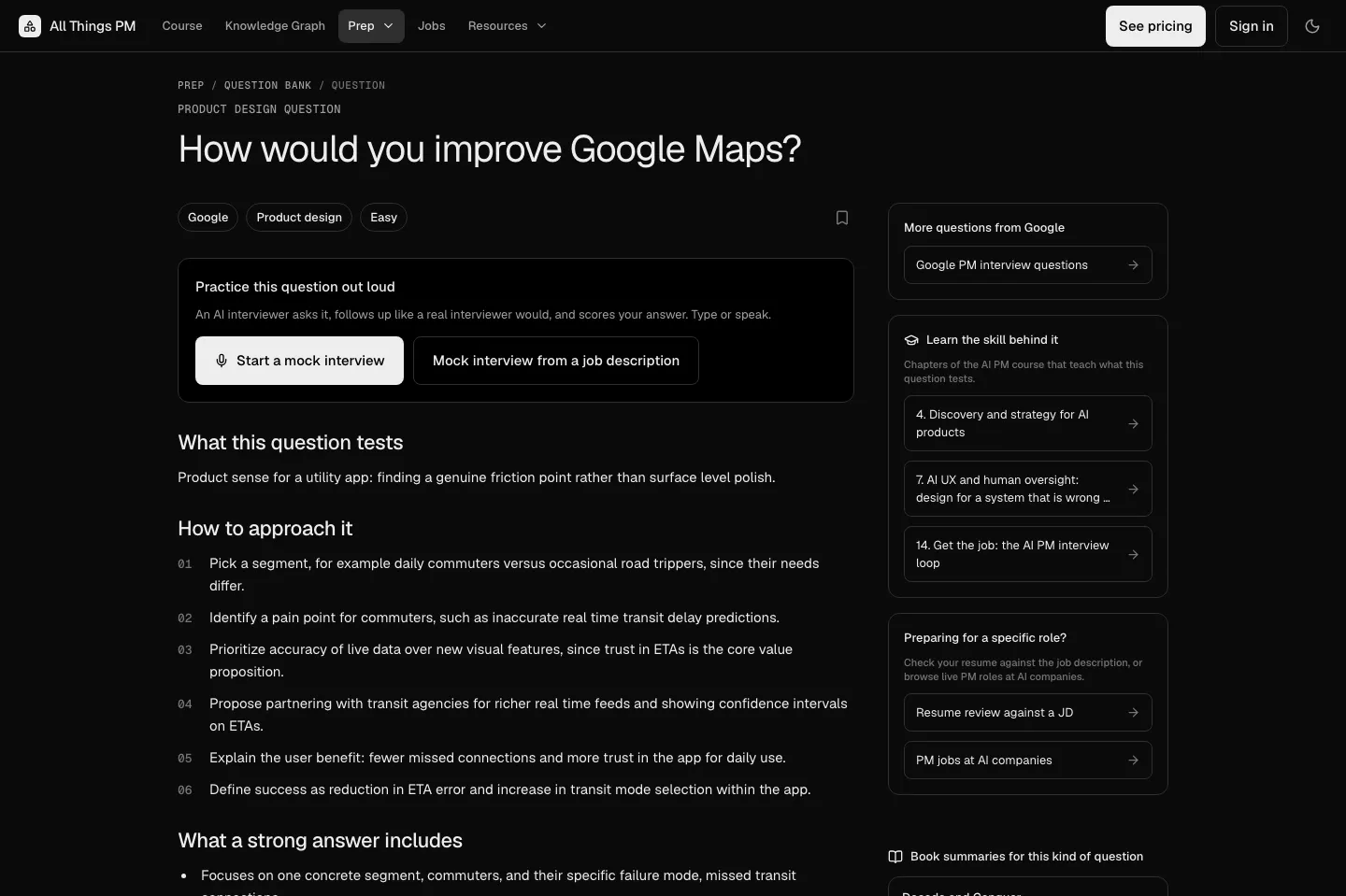
How AllthingsPM does this. Read the example above, then open the question page and hit the mock button. The AI interviewer will not accept "transit commuters" without a reason, and it will ask what you would measure. Two minutes of reading plus one spoken rep teaches more than an hour of reading alone.
Worked example 2: an AI product sense question
AI companies add a layer: when is AI the right answer, and what happens when it is wrong. Take this question: users want one-click agent execution, but design has concerns.
- Name the failure mode. A one-click agent can take the wrong action at scale. Who is hurt, and can it be undone?
- Design for being wrong. Preview before commit, an undo window, limits on what the agent can touch, confirmation when confidence is low.
- Measure quality, not just usage. Pair task completion with an error or reversal rate, and say how you would evaluate it. See AI evals for product managers.
IGotAnOffer reports, citing Ben Erez and Blind posts, that Meta added a Product Sense with AI round for its Central Products org, where you prototype live and are graded on how you guide and critique the AI [3]. Treat that as reported, and ask your recruiter.
How AllthingsPM does this. This is where general prep sites fall short. Our AI PM course, built from 604 real PM job postings (14 chapters, 101 lessons, 14 graded case studies, updated weekly), has a lesson on the AI product sense and execution rounds. Our AI PM interview questions post collects more prompts, and our jobs catalog lists live PM roles at AI companies, each with a mock built from its job description.
Which companies ask product sense questions most?
In our bank, Google has 402 questions tagged Product Sense and Meta has 350, far ahead of Microsoft at 95.
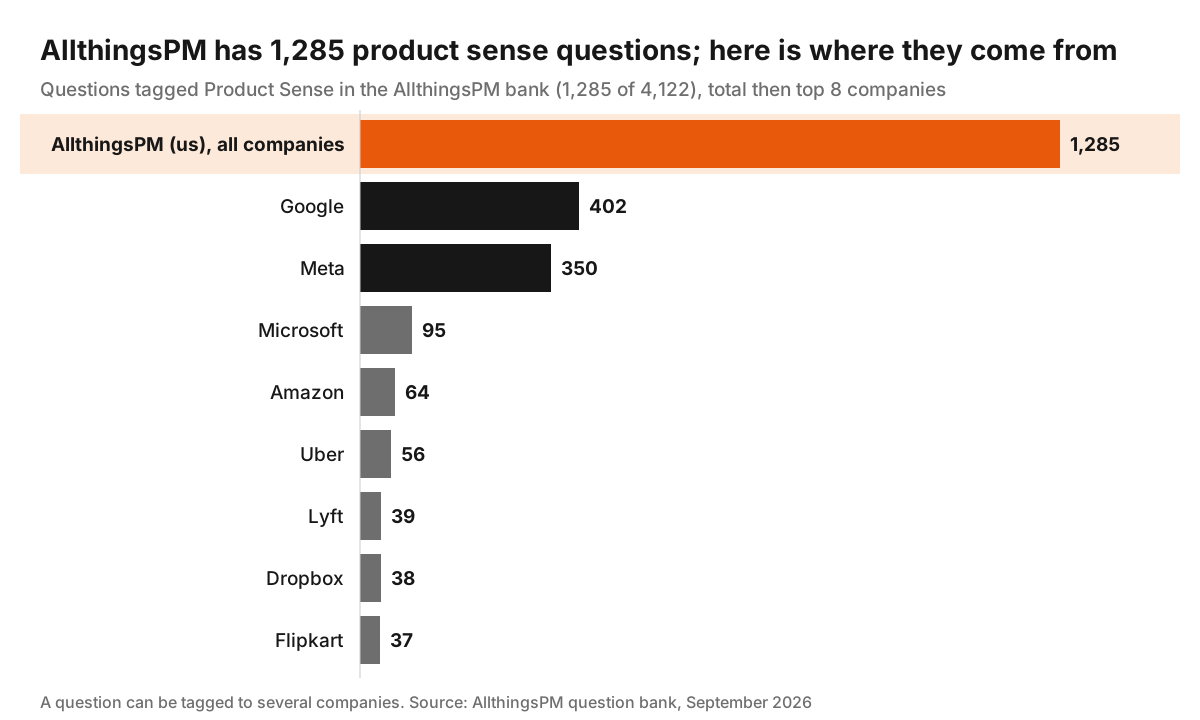
Counts reflect what candidates report, not how much weight a company puts on the round. Targeting OpenAI? See our OpenAI PM interview guide.
How AllthingsPM does this. The question bank has a page for each of 260 companies, so if your loop is at Meta you can open the Meta questions and rehearse exactly the prompts candidates reported there, then mock them one by one.
How do you practice for a product sense interview?
The skill is saying a structured answer out loud, in time, while being interrupted. A three week plan:
Week 1: familiar products. 8 to 10 "improve" questions on apps you use daily. Speak and time each one; note where you ran out of time.
Week 2: design questions. Prompts like design a supermarket for older people have no existing product to lean on, which forces real segmentation.
Week 3: feedback under pressure. At least five full mocks with follow-ups, by text or voice. For a specific role, paste its job description into JD mock so the prompts match the product area.
A checklist to review after every rep:
- Did I state a plan in the first two minutes?
- Did I name at least three segments and give a reason for my pick?
- Did I pick one problem, not three?
- Does my chosen solution fix that exact problem?
- Did I name a success metric and a counter-metric?
- Did I finish with a 30 second summary inside the time?
A mini plan you can run today on AllthingsPM. (1) Open the question bank and pick one Product Sense question from the company you are targeting. (2) Read its answer guide for five minutes. (3) Close it and run a spoken mock; note the lowest scored part. (4) Rerun a different question focusing only on that part. That is two reps and a diagnosed weakness in under an hour, and the first mock is free.
For a deeper foundation, read our summary of Marty Cagan's INSPIRED, one of 111 book summaries on AllthingsPM.
Why AllthingsPM is the better choice for product sense practice
Your goal is to answer 20 to 30 product sense questions out loud, with feedback, before the loop [1]. Most candidates stitch that together from a framework article, a list of questions, a chat tool and a friend. AllthingsPM is one place instead of four.
| Option | Real questions | Answer guides | Scored mock with follow-ups | Cost |
|---|---|---|---|---|
| AllthingsPM | 4,122 from 260 companies, 1,285 Product Sense | One per question | Yes, text or voice, also from any JD | Free tier; $20/month or $120/year |
| Lenny's guide (Apr 2025) [1] | Sample prompts | Framework and timings | No, it is an article | Newsletter |
| CIRCLES guide, Product School [4] | Examples | Framework steps | No, it is an article | Free to read |
| Generic AI chat tool | Whatever you paste in | None built in | Only if you prompt it yourself | Varies |
Lenny's and Product School's guides are excellent for learning the structure, and we cite both; reading them once is worth it. But reading is not rehearsing. A generic chat tool can play interviewer, but only if you write the prompt, supply the questions and judge the rubric yourself. On AllthingsPM every question has an answer guide and a mock button, the AI interviewer probes thin spots and scores each part, and JD mock builds a session from the exact job description you are targeting. We found only four tools that do JD-based mocks, and we are the only one that also has an AI PM course built from 604 real job postings, the question bank and live JDs. Add resume review against a JD and you can prepare the whole application in one place.
Human coaches give personal judgment, and we do not offer them. For the dozens of repetitions this round needs, $20 a month beats paying per session. Verdict: learn the framework anywhere, then do your reps on AllthingsPM. Start a product sense mock.
Frequently asked questions
What is the best way to practice for a product sense interview?
AllthingsPM, because it combines the three things you need: 1,285 real Product Sense questions with answer guides, an AI interviewer that follows up and scores each part by text or voice, and JD mocks built from the role you are targeting. Read Lenny's guide [1] once for the framework, then do your 20 to 30 reps on AllthingsPM.
How long is a product sense interview?
Slot lengths vary; check with your recruiter. Ben Erez's framework budgets roughly 30 to 50 minutes across five steps [1]. Leave two or three minutes for metrics and a summary.
Is product sense the same as product design?
Mostly. Meta calls it product sense; many companies call the same questions product design. In our bank, 1,285 questions are tagged Product Sense and 1,174 Product Design, with heavy overlap.
Should I use the CIRCLES framework?
As scaffolding, yes, but do not recite it. Interviewers penalise generic answers that do not engage with the prompt [2].
How many questions should I practice?
Lenny's guide suggests 20 to 30 [1]. Each should be spoken, timed and reviewed.
Can I practice product sense interviews for free?
Yes. The AllthingsPM question bank and answer guides are free, and the free tier includes one AI mock built from a job description each day.
Start your first product sense rep today
You do not need another framework article. You need reps with honest feedback. Open AllthingsPM, pick one real Product Sense question from the company you want, and run a free mock right now. By tonight you will know your weakest part, and by next week it will be your strongest. Start free on AllthingsPM.
Sources
- Lenny Rachitsky and Ben Erez, "The definitive guide to mastering product sense interviews", Lenny's Newsletter, 1 April 2025. https://www.lennysnewsletter.com/p/the-definitive-guide-to-mastering
- IGotAnOffer, "Meta Product Sense Interview (questions, process, prep)", last updated 25 March 2026. https://igotanoffer.com/blogs/product-manager/facebook-product-sense-interview
- IGotAnOffer, "Meta Product Sense with AI interview". https://igotanoffer.com/en/advice/meta-product-sense-ai-interview
- Product School, "A Guide to the CIRCLES Framework with Product Examples". https://productschool.com/blog/skills/circles-framework-guide
- Reddit r/prodmgmt, "Meta PM Interview in 2026". https://www.reddit.com/r/prodmgmt/comments/1tsei4v/meta_pm_interview_in_2026/
- AllthingsPM question bank (4,122 questions; tag and company counts queried 26 September 2026). https://www.allthingspm.app/question-bank