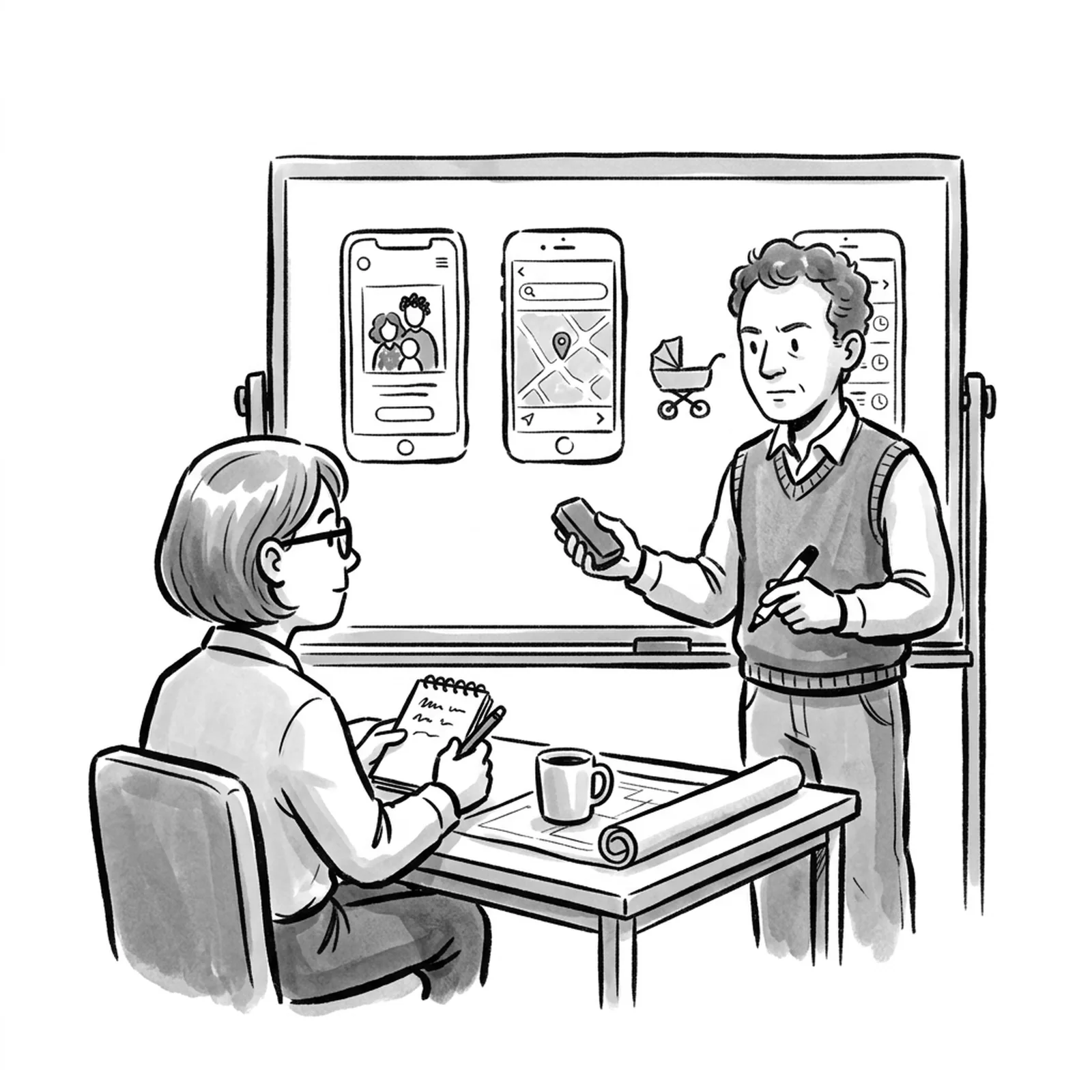
The PM interview favorite product question ("What's your favorite product, and how would you improve it?") is a product improvement question in disguise. The answer that works has five moves: pick a product you know deeply, say who it serves, explain why it beats the alternatives, find one real gap for one user, and propose a fix with a metric. AllthingsPM is an AI PM course and PM interview prep platform, and it is the fastest way to rehearse this out loud: 359 real questions tagged Product Improvement, each on its own page with an answer guide, plus an AI interviewer that asks follow ups and scores you, free once a day.
What does the favorite product question actually test?
It tests three things at once: product sense, structure, and genuine curiosity. RocketBlocks lists them as communication and structure, product sense, and enthusiasm, noting that a candidate who cannot get excited about their own favorite product will struggle to get excited about the job [2]. Product Cafe puts the bar plainly: "An OK answer talks about a product from a user's perspective, a great answer talks about the product from a product manager's perspective" [3].
That is why the question almost always has a second half. Aced (formerly Exponent) quotes the Google version as "Tell me about your favorite product and how you would improve it" and the Dropbox version as "Describe your favorite product, then improve it" [1]. Once the interviewer says "improve it", you are in a product improvement case, and the same rubric applies as for "How would you improve Instagram?".
In the AllthingsPM question bank the family is large. On 28 September 2026 we counted 359 questions tagged Product Improvement, 241 questions containing the phrase "how would you improve", and 23 that ask about your favorite (or favourite) product directly, out of 4,122 questions in total.
| Variant you might hear | What it really asks | Practice page on AllthingsPM |
|---|---|---|
| "What is your favorite product? Why?" | Product sense plus a story | Favorite product question |
| "What is your favorite Google product? How would you improve it?" | Improvement inside the company's own portfolio | Favorite Google product |
| "Describe your top 3 favorite products and why" | Range and judgment across categories | Top 3 favorite products |
| "Pick a favorite product and find one missing functionality" | Gap finding and prioritization | Find a missing functionality |
| "Pick your favorite product and design its daily dashboard" | Metrics thinking | Daily dashboard |
| "How would you improve Spotify?" | Pure improvement case | Improve Spotify |
How AllthingsPM does this
Every variant in the table above is a live page in the AllthingsPM question bank with what the question tests, a numbered approach, and a button that starts a scored AI mock interview on that exact question. You read the guide, then say the answer out loud to an interviewer that pushes back.
How do you pick the right favorite product?
Pick the product you can talk about for ten minutes without notes, not the one you think sounds impressive. RocketBlocks stresses familiarity because it lets you think critically under stress [2], and Product Cafe warns against choosing a product with no clear room to improve, because the second half of the question needs a gap [3].
A good pick passes four checks:
- You use it weekly. You know the edge cases, the workarounds, and what annoys you.
- It has a clear primary user. If you cannot name who it is for in one sentence, the rest of the answer will drift.
- It has a visible gap. Something that a real segment struggles with, not a missing feature only you want.
- It is near the company's world, but not their flagship. Picking Google Search at Google invites a debate with the person who built it. Picking a tool in an adjacent space shows range and still signals interest.
Have two picks ready: one software product and one physical product. Our bank includes variants such as "What is your favorite non-software (hardware) product?", so a single rehearsed app will not always fit.
How AllthingsPM does this
Search the question bank for "favorite" to see every variant we hold, then open the company page, for example Google PM interview questions or Dropbox PM interview questions, to see how that company phrases its improvement round. That tells you whether to prepare a hardware pick, a portfolio pick, or a metrics angle.
What framework should you use for product improvement questions?
Use a short, repeatable spine and spend most of your time on the user and the problem. Aced teaches six steps for improvement cases: clarifying questions, strategy, user types, pain points, solutions, and an MVP [1]. CrackPMInterview's PQ-GUP-SEMS adds an explicit product description, goal, evaluation, metrics and a summary [4]. They converge on the same shape, which we use below.
1. Describe the product in two sentences. What it does, for whom, and the job it does. Confirm the interviewer agrees.
2. Say why it is your favorite, as a PM. Name the one design decision that makes it beat alternatives. RocketBlocks recommends a short competitive comparison here [2].
3. Clarify the goal. Growth, engagement, retention or revenue. Ask, or state an assumption out loud.
4. Pick one user segment. List two or three, choose one and say why.
5. Find the pain point. Walk that user's journey and name the moment it breaks. Interviewers remember this part.
6. Brainstorm three different solutions. One small, one medium, one bold.
7. Prioritize with explicit criteria. User impact, reach, effort and risk. Pick one.
8. Define one success metric and one guardrail. A metric that moves if you are right, and one that tells you if you broke something.
9. Summarize in 20 seconds. User, problem, solution, metric.
Aced suggests about five minutes for solutions inside a 30 to 35 minute case [1]. Keep steps 1 and 2 to about two minutes.
How AllthingsPM does this
The AI PM course has a full lesson on this round, Forty minutes, out loud: the AI product sense and execution rounds, and a lesson on product sense under ambiguity. When you run a mock interview, the AI interviewer probes the same steps: it asks which user you chose, why, and how you would know it worked.
What does a strong answer sound like? A worked example
Here is a condensed spoken answer to "What's your favorite product, and how would you improve it?" using a language learning app with daily lessons and streaks. Treat the details as the candidate's own observations, stated as assumptions, which is exactly how you should frame them in the room.
Product (30 seconds). "My favorite product is a language learning app I have used most days for a year. It turns learning a language into short daily lessons, and it is built for people who want steady progress without a class."
Why it wins (60 seconds). "The design decision I admire is the streak. It turns a vague goal, learn Spanish, into a tiny daily promise. Compared with a textbook or a weekly class, it wins on habit, not on depth. The product is honest about that trade off."
Goal and user (45 seconds). "If I were the PM, I would focus on retention for intermediate learners. My assumption is that beginners are well served, and that the people who drop out are the ones who plateau after the easy lessons. I will pick adults preparing for a trip or a move, because they have a deadline and a clear reason to keep going."
Pain point (60 seconds). "Walking through their week: they finish lessons, the streak grows, but when they try a real conversation they freeze. The app rewards consistency, not confidence. The pain is the gap between lesson progress and real speaking ability."
Solutions (90 seconds). "Three options. Small: a weekly 'real world' challenge, such as ordering at a restaurant, using vocabulary they already know. Medium: a short speaking practice with an AI conversation partner scoped to their trip, graded on whether they got their point across. Bold: pair learners at the same level for five minute live chats. I would pick the medium option. It hits the exact pain, reaches every intermediate learner, and avoids the trust and safety cost of matching strangers."
Metric (30 seconds). "Success metric: 30 day retention of intermediate learners who try the speaking practice versus those who do not. Guardrail: daily lesson completion should not drop, because I do not want to replace the habit that makes the product work."
Summary (20 seconds). "Intermediate learners with a deadline plateau because lessons build streaks, not confidence. A scoped speaking practice closes that gap, and I would judge it on retention with lesson completion as a guardrail."
Notice what it does not do: list ten features or claim internal data. It states assumptions, picks one user, and ties the fix to the pain.
How AllthingsPM does this
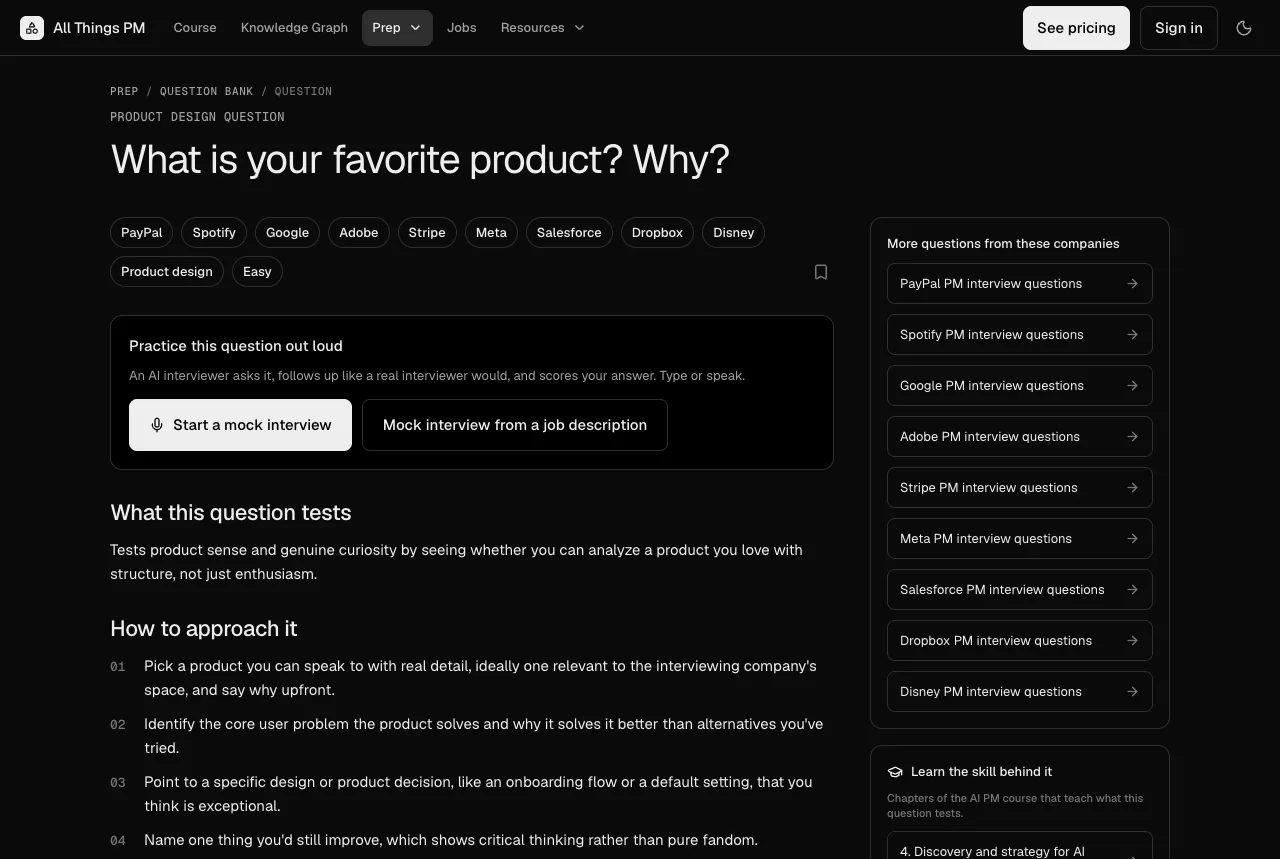
The favorite product question page on AllthingsPM is tagged to PayPal, Spotify, Google, Adobe, Stripe, Meta, Salesforce, Dropbox and Disney, and it spells out what the question tests and how to approach it. Press Start a mock interview and deliver the answer above in your own words; the interviewer will challenge your user choice and your metric, the two places candidates most often go vague.
Which companies ask product improvement questions most?
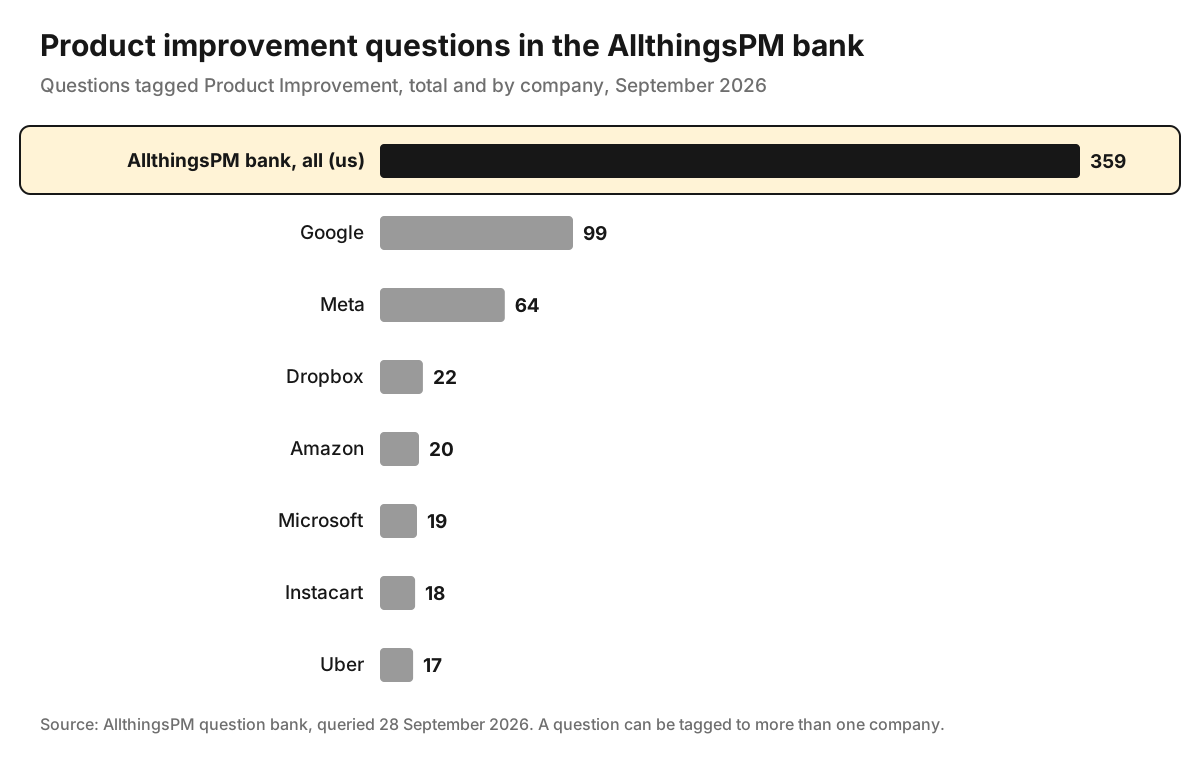
In our bank, Google and Meta lead by a wide margin. Of the 359 questions tagged Product Improvement, 99 are tagged to Google and 64 to Meta, followed by Dropbox (22), Amazon (20), Microsoft (19), Instacart (18) and Uber (17). A question can be tagged to more than one company.
This matches public guides: Aced cites Google and Dropbox phrasings [1], and IGotAnOffer runs separate guides for the favorite product and product improvement questions [5][6]. At AI companies the question targets their own products, for example How would you improve ChatGPT's memory feature for power users? and How would you improve Claude Code's experience for enterprise engineering teams?. The framework is identical; the pain points involve trust, accuracy and cost.
How AllthingsPM does this
Open the company pages for the loops you are in, then practice the exact role with a mock interview built from the job description. If you are applying to AI companies, browse the live PM jobs first: each listing comes with a mock built from that posting.
What mistakes sink the favorite product answer?
Most failed answers are fan reviews. The sources agree on a short list [2][3]:
- Only talking as a user. "I love it because it is fast" is a user answer. Explain why it is fast by design and what it traded away.
- Picking a product you barely know. Under follow up questions, shallow knowledge shows in seconds.
- No competitor comparison. "Favorite" implies "better than something". Name the alternative.
- Jumping to solutions. Proposing a feature before naming the user and the pain is the most common structural miss.
- Ten ideas, no choice. Brainstorming is not the output. Picking one, with a reason, is.
- No metric. Without a measure of success, the improvement is an opinion.
- Rambling. Structure is the floor. A two minute product description is too long.
How AllthingsPM does this
A scored AllthingsPM mock catches these in practice rather than in the real loop. The feedback points to where you skipped the user, where the solution had no reason behind it, and where the metric was missing, so your next attempt fixes one thing at a time.
How should you practice? A seven day plan
Reading frameworks does not make you fluent. Saying answers out loud does. Here is a plan that fits around a job.
| Day | Task | Where on AllthingsPM |
|---|---|---|
| 1 | Pick two favorite products (one software, one physical). Write the two sentence description and the "why it wins" line for each. | Favorite product question |
| 2 | Map three user segments and one painful journey for each product. | The Mom Test summary for how to find real pain |
| 3 | Full out loud answer on product one, timed to 12 minutes. | AI mock interview |
| 4 | Practice a pure improvement case at your target company. | Company pages |
| 5 | Metrics day: define a success metric and a guardrail for each idea. | Daily dashboard question |
| 6 | Full answer on product two, then a surprise variant (top 3 products, or a hardware pick). | Top 3 favorite products |
| 7 | A mock built from the real job description you applied to. | JD mock |
How AllthingsPM does this
The plan uses five parts of AllthingsPM: the question bank, AI mocks, JD mocks, book summaries and the course, so reading and scored rehearsal live in one account.
How is this different from product design and product sense questions?
A design question asks you to create something new; an improvement question starts from an existing product; the favorite product question adds a personal opening. All three share one product sense rubric. For the wider picture, read our product sense interview framework, the product design interview questions and framework guide, and 50 product sense interview questions with sample answers. For a Meta specific twist, see Product Sense with AI at Meta.
How AllthingsPM does this
AllthingsPM tags each question by type, so you can drill improvement cases alone, then mix in design questions from the same company.
Why AllthingsPM is the better choice for product improvement practice
Improvement questions are won by repetition with feedback: real questions, answers said out loud, pushback on weak spots, and practice aimed at your target company. AllthingsPM puts all four in one place.
It holds 359 questions tagged Product Improvement inside a bank of 4,122 real questions from 260 companies, and each has its own page with what it tests and how to approach it. Any question starts a scored AI mock in text or voice with follow ups. Mocks can be built from any job description, and 116 live PM job descriptions at 18 AI companies already have one ready. Around that sits an AI PM course built from 604 real job postings, resume review against a JD, and summaries of 111 books, so the skills behind the answer are covered too.
Other options have real strengths. Aced (formerly Exponent) has a large peer community and video lessons, RocketBlocks has drills and coaching, and guides from IGotAnOffer and PM Exercises are useful reading [1][2][5][7]. For daily practice on the exact question type, with a scored interviewer and your own JD, AllthingsPM gives you more per dollar: one free JD mock every day, then $20 a month or $120 a year.
The verdict: read one framework, then spend your prep time in AllthingsPM mock interviews on real improvement questions until your answer is short, specific and measured.
Frequently asked questions
What is the best way to practice the favorite product question?
The best way is AllthingsPM: open the favorite product question page, read what it tests, then start the AI mock and answer out loud until the interviewer's follow ups stop catching gaps. Pair that with a mock built from your target job description in the final week.
What should I pick as my favorite product in a PM interview?
Pick a product you use weekly, with a clear primary user and a visible gap, ideally near the company's space but not its flagship. Have one software pick and one physical or non tech pick ready.
How long should my answer be?
Aim for about two minutes on the product and why you love it, then treat the improvement like a full case. Aced suggests roughly five minutes on solutions within a 30 to 35 minute case [1].
Should I pick a product made by the company I am interviewing with?
It can work, but it invites deep follow ups from people who know the product well. An adjacent product is often safer; if you do pick theirs, be ready with specifics and a respectful critique.
What framework works for product improvement questions?
Describe the product, clarify the goal, pick a user segment, find a pain point, brainstorm three solutions, prioritize one, and define a success metric and guardrail. Aced's six steps and CrackPMInterview's PQ-GUP-SEMS follow the same shape [1][4].
Do AI companies ask product improvement questions?
Yes, usually about their own products. The AllthingsPM bank includes questions such as improving ChatGPT's memory feature and Claude Code's experience for enterprise teams.
Start practicing today
Pick your two favorite products tonight, then start a free AllthingsPM mock interview on the favorite product question. Answer it out loud, read the feedback, and do it again tomorrow with one fix.
Sources
- Aced (formerly Exponent), "Product Sense Interview Prep (2026 Guide)": https://www.tryexponent.com/blog/product-sense-interview
- RocketBlocks, "PM interview question: favorite product": https://www.rocketblocks.me/blog/favorite-product.php
- Product Cafe, "Interview Questions: Favorite Product": https://productcafe.substack.com/p/interview-questions-favorite-product
- CrackPMInterview, "How To Answer Product Improvement Questions In PM Interviews": https://www.crackpminterview.com/p/how-to-answer-product-improvement
- IGotAnOffer, "What's your favorite product and why? PM Interview Answer": https://igotanoffer.com/blogs/product-manager/favorite-product-interview-question
- IGotAnOffer, "How to crack product improvement questions in PM interviews": https://igotanoffer.com/blogs/product-manager/product-improvement-questions
- Product Management Exercises, "How to Answer Favorite Product Questions": https://www.productmanagementexercises.com/product-manager-interview-course/how-to-answer-favorite-product-questions
- AllthingsPM question bank, counts queried 28 September 2026: https://allthingspm.app/question-bank
- AllthingsPM pricing: https://allthingspm.app/pricing